Review of the SBIR and STTR Programs at the Department of Defense (2026)
Chapter: 9 Experienced SBIR/STTR Firms
9
Experienced SBIR/STTR Firms
As part of its assessment, the committee was asked to investigate the impact of statutory changes to the Small Business Innovation Research (SBIR) and Small Business Technology Transfer (STTR) program requirements over time, including more stringent standards that may restrict the number of awards or award sizes. The concept of making multiple SBIR awards to the same firm has been controversial since at least the 1992 reauthorization of the program (GAO, 1992).1 At the 10-year anniversary of the program’s establishment, which also marked the introduction of the STTR program, the Government Accountability Office (GAO, 1992) recognized the unevenness in the distribution of SBIR awards by recipient and suggested that frequently awarded firms commercialize products at a significantly lower rate compared with other firms. Many scholars have revisited this issue, offering widely differing conclusions (Howell, 2017; Lanahan and Armanios, 2018; Lerner, 1999; Link and Scott, 2009; NRC, 2008; Tingle, 2016). The 2011 reauthorization of the SBIR/STTR programs introduced Phase I–II transition rate and commercialization performance metrics that, if not met, would impact eligibility to participate in the programs.2 These benchmark requirements were applied to multiple-award recipients with award counts above certain thresholds over set periods of time (SBA, 2014), and any company that fails to meet either benchmark is ineligible to submit a proposal for a Phase I (or Direct to Phase II) award for a period of 1 year.3
The SBIR and STTR Extension Act of 2022 created more stringent transition and commercialization performance requirements for what it defines as experienced firms—those receiving more than 50 Phase I or Phase II awards over
___________________
1 U.S. Congress, Small Business Research and Development Enhancement Act, P.L. 102–564 (October 28, 1992).
2 U.S. Congress, National Defense Authorization Act for Fiscal Year 2012, P.L. 112–81, Section 5165 (December 31, 2011).
defined periods.4 These performance requirements, if not met, limit the ability of such a firm to participate in the SBIR/STTR programs in a given year. Specifically, under these additional provisions, any applicant that received more than 50 Phase I awards over the 5 fiscal years preceding the most recently completed fiscal year must progress from Phase I to Phase II at or above a prescribed threshold rate, and any applicant that received more than 50 Phase II awards over the 10-year period preceding the 2 most recently completed fiscal years must achieve a certain average level of aggregate private-sector sales or private-sector investments per Phase II award received during that period. The act includes even higher commercialization standards for applicant firms that received more than 100 awards over that 10-year period. Each year any small business deemed an experienced firm under the terms of the 2022 reauthorization that fails to meet these increased standards is restricted, for a period of 1 year, in the total number of Phase I and Direct to Phase II awards it may receive from each federal agency. These provisions from the 2022 reauthorization went into effect on April 1, 2023.
The purpose of this chapter is to provide an analysis of how these provisions of the SBIR and STTR Extension Act of 2022 might affect the Department of Defense’s (DOD’s) SBIR/STTR programs and their outcomes. To this end, the extent of the population of firms that would meet these thresholds and might be impacted by these provisions is first characterized. This is followed by an examination of DOD’s reliance on these experienced firms over time and by DOD service or component. The chapter draws on the analysis conducted elsewhere in the report (and from external sources) to consider firms’ motives for engaging with the SBIR/STTR programs, how the new legislation might affect these different types of firms, and finally the performance of experienced SBIR/STTR firms as compared with other small businesses. The chapter also presents an analysis of the states in which multiple-award recipients are located.
SUMMARY OF FINDINGS
Overall, the committee’s analyses highlight three interrelated findings: (1) the 2022 provisions impose a significant administrative burden on the entirety of DOD’s SBIR/STTR programs while being applicable only to a very small number of potential firms; (2) the firms that are likely to be deemed experienced according to the 2022 legislation are more likely to achieve certain innovation outcomes than are firms with a smaller number of awards; and (3) the firms that are likely to be deemed experienced according to the 2022 legislation often come from states that receive relatively low levels of venture capital and are outside of traditional innovation clusters. Taken together, the analyses suggest that actions to limit the number of awards to a single firm may be detrimental to the defense innovation ecosystem and defense industrial base.
___________________
4 U.S. Congress, SBIR and STTR Extension Act of 2022, P.L. 117–183, Section 8 (September 30, 2022).
DATA SOURCES
The main source of data for this chapter is the public awards database housed in the Small Business Administration’s (SBA’s) SBIR.gov portal. The committee’s analyses focus on SBIR/STTR award activity from fiscal years (FY) 2012 to 2023. This period followed the major reauthorization in 2011 and captures variation after the 2018 reauthorization.5 These data are supplemented by additional firm- and project-level records from the Federal Procurement Data System, pulled in October 2024, as well as data from USASpending, Crunchbase, and the United States Patent and Trademark Office.
DISTRIBUTION OF DOD SBIR/STTR AWARDS
The starting point of an analysis of the impact of provisions such as those included in the SBIR and STTR Extension Act of 2022 is to characterize, to the extent possible, the population of firms that could be impacted by such provisions. To do so, the committee first undertook an analysis of the distribution of awards across DOD SBIR/STTR awardees.
Figure 9-1 illustrates the uneven distribution of DOD Phase I SBIR/STTR awards per firm. A total of 5,542 firms received awards from FY2012 to FY2023. Most participating firms (3,028, or 55 percent) received just a single DOD SBIR Phase I award, and an additional 18 percent (978) received just two Phase I awards. Thus, nearly three-quarters of firms received no more than two awards over the entire 12-year span. As the number of awards per firm increases, the number of firms drops off sharply, with only a small minority receiving 10 or more awards. At the extreme, just 17 firms received more than 101 Phase I awards, suggesting that the pattern of repeat participation is concentrated among a small, select group of firms.
Figure 9-2 presents the distribution of DOD Phase II SBIR/STTR awards per firm from FY2012 to FY2023, covering 3,807 unique firms. Similar to the case for Phase I, the distribution is highly skewed: more than half of the firms (1,961, or 52 percent) received one Phase II award, and an additional 725 (19 percent) received exactly two. Thus, roughly 70 percent of all awardees received no more than two Phase II awards over the 12-year period. As the number of awards increases, the number of firms declines sharply. Only a small number of firms consistently received multiple Phase II awards—for example, 25 firms received more than 50 Phase II awards, and only 8 received more than 100.
This pattern suggests that while many companies manage to reach Phase II at least once, a much smaller subset becomes deeply embedded in the program, receiving sustained funding across multiple projects. These high-frequency
___________________
5 U.S. Congress, John S. McCain National Defense Authorization Act for Fiscal Year 2019, P.L. 115–232 (August 13, 2018).
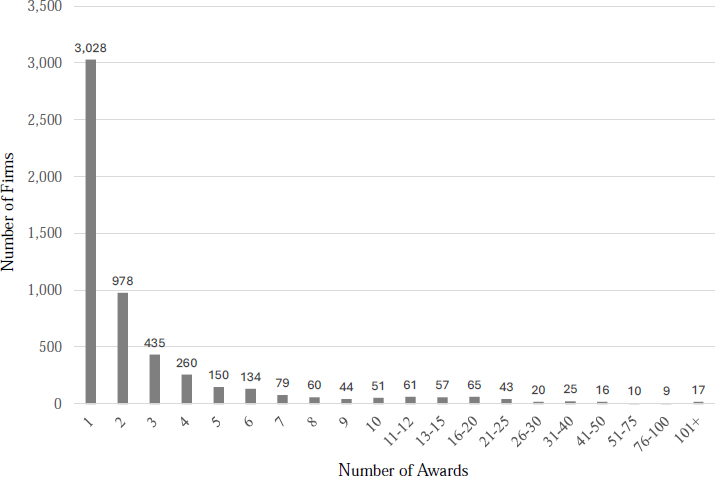
NOTES: The total number of DOD Phase I awards over this period was 21,219. The total number of companies receiving a Phase I award was 5,542.
SOURCE: Committee calculations based on the Small Business Administration’s SBIR/STTR Awards database (SBIR.gov).
participants likely have internal capabilities and networks that allow them to align repeatedly with DOD priorities. At the same time, the data underscore a potential barrier to scaling for many firms that successfully complete Phase I but struggle to advance consistently to or through Phase II. Understanding these dynamics could be key to improving the commercialization outcomes of the SBIR/STTR programs and ensuring a more equitable distribution of advanced-stage support.
THE 2022 EXPERIENCED FIRM CRITERION
To get a sense of how the provisions of the 2022 SBIR/STTR reauthorization might impact those companies that receive many awards, the committee undertook an analysis of DOD awards made to firms that would be defined as experienced under the terms of the reauthorization and therefore subject to the additional scrutiny and more stringent performance standards prescribed in that legislation. The increased benchmark for transition from Phase I to Phase II applies to any firm with more than 50 Phase I awards, from
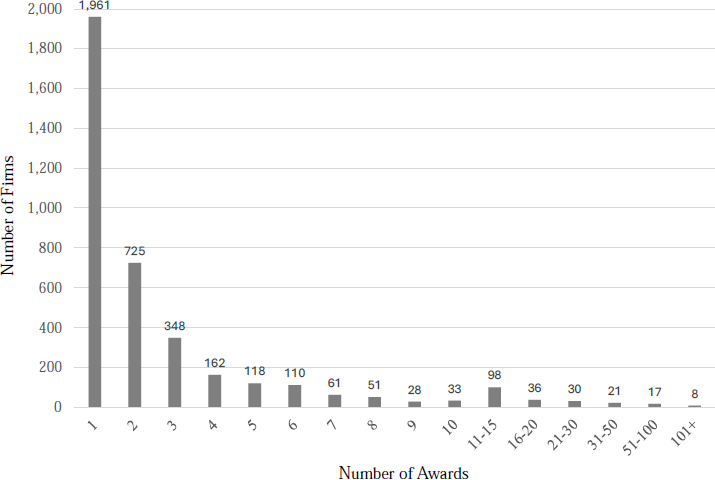
NOTES: The total number of DOD Phase II awards over this period was 13,484. The total number of companies receiving a Phase II award was 3,807.
SOURCE: Committee calculations based on the Small Business Administration’s SBIR/STTR Awards database (SBIR.gov).
any federal agency, over the 5 fiscal years preceding the most recently completed fiscal year, and the heightened commercialization benchmark applies to any firm with more than 50 Phase II awards, from any federal agency, over the 10-year period preceding the 2 most recently completed fiscal years. As noted above, an even more stringent commercialization benchmark applies to any firm receiving more than 100 Phase II awards. Figure 9-3 presents the number of unique, experienced firms, as defined by these guidelines, that received DOD SBIR/STTR Phase I or Phase II awards in each fiscal year, 2012–2023.
The number of experienced Phase I firms (black solid line) ranges from a high of 19 in FY2012 to a low of 8 in both FY2015 and FY2023, with relative stability in most other years, hovering around 10–15 firms per year. Phase II experienced firms (gray dashed line) show a smaller but generally increasing presence from 3 firms in FY2012 to a peak of 11 in FY2022.
These firms make up a small share of DOD SBIR/STTR awards, as well as a small share of DOD SBIR/STTR Phase I funding. As shown in Figure 9-4, firms receiving 51 or more Phase I awards within a 5-year period (excluding the
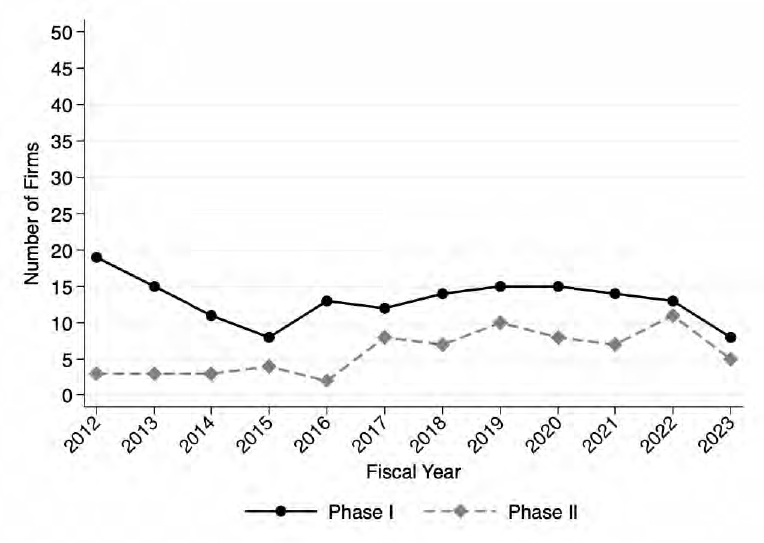
NOTES: For each year, experienced Phase I firms are defined as any firm that has received more than 50 Phase I awards, from any federal agency, over the 5 fiscal years preceding the most recently completed fiscal year. Experienced Phase II firms are defined as any firm that has received more than 50 Phase II awards, from any federal agency, over the 10-year period preceding the 2 most recently completed fiscal years.
SOURCE: Committee calculations based on the Small Business Administration’s SBIR/STTR Awards database (SBIR.gov).
most recent fiscal year) during the analysis period received between approximately 5 percent and 9 percent of the total Phase I funding. Firms identified as experienced by the Phase II definition accounted for a much smaller share of the total Phase I funding, generally between 2 percent and 5 percent.
Although experienced firms received a small share of DOD’s total SBIR/STTR funds from FY2012 to FY2023, as shown in Figure 9-4, they did capture a larger share of the funding for each phase. Firms with more than 50 Phase I awards over the previous 5 years accounted for 13 percent of all Phase I awards and 14 percent of Phase I funding over the analysis period. Similarly, experienced firms (with more than 50 Phase II awards over a 10-year period)
captured 6 percent of Phase II awards and nearly 6 percent of Phase II funding (see Table 9-1). Thus, a handful of experienced firms do capture a significant share of federal research and development (R&D) investment within DOD’s SBIR/STTR programs. Given that the allocated budget for each award reflects DOD’s case-by-case assessment of how best to meet its needs, the receipt of an outsized share of funding or awards may reflect the structural advantage these firms have as a result of their cumulative expertise and proven performance.
VARIATION ACROSS DOD SERVICE/COMPONENT AND ACROSS FEDERAL AGENCIES IN AWARDS TO EXPERIENCED FIRMS
Conversations with DOD SBIR/STTR program managers reinforced the committee’s interpretation that the trends outlined above stem from a shift toward a more meritocratic, competition-based evaluation system. In at least one DOD service/component, proposal materials are redacted to remove firms’ names, addresses, and past award history before review, ensuring that evaluators focus strictly on technical merit and relevance to mission needs.
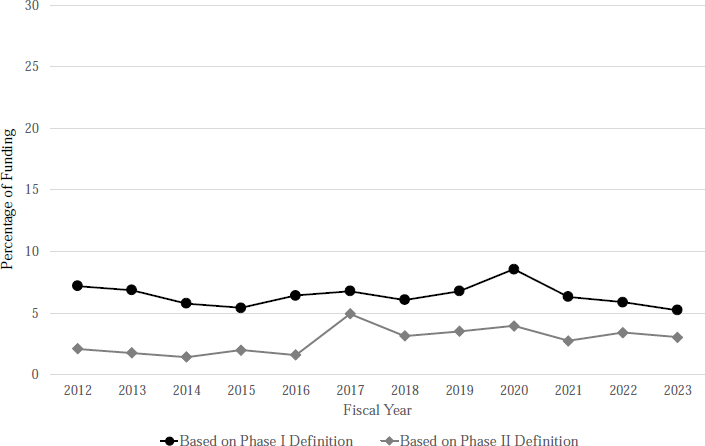
NOTES: For each year, experienced Phase I firms are defined as any firm that has received more than 50 Phase I awards, from any federal agency, over the 5 fiscal years preceding the most recently completed fiscal year. Experienced Phase II firms are defined as any firm that has received more than 50 Phase II awards, from any federal agency, over the 10-year period preceding the 2 most recently completed fiscal years.
SOURCE: Committee calculations based on the Small Business Administration’s SBIR/STTR Awards database (SBIR.gov).
| Branch | Percentage of Phase I Awards | Percentage of Phase I Funding | Percentage of Phase II Awards | Percentage of Phase II Funding |
|---|---|---|---|---|
| Air Force | 8.1 | 10.4 | 3.9 | 3.5 |
| Army | 17.4 | 17.2 | 8.4 | 7.9 |
| Navy | 15.6 | 15.6 | 7.3 | 7.5 |
| DARPA | 12.2 | 13.0 | 4.2 | 4.0 |
| DOD Total | 13.0 | 14.3 | 6.0 | 5.7 |
NOTES: For each year, experienced Phase I firms are defined as any firm that has received more than 50 Phase I awards, from any federal agency, over the 5 fiscal years preceding the most recently completed fiscal year. Experienced Phase II firms are defined as any firm that has received more than 50 Phase II awards, from any federal agency, over the 10-year period preceding the 2 most recently completed fiscal years. DARPA = Defense Advanced Research Projects Agency.
SOURCE: Committee calculations based on the Small Business Administration’s SBIR/STTR Awards database (SBIR.gov).
Across services and components, the current system is designed to prioritize fit and quality over familiarity or seniority. Thus, while experienced firms continue to receive a significant share of awards—especially from the Navy and Army—this reflects their ability to succeed in open competition rather than preferential treatment. A declining share of Phase I and Phase II funding to experienced firms in recent years suggests that DOD services and components are increasingly structuring their programs to encourage broader participation and reduce overreliance on incumbent firms.
Table 9-1 presents the share of SBIR/STTR funding, by phase, awarded to experienced firms across four of the largest DOD services and components—Air Force, Army, Navy, and the Defense Advanced Research Projects Agency—over the period FY2012–2023. The Air Force effectuated a sharp reduction in experienced-firm funding over this period, a shift closely tied to its adoption of the open topic model, reducing the share of Phase I awards to experienced firms from 12.7 percent to 6.4 percent and the share of Phase II awards from 3.6 percent to 2.5 percent. This approach prioritizes exploratory innovation by issuing many small Phase I awards, thereby broadening the applicant pool and reducing the proportion of awards going to repeat recipients. In contrast, the Navy continues to allocate a comparatively higher percentage of its SBIR/STTR funding to experienced firms, with 16.5 percent of Phase I awards going to experienced firms and 5.5 percent of Phase II awards going to such firms in FY2023 (although these shares declined from FY2020 when experienced firms captured 21 percent of the Navy’s Phase I awards and 11 percent of its Phase II awards). Continued reliance on experienced firms reflects the Navy’s long-standing orientation toward using SBIR/STTR as a mechanism to support procurement, which naturally favors firms with demonstrated performance and alignment with naval acquisition needs.
Similarly, the Army has maintained relatively high shares of awards to experienced firms but has shown a gradual reduction in its awards to such firms. Its share of awards to experienced firms for Phase I dropped from 16.7 percent in FY2012 to 9.1 percent in FY2023, and for Phase II from a high of 13.9 percent in FY2019 to 3.1 percent in FY2023.
A comparison of DOD with the other large federal funding agencies reveals that DOD is the largest user of experienced firms in its SBIR/STTR programs, although the National Aeronautics and Space Administration (NASA) also uses a substantial number of such firms. These levels signal moderate institutional reliance on established performers, potentially reflecting a desire for strategic or technical continuity in mission-oriented R&D. In contrast, agencies such as the Department of Health and Human Services (HHS) and the National Science Foundation (NSF) allocate much smaller proportions of awards and funding to experienced firms. Agencies such as DOD and NASA appear to value long-term partnerships with experienced performers as necessary for procurement, whereas HHS and especially NSF may emphasize novelty and diversity in their SBIR/STTR portfolios (NASEM, 2022a, 2023).
PERFORMANCE OF EXPERIENCED FIRMS
Under the provisions of the 2022 reauthorization, as implemented, companies that have received more than 50 Phase I awards over the 5 fiscal years preceding the most recently completed fiscal year must have achieved an average ratio of Phase II’s to Phase I’s of 0.50 (one Phase II award for every two Phase I awards). This is double the transition rate benchmark required for experienced firms under the 2011 reauthorization.6 With this in mind and to get some sense of how the transition rates of experienced versus other firms compare, the committee undertook an analysis of the average overall transition rate for firms receiving Phase I awards that would have been subject to the 2022 provisions had those provisions been in place over the period FY2012–2020.
Employing the same 5-year lookback as that called for in the 2022 reauthorization, the committee compared (1) the Phase II transition rates for those firms that would have been categorized as experienced with (2) all other DOD SBIR/STTR Phase I awardees. The results, reported in Figure 9-5, show that these experienced firms outperformed their less experienced counterparts.7 From
___________________
6 SBA calculates the Phase II/Phase I transition rate for a firm by dividing the number of Phase II awards received by the number of Phase I awards received. The measurement period for the count of Phase II’s begins and ends 1 year after the period used to calculate the number of Phase I’s received by a given firm. This calculation can be misleading as firms may receive two Phase II awards for the same project, yielding a transition rate >1. See https://www.sbir.gov/performance-benchmarks.
7 The committee observed the rate at which DOD SBIR/STTR Phase I awards made between FY2012 and FY2020 resulted in Phase II awards made through FY2023. Unlike the practice described by SBA on its website, the committee employed textual analysis of project abstracts to connect specific Phase II awards to specific Phase I awards and allowed additional time for transitioning. SBA bases its calculated transition rates on Phase I and Phase II counts over 5-year periods, offset by 1 year to allow for transition, but without connecting the Phase II awards to the Phase I awards included in their counts.
FY2012 to FY2018, experienced firms maintained an average transition (conversion) rate of around 0.6, while the rate for other firms was 0.45–0.5. However, the trend shifted in FY2019 and FY2020, as both types of awarded firms experienced a marked decline in conversion rates. By FY2020, conversion rates for experienced firms had dropped to about 0.4, while the rate for other firms had fallen below 0.3. It should be noted that this convergence at lower levels may reflect changes in DOD program priorities; increased competition; administrative backlogs; or external shocks such as the COVID-19 pandemic, which disrupted R&D operations and federal contracting timelines.8
![Phase I to II transition rates of DOD SBIR/STTR Phase I awardees (fiscal years [FY] 2012–2020)](https://www.nationalacademies.org/index.php/read/29329/assets/images/img-212.jpg)
NOTE: For each year, experienced Phase I firms are defined as any firm that has received more than 50 Phase I awards, from any federal agency, over the 5 fiscal years preceding the most recently completed fiscal year. The committee employed textual analysis of project abstracts to connect specific Phase I awards made from FY2012 to FY2020 to specific Phase II awards made through FY2023.
SOURCE: Committee calculations based on the Small Business Administration’s SBIR/STTR Awards database (SBIR.gov).
___________________
8 Additionally, it may take longer than the sample period allows to see whether a firm has successfully converted its Phase I award into a Phase II award.
The 2022 SBIR/STTR reauthorization significantly raised commercialization performance standards for firms with a history of frequent participation. The 2022 reauthorization requires that firms that have received more than 50 Phase II awards during the past 10 years, excluding the 2 most recently completed fiscal years, achieve a minimum average of $250,000 in sales and/or investments from the private sector per Phase II award received during that period. Thus, a firm holding 51 Phase II awards would need to achieve at least $12.75 million in total external sales or private-sector investments. The threshold increases further for companies with more than 100 Phase II awards; they must achieve an average of $450,000 per award, translating to more than $45 million for 101 Phase II contracts. This represents a substantial increase from the $100,000 average required of less experienced multiple-award recipients. Importantly, this requirement excludes sales that involve follow-on contracting directly with DOD itself; in other words, firms that succeed in transitioning technology and activities from SBIR/STTR to subsequent research and procurement contracts as part of the defense industrial base would be penalized for this outcome given that the source of these revenues would be federal funds.9
Many SBIR-funded innovations are designed for public missions—defense, health, and energy—for which the federal government is the primary customer. By not counting federal sales, the reauthorization reinforces a distorted picture of success, penalizing firms that deliver high-impact technologies to address national needs. This undermines the dual-use purpose of SBIR/STTR, which serves both economic and strategic goals. The 2022 reforms missed a key opportunity to modernize evaluation metrics and recognize the full public value of SBIR/STTR-supported innovation.
Companies oriented toward potential dual-use applications are generally well positioned to meet these thresholds, given their capacity to generate commercial sales and secure private funding. By contrast, specialized R&D firms, which frequently focus on mission-specific defense technologies and may be particularly valuable contributors as specialized firms within the defense industrial base, may struggle to achieve the same benchmarks.
Rigid adherence to these new thresholds, particularly for Phase I-to-Phase II transitions, could unintentionally constrain experimentation. The notion that SBIR/STTR-funded firms advance in a neat, linear progression—Phase I to Phase II to procurement success—oversimplifies the reality of early-stage research. Many companies require multiple Phase I awards to refine an initial concept, and an unsuccessful early attempt may lead a firm to pivot and seek another Phase I award that incorporates new insights. Indeed, the analyses presented in Chapters 7 and 8 show that securing at least five Phase I awards often serves as a practical minimum threshold before most firms can attract either private financing or follow-on DOD funding. Reducing the number of Phase I
___________________
9 Under the terms of the 2011 reauthorization as implemented for less experienced multiple-award recipients, follow-on federal funding or receipt of patents can also be used to meet the commercialization standard. See https://www.sbir.gov/performance-benchmarks.
opportunities in an effort to enforce higher transition rates may thus limit exploratory work, while similarly restricting Phase II awards could leave valuable knowledge underutilized.
Building on the analysis presented in Chapters 7 and 8, the committee examined the performance of SBIR/STTR awardees on a number of indicators, with awardees grouped based on their cumulative number of Phase I awards from FY2012 to FY2022. The committee found that experienced firms were more likely than the comparison group to obtain patents, private investment, and subsequent non-SBIR/STTR R&D funding or non-R&D procurement contracts from DOD. In the case of private capital and the receipt of non-R&D procurement, this likelihood was greater than that for less experienced multiple-award recipients. Especially notable for firms that received more than 50 Phase I awards is that these firms secured non-R&D funding from DOD at higher rates relative to a comparable set of small businesses that did not receive DOD SBIR/STTR funding.
Taken together, these findings suggest that firms that receive many awards have developed technologies that are valued by DOD. Further study is needed to better understand the impact of these awards on the defense supply base, but the evidence is clear: while there is a large variation in outcomes associated with experienced SBIR/STTR firms, the premium enjoyed by DOD SBIR/STTR awardees compared with other firms in the DOD innovation ecosystem mostly increases with higher numbers of awards, and with respect to patenting, private financing, and subsequent contributions to the warfighter through procurement, firms with a higher number of awards do better, on average, than less experienced SBIR/STTR awardees.
LOCATION OF EXPERIENCED FIRMS
Finally, the committee investigated where experienced firms are located, finding that these firms are often located in states that attract less venture capital funding, thus helping to spread DOD R&D funding more broadly across the United States. Figure 9-6 shows the top U.S. states ranked by the percentage of DOD SBIR/STTR Phase I awards that were granted to experienced firms in the FY2019–2020 time period. The top three states—New Hampshire, Massachusetts, and Maryland—stand out for having an exceptionally high concentrations of awards going to experienced firms, accounting for 39.3 percent, 36.6 percent, and 31.9 percent, respectively, of all the SBIR/STTR activity in the state. In each of these states, a small number of firms (one in New Hampshire and Maryland, and five in Massachusetts) were responsible for securing a large share of the state’s awards. Alabama and Texas also had notable award shares to experienced firms—19.2 percent and 18.7 percent, respectively—despite having only one or two firms that met the experience threshold. Cutting DOD SBIR/STTR funding to experienced firms would have uneven and potentially severe consequences for many states, particularly those in which one or a few firms dominate the award landscape. In these states, a cut in funding to
experienced firms could directly undermine a major component of the regional innovation economy. These firms often serve as anchors for technical employment, generate local procurement through subcontracting, and contribute significantly to state and local tax bases. A sudden reduction in funding could result in job losses, stalled R&D activities, and weakened innovation infrastructure.
In states with larger and more diverse innovation ecosystems, such as California, Massachusetts, and Virginia, the effects might be more diffuse but still substantial. Experienced firms in these states often lead high-risk, high-impact projects that form the backbone of DOD’s early-stage technology pipeline. Curtailing their participation could erode institutional knowledge, reduce economies of scale in proposal development, and ultimately impair the timely delivery of critical technologies to defense users. Moreover, these experienced firms frequently collaborate with universities and smaller businesses, meaning their decline would ripple across the broader ecosystem.
![Top U.S. states by percentage of DOD SBIR/STTR awards going to experienced firms (weighted average for fiscal years [FY] 2019–2020)](https://www.nationalacademies.org/index.php/read/29329/assets/images/img-215.jpg)
NOTE: State is based on location of record. For each year, experienced DOD Phase I firms are defined as any firm that has received more than 50 Phase I awards, from any federal agency, over the 5 fiscal years preceding the most recently completed fiscal year. Analysis limited to states with five or more awards in FY2019–2020.
SOURCE: Committee calculations based on the Small Business Administration’s SBIR/STTR Awards database (SBIR.gov).
Restricting funding to experienced firms also risks deepening existing regional disparities in innovation capacity. These firms often emerge in states that lack other federal R&D assets, such as national laboratories or top-tier research universities. In these states, SBIR/STTR funding represents one of the few sustained mechanisms for local firms to engage in high-value technological development. Eliminating that channel would likely shift funding back toward traditional innovation hubs, undercutting national efforts to democratize access to federal R&D support. In sum, a blunt cut to the eligibility of experienced firms would disrupt regional economies and weaken national defense innovation.
EXPERIENCED SBIR/STTR FIRMS AND THE DEFENSE INNOVATION ECOSYSTEM
SBIR/STTR firms typically operate as nonprime contractors within the defense industrial ecosystem, taking on R&D roles that may not align with the scale or scope of large prime contractors. The committee identified several distinct motivations for such firms to apply to SBIR/STTR programs. Some technology-focused companies seek out SBIR/STTR as a source of nondilutive (equity-free) investment to support early-stage product or process development. Because DOD is the largest federal sponsor of SBIR/STTR, it offers a particularly attractive funding vehicle—especially when the possibility of securing a Phase III contract could provide a reliable first-use customer.
For some companies, DOD SBIR funding serves as a springboard to larger commercial markets. For example, the startup Compound Eye received an Air Force Direct to Phase II SBIR award and an Army SBIR Catalyst Award to develop advanced sensing and perception technologies for defense applications. The same core technology designed for autonomous vehicles can be embedded within a broader product platform. In this sense, Compound Eye exemplifies a dual-use approach, leveraging defense R&D funding to develop solutions applicable to both military and civilian markets.10
Other firms are more specialized R&D organizations. They rely on SBIR/STTR funding to advance technologies that often form components of larger, warfighter-focused systems (Myers et al., 2025). These firms typically engage in long-term partnerships with DOD services and components and provide specialized prototypes or subsystems critical to mission needs. Although such firms occupy a valuable niche in the defense innovation ecosystem, they may have less appeal for private investors. With limited commercial potential beyond DOD, growth prospects of these firms are constrained, making them less likely candidates for venture capital or other forms of risk capital.
When viewed as a portfolio, these two types of companies—those pursuing dual-use possibilities and those specializing in defense-focused R&D—both serve essential functions. Firms oriented toward dual-use innovation bring
___________________
10 Based on committee discussions with DOD SBIR/STTR program managers. See also https://compoundeye.com.
fresh technological perspectives and benefit from DOD’s funding and user feedback. Meanwhile, more specialized firms evolve into trusted partners that repeatedly contribute critical expertise. Many SBIR/STTR program officials and administrators interviewed by the committee expressed neutral or positive views regarding so-called experienced firms, describing them as proven performers that accelerate the path to a deployed technology.
Experienced SBIR/STTR awardees can have an outsized impact on the human capital base of the U.S. defense innovation ecosystem. Applying to the SBIR/STTR programs requires a detailed application and thorough knowledge of the application process, filing requirements, and applicable deadlines (see Chapter 4). One SBIR/STTR program manager indicated to the committee that multiple-award recipients provide important proposal and contracting support to researchers who can bring valuable ideas to DOD, but who otherwise might not access the SBIR/STTR programs.11
The committee found that firms meeting the criteria for experienced—those receiving at least 51 Phase I awards in the previous 5 years or 51 Phase II awards in the previous 10 years—averaged 44 unique principal investigators who received funding from the DOD SBIR/STTR awards. This suggests that such firms operate as organizational platforms, enabling a broad array of researchers to apply for, manage, and execute government-funded R&D projects. Rather than being centered around a single founder or a narrow technical niche, these firms appear to have a dynamic function within the defense innovation ecosystem, with a diverse internal talent base and the organizational capacity to support multiple, simultaneous lines of inquiry. Their ability to attract, retain, and coordinate dozens of specialized principal investigators indicates a level of managerial and technical infrastructure that differentiates them from less experienced or smaller firms.
Moreover, this pool of technical talent positions experienced SBIR/STTR firms as important intermediaries in the broader defense innovation pipeline—not just as recipients of federal funding, but as hubs of capability that can rapidly mobilize expertise in response to shifting national security needs. Feldman and colleagues (2022) emphasized the generative effects of these firms, noting that they often serve as launching pads for new ventures, either through formal spin-offs or as former employees and principal investigators establish their own firms. In this way, experienced SBIR firms contribute not only to the immediate goals of DOD innovation agendas but also to the longer-term development of the entrepreneurial and scientific workforce. They play a dual role—facilitating applied R&D in support of defense priorities while nurturing the professional development of technical talent, thereby reinforcing the resilience and adaptability of the defense-oriented entrepreneurial ecosystem.
The limits on SBIR/STTR awards to single firms that were put in place as part of the 2022 reauthorization can be expected to impact a limited number of firms but may have an outsized impact on the health of the nation’s defense
___________________
11 Based on committee discussions with DOD SBIR/STTR program managers.
innovation ecosystem. As noted, firms often require multiple Phase I awards to refine and develop an initial idea, and limiting the number of awards to some multiple-award recipients based on their transition rate to Phase II may encourage less innovative research. Firms with multiple awards tend to employ many principal investigators to manage their SBIR and STTR awards over the course of their involvement in the programs and help some of those researchers access the programs by providing the corporate structure and application expertise some researchers may lack. Therefore, the limits on Phase I and II awards prescribed in the 2022 reauthorization may reduce the number of researchers benefiting from the programs and going on to make other contributions to the nation’s defense innovation system. While those limits are intended to curb repeat participation without demonstrated market impact, they risk penalizing firms whose primary customers are federal agencies—a common reality in the national security, energy, and health sectors.
The committee’s analysis also revealed that these limits may impact the geographic reach of the programs to parts of the country not typically associated with technology-intensive industries or venture capital investments, where firms with experience in the SBIR/STTR programs can serve as exemplars for other local firms. Importantly, the committee also found that firms at risk of exceeding the 2022 limits are more likely to contribute important capability and expertise to the defense supply chain and innovation ecosystem than are firms that receive fewer awards.
FINDINGS AND RECOMMENDATIONS
Finding 9-1: Performance standards (concerning follow-on funding or transition to Phase II) that potentially limit participation in the SBIR/STTR programs by particular firms, whether by limiting the ability to submit proposals or the number of awards that can be received, add administrative burden and limit the discretion of program executive officers and program managers.
Finding 9-2: DOD SBIR/STTR firms with more than 50 Phase I awards over a 10-year period are more likely to contribute capability and expertise to the defense supply chain and innovation ecosystem than are firms that receive fewer awards.
Finding 9-3: DOD SBIR/STTR firms with more than 50 Phase I awards over a 10-year period often come from states that receive relatively low levels of venture capital and are outside of those areas of the country perceived as traditional innovation clusters.
Finding 9-4: Excluding federal funding from the commercialization standard disadvantages firms that provide defense-specific technologies.
Recommendation 9-1: Congress should direct the Small Business Administration to revise the Policy Directive restriction on proposal submission by certain applicants that do not meet commercialization or transition benchmarks. Doing so would ensure that the Department of Defense can review and select the best proposals to meet its needs.
Recommendation 9-2: Congress should ensure that program executive officers and program managers have the flexibility to choose among applicants with the best technologies and those that can quickly deliver results for the warfighter. Congress should not mandate strict benchmarks restricting the receipt of awards based simply on the number of previous awards or prior Small Business Innovation Research/Small Business Technology Transfer (SBIR/STTR) funding received by a small business.
Recommendation 9-3: Congress should include additional federal funding in calculations of commercialization.
This page intentionally left blank.


