Review of the SBIR and STTR Programs at the Department of Defense (2026)
Chapter: 2 The Role of Small Business in Defense Technology Innovation: An Overview of DOD's SBIR/STTR Programs
2
The Role of Small Business in Defense Technology Innovation: An Overview of DOD’s SBIR/STTR Programs
Innovation is a cornerstone of national security, providing a strategic advantage for U.S. military operations. The private sector has been pivotal in the rapid development, procurement, and deployment of innovative technologies to support national defense—technologies that enable effective responses to emerging threats and the capacity to maintain robust defense operations. From the creation of the internet to advances in GPS and aerospace technologies, innovations that originated to address military needs have been adapted for civilian markets, enhanced productivity, and spurred new industries. Since the nation’s earliest days, the Department of Defense (DOD) and its predecessor organizations have maintained a vital partnership with small businesses, recognizing their essential role in bringing innovation to the forefront of national security. Today, the Small Business Innovation Research (SBIR) and Small Business Technology Transfer (STTR) programs serve as critical components of this partnership. This chapter provides a framework for understanding the multifaceted nature of the SBIR and STTR programs at DOD. As context for the committee’s analysis of the programs, the chapter provides an overview of DOD’s historical engagement with small business; this chapter also describes the interplay of the SBIR/STTR programs with the current defense innovation ecosystem and some advantages of SBIR/STTR in supporting and transitioning defense technology innovation.
A BRIEF HISTORY OF AMERICAN DEFENSE INNOVATION
Throughout the nation’s history, private firms have been instrumental in developing critical technologies that have significantly enhanced the capabilities of the U.S. military. From the early days of the Revolutionary War, when small arms manufacturers provided the Continental Army with weapons (Schakenbach Regele, 2019), to the development of advanced communication systems and cyber
technologies in recent decades (Bonvillian and Singer, 2018), small businesses have consistently demonstrated their capacity to meet DOD’s dynamic and complex needs.
Since its earliest days, the U.S. government has also been funding research to improve its military capabilities, a long-standing collaboration with industry that has not only fueled technological advances but also provided a strategic advantage in various conflicts and wars. During the Civil War, rifles produced by small arms manufacturers, located principally in a Connecticut small arms cluster (Ford and Schakenbach Regele, 2024), proved critical to the war effort. The creation of the National Research Council during World War I formalized the relationship between private industry and universities and catalyzed the growth of Army Aviation in the interwar years (McBride, 1992). During this same period, Thomas Edison worked with the Department of the Navy to establish the Naval Research Laboratory (McKinney, 2012), and during World War II, the Office of Scientific Research and Development (OSRD) spearheaded the Manhattan Project, the Penicillin Project, the invention of radar and sonar, and advances in aviation that helped secure Allied victory (Gross and Sampat, 2023a). Small firms were often pivotal in the rapid development, procurement, and deployment of such cutting-edge technologies (Nelson and Wright, 1992).
Demonstration of the importance of scientific innovation to military prowess during World War II served as a strong motivation for Vannevar Bush, the founder of Raytheon and first OSRD director, to lead a postwar movement advocating for increased government support for science (Gross and Sampat, 2023b). This movement would eventually lead to the creation of the National Science Foundation and establish the framework for the current structure of federal support for science connected to designated agency missions, such as that of DOD. Indeed, the postwar years were marked by the creation of the Service research laboratories and Federally Funded Research and Development Centers (FFRDCs), which serve as key organizations for DOD’s science and technology activities aimed at delivering advanced warfighting technical capabilities to provide overmatch for U.S. forces on any battlefield (Gross and Sampat, 2023a).
Similarly, the Cold War era, and the implied threats of the Sputnik launch, led to the establishment of the Defense Advanced Research Projects Agency (DARPA), which enlisted world-class scientists and engineers to lead high-risk, high-payoff research efforts focused on the development of groundbreaking military capabilities, such as GPS, stealth technology, and the internet (Azoulay et al., 2019). Throughout the Cold War, newly created technology firms pioneered advances in aerospace, electronics, and computer technologies that played a crucial role in maintaining the United States’s competitive edge (Gross and Sampat, 2023a; Roberts, 1991).
Regardless of the geopolitical era or the needs of the military at the time, small firms have served not only to address critical requirements but also to diversify the supplier base on which DOD relies to perform its mission. Simply put, small and innovative enterprises, such as Qualcomm, BBN Technologies, and Anduril, have played a crucial role in providing technological innovations that
serve the warfighter and support DOD’s mission to defend and protect the nation; in turn, the SBIR/STTR programs have played an important role in the early success of these companies.
Today, with the emergence of the People’s Republic of China as a technologically advanced strategic adversary, the continued presence of Russia as a technically capable adversary, and increased geopolitical tensions around the world overall, the United States faces new strategic challenges (Fuchs, 2010). Against this backdrop, new scientific advances—in such areas as robotics, space, artificial intelligence (AI), biology, and quantum computing—present new opportunities for innovation and for research investments. The SBIR/STTR programs are positioned to contribute to the achievement of DOD’s goals in these and other areas, helping to augment the nation’s military capabilities and bolster America’s national security. Small firms—especially startups—can improve the speed of the development, production, and deployment of new defense capabilities; expand the defense industrial base and the national security innovation base; and foster and promote the development of innovative defense capabilities (Congressional Budget Office, 2020).
THE SBIR/STTR PROGRAMS AT DOD
As discussed in Chapter 1, the SBIR program was established in 1982 as a competitive program aimed at promoting the translation of the scientific findings and engineering achievements of small businesses into technology developments and innovation activities. The STTR program was established in 1992 with the requirement that a small business awardee partner with a college, university, FFRDC, or qualified nonprofit research institution on a cooperative research/research and development (R&D) project to help promote the technology transfer and commercialization of research collaborations between those parties. Since the SBIR program’s establishment in 1982, more than 13,400 unique firms have received SBIR/STTR awards from DOD.
DOD is a complex organization comprising service branches, such as the Army, Navy, and Air Force; defense agencies such as DARPA and the Defense Threat Reduction Agency (DTRA); and combatant commands such as the United States Special Operations Command (USSOCOM)—each with unique geographic or functional mission field activities. In all, today, 14 services and components within DOD execute SBIR/STTR programs.1 Each service and component has a distinct mission, budget, and organizational structure. Their organizational structures have evolved over time to address emerging threats and to adapt to changing national security priorities—for example, the creation of the United States Cyber Command (CYBERCOM), the Defense Innovation Unit (DIU), and the Space Force.
___________________
1 The different services and components are discussed in greater detail in Chapter 4; including the Under Secretary of Defense for Research and Engineering, there are 15 services and components.
DOD operates command and field activities that execute specific R&D missions. As noted previously, for example, DARPA funds high-risk, high-payoff science and technology programs aimed at achieving technological advantages over adversaries. Agencies such as DTRA and the Joint Program Executive Office for Chemical, Biological, Radiological and Nuclear Defense (JPEO-CBRND) fund research designed to address threats resulting from weapons of mass destruction. DIU funds research and prototyping activities aimed at leveraging commercial technologies for military uses. These agencies fund small business research performers, using both SBIR/STTR funds and other research, development, test, and evaluation (RDT&E) funds.
As a defense mission agency, DOD performs a range of operations—including installation management, the provision of educational services, health care management, policy development and execution, and even R&D—but each of these operations is carried out only in service to the Department’s defense mission. Even a multi-hundred-billion-dollar procurement enterprise is ancillary to daily global military operational activities and the training, equipping, and fielding of military capabilities globally to support the execution of national defense missions, such as power projection, homeland defense, humanitarian assistance, and deterrence of future conflicts. In fiscal year (FY) 2023, DOD’s total budget was $894.2 billion, including supplemental appropriations; this budget funds all DOD activities, including personnel, operations, and maintenance of forces and systems, as well as procurement. In the FY2023 budget, $145 billion was allocated to RDT&E, covering activities from foundational scientific research to the prototyping and testing of military weapons and equipment. Funding for the earlier-stage accounts—Basic Research, Applied Research, and Advanced Technology Development—was about $22 billion. DOD’s SBIR program for FY2023 was nearly $3 billion.2
DOD RDT&E FUNDING
DOD’s budget originates in the president’s annual budget request to Congress. Final funding levels are determined in the annual Department of Defense Appropriations Act, which supports DOD’s full range of activities, based on authorizations in the National Defense Authorization Act, which falls under the jurisdiction of the House Committee on Armed Services and the Senate Committee on Armed Services. Reauthorization of the SBIR and STTR programs is under the jurisdiction of the House Committee on Small Business and the Senate Committee on Small Business and Entrepreneurship. RDT&E is one of DOD’s five major appropriation categories, and SBIR and STTR are funded through a small set-aside of extramural RDT&E funds. At times, Congress also provides additional DOD RDT&E funding through supplemental appropriations acts. The DOD RDT&E budget is managed primarily by the military services,
___________________
2 Presentation to the committee by Marcy E. Gallo, Congressional Research Service, April 18, 2024, Washington, DC.
which use the funding mainly to develop technologies, systems, and capabilities to meet their unique service operational requirements. Each service and component has its own science and technology budget. That budget funds basic and applied research and technology development with the aim of transitioning technologies to what are known in DOD as acquisition programs of record, which develop, deliver, and maintain operational defense systems and warfighter capabilities. The services’ and components’ SBIR/STTR programs often operate in parallel with rather than being integrated into these science and technology activities.
Because they operate as a set-aside, the SBIR/STTR programs are neither included in the annual DOD budget request nor specifically appropriated by the Appropriations Act. The DOD comptroller transfers the program funds from DOD’s RDT&E accounts according to statutory guidance, under the authority of and consistent with the levels required by the Small Business Act. Roughly, each participating component allocates 3.2 percent of its extramural R&D portion of the RDT&E budget (as calculated per SBA and DOD guidance) to the SBIR program, and 0.45 percent to the STTR program. However, in the committee’s view, the DOD budget materials provided to Congress provide little information on the SBIR/STTR programs and their activities, significantly less information than what is provided for other RDT&E activities.
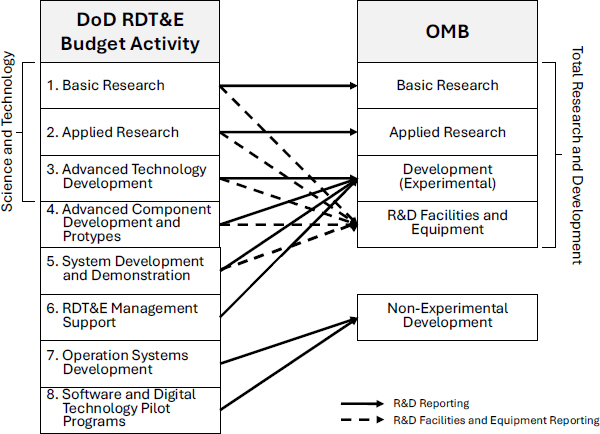
DOD’s RDT&E budget funds research, development, test, and evaluation efforts of both contractors and government installations toward the development of equipment, material, or software. DOD R&D activities overall are categorized according to eight RDT&E Budget Activities, shown in Figure 2-1, which collectively represent DOD’s efforts to use R&D programs to mature technologies and systems for eventual procurement for operational use. Figure 2-1 shows how this budget structure for RDT&E activities maps to Office of Management and Budget categories.
DOD’s RDT&E funding for FY2023 totaled $145 billion, representing about 16.4 percent of the Department’s overall budget in that fiscal year (Gallo, 2024b). DOD examines the share of its overall RDT&E funding that is distributed extramurally to determine the annual funding for the Department’s SBIR/STTR programs (that share is set at 3.2 percent for SBIR3 and 0.45 percent for STTR4). For FY2023, the total amount allocated to the SBIR/STTR programs was nearly $2.9 billion, or about 11 percent of DOD’s budget for “science and technology activities,” which are budget activities 1-3 (Gallo, 2024b) (see Figure 2-1). While spending on SBIR/STTR makes up a substantial portion of DOD’s science and technology budget, it represents only about 2 percent of the Department’s overall RDT&E funding and about 0.3 percent of its total spending (Gallo, 2024b). The remaining RDT&E budget can be allocated to intramural and extramural
___________________
3 15 U.S.C., Section 638(f)(1).
4 15 U.S.C., Section 638(n)(1)(B).
NOTE: OMB = Office of Management and Budget; R&D = research and development.
SOURCE: Adapted from a presentation to the committee by Marcy E. Gallo, Congressional Research Service, April 18, 2024, Washington, DC.
organizations to advance technology using contracts outside of the SBIR/STTR programs. Budget activities 4 and 5, for example (shown in Figure 2-1), are used for subsequent development, demonstration, and piloting of technologies toward greater levels of technology readiness, leading to procurement and deployment.
DOD’s extramural research programs, including SBIR/STTR activities, are managed by civilian and military personnel within government program offices and executed primarily by private-sector performers, including large and small defense contractors and universities. RDT&E activities are also executed internally through a network of more than 55 service laboratories and test ranges. In addition, DOD funds a set of FFRDCs and University Affiliated Research Centers that carry out additional R&D activities.
THE DEFENSE INNOVATION ECOSYSTEM
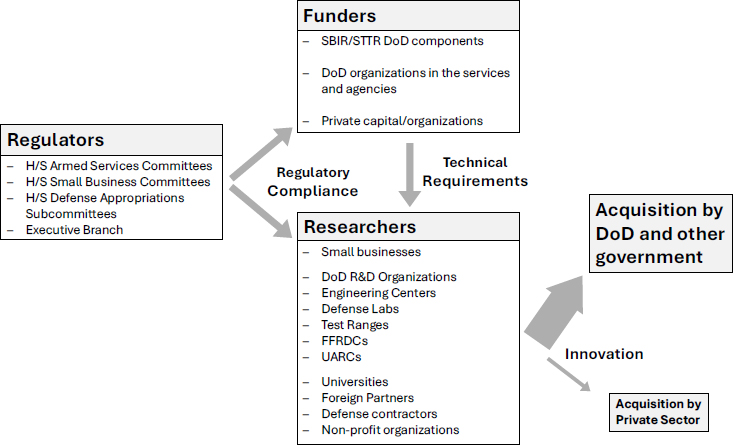
The U.S. defense innovation ecosystem comprises multiple key participants that contribute to both its effectiveness and its complexity (Figure 2-2). Because SBIR/STTR is just one small share of the activities within this ecosystem, it is difficult to identify the specific role of the programs in isolation. The broader ecosystem includes organizations and individuals that act as funders of R&D activities, including DOD organizations in the services and defense agencies, as well as private-sector organizations in the defense industry. Funding
NOTE: FFRDC = Federally Funded Research and Development Center; H/S = House and Senate; R&D = research and development; UARC = University Affiliated Research Center.
for the private sector has come from contracting with the defense agencies, as well as internal R&D investments and, more recently, an increasing number of private venture capital sources. In contrast to idealized markets that include multiple buyers and suppliers, the defense market is highly concentrated.
For a host of defense technologies in the United States, DOD is the only customer that procures and uses final systems, goods, or services, a market described by economists as a monopsony, although some emerging technologies, such as AI, machine learning, and autonomous systems, originated in the civilian sector and are dual-use (Center for Strategic and International Studies, 2025). This situation complicates procurement activities because of the paucity of competition and comparable contracts. As a result, market competition for DOD products is typically oriented primarily toward meeting technical requirements and achieving regulatory compliance instead of toward price. Innovation still occurs—including remarkable advances in science, technology, and military platforms and other equipment—giving the United States the world’s leading national security capabilities. Some of these innovations subsequently transfer to the commercial sector. Further complicating the investigation of SBIR/STTR innovation pathways, DOD funding may go to controlled or classified projects, and information on those projects may not be available for security reasons.
In addition to all of the funders and performers of research and technical work for DOD is a set of policy makers and regulatory organizations. These include Congress, whose oversight and appropriations committees pass laws, provide funding, and perform oversight over the SBIR/STTR programs.
Committees with principal jurisdiction include the House and Senate Small Business Committees, as well as the House Science Committee, the House and Senate Armed Services Committees, and the House and Senate Defense Appropriations subcommittees. Within the executive branch, oversight, funding decisions, and policy and regulatory activity stem from the White House; the Small Business Administration (SBA); and many offices within DOD, including the Office of the Secretary of Defense, the military services, and agency components. Because SBIR and STTR bridge funding and policy issues in sectors ranging from science and technology to acquisition to small business policy, and because the statutorily mandated goals of the programs are in tension with each other, the regulatory environment is particularly complex and involves competing priorities and incentives (NASEM, 2020).
The subsections that follow describe some of the major players in this ecosystem.
The Defense Prime Contractors
Prime defense contractors, commonly referred to as primes, are large companies that engage in direct contractual arrangements with DOD (Table 2-1). Since the 1990s, following significant consolidation in the defense industry, a small number of firms have become increasingly dominant (Amara and Franck, 2021; Chang and Chakrabarti, 2023). These prime contractors are responsible for integrating complex technologies into operational systems, managing vast supply chains, and ensuring that systems meet stringent performance and reliability standards. Primes, in turn, rely on networks of subcontractors, including firms participating in the SBIR/STTR programs. This subcontracting, although difficult to observe and measure, allows primes to incorporate innovative technologies developed by small businesses into larger defense systems. Additionally, primes may acquire small firms to integrate their technologies and expertise directly, further blurring the lines between the contributions of small and large defense contractors.
TABLE 2-1 Defense Prime Contractors: Five Largest by Obligations (Fiscal Year 2023)
| Company | Obligations (billions of dollars) |
|---|---|
| Lockheed Martin Corporation | 68.6 |
| Raytheon Technologies Corporation | 27.8 |
| General Dynamics Corporation | 23.0 |
| The Boeing Company | 21.8 |
| Northrop Grumman Corporation | 15.1 |
NOTE: Raytheon Technologies Corporation is now known as RTX Corporation.
SOURCE: Forecast International, 2024.
Subcontractors
Subcontractors are integral to the defense innovation ecosystem, providing specialized components, services, and expertise that support the large-scale projects managed by prime contractors. While subcontracting theoretically offers opportunities for firms of all sizes, in practice, many of the most significant subcontractors are themselves large or even very large companies. This is due in part to the complexity and scale of defense projects, which often require the substantial resources and established research, engineering, and manufacturing capabilities that larger firms possess. As a result, incorporating young and small firms into the subcontracting process has historically been a challenge. To become successful subcontractors, these smaller firms face such barriers as stringent qualification requirements; limited visibility into and from the final government customer; and difficulties navigating DOD’s procurement system, securing funding, and establishing credibility within a traditionally risk-averse environment—all of which can limit their participation and the infusion of innovative solutions into defense projects. Furthermore, and perhaps surprisingly, DOD, as the final customer for defense products and services, has limited visibility into the subcontracting arrangements made by the prime contractors and limited tools for supporting subcontractors.
Small Firm DOD Contractors
Incorporating small firms into the defense sector diversifies the supplier base, reducing reliance on a few large contractors and enhancing the resilience of supply chains, as outlined in DOD’s (2023c) Small Business Strategy. Small firms are pivotal contributors to the defense innovation ecosystem. Known as nontraditional defense contractors in the defense ecosphere, these firms can bring new skills, innovative capabilities, and even new resources to bear in support of the national security innovation base. Their smaller size and less bureaucratic structures enable them to adapt quickly to new information, changing requirements, and technological advances. In addition, many small firms focus on niche areas, providing specialized skills and trying out innovative approaches. Their agility, specialized expertise, and capacity for rapid innovation can position them to develop cutting-edge technologies to address DOD’s dynamic and complex needs. These firms sometimes operate at the forefront of emerging technologies, such as AI, cybersecurity, biotechnology, and autonomous systems. By introducing novel solutions and fostering competition, they can help foster a culture of innovation and risk taking and drive technological advances to enhance national security.
The advantages of small firms have been highlighted by analyses of the role of technological innovation and small businesses in defense strategy. The 2022 National Defense Strategy (NDS), for example, states that “the United States’ technological edge has long been a foundation of our military advantage,”
highlighting the importance of emerging technologies and innovation to national defense (DOD, 2022, p. 19). Furthermore, the NDS identified a goal to “Adapt and Fortify Our Defense Ecosystem,” stating that “we will bolster support for our unparalleled network of research institutions . . . as well as small businesses and innovative technology firms” (DOD, 2022, p. 20).5
Small firms have a variety of motives for applying to the SBIR/STTR programs. Some apply to receive nondilutive (equity-free) investment. These firms are engaged in developing technologies, and DOD, having the largest federal SBIR program, provides an attractive funding vehicle. In addition, securing a Phase III contract provides the firm with a reliable first-use customer. SBIR also helps the firm develop a product or process that can serve a larger commercial market. For example, the startup firm Compound Eye received one SBIR Direct to Phase II award from the U.S. Air Force and one SBIR Catalyst Award from the Army to develop advanced sensing and perception technologies for defense operations. The technology is applicable to all types of autonomous vehicles and is a component that fits into a product platform. Thus, the company is developing a potential dual-use technology.
Another type of SBIR-funded firm develops platform technologies that scale innovation. Anduril, for example, used DOD SBIR funding to develop a dual-use strategy, based on vertically integrated products that could be delivered as complete, end-to-end solutions. The company was founded in 2017 and currently has a market valuation of more than $14 billion (Tarr, 2024). Backed by venture capital investment, Anduril is discussing plans for an initial public offering, which is the gold standard for a startup company. Known in the investment world as unicorns, these types of companies are rare indeed.
Another type of SBIR awardee firm is a specialized R&D organization. Firms of this type use SBIR funding to advance their technologies, which frequently involve components of larger systems that serve the warfighter. These firms often work closely with the DOD service branches, form long-term trusted partnerships, and provide complex critical technologies that have limited commercial potential. NAVSYS, for example, a company that develops positioning, navigation, and timing technology, was founded in 1986 and received its first SBIR award in 1988. NAVSYS was selected as the Top Satellite Solutions
___________________
5 Two high-level documents that flow from the NDS—the 2023 National Defense Industrial Strategy (NDIS) (DOD, 2023d) and the National Defense Science & Technology Strategy 2023 (NDSTS) (DOD, 2023a)—similarly reiterate those themes and further highlight the value of funding R&D and working with small businesses to achieve stated goals. The NDIS states that “the Department will explore opportunities to expand programs that mitigate costs of entry for promising, small and non-traditional businesses that improve DOD’s technology edge and capabilities” (DOD, 2023d, p. 20). The NDSTS states that “the DOD will tap into the innovation potential of our nation’s small businesses by expanding engagements with and investments into this community to support their ability to prototype and scale their products into production” (DOD, 2023a, p. 6). Countless statements by DOD’s senior military and civilian leaders, policy and strategic documents, technology strategies, and congressional testimony are consistent with these themes. These policy goals are also mirrored by statements made by congressional leadership in legislation, reports, hearings, and floor speeches, as well as by White House officials in speeches, executive orders, and other communication.
Provider of 2024 by Aerospace and Defense Review for improving satellite technologies to address GPS challenges (“NAVSYS Corporation: Offering PNT for a resilient future,” n.d.). Other successful SBIR firms are examples of the more traditional type of SBIR awardee that serves an essential niche defense market and has limited appeal to private investors.
Private Capital
Private capital and the firms it supports play an important role in the defense innovation ecosystem. Recent years have seen a notable rise in venture capital (VC)-backed defense tech startups—notably Anduril Industries, Palantir Technologies, and SpaceX—and of private equity firms making investments in the defense supply chain. These firms exemplify how startups can leverage private investment to accelerate growth and innovation in the defense sector. VC firms provide substantial funding that enables startups to invest heavily in R&D, scale their operations, and bring advanced technologies to market more quickly. These firms often pursue ambitious projects aimed at disrupting traditional defense paradigms, introducing such innovative solutions as autonomous systems, advanced sensors, and data analytics platforms. VC-backed startups frequently operate at the intersection of commercial and defense markets, facilitating the transfer of cutting-edge commercial technologies to military applications.
However, tensions can arise between private capital objectives and DOD requirements. Venture capitalists typically seek profitable exits within a relatively short timeframe, while DOD requires dependable, long-term partnerships with suppliers for critical technologies. These rapid-growth expectations of VC-backed firms may not align with the slower pace of defense procurement and acquisition processes. Also, firms that focus on defense technologies often have limited potential to scale their technologies to mass markets to meet VC expectations. Defense-focused firms are often required to adopt practices that are not conducive to competing in commercial markets. These constraints are due to unique defense requirements; the security environment of the defense sector, including export controls and classification systems; and unique auditing and reporting requirements that drive up administrative overhead. On the other hand, venture capitalists may view a company’s receipt of SBIR/STTR funding as a certification of quality and follow-on procurement, potentially making such firms attractive for private investment (Feldman and Kelley, 2006; Lanahan and Armanios, 2018).
Overall, the rise of VC-backed defense tech firms highlights the increasing interest of private investment in national security and the potential to inject new energy and innovation into the defense sector. Their contributions complement those of other small and young firms, as well as traditional technology developers represented by the defense industry and government labs, collectively enhancing the technological capabilities of the U.S. military.
Recent Initiatives to Support Research and Innovation
Since the SBIR program’s establishment in 1982, DOD has experimented with other funding programs offering nondilutive capital. Designed to address shortfalls in private funding, these programs complement and extend the impact of the SBIR/STTR programs by providing additional funding opportunities beyond the R&D funding provided under DOD’s mainstream science and technology and R&D programs. These initiatives have formed part of the defense ecosystem, and they reflect DOD’s strategy over the years to increase the speed of innovation and address a lack of available private capital.
Several new initiatives over the past 15 years are worthy of note. First, DOD’s Rapid Innovation Fund (RIF), established in 2011, was designed to accelerate the adoption of innovative technologies. From 2011 to 2016, RIF made 670 awards totaling $1.4 billion, with 88 percent of the awards being made to small businesses (DOD, 2020). The program was never included in any President’s Budget Request, so it had to be supported completely by congressional earmarks, the last of which was in 2020.
Second, the Defense Innovation Unit (DIU), established in 2015, has been called “the Pentagon’s innovation experiment” (Kaplan, 2016). The organization is headquartered in Silicon Valley, with additional offices in Austin, Boston, Chicago, and Washington, DC. DIU operates in six critical areas of national security: AI/machine learning, autonomous systems, cyber, human systems, energy, and space. Its objective is to identify a problem, prototype a commercial solution, and then implement it in the field in under 2 years—a highly targeted and problem-focused orientation. To address a lack of private investment in hardware (Lerner and Nanda, 2020), DIU initiated the National Security Innovation Capital program in 2021, specifically to enable hardware startups to advance toward key milestones in their product development.
In addition, the SBIR and STTR programs have recently been augmented by two programs operated by AFWERX, a research funding organization within the Department of the Air Force. The Strategic Funding Increase Program (known as STRATFI) began in 2020 and the Tactical Funding Increase Program (known as TACFI) in 2021. These programs are available to small businesses that have been awarded an SBIR or STTR Phase II contract within the previous 2 years. The programs require matching funding either from a DOD office or from industry or a VC investor; they provide much-needed capital to advance a project toward procurement and commercialization.
The Rapid Defense Experimentation Reserve was initiated in 2021 to accelerate the development pipeline from prototypes to validated military capabilities, working directly with the services, combatant commands, the Joint Staff, and industry partners. The focus is on iterative feedback loops between warfighters and technologists throughout the testing and experimentation phases, and often on tailoring of commercially available components for military-specific use.
The Accelerate the Procurement and Fielding of Innovative Technologies pilot program, known as APFIT, was initiated in FY2022. Through this program, funding amounts in the range of $10 million–$50 million are awarded “to projects with small business or non-traditional performers to accelerate initial production and reduce the overall procurement timeline” (APFIT, n.d., para. 2). Awardees are selected each year by the Office of the Under Secretary of Defense for Research & Engineering, with projects being evaluated based on impact to the warfighter, sustainment support, and applicability to the broader DOD technology portfolio.
Finally, the Office of Strategic Capital, initiated in late 2022, provides financing tools such as direct loans and loan guarantees to boost tech firms focusing on dual-use technologies with applications beyond the military. Priority investment areas include space technologies, AI, cybersecurity, energy storage, semiconductors, autonomous systems, biotechnology, quantum computing, and advanced materials.6
In sum, the DOD innovation ecosystem has evolved and has recently included several new programs, oriented toward bridging the “valley of death”—a metaphor for the lack of funding for firms to move technologies forward toward DOD procurement. In this way, these programs are different from SBIR/STTR, which focus more on lower–Technology Readiness Level (TRL) projects. DOD funding is explored in more depth in the next section.
CONSIDERATIONS FOR THE COMMITTEE’S ANALYSIS OF THE SBIR/STTR PROGRAMS
Five considerations informed the committee’s overall approach to its assessment of DOD’s SBIR/STTR programs. The first is a central paradox: DOD’s SBIR/STTR programs are critically important for small business innovators working on defense-related technologies and indeed account for well over half of total federal SBIR/STTR funding; that said, the programs are relatively small within the operations of DOD. Practically speaking, DOD’s RDT&E budgets are the largest single source of innovation funding for advanced defense technologies in the world. And similarly, DOD’s SBIR/STTR programs are the world’s largest programs dedicated to small business defense innovation technology. In context, however, DOD’s SBIR/STTR programs represent only a small share of DOD’s extramural RDT&E budget (and an even smaller fraction of the overall DOD budget).
Second, in the above context, it is particularly important to consider how the SBIR/STTR programs can offer DOD distinctive strategic advantages. Consistent with oft-stated DOD goals, these programs diversify DOD’s industrial, innovation, and supplier bases by enabling small firms to compete for research funding, decreasing reliance on the small number of large defense prime
___________________
6 See https://www.cto.mil/osc.
contractors. The SBIR/STTR programs allow technology experimentation to inform the technological frontier of DOD initiatives by providing access to a variety of ideas and perspectives.
Third, firms have multiple motivations and incentives for applying for and receiving SBIR/STTR funding. One is the opportunity to receive nondilutive funding (i.e., funding received without having to give up equity in the company) with which to scale up product development and delivery and refine business operations without a specific defense orientation. Housing the largest federal SBIR/STTR programs, DOD provides an attractive funding target for firms developing new technologies. Other firms use SBIR/STTR funding to advance technologies that provide components for integration into larger defense systems that serve the warfighter. The different approaches pursued by small businesses require adaptable program management on the part of DOD to optimize program results and return to the taxpayer. In both cases, securing a Phase III contract provides a firm with a reliable first-use customer. The SBIR/STTR programs thus serve as a gateway to the broader set of DOD research, development, and acquisition activities for nontraditional defense contractors, and potentially as way for small businesses to engage with prime contractors, acquisition program managers, and operational units.
Fourth, innovation is realized via multifaceted pathways within the DOD ecosystem, which is marked by a large and complex departmental organizational infrastructure and acquisition system and a competitive environment among DOD contractors. Any assessment of the SBIR/STTR programs must account for the circuitous route by which technology transitions into defense acquisition programs and operational use over long periods of time, sometimes including integration into complex weapons systems. Such an assessment must also account for the different pathways a technology may take for commercialization outside of DOD or for dual commercial–military uses. The SBIR/STTR programs impact DOD acquisition and procurement activities; benefit both participating firms and large defense primes; and affect state and local economies and the supply of science, technology, engineering, and mathematics talent. These diverse impacts create a challenge for assessing the programs or choosing one or two metrics to apply in that assessment.
Finally, DOD’s SBIR/STTR programs operate in the context of the government-wide SBIR/STTR programs, creating challenges that cover a range of administrative, operational, and evaluation concerns. The DOD programs must be responsive to guidance from the White House to remain consistent with appropriate interagency initiatives and comply with SBA’s Policy Directive, which governs the SBIR/STTR programs. The programs must also be executed in a manner consistent with the Small Business Act, including provisions that may not be easily adaptable to DOD’s unique organizational structure and mission needs related to promoting the interest of the warfighter. Reconciling the statutorily mandated goals of the SBIR/STTR programs with the more DOD-specific goals included in other legislation, such as the National Defense
Authorization Act, or in DOD’s internal strategies and goals for its research and acquisition activities, requires attention.
The federated nature of DOD means that each SBIR/STTR program is executed differently throughout the Department. Each subagency that operates these programs must remain simultaneously responsive to SBA directives and to high-level DOD officials in the Office of the Secretary of Defense, as well as the leadership of the military service or defense agency or organization where the individual SBIR/STTR program resides. Each branch or organization within DOD has significant autonomy in administering its programs and defining its portfolio of projects, tailored to meet specific defense needs. This decentralized approach presents challenges in evaluating DOD’s SBIR/STTR programs. There are, in reality, numerous unique program implementations across the various branches and agencies, each reflecting different strategic priorities and technological focuses.
Given the federated nature of program management, the diversity of program goals, and a lack of consistent attention from leadership within DOD, those operating the programs face considerable challenges in shaping program activities to accord with institutional goals and strategies. Moreover, the guidance and any prioritized metrics for judging program outcomes from leadership (in each of the executing agencies and subagencies; in the defense acquisition programs intended as “customers” of transition SBIR projects; and in SBA, the White House, or Congress) are often in tension, if not contradictory.
The committee attempted to consider and balance these elements to analyze the interplay between the SBIR/STTR programs and the defense innovation ecosystem.
THE ROLE OF SBIR/STTR IN ACHIEVING DEFENSE MODERNIZATION GOALS
The SBIR/STTR programs are intricately connected to DOD’s broader modernization goals, providing a flexible mechanism for the development of technologies that align with the Department’s needs, from basic research to full-scale deployment. Indeed, one of the programs’ key features is their ability to fund early-stage research that can eventually transition to Phase III R&D or procurement awards on a sole source basis, at which point technologies are integrated into defense platforms. The programs are uniquely positioned in terms of scale and impact—small in the context of DOD but large in their impact on small business. They benefit from a flexible structure not subject to some of the strictures faced by other defense programs and thereby have an outsized potential to achieve defense modernization.
Despite the fact that the DOD SBIR/STTR programs make up a small portion of the overall DOD budget, their importance to the U.S. small business ecosystem has several strategic implications. Despite their small size within DOD, the programs have the potential to “punch above their weight” by acting as
catalysts for innovation and risk taking. DOD’s significant share of overall federal SBIR/STTR funding means that the DOD programs have the potential to influence the direction of small business activity nationally. While this is particularly important for defense-related areas, DOD also funds research in such areas as health topics related to trauma and battlefield recovery; environmental topics related to remediation and safety monitoring; and emerging technology topics related to national security, such as AI and cybersecurity. DOD research funding helps define opportunities for small business that affect the lives of every citizen. Several specific benefits of DOD’s SBIR/STTR programs are detailed below.
Strategic Funding Flexibility
As the United States seeks to compete with China and other global security and economic peers, as well as to keep up with the accelerating pace of commercial technological change that is increasingly likely to result in threats to the national security, DOD needs to make more efficient use of all programs and activities that can support the rapid development and delivery of new technology-based defense capabilities. Larger concerns about the DOD procurement system that are beyond the scope of this report affect the ability of SBIR/STTR firms to get their technologies into the formal acquisition program that has been approved and funded by DOD programs of record.
The SBIR/STTR programs have several advantages over many traditional DOD RDT&E activities in terms of speed of execution. Many of these advantages stem from the programs’ unique budgeting and program execution authorities and practices. For one thing, the SBIR/STTR programs are not beholden to the traditional DOD planning, programming, budgeting, and execution (PPBE) process. SBIR/STTR program funding is therefore not included in the annual DOD Budget Request, nor is it specifically appropriated in the annual Defense Appropriations Act (Commission on PPBE Reform, 2024). As a result, DOD SBIR/STTR administrators can avoid lengthy processes associated with those activities and instead focus its management attention on program execution. In theory, program officials could move much more rapidly from becoming aware of a promising research or technology development opportunity to obligating and delivering funds to small business performers of the work, especially as compared with traditional RDT&E programs. In fact, program officials are not even required to present program funding plans to Congress as part of the Budget Request, providing flexibility that is unheard of relative to DOD’s traditional programs and activities.
The SBIR/STTR programs can proceed with solicitations and awards even when other DOD programs are delayed by budget uncertainties. Currently, DOD executes its SBIR/STTR programs so that they are still affected by continuing resolutions, which have become a familiar part of the federal budget cycle and interrupt program processes, including soliciting proposals, selecting awardees, and awarding contracts and expending funds. Allowing the programs
to continue even when the government was operating under a continuing resolution would be valuable for officials responsible for RDT&E activities, who are often forced to pause many planned traditional RDT&E programs during the early quarters of new fiscal years while waiting for final appropriations acts to be passed by Congress and signed into law. The flexibility of the SBIR/STTR programs has the potential to make them a significant tool for rapidly initiating high-priority modernization efforts despite a traditional appropriations process that can be a lagging indicator of DOD’s needs and priorities.
Indeed, the SBIR/STTR programs, for the most part, operate outside of traditional DOD RDT&E financial management policies and procedures. Most important, the programs’ funds are not tied to any specific “budget activity” or TRL in either law or policy directives (see Box 2-1 and Tables 2-2 and 2-3). In fact, the funds can be used flexibly to invest in activities that move technologies seamlessly and rapidly from basic research to applied research and prototyping and even to limited initial production of test systems, all without requiring new requests of funds from Congress or senior DOD leaders. For traditional RDT&E programs, the need to move program support through a spectrum of funding streams (“colors of money” in DOD parlance)—many of which are controlled and overseen by various offices within DOD and by Congress—results in delays for both program managers and the larger defense industry, slowing the pace of technological advancement. Simplified procedures and support services can further help new firms navigate the complexities of defense contracting.
Flexibility in Transitioning Technology
Technologies typically require extensive further development or modification between initial discovery and readiness for deployment at any scale.
TABLE 2-2 Technology Readiness Level Definitions for Hardware
| Level | Definition |
|---|---|
| 1 | Basic principles observed and reported |
| 2 | Technology concept and/or application formulated |
| 3 | Analytical and experimental critical function and/or characteristic proof-of-concept |
| 4 | Component and/or breadboard validation in laboratory environment |
| 5 | Component and/or breadboard validation in relevant environment |
| 6 | System/subsystem model or prototype demonstration in a relevant environment |
| 7 | System prototype demonstration in an operational environment |
| 8 | Actual system completed and qualified through test and demonstration |
| 9 | Actual system proven through successful mission operations |
SOURCE: DOD, 2025c.
BOX 2-1
Technology Readiness Levels and the DOD SBIR/STTR Programs
DOD budget activities can be mapped to Technology Readiness Level (TRL) (Héder, 2017; Mankins, 2009), which is a technology measurement system used extensively within DOD and the National Aeronautics and Space Administration (NASA) to assess the maturity level of a particular technology (see Table 2-3). TRL is a simple scale ranging from 1 (idea) to 9 (successful implementation) for technology-agnostic evaluation. Generally, at DOD a technology must reach TRL 6 before it can be incorporated into systems acquisition programs. TRL is an important term in discussing how innovations reach the warfighter; for instance, the time and resources required to increase TRLs for critical technologies can severely impact scheduled deliveries for weapons systems (Katz et al., 2015). It has been estimated that advancing a single unit on the TRL scale can take about 20 months for small components and 50 months for a large system (Alexander, 2018).
A rough relationship exists between TRL and DOD research, development, test, and evaluation appropriations codes that could be better used to track SBIR/STTR awardee progress toward technology readiness. SBIR/STTR activity, generally conducted under DOD budget activities 1–3, correspond roughly to TRLs up to 6. Advancing technology after TRL 6 becomes more expensive. For example, using Navy SBIR data, Hay and colleagues (2013) estimated that SBIR firms advance the earliest TRLs (e.g., 2–3 or 3–4) at lower costs than their larger counterparts, but this advantage vanishes at higher TRLs. In their analysis of NASA SBIR/STTR proposals, Terrile and colleagues (2014) suggested that advancing from TRL 5 to 6 is about three times more expensive than advancing to TRL 5.
There are no legal or policy constraints on the TRLs that are appropriate for SBIR/STTR projects. Within DOD, different services and centers work at different points on the TRL scale. For example, the Army Research Office and DARPA’s Defense Science Office fund activities at lower TRLs. Programs such as the Office of Naval Research and Air Force Research Laboratory fund activities at higher TRLs. Within DOD, SBIR/STTR programs typically operate in accordance with the general funding culture of the service or center. In almost all cases, the overall goal of DOD’s research efforts is to advance TRLs so that capabilities can be eventually transitioned into acquisition programs. The scale of the SBIR/STTR funding—$1 million–$2 million in optimal cases—suggest that a single award could advance only component-level technologies (Alexander, 2018). Firms with more complex or integrating technologies might require multiple SBIR/STTR awards to advance them satisfactorily. Notably, the NASA program employs TRL information in SBIR/STTR selection (Belz et al., 2021).
The SBIR/STTR Policy Directive describes “work that derives from, extends, or completes an effort made under prior SBIR/STTR Funding Agreements, but is funded by sources other than the SBIR/STTR programs” as Phase III program funding (SBA, 2023, p. 25). In contrast with the standardized competitions of Phases I and II, SBA does not impose a cap on Phase III. The Policy Directive
TABLE 2-3 Technology Readiness Levels and Their Relation to DOD Funding Programs
| Technology Readiness Level | ||||||||
|---|---|---|---|---|---|---|---|---|
| 1 | 2 | 3 | 4 | 5 | 6 | 7 | 8 | 9 |
| RDT&E Budget Activity and Other Funding Types | ||||||||
| 6.1 | 6.2 | 6.2–6.3 | 6.2–6.3 | 6.3–6.4 | 6.4 | 6.5–6.7 | 6.5–6.7, Procurement, Operation & Maintenance | |
| Acquisition Life Cycle Phase | ||||||||
| Technology Maturation and Risk Reduction | Engineering & Manufacturing Development | Production, Deployment, and Sustainment | ||||||
| Science and Technology Programs | Acquisition Programs | |||||||
| Traditional SBIR Activities | ||||||||
NOTE: RDT&E = research, development, test, and evaluation; SBIR = Small Business Innovation Research.
SOURCE: Derived from Defense Acquisition University (DAU), n.d.d.
indicates that it is “typically oriented towards Commercialization of SBIR/STTR research or technology, including through further R/R&D work” (SBA, 2023, p. 25). While SBA collects data on SBIR/STTR Phase I and Phase II awards, tracking the transition to Phase III has been more difficult because of the multiple pathways available for transitioning technologies. Still, the evidence reviewed by the committee suggests high rates of continued activity from SBIR/STTR awardees.
The ability to award noncompetitive Phase III contracts and other awards to successful small businesses creates the potential for the more rapid development of prototypes, test and evaluation programs, and production of promising systems and capabilities. Enhanced use of this authority could allow DOD to increase the number of small businesses it works with in its broader set of research, development, and acquisition programs, and even the number of small businesses to which it awards procurement contracts for goods and services. Additionally, the programs have the full authority and ability to make use of the most responsive contract type needed to best support “speed of delivery.” This latitude includes the use of both Federal Acquisition Regulation (FAR)–type and non-FAR-type contracts (such as Other Transaction Agreements), cooperative agreements, purchase order agreements, technology prizes, and indefinite delivery/indefinite quantity and consortia awards, among many other options. All these contracting options enable program officials to reduce or even eliminate the traditional slowness of contracting processes and tailor agreements to best suit the needs of both DOD as a customer and small businesses, especially during technology transition activities.
Any agency or military service within DOD may award a Phase III contract to follow an SBIR/STTR award from a different part of DOD or even
another federal agency. Although Phase III has been viewed as the final objective of a proposing firm (Bhattacharya, 2021), as it represents an extended purchase of goods and services, the ultimate goal for any technology is to become part of a defense program of record, namely as an explicitly identified item in the defense budget (Hernández-Rivera, 2023). In other words, Phase III may mark an important part of any technology’s funding genealogy, but the technology has ultimately demonstrated value to the military if it becomes or is incorporated into a program of record.
In fact, better tracking of Phase III and DOD’s enhanced ability to identify contracts that are funding Phase III activities represents one of the best ways for DOD, industry, Congress, and the public to monitor technology transition in the defense research enterprise. Although SBA is required to collect these data, they have “limited use in providing information regarding the commercialization success” (Gallo, 2020, footnote 72). This data gap is also a problem for other federal science and technology programs that have yet to initiate such a systematic and transparent way of tracking the progress of research investments through commercialization and ultimately, in the case of DOD, to practical incorporation into the defense acquisition system to serve the warfighter. Of the five federal agencies with large extramural R&D budgets, only DOD and the National Aeronautics and Space Administration have extensive procurement that can be linked to their SBIR/STTR programs.
Expansion of the National Security Innovation and Industrial Base
Senior DOD and congressional officials often cite the need to expand the base of companies participating in the development, production, and delivery of new technologies, systems, and services to support defense capabilities, often lamenting that DOD works with an increasingly smaller share of the total population of commercial companies with defense-relevant technological innovation and production capabilities. As a result of inherent advantages, the SBIR/STTR programs can be used to strengthen and expand the defense industrial base and national security innovation base.
First, SBIR/STTR program funding is limited to U.S.-owned small businesses. Program funding therefore inherently strengthens domestic innovation and manufacturing firms working in the defense sector, consistent with many stated domestic economic growth policies, security requirements, and political considerations. The strengthening of U.S. technology-oriented small businesses is widely viewed as consistent with job growth, global competitiveness, and enhancement of technological innovation.
The STTR program funds are mandated to be used to strengthen partnerships between two sectors generally viewed as sources of technological innovation—small businesses and not-for-profit research institutions and universities. The dedicated funding for these partnerships under the STTR program is well aligned with the goals of speeding the transition of useful intellectual property to technologies and systems for both defense and commercial
markets, creating the technological workforce needed to support the private sector, and enhancing the quality of academic research through more direct connection to and inspiration from real-world technological and operational challenges.
The flexibility of the SBIR/STTR programs also allows DOD to invest in early-stage niche defense capabilities, extend and modify commercial technologies to evaluate their possible defense applications, and invest in transitioning promising academic research—all of which serve to expand the nation’s defense industrial and innovation bases. Importantly, the programs do not consider past performance as part of the source selection process, making them an ideal entry point into the defense industrial base for new small businesses. The programs have the authority to make the entry of small businesses into the sometimes complex procedures of defense acquisition more attractive and manageable, including special authorities to protect the intellectual property generated under program activities; the potential to use simplified procedures for requesting and auditing contract costs7; and assistance for companies in maturing their businesses and enhancing their ability to access defense customers and markets under Commercial Assistance Programs, APEX Accelerators, MentorProtégé programs, and other efforts.
Driving Innovation in Critical Technology Areas
DOD’s SBIR/STTR programs are additionally well placed to support strategic efforts toward the development of innovative defense capabilities in high-priority areas, ranging from AI to biotechnology to hypersonics and directed energy. As fixed percentages of extramural R&D, rather than line-item appropriations, the programs are a reliable and flexible source of funding for DOD priorities. DOD has the authority to shape SBIR/STTR topics and award contracts in areas of the highest priority, including by increasing or decreasing awards made in various areas as priorities change or even using open topics when considered advantageous; program managers need not set topic areas and activities years in advance of appropriations, since the programs stand outside of traditional Pentagon programming and budgeting activities. Uniquely, the programs are not subject to changes through congressional budget cuts or earmarks, which routinely adjust the course of other Pentagon R&D programs, sometimes in unanticipated ways. The approximate overall program size, including at the subagency level, is known well in advance, allowing DOD leaders to plan for the integration of program activities with other science and technology, acquisition, and procurement activities. The programs’ structure and regulations allow DOD to support promising efforts and companies, including while waiting for additional funding to be programmed using the traditional PPBE process
___________________
7 U.S. Congress, National Defense Authorization Act for Fiscal Year 2016, P.L. 114-92, Section 873 (as amended) (November 25, 2015).
(Commission on PPBE Reform, 2024). In addition, the programs are not subject to congressional marks during the appropriations process, which may facilitate advancing emerging technologies (Commission on PPBE Reform, 2024). DOD can use simplified and flexible contracting procedures, thereby reducing bureaucratic delays in supporting projects; Phase III awards can also be used to provide bridge funding prior to transition of an SBIR/STTR project into a program of record. By supporting small businesses and fostering partnerships with research institutions, DOD’s SBIR/STTR programs enhance domestic innovation and facilitate the transfer of technology out of labs and universities. The programs’ flexibility allows DOD to invest in early-stage niche defense capabilities, extend and modify commercial technologies to evaluate their possible defense applications, pull new companies into the defense innovation ecosphere, and invest in transitioning promising academic research—all of which serve to expand the nation’s defense industrial and innovation bases.
By providing funding and support to small businesses at the earliest stages of the innovation process, DOD’s SBIR/STTR programs have the potential to encourage the development of cutting-edge technologies that address the Department’s evolving requirements, and they serve as critical mechanisms for ensuring that DOD continues to benefit from the specialized expertise of small businesses. The programs offer a pipeline of innovation that is essential for maintaining national security and technological superiority, with secondary effects such as generating patents, funding award-winning research, training a science and engineering workforce, and potentially leading to development of successful commercial technologies and systems.
Given their potential strategic benefits, assessment of DOD’s SBIR and STTR programs is usefully informed by an in-depth qualitative and quantitative analysis of the degree to which the programs—in whole or in part—realize these strategic objectives over time. Specifically, with this discussion of the role of the SBIR and STTR programs in the context of the defense innovation ecosystem as a backdrop, this report now turns first to the landscape of DOD SBIR/STTR awards and an in-depth analysis of the process by which DOD’s SBIR and STTR programs operate, and then to an assessment of the impact of those awards and awardees both within DOD and in the broader commercial marketplace.
FINDING
Finding 2-1: SBIR/STTR firms bring distinct capabilities to advance the U.S. defense innovation system.


