Climate Change and ‘A New Normal of Extremes’
Feature Story
Last update October 1, 2021
A recent Climate Conversation explored the impacts of severe weather events exacerbated by a changing climate.
Summer 2021 inflicted a range of destructive extremes on the U.S., from record-breaking heat waves in the Pacific Northwest to a hurricane that battered the South before driving disastrous flooding in the Northeast.
“We had the warmest summer on record, we had Hurricane Ida devastate not one but two parts of our country, and floods are becoming all too common,” said J. Marshall Shepherd, director of the University of Georgia’s Atmospheric Sciences Program. “We are in a new normal of extremes.”
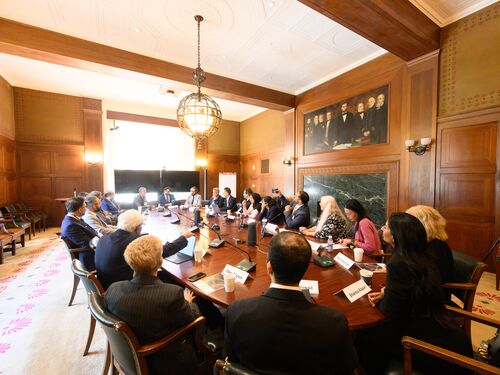
Shepherd moderated a webinar hosted by the National Academies that examined the extreme events that are becoming more frequent as the climate changes, and discussed how the nation can better prepare for them.
Currently, heat islands, extreme rain, and power outages are overwhelming the capacity of communities, explained Craig Fugate, former administrator of FEMA. “The infrastructure wasn’t built for it, our response systems weren’t built for it, and the communities themselves are not resilient against these impacts.”
And communities in vulnerable locations are being hit repeatedly by these events. “They are impacting the same people over and over and over again, and we really need to do what we can to get out of that cycle of recovery,” said Melissa Aho, policy director and chief resilience officer for the Washington State Department of Natural Resources.
Doing what we’ve always done is another sign of insanity in a changing environment.
How can the nation become more resilient in the face of this new normal? By developing stronger building codes, better land-use planning, and building infrastructure for the future rather than the past, Fugate explained. More fundamentally, he said, cities and towns must be willing to do things differently rather than just reacting to each disaster.
“Doing what we’ve always done is another sign of insanity in a changing environment,” said Fugate.
Plan for the unexpected
After Hurricane Katrina in 2005, cities started developing plans for hurricanes that often assumed five to six days of warning to prepare, said Fugate; they wrote out how long it would take them to do certain activities, and then hoped the storm would fit that timeline. But that doesn’t work with storms that intensify rapidly and unexpectedly.
“We’ve got to flip this around and start looking at our plans and be more adaptive and flexible to what is happening, and don’t try to make events fit our plans,” said Fugate; instead, planning needs to be a dynamic process that can be adjusted.
One of the biggest problems is that our physical infrastructure isn’t built for extreme rainfalls, which are increasing in frequency and not limited to the tropics or the coasts, said Fugate. And floods don’t just happen in the special flood risk areas identified on maps used by the National Flood Insurance Program.
“Too many people think that if they don’t live in a flood zone, they don’t have a flood risk,” he said. “If we want to build resilience today for climate, the best and fastest thing to do is to get people to buy flood insurance who don’t live in the special risk area, but who have a flood risk that is increasing.”
There’s also a need to accelerate planning and preparation, said Aho. “The need we have in front of us is much greater than the pace at which we are currently addressing it.”
Focus on people rather than property
Noting that about 40% of Americans don’t have $400 in case of an emergency, Aho stressed the need to improve people’s resiliency against an array of hazards — without necessarily being able to predict what the next hazard will be: “How do we strengthen the ability to bounce back from anything?”
Work especially needs to be done to build the resilience of communities that have been left more vulnerable by the effects of structural racism and other biases, she explained. “Working with front-line communities, listening to front-line communities and folks who are disproportionately affected, going to where they are at, and being able to provide resources — like cash and other resources — so that they can address their needs, is where we need to continue to go,” she said.
For a long time, federal investments to build resilience and protect infrastructure have focused on property more than people, said Fugate. Cost-benefit analyses have often led FEMA to focus mitigation work in affluent areas, because protecting those locations yields the greatest dollar return on investment.
But that’s starting to shift, and FEMA is looking at how to avoid impacts on communities, said Fugate.
“That’s going to be critical because … whether it’s extreme heat, flooding, or other climate extreme weather, the most vulnerable populations are generally the poorer populations with the least resources,” he said. “And that’s what we need to change [about where] we make our investments — looking at people, not just at stuff.”
Revamp risk communication
Scientists and forecasters also need to find better ways to convey information about emerging extremes to people, the speakers pointed out. “These are events that are increasing in frequency, but if you look at actual experiences, very few people have gone through this,” said Fugate.
That means retiring archaic terms like “100-year flood” and “500-year flood,” which can mistakenly imply that another such flood won’t happen again for hundreds of years, said Fugate; it also means doing a better job of describing risk and potential impacts in terms that are concrete.
“We don’t do a good job of communicating risk,” he said. “We don’t put it in terms of: What does this mean to me and my family? What does it mean to my business?”
“We need to localize and personalize and almost tell a story, so people understand the context of the risk and what it means to them: Is this a storm where I’m going to get wet, or is this a storm that’s life-threatening [and] I could drown?” Fugate said.
Shepherd agreed that discussions about climate change need to move from abstractions to stories with tangible meaning. “We’ve got to bring this to the kitchen-table issues that matter to Americans — and bring the conversation down out of graphs and trend lines and polar bears.”
Watch the webinar or register for the next Climate Conversations webinar on Oct. 21, which will explore how to track and verify greenhouse gas emissions.