National Academies Announce 2023 Recipients of Eric and Wendy Schmidt Awards for Excellence in Science Communications
News Release
By Olivia Hamilton
Last update November 2, 2023
WASHINGTON — The National Academies of Sciences, Engineering, and Medicine announced today this year’s recipients of the Eric and Wendy Schmidt Awards for Excellence in Science Communications, given by the National Academies in partnership with Schmidt Futures. These prestigious awards recognize science journalists, research scientists, and science communicators who have developed creative, original work to communicate issues and advances in science, engineering, and medicine to the general public.
A total of 24 awards, split among eight categories, were announced — nine awards for science communication by research scientists, nine awards for science journalists, and six awards for science communicators. In each of the categories, one $40,000 top prize and two $20,000 awards were given, totaling $640,000.
The winners will be honored during an invitation-only workshop and recognition event on Jan. 11 and 12, 2024, in Washington, D.C.
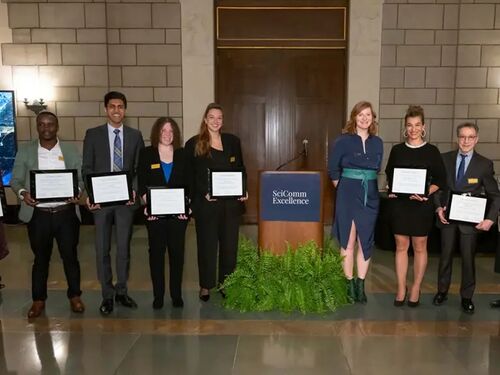
“On behalf of the members of the awards committee and jury, I extend heartfelt congratulations to this year’s winners. They are bringing passion, skill, and insight to telling stories about the science, medicine, and engineering that affect our lives, connecting these areas to humanity, society, the arts, the planet, and beyond,” said Leah H. Jamieson, selection committee chair and Ransburg Distinguished Professor of Electrical and Computer Engineering and Dean Emerita of Engineering at Purdue University. “We are delighted that the recognition of these 24 winners will help advance careers in science communication while informing the public about fields that play such important roles in people’s lives.”
“The ability to capture the complex, ever-evolving nature of science accurately and compellingly is truly a gift — one that all of our winners clearly possess,” said National Academy of Sciences President Marcia McNutt. “Their works convey to the public just how beautiful, inspiring, and exciting the sciences can be. I am thrilled to be recognizing their considerable talents with these awards.”
“The scientists, communicators, and journalists honored in the second year of these awards can take the most complex of subjects — race and genetics, climate anxiety, the nature of infinity, AI blood disease detectors — and transform them into accessible, understandable stories,” said Wendy Schmidt, co-founder of Schmidt Futures and president and co-founder of the Schmidt Family Foundation and Schmidt Ocean Institute. “Their words are a light that cuts through the fog of jargon and disinformation, guiding us to a clearer and more profound understanding of our world.”
Chosen by the selection committee from nearly 500 entries for works published or aired in 2022, the recipients are:
Science Journalist: Freelance
Top Prize Winner:
Andrea Obaid Carrión for
“Kitchen Lab (Cocina Lab)”(Neurona Group)
“Chilenautas” (Neurona Group)
Obaid Carrion harnesses the knowledge of Chile’s scientists and taps into cultural avenues to make complex science accessible and delicious. Her enthusiasm for demystifying science with an approach that will engage and interest large audiences is rare and should be applauded. Obaid’s unique voice has an incredible impact, elevating how science intertwines with life in Chile.
Winners:
Charles Piller
Vaishnavi Chandrashekhar
Science Journalist: Early Career
Top Prize Winner:
Simar Bajaj, Harvard University, for
“Pig to human heart transplants are the future. Are we ready for it?” (The Guardian)
“A New, Transparent AI Tool May Help Detect Blood Poisoning” (Undark)
“Most People at Risk for Lung Cancer Never Get Screened: Here’s How to Fix That” (Scientific American)
Bajaj is an exceptionally talented and prolific writer who does an incredible job of centering the human story in his work. He delivers solid science with elan and wide-ranging references to history, and once started, his work is impossible to put down. A truly outstanding early-career journalist.
Winners:
Jordana Cepelewicz, Quanta Magazine
Sofia Quaglia
Science Journalist: Community Coverage
Top Prize Winner:
Yvette Cabrera, The Center for Public Integrity, for
“Ghosts of Polluters Past” (Grist)
“Toxic Churn” (Grist)
Cabrera impresses with her dedication to following the scientific evidence that demonstrates how one community has been impacted for generations, and their concerns ignored. Her work exhibits strong reporting as well as her ability to build community and trust. Cabrera’s investigations are high-impact, well-executed, and engagingly communicated.
Winners:
Fredrick Mugira
Tristan Baurick, The Times-Picayune
Research Scientist: Graduate Student
Top Prize Winner:
James Dingley, Massachusetts Institute of Technology, for
“Restoring the Sound of Notre Dame” (Atomic Frontier)
Dingley’s short-form science communication video is an expertly produced, highly engaging educational product narrated by Dingley himself. He does a beautiful job of explaining the science behind technical topics in an accessible way by mixing history, chemistry, and engineering with allusions to stories told in popular culture. Dingley’s work is an excellent example of the roles that science and engineering can play in the arts.
Winners:
Katrina Miller, University of Chicago
Sumeet Kulkarni, University of Mississippi
Research Scientist: Early Career
Top Prize Winner:
Britt Wray, Department of Psychiatry and Behavioral Sciences at Stanford Medicine, for
Generation Dread: Finding Purpose in an Age of Climate Crisis (Knopf Canada)
Don’t Look Up - the first climate psych film? (Gen Dread)
The Climate Baby Dilemma (90th Parallel Productions)
Wray possesses a remarkable knack for crafting communication that connects with diverse audiences, and her works have the power to speak to all generations about how personal and global the climate crisis is. Wray’s work not only informs but also engages and resonates, making her a standout communicator capable of navigating the intricate web of science communication with finesse and impact.
Winners:
Ben Rein, Stanford University
Sanjay Mishra, Brown University and Rhode Island Hospital
Research Scientist: Later Career
Top Prize Winner:
Steven Strogatz, Cornell University, for
“How Infinite Series Reveal the Unity of Mathematics” (Quanta Magazine)
“Why Is Inflammation a Dangerous Necessity?” (Quanta Magazine)
“Infinite Hotel” (Netflix)
Strogatz’s skill in making complex topics relatable and engaging is truly commendable, and his contributions serve as a beacon in the realm of making mathematics accessible and fascinating to a wider public. He reveals, with superb quality, the wonder and depth of math, managing to be both entertaining and thought-provoking for a wide range of audiences.
Winners:
Neil Lewis Jr., Cornell University
Saad Bhamla, Georgia Institute of Technology
Science Communicator: Independent
Top Prize Winner:
Janina Jeff for
“R&B Rhythm and Blackness” (In Those Genes Podcast)
“Blackletes” (In Those Genes Podcast)
“Baby Got Black” (In Those Genes Podcast)
Through her meticulous research and articulate storytelling, Jeff dismantles misconceptions, offering a powerful narrative that underscores the urgency of confronting and eradicating racial prejudice, as well as furthering research in genetics and life sciences. Absolutely brilliant.
Winners:
Elijah Yetter-Bowman, Ethereal Films
Xavier Cortada, University of Miami
Science Communicator: Organizational
Top Prize Winner:
Sarah Goodwin, Science Communication Lab, for
“Fire Among Giants” (Science Communication Lab)
“Tshaka Cunningham: Finding Faith in Science” (Science Communication Lab)
“The CRISPR Apostle: Rodolphe Barrangou” (Science Communication Lab)
Goodwin’s approach to science communication — storytelling centered mostly around scientists telling the stories of their work — is direct, authentic, and powerful. Her videos demonstrate excellent quality and tackle intriguing and lesser-discussed aspects of the scientific endeavor, adding depth and diversity to the science communication landscape.
Winners:
Calvin Mackie, Center for the Innovative Training of Youth d/b/a STEM Global Action (SGA)
Kristan Uhlenbrock, The Institute for Science & Policy at the Denver Museum of Nature & Science
The National Academies’ Eric and Wendy Schmidt Awards for Excellence in Science Communications were created to increase the quality of science communication by recognizing outstanding science communication among research scientists, early-career science journalists, and science communicators and creating opportunities for science journalists to make connections and pursue stories at the national, regional, and local levels. For more information on the awards and the work of this year’s recipients, please visit https://www.nationalacademies.org/awards/excellence-in-communication.
Follow program updates by signing up for our newsletter and join the conversation on:
The National Academies of Sciences, Engineering, and Medicine are private, nonprofit institutions that provide independent, objective analysis and advice to the nation to solve complex problems and inform public policy decisions related to science, engineering, and medicine. The National Academies operate under an 1863 congressional charter to the National Academy of Sciences, signed by President Lincoln.
Founded by Eric and Wendy Schmidt, Schmidt Futures is a philanthropic initiative that finds and connects talented people across fields, generations, and geographies to harness their collective skills for public benefit.
Contact:
Olivia Hamilton
Communications Specialist
National Academies’ Office of News and Public Information
202-334-3953; e-mail ohamilton@nas.edu
More like this


Events
Right Now & Next Up
Stay in the loop with can’t-miss sessions, live events, and activities happening over the next two days.
TRB Annual Meeting | January 11 - 15, 2026
January 11 - 15, 2026 | The TRB Annual Meeting brings together thousands of transportation professionals worldwide for sessions across all modes and sectors.