Gulf Futures Challenge Winners Offer Bold Solutions for Offshore and Resilience Challenges
Program News
By Maeghan Klinker and Kenza Sidi-Ali-Cherif
Last update April 23, 2026
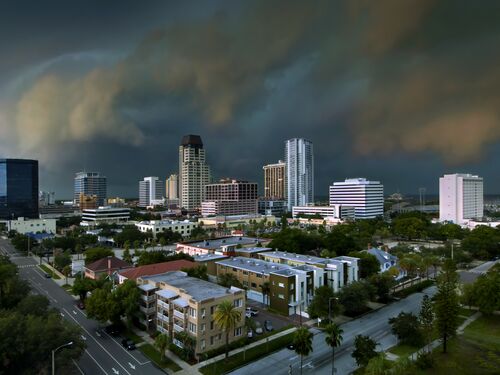
Storm Clouds Over St. Petersburg, Florida
In 2024, the Gulf Research Program (GRP) of the National Academies asked the people of the U.S. Gulf Coast to envision bold science-based ideas to create safer and more resilient communities where people in the Gulf region can live, work, and thrive. Through its Gulf Futures Challenge, the GRP aimed to leverage the inherent talent and knowledge of the people of the Gulf by supporting ideas and solutions from those who understand the region best.
The open competition received 165 compelling proposals from innovators in all five Gulf Coast states — Texas, Louisiana, Mississippi, Alabama, and Florida — and more than 100 reviewers directly evaluated science‑driven ideas that addressed real problems facing their communities.
This week, the Louisiana Public Health Institute and the Gulf Offshore Research Institute were announced as the challenge’s winning finalists, with each receiving $20 million dollars to implement their proposals.
Creating Gulf Learning Resilience Hubs
Health is the foundation of resilience — without it, people and communities cannot recover or thrive. The Gulf Coast faces a growing crisis: increasingly frequent disasters are disrupting health care when it is needed most. Hurricanes, flooding, and extreme heat increasingly strain an aging electrical grid, leaving communities without power, clean water, or access to essential medical care. Recent research has shown that this lack of access results in indirect deaths that far exceed the deaths officially attributed to a disaster.
The Louisiana Public Health Institute (LPHI) — a nationally recognized innovator with over 25 years of experience in health systems redesign, data and research infrastructure, and disaster recovery — proposed an innovative “Gulf Hub” concept. This effort aims to transform eight Gulf Coast Community Health Centers into Learning Resilience Hubs — energy-independent, climate adaptive health care facilities that remain operational before, during, and after disruptions and disasters.
Community Health Centers (CHCs), which serve as lifelines for over 4 million Gulf Coast residents, are particularly vulnerable to disruptions from extreme weather. When clinical operations are interrupted, patients lose access to primary care, behavioral health support, lifesaving medications, and connections to community resources impacting short- and long-term health outcomes.
By integrating solar and storage technology, robust communications systems, enhanced programming, and flood-resistant infrastructure, LPHI’s Learning Resilience Hubs will ensure uninterrupted health care for Gulf communities.
LPHI will also embed the Gulf Hub Data Network — a regional data warehouse and patient-centered research network — to support care delivery across providers and state lines, provide access to patient health records during times of disaster and evacuation, and generate evidence on disaster resilience in health care. For patients, this means uninterrupted access to medications, primary care and chronic disease management, and behavioral health support even during crises.
LPHI’s vision for the Gulf Hub model is ambitious. Within a decade, they intend to foster an adaptive and future-ready health care ecosystem in which 135 CHCs across Louisiana, Mississippi, Alabama, and Florida are operating as Learning Resilience Hubs.
Not only will Gulf Hubs support the well-being of Gulf Coast residents, but its model can be scaled nationally, informing policy, infrastructure investment, research, and patient-centered clinical practice in disaster-prone regions across the country.
Repurposing Offshore Petroleum Infrastructure
Offshore oil and gas platforms have long been part of the Gulf Coast’s economy, workforce, and marine environment. As many of these platforms reach the end of their operational lives, the region faces a growing challenge: how to manage aging offshore infrastructure while also considering environmental impacts, economic transitions, and future uses of offshore space.
Removing offshore platforms can be costly and may eliminate marine habitat, research access, and opportunities for emerging offshore industries. These challenges highlight the need for new approaches that consider environmental, economic, and community outcomes together.
The Gulf Offshore Research Institute (GORI) — a nonprofit organization focused on developing innovative uses for offshore infrastructure to support research, economic development, and environmental stewardship in the Gulf region — will implement an ambitious proposal to repurpose aging offshore platforms into multi-use offshore hubs. These hubs will support environmental stewardship, economic diversification, and workforce development across the Gulf region.
GORI’s concept focuses on adapting existing offshore platforms for new uses such as habitat conservation, aquaculture, ocean monitoring, renewable energy, and critical mineral research. The project includes demonstration sites that would test how platforms could be reused for different purposes depending on their location, ecological value, and structural condition. In addition to research and pilot projects, the effort includes workforce training programs, public data access, and partnerships with educators, industry, and coastal communities to support new offshore industries and workforce pathways.
Technical components of the project include several applied research areas:
Habitat monitoring: baseline ecological surveys and ongoing monitoring to document species composition, biomass, and habitat complexity before and after any retrofit activities.
Energy demonstrations: pilot projects testing combinations of solar, wave, wind, geothermal, or hydrogen systems to support on-site operations and to evaluate integration and cost-effectiveness.
Ocean observation: deployment of sensor arrays and data systems to collect oceanographic and meteorological information for research and management uses.
Aquaculture pilots: modular systems for cultivating selected marine species, with attention to environmental interactions, feed sources, and regulatory requirements.
Mineral recovery trials: small-scale tests of seawater extraction techniques for elements such as lithium and cobalt to assess technical feasibility and environmental impacts.
By exploring how legacy offshore infrastructure can be repurposed rather than removed entirely, GORI’s work could help the Gulf region transition existing infrastructure into long-term regional assets. The project aims to provide models, data, and lessons learned that could inform future decisions about offshore infrastructure, economic development, and environmental management across the Gulf Coast.