Why Chemistry Might Be Our Best Clue to Life on Other Planets

Program News

Space, Security and Conflicts

By Mike Janicke and Nancy Huddleston

Last update June 25, 2025
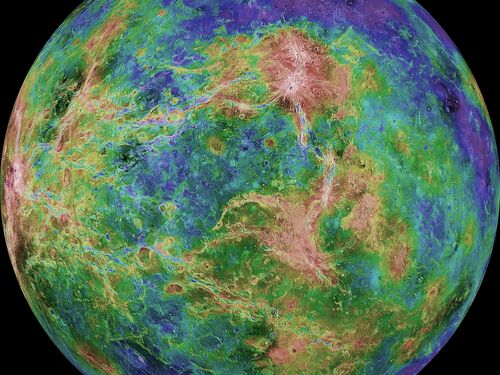
Hemispheric View of Venus Centered at 270° East Longitude. The view of Venus, after more than a decade of radar investigations culminating in the 1990-1994 NASA's Magellan mission, is centered at 270 degrees east longitude.

Image Courtesy: NASA/JPL/USGS

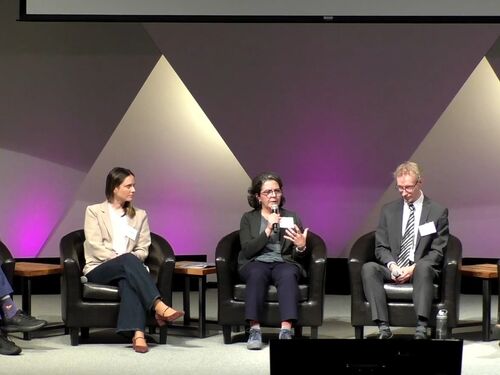
If you were able to catch the last webinar from our Chemical Sciences Roundtable, “Chemistry in 2050– Space” you know that it was out of this world, literally and figuratively.  The webinar explored the many ways chemistry can be applied to understand the universe, including to help answer the elusive question of whether or not life exists on other planets.  A panel of luminaries in their fields was moderated by Dr. Edward Ashton, an expert in advancing Magnetic Resonance Imaging for cancer treatment and the author of Mickey7, a science fiction novel about 3D printing workers in space that is the basis for the recently released feature film Mickey 17. 

Participants discussed several common themes throughout the event: the importance of extreme environments in shaping chemistry, the limitations of our Earth-centric perspective when searching for life, the critical need for better laboratory data to interpret astronomical observations, and the potential for biology to adapt to and thrive in space conditions.

The event began with Dr. Jenny Bergner, an astrochemist at UC Berkeley, who studies the effects on chemical processes of extreme conditions of space—temperatures as low as 10 Kelvin and pressures 13 orders of magnitude below Earth's atmosphere. Combining laboratory simulations with telescope observations, particularly from the James Webb Space Telescope, Dr. Bergner studies how volatiles like water and carbon-bearing compounds are incorporated into forming planets.

Bergner emphasized the critical need for more lab-based astrochemistry to interpret astronomical data properly. "All of the rules of chemistry are the same, but the outcomes can be really different because the physical conditions are so different,” she said.

Building on this foundation, Dr. Jason Dworkin from NASA Goddard described his work analyzing meteorites and asteroid samples—what he calls "witnesses" to the early solar system. The OSIRIS-REx mission's samples from asteroid Bennu have revealed evidence of alkaline brines and observation of 14 of the 20 amino acids and all of the DNA and RNA nucleobases, suggesting connections to prebiotic chemistry. Dworkin explained how these pristine samples help scientists understand the chemical pathways that could lead to life, bridging astronomical observations with potential biological origins.

Dr. Sara Seager of MIT then shifted the focus to detecting life on exoplanets, pointing out that we are the first generation in human history trying to do that. Her work involves the use of transit spectroscopy to detect gases in exoplanet atmospheres that could be signs of life. Seager talked about her research in detecting phosphine in Venus's clouds.  Phosphine can be a biosignature on Earth that is produced by microbial life in oxygen-deprived environments. She noted that her work has been controversial, however, with questions still open as to whether the observed signal might have been from sulfur dioxide instead of phosphine, or that the phosphine might have been produced by non-biological sources.  Dr. Seager’s more recent research has focused on biochemistry in sulfuric acid environments, challenging our assumptions about where life might exist.

Finally, Dr. Jennifer Talley from the Air Force Office of Scientific Research discussed the practical applications of space bioscience. She explores how polyextremophiles and synthetic biology might enable future technologies in space, from biomanufacturing to life support systems. Talley emphasized the challenges of the "design-build-test-learn" cycle in space environments and the need to understand how biological homeostasis functions beyond Earth.

The panelists also identified research gaps, particularly in funding simple but essential experiments that provide fundamental constants and parameters, and the need for more nimble mission approaches.


The Chemical Sciences Roundtable (CSR) explores cutting-edge topics to inform and advance the fields of chemistry and chemical engineering by bringing together experts from government, industry, non-profits, and academia in workshops, webinars, and other activities. Themes for this year’s CSR webinars and workshops focus on what chemistry will look like in 2050 and the challenges along the way.
Panelists

Moderator - Edward Ashton, Senior Director of Medical and Scientific Affairs, ICON plc   Edward Ashton serves as Senior Director for Medical and Scientific Affairs for ICON plc, a global clinical research organization, where he leads the company’s efforts in oncology drug development. In this role, he has directed the conduct of more than 450 human clinical trials over the past twenty-five years. He holds a doctorate in Electrical Engineering with a specialization in medical imaging. His primary research interest is in magnetic resonance imaging. In particular, he has been a leader in the use of dynamic contrast-enhanced MRI as a tool for characterizing the tumor microenvironment, and of magnetic resonance elastography for the in vivo assessment of liver fibrosis. He is also the author of six published novels, most prominently including Mickey7, which is the basis for the recently released feature film Mickey 17, directed by Bong Joon-ho (Parasite, Snowpiercer) and starring Robert Pattinson, Naomi Ackie, and Mark Ruffalo. His short fiction has appeared in venues ranging from the newsletter of an Italian sausage company to Analog, Fireside Fiction, and Escape Pod. You can find him online at edwardashton.com.  
Panelist - Jennifer Bergner, Assistant Professor for the Department of Chemistry, University of California – Berkley   Jenny Bergner is an Assistant Professor in the Department of Chemistry at UC Berkeley, with joint affiliations in the Department of Astronomy and Lawrence Berkeley National Lab.   She is an expert in astrochemistry with a focus on understanding how the composition and potential habitability of nascent planets are influenced by the chemistry at play during their formation.  In recent years, she has been recognized with the Annie Jump Cannon Award (American Astronomical Society) the Chevron Chair in Chemistry (UC Berkeley), and a Scialog Fellowship (RCSA).  She completed her PhD at Harvard, followed by a NASA Sagan Postdoctoral fellowship at the University of Chicago.  
Panelist - Jason Dworkin, Senior Scientist for Astrobiology, Solar System Exploration Division Project Scientist, OSIRIS-REx, NASA Goddard Space Flight Center   Jason Dworkin is the Senior Scientist for Astrobiology at NASA Goddard Space Flight Center (GSFC) and the Project Scientist for NASA’s OSIRIS-REx mission. He is the founder and director of the Astrobiology Analytical Laboratory at GSFC which employs modern analytical methods to examine authentic samples of the early solar system as well as laboratory models of ancient environments. He has 40 years of experience in assessing the organic species available for the origin and early evolution of life with a focus is on understanding the extraterrestrial input and origin of organic molecules relevant for life. This objective has been to study increasingly documented and constrained systems, from plausibly early Earth chemistry, chemistry of astrophysically relevant laboratory ices, organic and chiral analysis of meteorites, to analysis of sample returned material and how to protect that material from contamination. He has received numerous awards for his work with OSIRIS-REx and for science leadership at GSFC. He received an A.B. from Occidental College and a Ph.D. from the University of California, San Diego both in biochemistry.  
Panelist - Sara Seager, Class of 1941 Professor of Planetary Science, Professor of Physics, Professor of Aerospace Engineering, Massachusetts Institute of Technology (MIT)   Sara Seager is an astrophysicist and a Professor of Physics, Professor of Aeronautical and Astronautical Engineering, and the Class of 1941 Chair Professor of Planetary Science at the Massachusetts Institute of Technology. She is known for her pioneering research on exoplanets and their atmospheres. Her research has introduced many foundational ideas to the field of exoplanets, planets orbiting stars other than the Sun. She is now at the forefront of the search for the first Earth-like exoplanets and signs of life on them. In addition, she is pursuing exploration of Venus as a habitable world through laboratory experiments of biochemicals in concentrated sulfuric acid. Professor Seager earned her BSc in Math and Physics from the University of Toronto and her PhD in Astronomy from Harvard University. For her research Professor Seager was awarded a MacArthur “genius” grant, the Kavli Prize in Astrophysics, one of Canada’s highest civilian honors, appointment as an Officer of the Order of Canada, membership in the National Academy of Sciences, and has Asteroid 9729 named in her honor. She is the author of, “The Smallest Lights in the Universe: A Memoir”.  
Panelist - Jennifer Talley, Program Officer for Life Sciences in Space, Air Force Office of Scientific Research (AFOSR)   Jennifer L Talley is a Program Officer of Space Biosciences at the Air Force Office of Scientific Research in Arlington, Virginia. As program officer she discovers, shapes, and supports basic research that will benefit the Air Force (AF), Space Force (SF), and more broadly the Department of Defense (DoD). Dr. Talley became an Air Force civilian researcher in 2011. She was a Senior Research Biological Scientist in the Integrated Seekers and Processing Branch, Guidance Division in the AFRL Munitions Directorate at Eglin Air Force Base, Florida. Some of her major awards and decorations include: 2023 Research Excellence Award, 2022 Demonstration Award, 2020 Notable Achievement Award, 2019 Special Act of Service Award, 2018 AFOSR Star Team Member, 2017 Outstanding Mentor Award, and 2017 Windows on the World AFOSR Award. In 2019, she was listed as the co-inventor on U. S. Patent No. 11,703,88 for Bio-Hybrid Odor-Localizing Autonomous Air Vehicle. Prior to her current position, Dr. Talley earned a master’s in strategic studies at Air War College in residence, Grand Strategy Seminar, at Air University, Maxwell AFB, Alabama. Dr. Talley received a PhD in Biology from Case Western Reserve University in 2010 and a BS in Mathematics from the University of Arizona in 2003.  

Staff

Michael Janicke, CSR Director mjanicke@nas.edu.  Darlene Gros, Senior Program Assistant.   Kayanna Wymbs, Research Assistant  
Subscribe to Email from the National Academies
Keep up with all of the activities, publications, and events by subscribing to free updates by email.