Knowing and Learning Mathematics for Teaching: Proceedings of a Workshop (2001)
Chapter: Pre-Workshop Tasks
Pre-Workshop Tasks
Before coming to the Workshop, participants were asked to do two tasks and to bring their thinking to the workshop. The tasks below were developed as part of research conducted at Michigan State University (Ball, 1988; Kennedy, Ball, & McDiarmid, 1993). Participants were asked to consider how they would
|
Figure 1. Homework Tasks Task 1 Let's spend some time thinking about one particular topic that you may work with when you teach, subtraction with regrouping. Look at these questions (52 – 25, 91 – 79, etc.). How would you approach these problems if you were teaching second grade? What would you say pupils need to understand or be able to do before they could start learning subtraction with regrouping? Task 2 Imagine that one of your students comes to class very excited. She tells you that she has figured out a theory that you never told the class. She explains that she has discovered that as the perimeter of a closed figure increases, the area also increases. She shows you this picture to prove what she is doing. |
|
|
|
|
|
How would you respond to this student? |
|

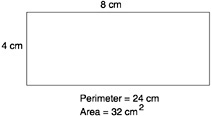
approach the tasks and how they would want elementary teachers to approach them. They were also asked to reflect on the mathematical knowledge, skill, and even sensibilities that their approach would require of a teacher.
Participants were also asked to read material from Chapter 1 and Chapter 4 of Liping Ma's book Knowing and Teaching Elementary Mathematics. Ma used the two tasks above to interview Chinese elementary teachers and then compared the Chinese teachers' responses to those obtained by the Michigan State researchers who had interviewed U.S. teachers. Participants were given the following questions concerning the Ma excerpts.
CHAPTER 1
-
Ma raises the issue of vocabulary and appropriate word choice in teachers' mathematical talk with students. How does this play out in both the teachers' grasp of mathematics and how the students came to understand the mathematical concept?
-
Ma quotes Jerome Bruner (1977) on the notion that the more fundamental the concept, the greater the applications. How is this idea reflected in the different approaches used by the teachers? What does this indicate about the mathematics teachers must know in order to be effective teachers?
-
Ma describes two ways of thinking about knowing a mathematical concept: as a sequence of steps leading to the concept or as a package of knowledge whose elements contribute in different ways and at different points to the knowing. With which of these ways are you most comfortable? Select another topic and try to analyze it from both perspectives.
CHAPTER 4
-
Is there any indication of how attitude towards mathematics affected the teachers' approaches both to the problem and to how they responded to the question?
-
Read the responses of the teachers carefully. Can you categorize the responses according to the level of the teachers' mathematical understanding?
-
Ma writes that only teachers with mathematical inquiry themselves can foster this in their students. Do you agree? How do the teachers interviewed display mathematical inquiry?
REFERENCES
Ball, D. L. ( 1988). Knowledge and reasoning in mathematical pedagogy: Examining what prospective teachers bring to teacher education. Unpublished doctoral dissertation, Michigan State University, East Lansing.
Bruner, J. ( 1977). The process of education. Cambridge, MA: Harvard University Press.
Kennedy, M. M., Ball, D. L., & McDiarmid, G. W. ( 1993). A study package for examining and tracking changes in teachers' knowledge (NCRTL Technical Series 93-1). East Lansing, MI: The National Center for Research on Teacher Education.
Ma, L. ( 1999). Knowing and teaching elementary mathematics: Teachers' understanding of fundamental mathematics in China and the United States. Mahwah, NJ: Lawrence Erlbaum.


