Preparing Our Teachers: Opportunities for Better Reading Instruction (2002)
Chapter: 3. Sounds, Letters, and Words: How Print Works
3
Sounds, Letters, and Words
How Print Works
The 26 letters are the obvious part of reading. But what do those letters represent? Thinking about the letters alone is as odd as thinking about the “2+2” side of an equation and not the “=4” side. Written English is based on an alphabetic principle: Letters “stand for”—symbolize, represent, correspond to—units of spoken language.
The alphabetic principle is not the only possible design base for a writing system, but it is the way that English, Spanish, Vietnamese, Russian, and many other writing systems work. In these systems, letters are associated with small units of sounds called phonemes. The alphabetic principle does not prescribe one unique letter for each unique sound though. There are plenty of cases in English of words with spellings we can complain about. But even as we complain, we take for granted the alphabetic principle and take issue only with the consistency or directness of its use. For English the alphabetic principle is applied with a deep orthography. Orthography means spelling. A deep orthography goes beyond phonemes. The H in GHOST shows that etymology—the history of language structures—is in our orthography. The same letter C for different sounds in MAGIC and MAGICIAN demonstrates the effect of morphology—the forms and different categories of words.
The alphabetic principle raises questions about the form and structure of language. Teachers need ample opportunity to study them. Otherwise, they are handicapped as they try to teach children in three of the areas of competence that are essential for learning to read an alphabetic system:
-
Phonemic awareness. Beginners notice that a spoken word has parts that are unrelated to its meaning—just sounds that can be separated and combined, ready to be represented by letters in written words.
-
Phonics. Readers use systematic correspondences between letters in written words and sounds in spoken words. Phonics drives the search of the crowded storehouse of memory to locate words that readers have met before. Phonics provides the material for readers to construct pronunciations of written words they never before met.
-
Fluency. Fluent readers coordinate word identification and comprehension, achieving their purposes for reading, having put processes and strategies on “automatic pilot.”
|
THE and THEN Billy had an urge to read to Sandy Doan, the intern teacher. He wanted to show off how much he had learned, and he knew he could ask for help now and then. When Sandy helped, she applied what she knew about phonics and about Billy. She started at the beginning of the word and went left to right and blended, so that Billy could put the parts together and recognize the word. When the book had patterns that hadn’t been the focus of lessons yet, Sandy was quick to fill in, but she made sure to let Billy’s new learning shine through whenever it could be applied. Sandy knew that Billy had just finished studying a unit focusing on short e with words like BET, MEN, and LED. The reading was going fine until they came to the word THEN. Two lines above Billy had read HEN with no hesitation. Sandy’s plan was to start with TH, providing the sound herself if there was any hesitation but making sure to give Billy the floor for the rest of the word. She covered up the end of word, and together they pronounced a sound for the first two letters. Then she uncovered the vowel, and Billy took over and read confidently to the end of the word. “THUN,” Billy said, beginning like THE but ending like SUN. “THUN?” Sandy asked, confused as her plan went awry. “TH, THE, THUN,” Billy paused between the successively larger parts. “What’s that?” As soon as she heard Billy say THE, Sandy saw the trap she had fallen into. There was a bulletin board in the classroom with a short list of words. It was labeled “Instant Words.” The class would go over the list, and the children and teacher would chant, “What do we do about instant words? We know them; we see them; we say them.” The word THE was at the top of the list. And, no doubt, here were exactly the same letters in the word THEN! Sandy learned from this. It was crucial for her to help Billy apply both sorts of word identification strategies—instant words and phonics patterns like short e. As a teacher she would have to be ready for “traps” that could come up when it looked like both strategies could apply. Right now she said, “Oh, Billy, that’s another instant word. It’s THEN.” Billy read it out and sailed on to the rest of the sentence. Later Sandy had a lot of thinking and talking to do with her mentor teacher so that she could be prepared to avoid or handle other problems like this. Was there something in the teacher’s manual about it? Maybe there was an article somewhere. Maybe it was just something to learn from Billy! |
These three big ideas call for a significant time commitment for teachers’ professional preparation, even though they take up a small proportion of the total class time for children. Teachers need broad and deep knowledge about sounds, letters, and words. They must apply that knowledge skillfully in different tasks with different children.
What do effective teachers do with such knowledge? While good materials and good curricula are available and helpful, it takes a well-prepared teacher to find them and enact them for the benefit of each child. Well-prepared teachers know how to examine a textbook to check its completeness. Suppose a phonics program covers final N-T and final N-D consonant blends (as in BENT and BEND) and covers S-T (as in BEST) but leaves out S-D. The well-prepared teacher is not worried about the gap, knowing the omission is not an error but a reflection of the structure of the English language.
Effective teachers take the time to be sure that the materials, learning tasks, and assessments do not trip up individual students or mislead the teacher about a child’s progress and understanding. Suppose a child says that DON and DAWN sound the same, but the book says they are not, or a child treats TOLD, TOLL, and TOE as homophones, just like TOO, TWO, and TO, but the teacher recognizes differences in the endings of the words. A well-prepared teacher knows these are two predictable consequences of the diversity in American English, not necessarily wrong or inattentive responses to phonemic awareness lesson tasks. A teacher must use different sets of words to gauge children’s phonemic awareness. Similarly, a young first grader may consistently read the TR cluster as if it were CH. The well-prepared teacher recognizes a common pattern of spoken-language development and does not confuse it with insufficient application of phonics.
Teachers are the not-to-be-missed link for children’s learning and development. A teacher’s knowledge about the facts of language is a crucial resource. Teacher preparation and professional development must help teachers apply this resource in their day-to-day practice regarding phonemic awareness, phonics, and fluency.
facts about sounds and spoken words
Too few teachers have had a chance to learn the facts about language. What parts does a language have? How do children develop language? What differences are there among languages and even within a single language? Specialized courses about the teaching of reading should rest on a solid bedrock of knowledge about language.
Medical schools expect entering students to know biology; it is a prerequisite. Law schools expect their candidates to know about the history and structure of government.
Schools or departments of education should be able to count on incoming students knowing a good deal about language. Liberal arts and science departments should ensure that service courses teach about the structure of language and the language development of children.
Nowadays, though, it is seldom the case that entering education students are so prepared. So teacher education curricula and professional development plans must take the time and develop the resources to teach the facts of language.
There are several layers of language structure that teachers need to understand. Two are especially important for dealing with sounds and words—morphology and phonology. Neither term is in the common parlance. We begin with morphology. Though an unfamiliar term, it involves familiar concepts.
Morphology and Morphemes
Past tense, plural, root, suffix—these are familiar from foreign-language or writing classes. Such categories are part of the morphology of any language. Morphology is the study of the smallest meaning-bearing units in language. Morphemes are these units—words and meaningful parts of words.
The word FRIENDS has two morphemes: {friend} is the root morpheme and {s} is the plural morpheme in the suffix. In FRIENDLY the suffix changes the class of the word; it turns a noun into an adjective. The prefix in UNFRIENDLY changes the meaning to the opposite. BEFRIENDED uses the root with a prefix that turns it into a verb and a suffix that can signal past tense. UNBEFRIENDED is going too far, but we can push through to a meaning if we absolutely must.
Morphological patterns do not replace phonics patterns; they augment them. Morpheme patterns with high frequency can serve as guides to break words into “chunks.” It is too hard to read very long words letter by letter, left to right. Proficient readers can rely on manageable chunks made of roots and affixes (prefixes or suffixes). Perceiving the chunks in a word eases memory searching for more fluent identification of known words. Morpheme chunking also lets readers build up to words they haven’t seen before. Sometimes the reader recognizes that the chunks add up to a word known from listening or speaking but that is new in the reading vocabulary. Other times the reader learns a completely new word, putting together the morphemes to construct the meaning at the same time that he or she meets the spelling and pronunciation.
There are two types of affixes in morphology that teachers have to be prepared to handle: derivational and inflectional. Derivational morphemes change the meaning of the root (FRIENDLY becomes UNFRIENDLY) or the class of the word (FRIEND, the noun, becomes the verb BEFRIEND). They appear as both suffixes and prefixes in English.
Sometimes the derivational morpheme affects the reading and pronunciation of the root. The last sound in the adjective ELECTRIC changes when {ity} is added for the noun ELECTRICITY but changes in a different way when {ian} makes the noun ELECTRICIAN. Sometimes spelling and pronunciation differences cover up the fact that the same root or affix is working in a pair of words. The root is affected in EVADE/EVASION or CONCLUDE/CONCLUSION. The prefix is affected in IMPERFECT/INDUBITABLE. Morphemes like {in} that originate in Latin are notorious shape shifters, becoming IR in IRREVERENT, IM in IMMATERIAL, and so on.
The inflectional morpheme is the other type of morpheme that teachers need to know about. In English there are only eight inflectional morphemes, but they are used very often. They are all suffixes, and each one works with a particular class of words. Sometimes, the root affects the pronunciation of the suffix. An example is the {s} inflection for plural nouns. This plural suffix is read with the same sound in words like TRICKS and POTS but a different sound in a word like DOGS. The morpheme adjusts to the last sound of the root word.
Teachers should know that children learn many derivational morphemes while they learn to read. Inflectional morphemes, though, children do not need to learn in school. They should learn to use them in reading and writing, but they already have a complete inflectional system when they come to school. They may not know they know it, but they use it and take it for granted. A great deal of research shows that the various dialects of English do not skimp on inflectional morphology. Whatever dialect of English children bring from home, the teacher can rest assured that it works to distinguish between past and present, for instance, and
singular and plural. A home dialect may mark number on a noun or tense on a verb in a different way than happens in the system the teacher takes for granted, but the child (and community) knows and expresses the distinctions.
Teachers need to know enough about English morphology to use it while teaching reading and, if need be, to adapt materials for lessons with the particular students in their classes. They need to know how morphology can work in other languages, especially languages like Spanish with which so many American school children have early experience. Teachers need to be prepared to work effectively with children who find the English morphological patterns so unusual that they stumble over them rather than find them helpful for word identification during reading.
|
THE SCIENCE BEHIND PHONEMES AND PHONOLOGY How do scientists find the phonemes of a language? How do they know a phoneme when they see one? Well, actually, they have to see more than one at a time to see just one. Linguists investigate how phonemes function in a stream and how they contrast in a system. Phonemes function in the words of a language; they function to indicate differences between words. The contrasts among all the phonemes form a system for the language. The word “lit” and the word “let” each have three phonemes—three chances to be different. Cutting the words up into any smaller or larger pieces won’t work in the same way. The first phonemes—/l/ in phonemic notation—are the same in the two words, no matter if they seem a little different to a machine or a speaker of another language. Substituting the first phoneme from “lit” for the one in “let” will not make a different word. The same goes for the third phoneme, /t/. But switch the second phonemes—/l/ and /ε/—and you’ve switched words. This substitution procedure with minimal pairs is a tool for Identifying phonemes. If “lit” and “lip” are the minimal pair, we see that the third phonemes make the difference; if we investigate “lit” and “bit,” the functioning of the first phoneme is highlighted. “I lit the candle” means something quite different from “I bit the candle,” and the phoneme that signals the meaning difference has nothing to do with matches or teeth! Switch one phoneme and switch the whole meaning, even though neither phoneme alone means what the word it is in means! The phoneme makes the difference but doesn’t mean the difference. So what does /l/ mean? A good definition of /l/ is the following: /l/ is not /l/ or /ε/ or /t/ or /b/ or /p/ or /k/ or /n/, /s/, /r/, and so on for all the other phonemes of English. It’s an odd definition but not unique in our experience. Like the definition of “middle child” depends on contrasts among ages of siblings in a family, what a phoneme means is also a matter of contrasts but within the phonology of a language. |
Phonology and Phonemes
Knowing about phonology is important for teachers of beginning readers because the basic units—phonemes—are what letters of the alphabet represent.
Examples are a good way to start thinking about phonemes. The spoken words MOUSE and HOUSE are alike except for the first phoneme. Change the middle phoneme of PEG and it turns into PIG. Leave out the second phoneme in SPAT and it’s SAT. MAID, FADE, and PLAYED rhyme—the same phonemes at the end, no matter the spellings. But PLAID does not have the same middle phoneme as MAID, no matter the spelling, and, of course, they don’t rhyme!
Children learn phonemes coincidentally as they acquire language to negotiate
|
While phonemes have no meaning outside this system of contrasts, we can describe them acoustically, that is, by diagrams of the sound waves they are typically associated with. Without instruments, we can also describe phonemes in terms of the way they are typically made. Called articulatory descriptions, these cover the flow or obstruction of the breath stream through the mouth or nose and the movement or position of the tongue, lips, and vocal cords. Take “bit” as an example: With /b/ the two lips clamp together to stop the flow of breath while the vocal cord vibrates—technically, a bilabial voiced stop; With /i/ the front part of the tongue is in a high position, toward the roof of the mouth, without much tension in the tongue muscle and the air stream flows freely—technically, a lax high front vowel; With /t/ the tip of the tongue touches the roof of the mouth behind the teeth to stop the air flow and the vocal cords don’t vibrate—technically, an alveolar voiceless stop. Studies of the phonology of English and other languages are an active area of science. Many questions are still to be resolved. A current example of interest for beginning reading involves entities bigger than phonemes and smaller than syllables, linguists specializing in phonology argue and provide evidence for a three-unit syllable subdivision—onset, nucleus, coda. For the syllable “strict,” /str/ is the onset, /i/ is the nucleus, and /kt/ is the coda. Psychologists and educators sometimes use a two-unit subdivision—onset and rime. /str/ is the onset and /ikt/ the rime. Should linguists move to a two-unit division? Should they keep the three units but add the two units as another layer in phonology? Should psychologists and educators move to a three-unit subdivision? Now is the time to see what precise questions to ask, what evidence to assemble. Tune in to the further exploits of phonologists for the answers—and new phonology questions. |
their way through childhood, getting cookies and hugs, not pulling the dog’s tail, and trying to put off bedtime for a little while longer. People use phonemes without being aware of their existence. People rely on all aspects of phonology without thinking about it.
In fact, native-language phonology gets to be so much a part of us that it can undermine attempts to learn another language. No matter how we try to fix our mouths, those two French words come out the same even though the French teacher tells us they have to be different. We cannot believe our ears when the Spanish teacher tells us that two sounds are alike when they sound so different to us!
And this is the crux of the matter: Ears are not enough. Hearing phonemes involves the phonology of a language, not just human ears. Phonemes are categories—categories that are part of the phonology of a specific language.
In English, PA and SPA have the same /p/ phoneme. A machine measuring movements of the mouth and the breath stream would indicate considerable difference between the first sound of PA and the middle sound of SPA. So would a graph of the resulting sound waves. In another language, like Korean, those kinds of differences are categorized as two different phonemes. But it is just one phoneme in English. The phonology of English differs from the phonology of Korean, or Spanish, or, in fact, all other languages.

The phonology of a language is not just a list of phonemes. Phonology defines categories like vowels and consonants. It defines syllables and permitted patterns of phoneme combinations within a syllable.
In American English, for example, the phonemes /mps/ are permitted to appear together in that order as a consonant cluster. Think about words like CAMPS or JUMPS. But there are not and never will be words or syllables in American English that begin with /mps/ or even with the smaller consonant cluster /mp/. This is a finding from the study of the phonology of American English.
When English “borrows” a word from another language, the word is often adjusted to the phonology of English. If the borrowed word starts with /mp/, we patch it up to fit into our phonological system. We add an unaccented vowel before the /m/ or between the /m/ and the /p/. There is a poet from Malawi whose name is difficult for English speakers to pronounce: Edison Mpina. Listen for the

patch you use to handle the cluster forbidden in American English! We may borrow, but we keep our interest in English phonology!
People who speak English as a second language often show systematic traces of the phonology of their native language. A grandmother talking about a FILM says what sounds like FILL ‘EM to her granddaughter. Nana’s first-language phonology does not allow /lm/ consonant clusters. Similarly, SPECIAL becomes ESPECIAL for those whose first-language phonology forbids initial /sp/ clusters. The patching strategies that bring other phonologies into accents for American English are like those that occur when words are borrowed into English from other phonologies.
Teachers need to be ready for the individual differences in language development they will find in their classrooms. They should be able to recognize ordinary developmental pacing and to notice language- or speech-related problems that should be referred to a specialist. By age 6, most children speak and understand the essence of the phonological system used in their community. Of course, some aspects are consolidated earlier than others. For example, for quite a few kindergarten children, the word JOKE is pronounced like DOKE, but within the next year the initial sound of JOKE becomes a reliable part of their language production.
A final important set of facts for teachers to know about phonology is how it reflects the language diversity in the United States. Each teacher should know the features of the dialect she or he speaks. All teachers should also know about
|
ENGLISH IN THE UNITED STATES—NO KING OR KING’S ENGLISH Some Americans say the following pairs of words are pronounced the same:
Some of us agree on one pair but disagree about another. Who’s correct? There’s no way to tell. We do not have a national language academy. When the words in any of these pairs are claimed to be the same, two phonemes have been merged. Some of these mergers have been spreading in the United States for more than 100 years; others are recent. Mergers can be unconditional—applying to all words that have the phoneme at issue—or they can be limited to words with certain phonology or morphology patterns, or even limited to an exceptional word or two. Like other aspects of language change and variation, a merger can be found in some regions of the country and not others, in cities and not in the countryside, or vice versa. A merger can be more evident among women or among men, more widespread among one age group than another. “Chain shifts” are another way that English dialects show diversity in the United States. The following is a contemporary vowel shift in cities from Syracuse to Chicago:
Besides differences in the inventory of phonemes, languages and dialects have different conditions for syllable structures. English allows “closed” syllables. BEE is open and BEET, ending with a consonant, is closed. But there is variety here, too. |
the varieties of English and other languages spoken in the communities they work in and about the influence of contact with other languages spoken in the community as well.
Language differences are inevitable over time. While literature, film, and drama alert us to the difference between Shakespearean English and our everyday language, we seldom notice that the phonology of American English from the year
|
In the northern United States, JIMMY expects that the first syllable of his name is JIM, a closed syllable, while the second syllable, my, is open. If he goes South, he hears his name with an accent—It’s JI (open) and MY (also open). He may perceive the accent as charming or annoying, but it’s just a part of life in a diverse country. English permits clusters of two or three consonants at the end of syllables, like at the end of test. Final consonant clusters are often simplified—one consonant is deleted. The deletion occurs more in some dialects of English than in others, and the conditions under which consonants are deleted differ from dialect to dialect. Both phonology and morphology get involved. If the final consonant signals a past tense (a morphology matter), the process of simplification is inhibited in African American vernacular English. Compare what happens with TEST and MESSED. Remember, for many of us they rhyme—despite the spelling, they have the same three last phonemes. But MESSED has the verb plus a past tense verb morpheme at the end, while TEST is just one morpheme for the whole word. In the African American vernacular English dialect, the one morpheme TEST is much more likely to be simplified—pronounced without the final /t/—than is the two-morpheme word MESSED. So this pair of words would not be a good example of a rhyme! Some people decry the diversity of American English as evidence of decay; others romanticize any differences. Sociolinguists actively study the diversity in English in the United States and know it shouldn’t be oversimplified in either direction. Current research addresses a range of issues: Who are the harbingers of change? How does it spread? When is diversity evidence of change in progress? What aspects of language are ripe for diversity or change? Which are universal aspects of diversity and change and which are specific to a certain language or society? They ask, too, how ways to teach reading and prepare teachers can best be informed by results from sociolinguistic studies. For detailed information on language diversity in the United States see Atlas of North American English: Phonetics, Phonology and Sound Change, by W.Labov, S.Ash, and C.Boberg (New York: Mouton de Gruyter, 2002). |
1800 was different than the phonology of 2000. There is even evidence of differences between generations. Geography and society matter, too, in language diversity—the region of the country, urban or rural roots, ethnic background, gender, and class relations. In places where two languages have coexisted over time, like English and Spanish in the Southwest, dialects of both languages reflect the language contact—even for people who speak only one of the languages.
penetrating words—phonemic awareness
To speak or understand a language we depend on phonemes, but we do not need phonemic awareness to speak or understand. Children in kindergarten and beginning first grade are proficient at speaking and listening; they know how to use phonemes. But they may not know about what they know.
As we learn to read an alphabetic writing system we become aware of the sounds inside words enough to talk and think about them. For beginning readers and writers there is a crucial “ah-hah” experience—the recognition that each letter in a written word can be related to a part of a spoken word. But suppose the beginner is not aware that there are little parts, phonemes, in spoken words. Suppose, that is, that the beginner is not phonemically aware?
Before age 5 or so, children typically do not have a way to talk about phonemes or to acknowledge their existence in any other way—to recognize or produce them on purpose, for instance. In a discussion about the sounds in the word CAT, they can contribute lively comments about meows and purrs, but they’ll be mystified if the conversation focuses on sounds of consonants and a vowel in a certain sequence.
Separating the word from its referent is not an easy task for very young children; they do not delve into the phonemes that make up the spoken word. Children are attentive to syllable structure at a young age, before they are sensitive to the boundaries between words and phonemes. To observe this, just ask preschoolers or young kindergarten children to repeat lines from the Pledge of Allegiance. In the last line, some children will say “liver tea” for the word “liberty” in the original. The children preserve the structure of the syllables, but the words and phonemes are not as salient. It should not surprise the teacher that very young children are better at counting syllables than they are at counting words or phonemes.
Phonemic awareness and reading are mutually reinforcing. It’s not a one-way street. So why not save everyone’s time and effort by focusing on reading and letting phonemic awareness take care of itself?
There are several reasons to spend teacher preparation time on phonemic awareness. Each is based on evidence from numerous research programs. First, children who display phonemic awareness are more likely to be good readers at a later age. Second, instruction focused on phonemic awareness works well with children who display no initial awareness, even before they have learned to recognize letters reliably. Third, children who become phonemically aware as a result of such programs later perform better while learning to read words than do similar children who have not participated in phonemic awareness instruction.
What is it that a phonemically aware person knows? He or she knows that spoken language has a form—a spoken word can be broken into parts. He or she
|
They Simply Didn’t Understand What Was Being Asked Ruth Nathan, Ph.D., third-grade teacher, Rancho Romero Elementary School, Alamo, California 
I got my first teaching credential in my mid-20s. I got a job in Des Moines, Iowa, teaching upper elementary. I had a number of children, even back then, who couldn’t read, didn’t have a clue. And I didn’t have a clue how to teach them. I had a full undergraduate teaching credential but no decent course to teach reading. I took time off to raise my children. Later, I went for a master’s degree in reading. Now I am a third-grade classroom teacher, and I teach graduate classes at a nearby university. First-grade and kindergarten teachers need to understand phonemic awareness, but most of them don’t. They don’t understand that kids need to move from the meaning of words to the idea that words are sounds that can be broken into different parts. I never fully understood this myself until I was asked to lead in-service training of teachers. I knew a lot about the alphabetic principle and the importance of teaching phonics, but I never totally understood phonemic awareness. So with a few colleagues, I put myself back in a graduate school mode. We met, read, visited kindergarten classrooms, and did research ourselves, until we got it. We learned how to do diagnostic phonemic awareness tests and went out and assessed kids. Then the lightbulb went off. I realized why some kids don’t understand phonics. It’s because when their teachers were instructing them, the students weren’t phonemically aware. They didn’t know how to take a word and break it up into sounds. It wasn’t necessarily because they couldn’t do it, but they simply didn’t understand what was being asked of them. I learned that phonemic awareness could be taught, and ordinary classroom teachers can teach it. And then kids can rely on it to know what they are supposed to do in phonics lessons. |
knows that a language has relatively few sounds that are recycled, rearranged, for use in many different words. Take CAP, HAT, and CAT. Five of the phonemes of English reappear among the nine phonemes that make up these words. Knowing that ordering matters is another part of phonemic awareness. SPOT is not the same as POTS even though the words use the same phoneme segments.
In sum, phonemically aware people know not only their language but also about their language. Metalinguistic is the general term for this kind of knowledge. It is really quite a trick. Humans do a great deal that they are unable to describe or otherwise display awareness about. If you try to say explicitly what you do to go up a flight of stairs, you can see the problem!
What tasks show whether someone is phonemically aware or not? There are essentially three basic types of activities. The first two have to do with the phonemes in a single syllable. Synthesis activities start with parts and make a whole. A sample task is: “Given the phonemes /m/, /ε/, and /n/, blend them to pronounce a word.” The answer is men. Analytic activities do the opposite. A sample task is: “Given the word men, report how many phonemes it has.” Three is the answer.
The third kind of phonemic awareness activity has to do with the phonemes in the system of the language, not in one syllable or word at a time. Identity activities locate phonemes that are the same but that occur in different words and in different places within words. A rather tricky identity task follows: Take the eight words MET, NEW, MINE, TOM, NEAT, TEND, PAN, SMALL. Sort them into two sets, one set of words that uses the phoneme /m/ and the other with /n/. The answer is one set with four words and one with five words. Notice that MINE works in both sets—the first phoneme is identified as /m/ and the last phoneme as /n/.
What Does Writing Have to Do with Phonemic Awareness?
Very young children’s writing attempts are often more like drawing or decoration, so phonemic awareness is not relevant. When scribbles and letter-like forms enter the picture and especially when recognizable letters appear, awareness of phonemes gets to be virtually inevitable. In writing there are opportunities for all three types of phonemic awareness activities—analysis, synthesis, and identity. The child analyzes the sounds in a message in order to choose letters to represent it in writing. When the young author reads back the message, there is an opportunity
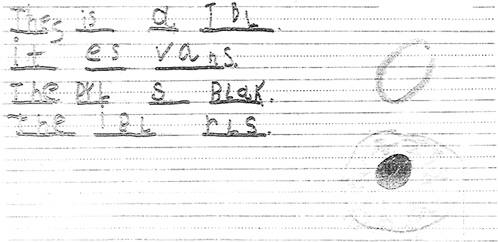
In kindergarten Nate wrote a four-sentence story about a favorite toy. He could read the story to his teacher after he wrote it and even a week later. “This is a eyeball. It has veins. The pupil is black. The eyeball rolls.”

Nate kept writing and reading back, branching out into narrative fantasies: “I sa a Algadr and He smild At Me and we wat nito the wdr,” read back as “I saw a alligator and he smiled at me and we went into the water.”
for synthesis. Phoneme identity comes into play as a young author looks to models or written words to choose letters for a sound or word.
A child’s first spellings are full of interesting problem solving. As the child provides estimated spellings, the alert teacher can observe and, when appropriate, assist the child’s attempts to attend to all the phonemic segments in a word. Typically, beginners use letters to represent only the beginning sound of a syllable. They may combine the lone letter with scribbles or lines indicating the relative length of the word.
In time, children try to represent all the sounds in all the syllables of a word. They estimate which letter to use when. They often notice a similarity between a sound in the word they want to write and the sound of the letter name. Nate, for example, spells VEIN with an A as the vowel in the middle. Once a child begins to spell conventionally, using models from spelling lessons and reading experience, memory searches and spelling principles overshadow problem solving.
Teachers must be prepared to amplify children’s early writing attempts. They can offer tools and advice to spotlight phonemic awareness as children are writing on their own or to dictation. In one dictation practice, sometimes called “writing for sounds,” the teacher stretches out the sounds in each word, enunciating in an exaggerated way, modeling part of the analytic work on phonemes that she is promoting among the children.
Some have expressed fear that children who estimate spellings in early writing will later fail to learn conventional spellings. There is no evidence to substantiate that fear.
The best spellers among us still estimate spellings each and every time they look up a word to see how it is spelled. They have to estimate the spelling of a word—using hints from phonemic analysis and conventional spelling in tandem—to find it in the dictionary! Of course, we defer to the dictionary’s conventional spelling and abandon our estimation. Not only is it the graceful thing to do, it’s practical if we want our writing to communicate to others!

Hannah writes (and later reads back): My parents love me no matter what. They give me presents on my birthday and on Christmas day.
Countering myths
Phonemic awareness instruction is newly popular, and some widely circulated information and assumptions are erroneous. During their professional development, teachers should be put on guard about myths, such as the following:
-
Myth 1: Phonological awareness and phonemic awareness are the same thing. No, some manipulations of the sounds of language are not phonemic awareness tasks. A child may be asked to segment sentences into words, or words into
-
syllables, or syllables into onsets and rhymes. These are phonological awareness activities. They may be useful as an introduction for phonemic awareness tasks but are not themselves at the phoneme level, the level that matters for the alphabetic principle.
-
Myth 2: Auditory discrimination is the same as phonemic awareness. No, phonemic awareness tasks must maintain a metalinguistic element. Say a child recognizes that the third word is different in the set BIT, BIT, BEAT. This is not a display of phonemic awareness. Perceiving the difference is a part of linguistic, not metalinguistic, knowledge.
-
Myth 3: Phonemic awareness curricula teach children the phonemes of a language. No, children begin acquiring the phonemes of their native language in infancy and essentially have finished by kindergarten. Phonemic awareness activities do not replace programs for children learning English as a second language or programs that address hearing problems or speech and language delays or disorders.
-
Myth 4: All the phonemes of the language must be covered in a phonemic awareness curriculum. No, there is no need to cover all the phonemes of a language. Good effects have been achieved with programs that use just a few consonants and vowels that can be combined to make many syllables and words. No specific set of phonemes has been shown to be crucial for complete instruction. More and more time on phonemic awareness activities does not produce better and better results.
-
Myth 5: All children need the same instruction in phonemic awareness. No, research has not shown that there is a single best task or type of phonemic awareness activity. Nor has it shown that a particular sequence of phonemic awareness tasks is required. In any given kindergarten or first grade, some students will be well beyond the need for any phonemic awareness experiences and will make the best progress by getting on with their reading. Other children in the same class may not be able to respond to the phonemic awareness tasks without special preparation covering one-to-one identity or sorting tasks.
-
Myth 6: Phonemic awareness tasks involve only oral language, never letters. No, while the focus is on the spoken word, there are ways to make phonemic awareness tasks more concrete. Children can manipulate tokens, like blocks or tiles, while they synthesize, analyze, or identify phonemes in spoken words. Letters need not be avoided in phonemic awareness instruction. In fact, research has shown that it is helpful to use tiles with letters that correspond to one or more of the phonemes in the task.
corresponding with letters—phonics
Proficient readers may not be aware of all the ins and outs of the phonics connecting letters and sounds for reading English. They may not be able to talk about phonics patterns, but their actions show their proficiency. A reader uses phonics:
-
to quickly and accurately search memory to identify words met in print before;
-
to figure out a pronunciation for a never-before-seen printed word and to search for its identity among words known through speaking and listening; and
-
to identify the sounds that go with a printed word and begin learning it as a new word through reading.
Phonics has a long history in the lore of teaching reading and teacher preparation. Every teacher of the early grades knows something about it, so we emphasize the “news.” The key word in contemporary discussions of phonics is systematic.
A good way to understand what systematic phonics means is through a simple word like CAP. Think about the following part of the system that includes CAP. CAP is an example of a word pattern that comes early and often in books for beginners: the consonant+short vowel+consonant pattern. But you do not really know CAP unless you know that CAPE does not have the sound of CAP in it. CAPE is an example of another equally important pattern for beginners: long vowel+consonant+e. Sometimes this is called the “silent e” pattern. In some longer words the letters of CAP appear with a different vowel sound. Systematic patterns in multisyllable words allow us to predict the “lazy” vowel (schwa) in the unaccented syllable in ESCAPADE as well as another appearance of the long vowel in the first open syllable of CAPABLE.
Consider just the first segment of CAP. What does a C say? Or, better to ask, what does a C say at different times? Compare the C in CAP and PACK and with the T in TAP and PAT. The T works pretty much the same way at the start or the end of the word, but the C takes a K along to say its sound at word’s end. In ACCURATE, two C’s do the work (like the two T’s in ATTITUDE). In CEMENT and CIGAR, the C says something else, sounding like an S often does. Words in a set like the one with CUT and KIT bring up the other consonant, K, that says the same thing C does in CAP. And sometimes they overlap and give us homonyms—CANE, KANE—though the second is a proper noun. In CHICKEN and CHOOSE, C is part of a consonant digraph and has yet a third sound, but beware of the CH in words from Greek like CHORUS because that gets back to the sound in CAP. And what if we add the IAN suffix to magic? The C sound is like SH.
No wonder we refer to the alphabet as the ABC’s and stop at the C! The letter C provides a good idea of the complex but systematic phonics a proficient reader relies on for reading English.
What do children learn to become proficient? It’s like the modern business method of just-in-time inventory. Children need to learn just enough to be able to start self-teaching for word identification. Everyone knows that school cannot teach children each and every word they need for reading—close to 100,000 for success in the elementary grades! School cannot possibly cover even the 500 or so patterns of letter-sound correspondence. Luckily, there is good evidence that self-teaching of phonics takes over once children have a good start. School must give children a chance to work successfully on some of the letter-sound patterns. School must give them a chance to practice applying the patterns they learn and a chance to practice self-teaching—finding, learning, and using new patterns.
Curricula vary about how phonics patterns are introduced and used. Synthetic methods begin with a focus on a letter (or letters) that represent a single phoneme and blend them into words or syllables. Analytic approaches begin with words and segment them into smaller letter-sound correspondence units. And there are mixed approaches that go from part to whole to part again. There are also programs that consider slightly larger units. They rely on patterns of onset and rime segments or groupings of words in word families. CAP yields C as onset and AP as rime. Substituting other onsets like T, L, and S produces TAP, LAP, and SAP for a word family. Consonant blends can be added—TR and STR for TRAP and STRAP.
Phonics programs of all types recognize that some words that occur very frequently in speech and writing are spelled in unexpected ways and need special treatment. For example, H-A-V-E does not spell a word that rhymes with SAVE, even though many words with A-V-E do rhyme with SAVE—like CAVE and PAVE. Note, too, the beginning of WHO does not sound at all like the beginning of WHAT despite the same first two letters. Frequently used words that are oddly spelled are learned as whole words, not analyzed or synthesized. They are often called “sight” or “instant” words.
Of course, the goal is to read all words at a glance, quickly, as if there is no underlying phonics process going on. When a word first enters a child’s reading vocabulary, it betrays the process that was involved in learning it. It may show traces of segmenting and blending at the single-sound level or at the onset-rime level. Or it may show a trace of the analogy from known word families or the way it was memorized as an instant word. If a child is to comprehend and read for a variety of purposes, he or she must become an “instant reader” of just about everything so that meaning can be the main event.
The need for teacher expertise about phonics is great. On the one hand, phonics programs on their own are not enough. There is no evidence that there is a single

best phonics program that can be used off the shelf. There is no evidence about which letter-sound correspondence patterns must be included, which are the best methods of using them for word identification, or which sequence of instruction steps should be followed. A variety of approaches have produced good results, but if there are required ingredients, research has not yet found them.
On the other hand, incidental and occasional phonics instruction is not enough to prevent reading difficulties and start children out right. Most children profit from more than a mention of phonics patterns or occasional use of methods for identifying letter-sound correspondences to identify words. It’s not enough for a teacher to be a good reader who occasionally shares her expertise at processing words as the occasions arise. There’s too much in the system of letter-sound correspondences and it is too complex. There’s little chance of finding all the crucial examples, of improvising explanations, and of providing sufficient practice on the spot.
It is up to teachers to choose and use good materials and the best-possible curriculum. Even if the teacher has a great program that worked beautifully for the children in last year’s class, the teacher is responsible for ensuring that it or something else works to suit each child in this year’s class. Teachers’ knowledge of phonics underlies their ability to enact the curriculum under changing day-to-day conditions, to monitor its effectiveness, and to augment or repair it where needed. In-depth teacher knowledge is required to support children’s practice with applying the knowledge of phonics patterns and strategies on materials outside the reading lesson. The informed teacher provides the safety net as children become self-teaching and venture into challenging materials. The teacher’s deep knowledge of phonics
guides his or her choice of materials and methods of assistance as the children attempt to apply the phonics in their reading for different purposes.
A well-prepared teacher’s knowledge base includes the research about how children approach reading and word identification, even before there is any formal instruction. In order to support children’s success in the most efficient ways, teachers must see how their plans, lessons, and observations are affected by the stages and phases that children go through on their way to full proficiency. Teachers must also have a good grasp of the content of phonics—the common letter-sound correspondences and the patterns found in multisyllabic words. Finally, teachers need to keep abreast of the research and practice about effective methods for teaching letter recognition and about the synthetic, analytic, or mixed approaches to teaching word identification. To keep up with the news and to make the best choices for their students, teachers need to know terms and techniques for a variety of approaches to phonics, even though they need not (and probably should not) use them all during any one instructional year. They must know about and be able to coordinate with the school-, district-, or state-mandated curriculum and materials.
fast, easy, complete reading—fluency
Fluent readers assemble the reading process in full. They identify letters, sounds, and words. They understand. They are quick, accurate, automatic. They read with intonation and tempo that suit the meaning. Among other things, fluent readers:
-
emphasize meaningful contrasts with the number word in “SUSAN HAS TWO BROTHERS AND JENNY HAS THREE BROTHERS.” For “SUSAN HAS TWO BROTHERS AND JENNY HAS TWO SISTERS,” they emphasize the family relation contrast.
-
end on a higher pitch for “DID YOU OPEN IT?” and “YOU OPENED IT?” There is a chill if they read “DID YOU OPEN IT?” with a falling intonation—a hint of blame or accusation. But fluent readers end the intonation pattern lower for “WHY DID YOU OPEN IT?” unless the meaning includes clarification or rhetorical effect: “WHY DID YOU OPEN IT? BECAUSE YOU ARE JUST LIKE PANDORA!”
-
make use of the comma to pause and to make sense of “TO PATRICK, HENRY WAS A HERO.”
The text helps or hinders fluency. Some material provokes fluency problems. Doubters should read a technical article for a profession they have not studied. There can be false starts, frequent stops, mispronunciations, and a need to reread almost every sentence and paragraph to understand the material. The more we read the same or related material, the more fluently we read.
A beginner might find that just about all texts present a fluency problem. Teachers need to know how to move a halting reader toward fluency. Fluency is the worry when we say, “Chris read each word correctly, but it seemed like she had no idea about the meaning,” or “Alejandro sounded out almost every word. It was so slow and disjointed that no one could possibly remember what the first part was by the time he finished.” On the other hand, “Hoang reads with expression” is a way to say Hoang seems fluent.
To increase fluency for students like Chris and Alejandro, more is the answer—more reading, that is. Practice makes, if not perfect, at least better. We have known that for a long time. But it will not help if a child is practicing the struggle, practicing the failure to coordinate word identification and comprehension. The reading practice that brings fluency has to be of the right type. To arrange the right type of practice, the teacher should be able to draw on a knowledge base from ongoing research about features of reading materials and activities relevant to fluency practice.
The well-prepared teacher knows how to find the right materials for different children and how to pass on to children the art of choosing good reading materials that provide good practice for fluency. There must be a fit between the reader and the book or passage. The fit takes into account interest and ease, familiarity and challenge, the known and what can be learned next. Is there enough but not too much demand from the vocabulary, letter-sound patterns, sentence structures? Is there help or hindrance from the use of idioms and figurative language, the reliance on inferences, the narrative or expository structure? Are there supports for chunking the text into meaningful parts—punctuation, headings, features of the typeface?
In addition, the well-prepared teacher knows how to make more difficult materials more accessible. The teacher clears hurdles likely to be encountered in a passage or chapter with minilessons on concepts, vocabulary, and text structure and reminders about patterns of letter-sound correspondence and punctuation. The well-prepared teacher arranges assisted readings, with taped or live readers, so the child follows along or echoes phrase by phrase or takes turns listening and reading with a partner. The assistant provides a model and a scaffold for fluent reading.
The teacher can arrange repeated readings so that problems with letters, words, or comprehension can be worked out gradually. Rereading can be made acceptable, even exciting, to the student practicing toward fluency. When the child reaches fluency on a passage, the child performs it—a presentation to parents, a poem for a nursing home audience, at story time for preschoolers, maybe an audio- or video-tape to be made for a library of passages for use by any of the above. The performance allows for assessment of fluency, too, if the teacher sets criteria to indicate adequate speed, accuracy, and comprehension as well as an assessment of suitable emphasis and tempo.
Practice for fluency can take advantage of time beyond that allotted for reading lessons. The well-prepared teacher knows how to arrange for independent reading of materials that fit the different children and how to ensure that the practice actually happens as expected. The teacher can arrange for help from parents and the community in the process of independent, assisted, and repeated reading.
|
MAKING FLUENCY CENTRAL IN SECOND GRADE A report on fluency by the Center for Improvement of Early Reading Achievement includes the following description of a second-grade curriculum that is a hothouse where children’s fluency can blossom. Fourteen teachers and 105 children participated in the successful experiment. (See Stahl, Huebach, and Crammond, in press, for details.) The redesigned basal reading lesson used the story from the children’s second-grade reading text. This text would be difficult for children reading below grade level. With the support provided by the program, however, children who entered second grade with some basic reading ability could profit from a conventional second-grade text. The teacher began by reading the story aloud to the class and discussing it. This discussion put comprehension in the foreground, so that children were aware that they were reading for meaning. Following this, the teachers reviewed key vocabulary, designed comprehension exercises, and performed other activities around the story itself. Sometimes this involved echo reading, or having the teacher read part of the story and the class or group echo it back. Other times, it involved having children read and practice part of the story. Then the story was sent home and read with the child’s parents or other readers listening. For children who struggled, the story was sent home additional times during the week. Children who did not have difficulty with the story did other reading at home on these days. The next day, the children reread the story with a partner. One partner would read a page while the other would monitor the reading. Then they would switch roles until the story was finished. Following partner reading, the teacher would do some extension activities and move onto another story. Although this lesson was an important part of the program, it was not the only reading that children did. Later in the day, time was set aside for children to read books that they chose. These were usually easy to read and read for enjoyment. Children sometimes read with partners during this period, as well. This time ranged from 15 minutes in the beginning of the school year to 30 minutes by the end. Also, children were required, as part of their homework, to read at home. Outside reading was monitored through reading logs, and teachers made sure that the children in this program read at home an average of four days a week for at least 15 minutes per day. SOURCE: M.R.Kuhn & S.A.Stahl. 2000. Fluency: A Review of Developmental and Remedial Practices. Ann Arbor: University of Michigan, Center for the Improvement of Early Reading Achievement. |
Sample Activities for Teacher Learning
Teacher Refresher About Phonemes
Moving Away from Spellings
This activity starts with familiar issues of spelling and sound similarities progressing to phonemes. It can bring teachers with disparate backgrounds to a common ground for subsequent work on phonemic awareness. The activity covers several sessions; there should be an instructor well versed in reading and phonology who can supply information and extra help as well as facilitate discussion and group work. Even teachers who have had little exposure to phonemes and such terminology can begin with the activities in steps 1 and 2. The discussion in step 3 may reveal the need for extra help between group meetings so that all can participate fully in the homework and the next class.
-
The whole group discusses the terms homonym, homophone, and homograph. Focus on homophones—words that are pronounced alike regardless of spelling—and homographs—words that are spelled alike regardless of how they are pronounced.
-
Divide into small groups of five or so that will also be convenient for homework groups later. For 15 minutes, small groups make lists of as many homophone and homograph pairs as they can, underlining the crucial similarity or difference in each word.
-
Reassemble in a large group. Pool the results, making a list of pairs for homophones on the blackboard or an overhead projector. Pool the results for homographs making a second list of pairs.
Focus the whole-group discussion on the underlined parts of the words in the lists. Discuss the small units of similarity or difference in terms of phonemes. Assist the teachers to review the phonology they learned in prerequisite courses about language structure. Write a phonemic symbol for the sound that is the same in each word of the homophone pairs and the two phonemic symbols for the sounds that are different in the homograph pairs. If members of the class are familiar with different phonemic symbol systems, build consensus to rely on one notation acceptable to the group as a whole.
-
For homework each group will work on syllable frames. Consonants (C) and vowels (V) in sequence make the frames. To use a frame, vary one item, keeping the rest constant. List as many words as possible that are examples of each frame.
|
|
CVC—varying V, producing, for example, BIT, BEAT, for the frame where /b/ is the first constant and /t/ is the second constant; |
|
|
CV—varying V, producing, for example, BE, BY, where /b/ is the constant; |
|
|
C(C)VC(C)—varying Cs before and after V, so where /ε/ is the constant, SET—also SLED and TESTS since using clusters of as many Cs as possible is part of the frame. |

-
After discussing the frames and lists to be produced, each small group meets briefly to choose the constants to be used in each frame and to plan homework coordination. Before leaving, each group registers the constants with the instructor—no duplicates among the groups.
-
The next class meeting starts in small groups for half an hour. Each group is asked to answer the following questions, proving the answers by referring to the word lists made for homework:
|
|
Are there phonemes of English that can occur in only closed (CVC) syllables or only open (CV) syllables? |
|
|
How many phonemes can there be in initial and final consonant clusters? |
|
|
Are there any dialect differences in the class? Include evidence from words that are judged to have the same phonemes by some in the group but not everyone. |
-
Reconvening as a whole group, the class pools results, checking the accuracy of the answers with respect to all the lists generated by all the groups. It may well be necessary to place conditions on generalizations due to the results from one of the frames or from dialect differences found in one of the groups. Disputes or deeper queries should be recorded and submitted to a local linguist for a response that will be distributed to the group.
Practicing Phonemic Awareness
This activity allows teachers to think about, experience, and create phonemic awareness activities. The activity covers multiple meetings. Articles and teachers’ manuals or children’s texts should be available for reference or to take home for further work. In many instances, groups that come together to learn will have different degrees and kinds of background knowledge about phonemes, so the first step is to establish common ground. This activity starts with the “interference” that good spellers have when they try to think about phonemes.
-
Background preparation in a whole-group session, recalling phonology classes:
|
|
Discuss words that have a different number of letters and phonemes. Write AX on the board, noting that it has two letters, three phonemes. Check to see if there is any dialect difference in the group—the most common pronunciation is likely to be /æ k s/—but there may be different pronunciations of the vowel. But the numbers of letters and phonemes are the same. Elicit more examples of words that have fewer letters than phonemes. Elicit examples of words that have fewer phonemes than letters, like MEAN (compare the different spelling for the same vowel sound in ME). |
|
|
Write ASK on the board next to AX. Discuss pairs of words that have the same phonemes in different orders. Expect reports of dialects in which ASK and AX are homonyms, with both pronounced /æ k s/. Elicit more examples of words that have the same phonemes in different orders. |
|
|
Establish common meaning for terms the group uses when talking about phonemes and spellings (e.g., digraph, diphthong, clusters, blends, long, short, tense/lax, nasal, affricate, open syllable). |
-
Introduce phonemic awareness activities in a whole-group session.
|
|
Begin with phonemic manipulation. Encourage cooperation and avoid putting people on the spot. The instructor should help |
|
|
liberally at the start to ensure correct answers and to shift more responsibility to the class as the game progresses. Play until the class seems adept at the phoneme manipulations. |
|
|
The game starts with a single-syllable spoken word (e.g., GOLD) and six player moves: |
||
|
|
|
|
|
|
||
|
|
||
|
|
||
|
|
||
|
|
||
|
|
Play as a dice game with the symbols pasted to the sides of a cube that is rolled, or use a wheel to spin with segments labeled for each move. Each player rolls or spins, performs the manipulation that turns up, and passes the new syllable and a turn with the dice or wheel to the next player in the row/circle/aisle. If the dice roll is |
|
|
|
The following is a way to complicate the game to maintain interest among grown-ups: |
|
|
|
If a player gets a syllable that is a not a word in English but just a nonsense syllable, before rolling the dice and following the directions on it, the player announces a choice between continuing the chain or beginning a new chain by supplying a new single-syllable word to manipulate. If the player fails to notice that the syllable is a nonsense word in English, the player loses a turn. |
|
|
|
Discuss the concept of phonemic awareness in light of the manipulations in the game. Recall the caution about confusing phonemes |
|
 delete the first or last phoneme (front GOLD, make OLD or GOAL)
 insert a phoneme at the beginning or the end (from OLD, make SOLD)
 change the order of phonemes (from GOAL, make GLOW),
 insert, delete, or change in the maddle (from SOUL, make STOLE)
 pass to a new person
 start a new chain with a new syllable
 , the player gets a free pass and the right to toss the syllable and the next turn to anyone in the room, even to keep it or pass it to the instructor, thereby starting a new order of players. Sometimes a sequence of deletes can end the game—no more phonemes to manipulate!
|
|
and spellings. Emphasize the difference between proficiency with a language and the metalinguistics involved in phonemic awareness. Comment on any noticeable dialect differences. |
-
In a whole-group session, give definitions and examples for each of the three major types of phonological awareness activities: synthesis, analysis, and identity (p.94). Provide examples of each type of activity. During the discussion, bring up the following:
|
|
Consider the choice of words or syllables to be used in phonemic awareness tasks. For example, prefer consonants that are least likely to be distorted if exaggerated (like /f/ or /s/ or /m/) and long vowels (as in ME) that may be easier to perceive than short vowels (as in MIT). After a good introduction to the task and some proficiency, the other phenomes might be added if phonemic awareness tasks are still needed. |
|
|
Consider the use of manipulatives and visual aids to add a concreate element to the task. Discuss the use or introduction of letters that correspond to phonemes not only as manipulatives or visual aids but also to transfer the application of phonemic manipulations in reading and writing tasks. |
|
|
Consider completeness of coverage. Starting with a focus on initial and final phonemes is all right, but the second elements in consonant clusters and the vowels in closed syllables shouldn’t be ignored. Similarly, while two or three phoneme syllables may be a good starting point, one and four or more phoneme syllables shouldn’t be overlooked. |
|
|
Consider the needs of students. Are there dialect differences that would have an impact on the activity if certain words or phonemes are used? Is there a way to assess whether the activity is not needed at all by some children and perhaps is too difficult for others? |
-
Divide the class into groups of three or four. Each group is to create a phonemic awareness activity and explain to the class the kind of unit it would be a part of. Make sure that some groups focus on synthetic, some on analytic, and some on identity activities. They may browse
-
through available books, articles, teachers’ manuals, and children’s texts for ideas. The groups will make the activity, the material for it, and the plans to implement it. The groups will be prepared to demonstrate the activity to the class and to discuss it in terms of the matters brought up during steps 2 and 3 above.
-
Reconvene for the demonstrations and discussions. Suggest ways to pilot the activity—as improved during the discussion—with groups of children and to assess its feasibility and effectiveness.
Signs in a Different Alphabet
This is a group problem-solving activity that allows teachers and teachers-to-be to work with words written in an unfamiliar alphabet. The exercise can give substance to what the students have learned from reading and lectures as well as a sense of what children experience when entering alphabetic literacy.
Ask students who are literate in Russian to assist with pronunciation and to observe the problem solving.
-
The class meets first as a whole group. Explain to the students that they are going to problem solve and role play. Tell them the purpose of the activity is to have an experience somewhat similar to the complex one children have when they are learning to read. The experience will be followed by a class discussion of the multitasking involved in reading and learning to read. They have an advantage over first graders because they already know what reading is in one language. They have a disadvantage because they have not been surrounded by the Cyrillic alphabet and the Russian language before trying to read the words.
|
|
The problem is hunger. The solution is to identify the sign for a restaurant. |
|
|
The role and the context: The students are tourists in a Russian city—not Moscow or St. Petersburg, a lot less cosmopolitan. Hotels, apartments, shops, restaurants, and various other establishments are in big buildings with facades that have no street-level large windows or other distinguishing marks. But there are signs. |
|
|
Show the signs the students must choose among and leave them on display. |
|
|
|
|
|
The tourists didn’t pay attention to signs over the past few days when they had a bilingual guide. They hadn’t learned to speak, read, or write Russian before the trip. Written Russian is alphabetic, but the letters are different than the ones for English. Some look familiar from English or Greek or math. |

|
|
Each tourist has learned a little Russian and found friendship groups to share problems with. In 5 minutes they’ll start the groups, but first they “cram” some Russian. |
|
|
Pass out small slips of paper, each one with four rows from the chart below. Mix up the rows that are given out so that no one gets the exact same four words. |
|
|
Tell the students you are going to collect the papers in 5 minutes but that they can take notes to the group of friends they will work with. |
|
Words in Russian |
Hints about pronunciation |
English meaning |
|
HET |
nyet |
not or no |
|
HOC |
nos (like ‘most’ without ‘t’) |
nose |
|
|
novwiy |
new |
|
|
ovoshi |
vegetables |
|
CECTPA |
sestra |
sister |
|
CTAPT |
start |
start |
|
|
soop |
soup |
|
|
rekord |
record |
|
|
stewl |
chair |
|
|
chie (rhymes with tie) |
tea |
|
|
sahlaht |
salad |
|
|
sigahrah |
cigar |
|
|
s-shah |
USA |
|
|
bar |
bar |
|
|
sevodnyah |
today |
|
PAKETA |
rocketa |
rocket |
|
|
obed |
meal |


-
Divide the class into groups of five to pool resources (what they learned from the small part of the table each one had) for 30 minutes and solve the problem: Where can they get something to eat? They should talk about how they figured out what the signs said and why they think they
-
are right. Fifteen minutes into the exercise, talk to the groups about cognates—words that sound similar in two languages. Tell them that if they “sound out” the signs they might recognize the similarity to an English word that will help them out.
-
Reconvene as a whole group and give everyone a copy of the full chart above. Reveal the “answers” for each sign:
 (bank), PEMOHT (repair),
  (telephone), PECTOPAH (restaurant),
  (hotel). Have volunteers use their new knowledge of Cyrillic letters and Russian sounds to try pronunciations of each word. Get the “sounding out” fine-tuned by the Russian speakers.
 -
Ask for volunteers explain what answer their groups arrived at and what they did to get there. Weave in the topics in steps 5 through 8 below.
-
Discuss letter knowledge. Some letters in the Cyrillic alphabet look like ones from the Latin alphabet used for English. Consider what knowing a letter name does. Is it easier to identify, remember, refer to, and use for problem solving? Did anyone find less certainty or more errors related to letters unlike the ones in the Latin alphabet? Did anyone rely on features, orientation, and categories from the Latin alphabet to refer to letters they had no names for—
 as perhaps “upside down small h” or
  as “backwards R.” Notice that
  may look like a fancy lowercase b to an English reader, but
  and B are different letters in Russian. Consider youngsters figuring put what is important to notice about letters. It is a big job to remember letter shapes and distinguishing among the 26 used for English.
 -
Discuss letter-sound correspondence. Elicit some specific letter-sound relations: P is for the /r/ sound; C is for /s/; H is for /n/. Show how the correspondence works for the Russian words in the large table. Notice the stability in letter-sound correspondences. An exception in the table is Γ, but from this small set it isn’t clear if there is a systematic pattern or if one of these words is an exception.
The “tourists” know one written language and so realize that it is useful to rely on a sound-symbol correspondence from one word to read the same symbol in another word. Children have to come to that realization.
-
Experienced readers know, too, that it is possible to gain accuracy and speed at letter-sound correspondences and word identification. What if a child thinks it is always going to be so hard, slow, and often filled with uncertainty?
-
Discuss methods for identifying words. Was anyone aware of segmenting and blending in a left-to-right order? Did the letter-by-letter process change for any of the words? Did any bigger chunks come into play? For instance, once CT was pronounced like the beginning of the English cognate START, was it easier and faster to zoom through the rime, getting the vowel, and finding it not so hard to remember that the P in the Cyrillic alphabet is /r/ and then to recognize the final T to confirm the word identification? Did analogy from the English cognate complement the segmenting and blending process? What about the cognate “restaurant”? When a word is known through speaking and listening, the pieces seem to come together more easily more accurately and to be more memorable. Consider the of a child beginning to read who does not know some supposedly easy words from their oral-language experience.
-
Discuss more general problems: Some groups will have had some missing evidence. What was pooled from their little slips of paper might have left out useful patterns shown in the larger table. Relate this to children who miss some days from school or who do not share some common childhood experiences or in some other way have gaps in their resources. Other groups will have gone down garden paths. They may have searched for related meanings to be reflected in the words—but, for instance, MEAL and VEGETABLE were not much help with RESTAURANT. How do you monitor and change directions when your approach isn’t working well enough?
-
Request the class members to write about one or two things they have a new perspective on about teaching children who are learning to read. Post the responses in a class chat room for further consideration.
resources
School studies: This chapter has more detail about the teacher knowledge base than the other chapters because, while there is much publicity about the topics covered, there is insufficient information about them for effective work in teacher preparation. To counteract any idea that we believe this is the only important content, let us note here again that we call for integrated instruction with all the aspects of reading depicted on p. 6 in order to provide the opportunities for children listed on p. 11. The following references show different faces of integrated instruction:
Gambrell, L., Morrow, L.M., Neuman, S.B., & Pressley, M. 1999. Best Practices in Literacy Instruction. New York: Guilford.
Juel, C. 1988. Learning to read and write: A longitudinal study of 54 children from first through fourth grade. Journal of Educational Psychology, 80, 437–447.
Pressley, M., Wharton-McDonald, R., Allington, R., Block, C.C., Morrow, L., Tracey, D., Baker, K., Brooks, G., Cronin, J., Nelson, E., & Woo, D. 2001. A study of effective first-grade literacy instruction. Scientific Studies of Reading, 5(1), 35–58.
Taylor, B.M., Pearson, P.D., Clark, K.F., & Walpole, S. 1999. Effective schools/accomplished teachers. Reading Teacher, 53(2), 156–159.
Basic reviews of the knowledge base relevant to this chapter can be found in the following recent publications:
Kamil, M.L., Mosenthal, P.B., Pearson, P.D., & Barr, R. (Eds.). 2000. Handbook of Reading Research: Volume III. Mahwah, NJ: Erlbaum. (See especially Blachman on phonological awareness, Goswami on phonological and lexical processes, and Templeton and Morris on spelling.)
National Research Council. 1998. Preventing Reading Difficulties in Young Children. Committee on the Prevention of Reading Difficulties in Young Children, C.E.Snow, M.S.Burns, and P.Griffin, Eds. Washington, DC: National Academy Press. (See especially Part I, Chapter 2, Part II, and Part III.)
National Reading Panel. 2000. Teaching Children to Read: An Evidence-Based Assessment of the Scientific Research Literature on Reading and Its Implications for Reading Instruction: Report of the Subgroups. Washington, DC: National Institute of Child Health and Human Development. (See especially Chapter 2, “Alphabetics,” and Chapter 3, “Fluency.”)
Neuman, S.B. & Dickinson, D.K. 2001. Handbook of Early Literacy Research. New York: Guilford Press. (See especially Stahl on phonics and phonological awareness, Goswami on phonological development, Hiebert and Martin on beginning reading texts, Adams on explicit systematic phonics, Richgels on invented spelling, and Tabors and Snow on bilingual children.)
Language, general introductions, suitable for nonspecialists:
Finnegan, E. 1999. Language: Its Structure and Use. New York: Harcourt Brace.
Fromkin, V., & Rodman, R. 1998. An Introduction to Language. New York: Harcourt Brace.
Language, more specialized, useful background for teacher educators:
Akmajian, A., Demers, R.A., Farmer, A.K., & Harnish, R.M. 1995. Linguistics: An Introduction to Language and Communication. Cambridge, MA: The MIT Press.
Pinker, S. 1999. Words and Rules: The Ingredients of Language. New York: Perseus Books.
Language, specifically about teacher preparation:
Fillmore, L.W., & Snow, C.E. 2000. What Teachers Need to Know About Language. Washington, DC: Center for Applied Linguistics.
Moats, L.C. 2000. Speech to Print: Language Essentials for Teachers. Baltimore: Paul H. Brookes. (This textbook is specifically directed toward teacher preparation.)
Child language development:
Berko-Gleason, J., Ed. 1989. The Development of Language. Columbus: Merrill.
Bowerman, M., & Levinson, S.C., Eds. 2001. Language Acquisition and Conceptual Development (Language, Culture and Cognition 3). New York: Cambridge University Press.
Diversity within American English, overviews:
Labov, W., Ash, S., & Boberg, C. 2002. Atlas of North American English: Phonetics, Phonology and Sound Change. New York: Mouton de Gruyter.
Schneider, E.W., Ed. Focus on the USA. Varieties of English Around the World, Vol. 16. Philadelphia: John Benjamins North America.
Diversity within American English, specifically about education:
Wolfram, W., Adger, C.T., & Christian, D. 1999. Dialects in Schools and Communities. Mahwah, NJ: Earlbaum.
Diversity within American English, sample publications about specific varieties:
Leap, W. 1993. American Indian English. Salt Lake City: University of Utah Press.
Mufwene, S., Rickford, J., Bailey, G., & Baugh, J. 1998. African-American English: Structure, History and Use. New York: Routledge.
Phonemic awareness, phonics, and fluency, less technical and in the context of integrated instruction:
Center for the Improvement of Early Reading Achievement. 2001. Put Reading First: The Research Building Blocks for Teaching Children to Read. Washington, DC: National Institute for Literacy.
National Research Council. 1999. Starting Out Right: A Guide to Promoting Children’s Reading Success. Washington, DC: National Academy Press.
Phonemic awareness, phonics, and fluency, sample publications on specific topics:
Adams, M.J., Bereiter, C., Hirshberg, J., Anderson, V., & Bernier, S.A. 1995. Framework for Effective Teaching, Grade 1: Thinking and Learning About Print, Teacher’s Guide, Part A. Chicago: Open Court.
Adams, M.J., Foorman, B.R., Lundberg, I., & Beeler, T. 1997. Phonemic Awareness in Young Children: A Classroom Curriculum. Baltimore: Brookes.
Bissex, G.L. 1980. GYNS AT WRK: A Child Learns to Read and Write. Cambridge, MA: Harvard University Press.
Bradley, L., & Bryant, P. 1985. Rhyme and reason in reading and spelling. International Academy for Research in Learning Disabilities, Monograph Series, 1. Ann Arbor: University of Michigan Press.
Bruck, M., & Treiman, R. 1992. Learning to pronounce words: The limitations of analogies. Reading Research Quarterly, 27, 375–388.
Carlisle, J.F. 1995. Morphological awareness and early reading achievement. Pp 189–209 in L.B.Feldman (Ed.), Morphological Aspects of Language Processing. Hillsdale, NJ: Erlbaum.
Chomsky, C. 1979. Approaching reading through invented spelling. Pp 43–65 in L.B.Resnick and P.A.Weaver (Eds.), Theory and Practice in Early Reading, Vol. 2. Hillsdale, NJ: Erlbaum.
Cisero, C.A., & Royer, J.M. 1995. The development and cross-language transfer of phonological awareness. Contemporary Educational Psychology, 28, 275–303.
Corneau, L., Cormier, P., Grandmaison, E., & Lacroix, D. 1999. A longitudinal study of phonological processing skills in children learning to read in a second language. Journal of Educational Psychology, 91(1), 29–43.
Cunningham, A.E., & Stanovich, K.E. 1997. Early reading acquisition and its relation to reading experience and ability 10 years later. Developmental Psychology, 33, 934–945.
Dahl, K.L., Scharer, P.L., Lawson, L.L., & Grogan, P.R. 1999. Phonics instruction and student achievement in whole language first-grade classrooms. Reading Research Quarterly, 34, 312–341.
Ehri, L. 1992. Reconceptualizing the development of sight word reading and its relationship to receding. Pp. 107–143 in L.E.Gough & R.Treiman (Eds.), Reading Acquisition. Hillsdale, NJ: Erlbaum.
Ehri, L.C. 1995. Phases of development in learning to read words by sight. Journal of Research in Reading, 18, 116–125.
Ehri, L.C., & Soffer, A.G. 1999. Graphophonemic awareness: Development in elementary students. Scientific Studies of Reading, 3, 1–30.
Ericson, L., & Juliebo, M.F. 1998. The Phonological Awareness Handbook for Kindergarten and Primary Teachers. Newark, DE: International Reading Association.
Fashola, O.S., Drum, P.A., & Mayer, R.E. 1996. A cognitive theory of orthographic transitioning: Predictable errors in how Spanish-speaking children spell English words. American Educational Research Journal, 33, 825–843.
Faulkner, H.J., & Levy, B.A. 1999. Fluent and nonfluent forms of transfer in reading: Words and their message. Psychonomic Bulletin & Review, 6(1), 111–116.
Foorman, B., Francis, D.J., Fletcher, J.M., Schatschneider, C., & Mehta, P. 1998. The role of instruction in learning to read: Preventing reading failure in at-risk children. Journal of Educational Psychology, 90, 37–55.
Gaskins, I.W., Ehri, L.C., Cress, C., O’Hara, C., & Donnelly, K. 1996/1997. Procedures for word learning: Making discoveries about words. The Reading Teacher, 50, 312–327.
Goswami, U. 1995. Phonological development and reading by analogy: What is analogy and what is not? Journal of Research in Reading, 18, 139–145.
Goswami, U. 1999. The relationship between phonological awareness and orthographic representation in different orthographies. Pp. 134–156 in M.Harris & G.Hatano, Eds., Learning to Read and Write: A Cross-Linguistic Perspective. Cambridge: Cambridge University Press.
Henderson, E.H. 1981. Learning to Read and Spell: The Child’s Knowledge of Words. DeKalb: Northern Illinois University Press.
Henry, M. 1997. The decoding/spelling continuum: Integrated decoding and spelling instruction from pre-school to early secondary school. Dyslexia, 3, 178–189.
Hudelson, S. 1984. Kan Yu Ret an Rayt en Ingles: Children become literate in a second language. Pp. 462–477 in D.B.Durkin, (Ed.), Language Issues: Readings for Teachers. White Plains: Longman.
Juel, C., & Minden-Cupp, C. 1999. Learning to Read Words: Linguistic Units and Strategies. Ann Arbor: University of Michigan, Center for the Improvement of Early Reading Achievement.
Kuhn, M.R., & Stahl, S.A. 2000. Fluency: A Review of Developmental and Remedial Practices. Ann Arbor: University of Michigan, Center for the Improvement of Early Reading Achievement.
Lundberg, I., Frost, J., & Peterson, O. 1988. Effects of an extensive program for stimulating phonological awareness in preschool children. Reading Research Quarterly, 23, 263–284.
McKenna, M.C. 1998. Electronic texts and the transformation of beginning reading. In D. Reinking, M.C.McKenna, L.D.Labbo, & R.D.Kieffer (Eds.), Handbook of Literacy and Technology: Transformations in a Post-Typographic World. Mahwah, NJ: Erlbaum.
Rashotte, C., & Torgesen, J. 1985. Repeated reading and reading fluency in learning disabled children. Reading Research Quarterly, 20, 180–188.
Rasinski, T.V. 1990. Effects of repeated reading and listening-while-reading on reading fluency. Journal of Educational Research, 83(3), 147–150.
Samuels, S.J. 1979. The method of repeated readings. The Reading Teacher, 32, 403–408.
Share, D. 1995. Phonological receding and self-teaching: Sine qua non of reading acquisition. Cognition, 55, 151–218.
Share, D., & Stanovich, K. 1995. Cognitive processes in early reading development: Accommodating individual differences into a mode of acquisition. Issues in Education: Contributions from Educational Psychology, 1, 1–57.
Stahl, S.A. 1992. Saying the “p” word: Nine guidelines for exemplary phonics instruction. The Reading Teacher, 45, 618–625.
Stahl, S.A., Duffy-Hester, A.M., & Stahl, K.A.D. 1998. Everything you wanted to know about phonics (but were afraid to ask). Reading Research Quarterly, 35, 338–355.
Stahl, S.A., Huebach, K., & Crammond, B. In press. Fluency-based reading instruction. Elementary School Journal.
Stahl, S.A., Suttles, W., & Pagnucco, J.R. 1996. The effects of traditional and process literacy instruction on first graders’ reading and writing achievement and orientation toward reading. Journal of Educational Research, 89, 131–144.
Stanovich, K.E., & West, R.F. 1989. Exposure to print and orthographic processing. Reading Research Quarterly, 24, 402–433.
Tan, A., & Nicholson, T. 1997. Flash cards revisited: Training poor readers to read words faster improves their comprehension of text. Journal of Educational Psychology, 89, 276–288.
Torgesen, J.K., & Hecht, S.A. 1996. Preventing and remediating reading disabilities: Instructional variables that make a difference for special students. In M.F.Graves, P.van den Broek, & B.M.Taylor (Eds.), The First R: Every Child’s Right to Read. New York: Teachers College Press.
Treiman, R. 1985. Onsets and rimes as units of spoken syllables: Evidence from children. Journal of Experimental Child Psychology, 39, 161–181.
Treiman, R., & Baron, J. 1983. Phonemic-analysis training helps children benefit from spelling sound rules. Memory and Cognition, 11, 382–389.
Vandervelden, M.C., & Siegel, L.S. 1995. Phonological receding and phoneme awareness in early literacy: A developmental approach. Reading Research Quarterly, 30, 854–875.
Vandervelden, M.C., & Siegel, L.S. 1997. Teaching phonological processing skills in early literacy: A developmental approach. Learning Disabilities Quarterly, 20, 63–81.
Wagner, R., & Barker, T. 1994. The development of orthographic processing ability. Pp. 243–276 in V.Berninger (Ed.), The Varieties of Orthographic Knowledge I: Theoretical and Developmental Issues. The Netherlands: Kluwer.
Yopp, H.K. 1992. Developing phonemic awareness in young children. The Reading Teacher, 45, 696–703.
Yopp, H.K. 1995. A test for assessing phonemic awareness in young children. The Reading Teacher, 49, 20–29.