Review of the Army's Technical Guides on Assessing and Managing Chemical Hazards to Deployed Personnel (2004)
Chapter: Appendix E Probabilistic Approach to Address Exposure to Multiple Chemicals for Course-of-Action Analysis
Appendix E
Probabilistic Approach to Address Exposure to Multiple Chemicals for Course-of-Action Analysis
The percent P* of a unit expected to be seriously affected (in a mission-hindering way) by acute respiratory exposure(s) to multiple chemicals could be estimated using the following procedure. Such exposures might affect similar toxic end points and/or different toxic end points. This procedure is a generalization of the assumption made in Chapter 4 that, in the case of exposure to a single chemical, P* = F × P where F is the estimated fraction of the unit exposed to that chemical and P is an estimate of the percent of exposed individuals expected to incur serious (mission-incapacitating) illness, modeled as
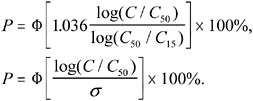
(E-1)
In that equation, Φ is the cumulative normal (Gaussian) probability distribution function; log denotes logarithm (using any specified base, such as 10 or e); C50 and C15 are estimated (e.g., 1-hour) concentrations that elicit a 50% and 15% response, respectively, obtained from a lognormal dose-response curve previously fitted to relevant toxicity data as described in Appendix C (estimates of C50 and C15 are listed for five chemicals in Chapter
4, Table 4-1); and σ is the estimate of the lognormal-model “shape” parameter, the inverse of which specifies the steepness of the corresponding fitted dose-response curve.
The subcommittee wishes to consider the general case in which deployed personnel are exposed to n subsets of chemicals, each ith subset of which contains ni chemicals (for i = 1, … n) that all induce a common (mechanism-specific) toxic end point Ti that is independent from any different Ti—specific mechanisms and from any different end points Tj (for j ≠ i) induced by other chemicals involved in the exposure scenario considered. Typically neither n nor ni will be large (i.e., exceed 2 or 3), but the case of multiple chemicals is treated here in general terms to explain the general approach clearly. The 1-hour respiratory concentration of the jth chemical in the ith subset shall be denoted Ci,j, where j = 1, …, ni and where again i = 1, …, n. Because this general treatment involves double-subscript notation, it will be convenient to adopt the alternative notation µ = C50 for the lognormal location-parameter estimate C50. Thus, for the jth chemical in the ith subset, Equation E-1 can be rewritten as

(E-2)
Different chemicals with similar values of σ as well as similar values of μ for a given end point can be treated as if they were all the same chemical. In the absence of information supporting an alternative assumption, it is reasonable to assume in the context of using the lognormal dose-response model that different chemicals with substantially different values of σ for a given end point act via independent mechanisms. Concentrations Ci,j of different chemicals affecting a common end point Ti, all of which have similar values of σi,j but have substantially different values of µi,j, can reasonably be assumed to represent corresponding weighted contributions to an aggregate effective concentration Ci that acts via a single underlying mechanism to elicit Ti. We now assume that, for all i, the ith set of median-response concentrations µi,j are sorted in order of ascending magnitude for j = 1, …, ni, such that µi,1 always denotes the smallest median-response concentration, which in turn corresponds to that chemical with the highest toxic potency among the ith subset of chemicals. It follows that the relative weight of the jth contribution to Ci is (µi,1/µi,j), and thus that

The incapacitated percent Pi of a unit exposed to the ith subset of chemicals is therefore approximated by

(E-3)
where the function M in the denominator of each bracketed expression denotes the arithmetic mean over j = 1, …, nj with similar values of σi,j conditional on i. A more conservative estimate of Pi is obtained if M is taken to be the maximum or the minimum of σi,j when the numerator of each bracketed expression in Equation E-3 is ≤0 or is >0, respectively.
The probability P of incapacitation via any of the n end points considered is (by “de Morgan’s rule”) equal to the complement of the joint probability that none of these n end points will occur. Because the probability of incapacitation via (mechanism-specific) end point Ti is by definition independent of that via end point Tj for i ≠ j, it follows that this joint probability is just the product of the probabilities (1−Pi ) for i = 1, …, n, and consequently that

(E-4)
where Pi was defined in approximation E-3.
The percentage P* of a unit seriously affected by chemical exposure is finally calculated as P* = P × F, where F is the estimated fraction of the unit exposed to the n subsets of chemicals considered. If each among m mutually exclusive fractions Fk of a unit (for k = 1, …, m) is exposed to a combination of chemical concentrations that together generate a corresponding predicted response percentage P[k] calculated using Equation E-4 (where bracket-subscript notation is used to distinguish this percentage from one defined by Equation E-3), then
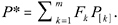
As explained in Chapter 4, the calculated percentage P* directly specifies the unit status as indicated in Chapter 2 (Table 2-4). In this way, P* is used to classify the operational risk management (ORM) risk level defined
in the military risk assessment matrix by comparing the quantity (100% − P*) directly to the unit-strength percentage ranges that define the various risk levels as specified in Appendix C of FM 101-5-1, in TG 230 Table 3-4, and in Chapter 2 (Table 2-4) and Chapter 4 (Table 4-1) of this report.
This default probabilistic risk-modeling approach for multiple chemicals explained above is illustrated in Box E-1.
|
BOX E-1 Example of Probabilistic Approach for Multiple Chemicals It is assumed that a proposed mission would require 40% of a unit be exposed by inhalation for 1 hour to simultaneous ambient concentrations of 25, 4, and 2 ppm of hydrogen sulfide, hydrogen cyanide, and 1,1-dimethylhydrazine, respectively. From Chapter 4 (Table 4-1), corresponding information listed in Appendix C, and the definitions µ= C50 and σ = 0.9648 log (C50/C15), the exposure levels, the lognormal-model parameter estimates µ and σ, and the corresponding “severe” toxic end points for these three chemicals can be summarized as follows:
Severe effects of respiratory exposure to either hydrogen cyanide or hydrogen sulfide include severe and potentially lethal histotoxic hypoxia due to inhibition of cellular oxidative metabolism, and σ? values for these chemicals are both relatively small. In contrast, severe effects of dimethylhydrazine exposure include tremors and vomiting via uncharacterized central nervous system (CNS) interference. This example could be considered to involve n = 2 subsets of chemicals: the first including hydrogen cyanide and hydrogen sulfide (the two chemicals with a similar toxicity mechanism, with σ? ≈ 0.374), and the second including only dimethylhydrazine. Corresponding application of Equation C-2, Equation C-3, and the definition P* = P × F with F = 0.40, in this case 
|
||||||||||||||||||||||||||||||
|
yields which implies that the proposed mission has a unit status of “amber” (mission capable, with minor deficiencies implying a total of 70-85% unit strength) if chemical exposures were considered the only risks to the mission. If in this example toxicity due to hydrogen cyanide and hydrogen sulfide were considered to arise from completely independent mechanisms, then corresponding calculations would yield P1 ≈ 1.2%, P2 ≈ 0% and P3 ≈ 24.7%, implying that P ≈ 25.6% and P* ≈ 10% and consequently, that the mission has a unit status of green (mission capable, with unit strength ≥85%). An additive approximation of aggregate risk due to both hydrogen cyanide and hydrogen sulfide assuming complete independence would be 1.2% + ~0% ≈ 1.2%. Note how much the latter approach underestimates the corresponding aggregate risk (~33%) that was predicted above assuming a common mechanism of action and a (conservatively estimated) common value of σ. Abbreviations: AEGL, acute exposure guideline level; CNS, central nervous; ppm, parts per million. |


