Brave New Universe: Illuminating the Darkest Secrets of the Cosmos (2006)
Chapter: Photos
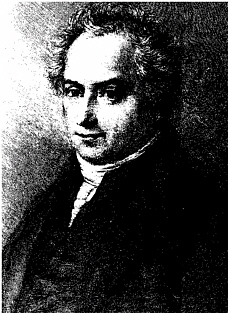
Heinrich Wilhelm Olbers (1758– 1840), originator of what is now known as “Olbers’ paradox,” the problem of why the night sky is so dark given that the universe is full of luminous sources. (Courtesy of the Bakos Observatory collection, University of Waterloo.)

Albert Einstein (1879–1955) was undoubtedly the greatest physicist of the 20th century. In developing the special and general theories of relativity, he updated Newton’s ideas with more comprehensive descriptions of motion and gravitation. He spent his final years trying to develop a unified theory of all natural forces. (Courtesy of the AIP Emilio Segre Visual Archives, W. F. Meggers Collection.)
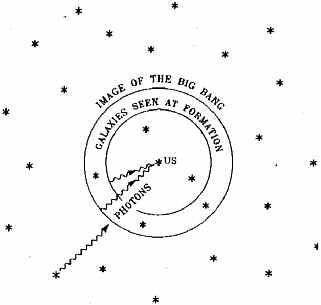
As shown here, the maximum distances traveled by incoming photons carve out spherical imaginary surfaces centered on Earth, distinguished by their time lags. If our telescopes were powerful enough, we could see an image of the universe shortly after the Big Bang itself. Beyond that shell, for an unbounded universe, photons would not have had enough time to reach us. Hence, the light we see in the sky is the sum of a finite set of sources, leading to darkness at night. (Illustration designed by Paul Wesson.)
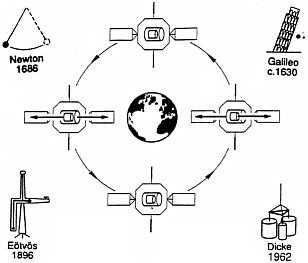
Various attempts to measure the equality of inertial mass and gravitational mass. Displayed counterclockwise are depictions of Galileo’s legendary dropping of two different weights from the Leaning Tower of Pisa, an experiment by Newton involving a simple pendulum and the torsion balances of Eötvös and Dicke. Shown in the center is the design concept for STEP (Satellite Test of the Equivalence Principle), projected for launch into Earth orbit after 2011. Astronomers expect that this spacecraft will be able to measure the equivalence of mass within one part in 1018. (Adapted from and by courtesy of NASA.)
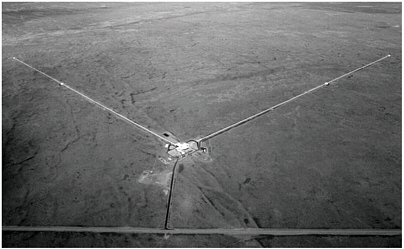
The LIGO (Laser Interferometer Gravitational-Wave Observatory) detector in Hanford, Louisiana, stands guard for gravitational waves reaching Earth, resulting perhaps from cosmic cataclysms. Its two long arms ensure full spatial coverage of incoming signals. A second detector, located in the state of Washington, serves to confirm any disturbances measured by the first (and vice versa). (Courtesy of NASA.)
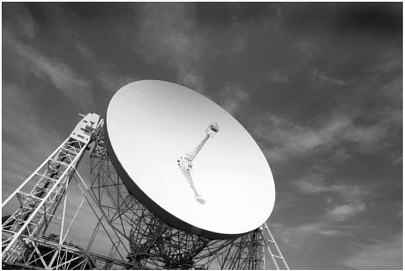
The 250-foot-diameter Lovell Telescope, at Jodrell Bank Observatory in Cheshire, England, is one of the largest radio dishes in the world. Recently, astronomers used the delicate instrument to detect the first-known dark galaxy, VIRGOHI21. (Photograph by Craig Strong, courtesy of the University of Manchester.)
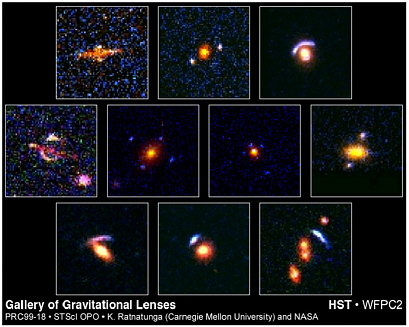
Assorted examples of gravitational lenses: situations in which the gravitational influence of closer objects (such as galaxies) distorts the light from distant bodies (such as quasars). Such distortion is a direct result of the warping of space-time predicted by Einstein’s general theory of relativity. (Courtesy of NASA.)

The distribution of luminous and dark material (illustrated as a faint haze) in the cluster of galaxies CL0025+1654, about 4.5 billion light-years away. Employing the Hubble Space Telescope, astronomers used the gravitational lensing of more distant objects to determine the dark matter’s layout. They found that the distribution of invisible material closely follows that of the visible galaxies in the cluster. (Image by J-P. Kneib et al., Observatoire Midi-Pyrenees and Caltech, courtesy of the ESA and NASA.)

The detector at the Sudbury Neutrino Observatory (SNO) lies more than 2,000 meters (one and one-quarter miles) under Earth’s surface, where it awaits the rare impact of neutrinos from space. Data from this device have been used to ascertain the relative masses of various types of neutrinos and to help assess their relative contribution to the dark matter. (Courtesy of Ernest Orlando, Lawrence Berkeley National Laboratory and the Sudbury Neutrino Observatory Institute.)
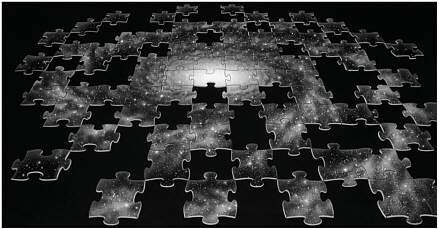
Like this shattered puzzle (“Galaxy Puzzle,” illustrated by Lynette Cook), could the universe be fated to disintegrate? According to the controversial “Big Rip,” scenario, billions of years from now the dark energy of the cosmos will tear its fabric apart. Everything in existence would be decimated—from mammoth galaxies down to tiny atoms. Such a catastrophic ending is but one of many conceivable fates for the universe. Theorists have suggested other possibilities—including a “Big Crunch,” in which the cosmos someday collapses back to a singularity. (Copyright 1996 Lynette Cook, http://extrasolar.spaceart.org, used by permission.)

Cambridge University’s Centre for Mathematical Sciences, with its playful, futuristic architecture, is a haven for scientists contemplating the origin, fate, and structure of the cosmos. (Photograph by Paul Halpern.)
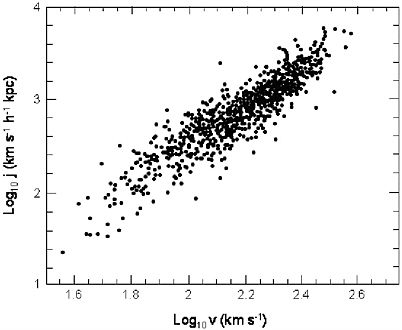
The Tully-Fisher relationship between the angular momentum per unit mass (j) and the spin velocity (v) of a typical spiral galaxy. Plotted on a logarithmic (base 10) scale to encompass the wide range of values, it indicates a slope that lies near one. This suggests a commonality between the ways that spiral galaxies acquired their spins. (Based on data from various sources as interpreted by Paul Wesson.)

The angular momentum (J) and mass (M) of a typical astronomical object are correlated. To cover the large range in these parameters, from planets to the local supercluster, one can use a logarithmic scale as shown. The slope of the correlation depicted here lies between 1.7 and 2.0 and implies that astronomical objects acquired their spins in some similar fashion. (Based on data from various sources as interpreted by Paul Wesson.)
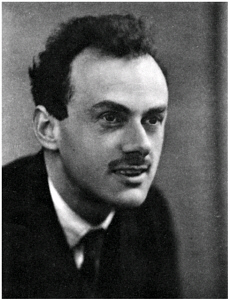
Paul Adrien Maurice Dirac (1902– 1984) was one of the principal developers of quantum physics. His speculative Large Number Hypothesis, relating various parameters in the universe, led to the curious idea that gravity has changed its strength over time. (Photo by A. Bortzells Tryckeri, courtesy of the AIP Emilio Segre Visual Archives.)
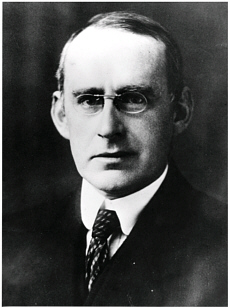
Arthur Eddington (1882–1944), one of the foremost British astronomers, was among the first to understand the implications of general relativity. He organized solar eclipse expeditions to test the theory and contributed greatly to its popularization. In his later years he stirred up controversy with his ideas about the role of human thought in the shaping of physical concepts. (Courtesy of the AIP Emilio Segre Visual Archives, gift of S. Chandrasekhar.)