National Summit on Strategies to Manage Herbicide-Resistant Weeds: Proceedings of a Workshop (2012)
Chapter: The Epidemiology of Herbicide Resistance--Jodie Holt
The Epidemiology of Herbicide Resistance
Jodie Holt
University of California, Riverside
Herbicide resistance is the naturally occurring ability of some plants to survive treatment at a normal field dosage of the herbicide. Resistance is a universal phenomenon among living organisms and has been found in bacteria to antibiotics, fungi to fungicides, insects to insecticides, and plants to herbicides. While resistance to herbicides was discovered later in time than resistance in other pest organisms, the number of cases worldwide is large and continuing to increase. Resistance is a biological phenomenon that results from environmental selection on the genetic diversity of living organisms. Random mutations are common, and resistant genes likely already exist in weed populations. Since genetic traits are inherited from parents, resistant plants will pass the genes for resistance to their offspring. Under selection by the environment, the best adapted plants will leave more offspring; thus, when an herbicide is present in the environment, any plants resistant to that herbicide will be best adapted, survive, and leave more offspring than susceptible plants. After several cycles of selection by the same herbicide, an entire population of weeds can be resistant where formerly there were only susceptible plants. Resistant plants are genetic variants of the same species as susceptible biotypes. This change in traits (genes) of a population of a species over time is evolution, which can occur over very short time frames.
There are many agricultural practices, including nonchemical ones, that have the potential to kill susceptible weeds and that select for weeds best adapted to those practices. The result of this selection can be very rapid evolution (genetic change within populations of a species) or very rapid succession (shifts in entire species to others that are better adapted to the agricultural practices). In addition to evolution of herbicide resistance, many examples of rapid weed succession have been observed in a variety of cropping systems. For example, repeated mowing can select weeds with predominantly prostrate growth forms; perennial cropping systems (e.g., orchards) often select perennial weeds; and weed species typically shift from predominantly grass weeds to broadleaf (dicot) weeds following repeated use of grass-specific herbicides. Any herbicide chemistry or use pattern that increases selection pressure on weeds constitutes a high risk for
evolution of resistance. The general principle that should guide all weed management is to reduce the selection pressure caused by repeatedly using the same method of control (chemical or nonchemical). In other words, care should be taken to manage selection pressure on weeds.
KEY POINTS
 Understand the biology first!
Resistance is:
o Universal among living organisms, from bacteria to antibiotics, insects to insecticides, and plants to herbicides.
o A biological phenomenon that results from environmental selection on the genetic diversity of living organisms; the best adapted plants leave more offspring.
o A response to selection—weed control, including use of the same herbicide, is a form of selection.
Resistance is not:
o Restricted to herbicides; continuous use of any practice will select for best-adapted weeds resulting in evolution of resistant biotypes or succession to adapted species.
Principles from biology that underpin resistance management include:
o Increased selection pressure causes resistance to evolve.
o Herbicide-resistant and susceptible biotypes need to be controlled equally.
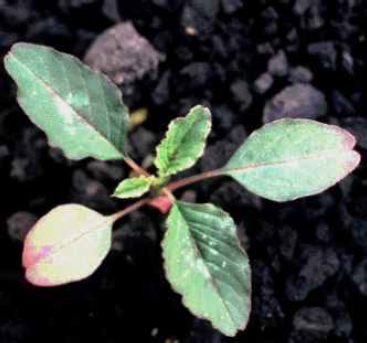
Palmer amaranth (Amaranthus palmeri), courtesy of the Weed Science Society of America.

