National Summit on Strategies to Manage Herbicide-Resistant Weeds: Proceedings of a Workshop (2012)
Chapter: The Australian Experience of Managing Herbicide Resistance and Its Contrasts with the United States--Michael Walsh
The Australian Experience of Managing Herbicide Resistance and Its Contrasts with the United States
Michael Walsh
University of Western Australia
Since the 1990s, the grain-growing regions of Australia have experienced a major problem with herbicide-resistant weeds. This occurred because of a unique combination of events. First, the highly productive pasture species annual ryegrass (Lolium rigidum) was present at high densities across vast areas devoted to livestock production. Then, from the 1970s, much of this pasture land dominated by Lolium was converted to wheat fields. With this dramatic shift from livestock to crop production, Lolium instantly was a problematic crop weed. The newly available acetyl coenzyme-A carboxylase (ACCase) herbicides were used widely and persistently. Herbicide use without diversity on huge populations of genetically variable Lolium across vast areas resulted in widespread resistance evolution. Cross pollination among resistant survivors ensured multiple herbicide resistance and the loss of efficacy of many herbicides. This shattered the illusion of herbicide invincibility and drove the search for integrated control strategies. Multiple resistance forced diversity in weed-control practices and the use of both herbicide and nonherbicide tools for sustainable weed control. For example, Lolium, like many crop weeds, relies on annual seed production and seed maturity is synchronized with crop maturity. Importantly, Lolium seed remains attached to the plant at the same height as the crop seed heads at grain harvest. Modern grain harvesters are efficient at sorting weed seed from crop grain, thus some 95 percent of Lolium seeds pass intact through the grain harvester to be returned to the crop field in the chaff fraction, perpetuating the ongoing weed problem. Therefore, grain harvest represents an excellent opportunity to target Lolium seed production. Toward this, Australian farmers have developed and adopted several “harvest weed seed control” (HWSC) systems that effectively target annual ryegrass and other weed seeds during the harvest operation. The HWSC systems currently used in Australia include chaff carts, direct harvest residue baling, narrow windrow burning, and the recently introduced Harrington Seed Destructor. The use of HWSC in addition to herbicidal weed control now
has been proven to reduce Lolium infestations dramatically, clear evidence of the value of new weed-control tools in prolonging the life of herbicides.
KEY POINTS
 When ryegrass pastures were converted to wheat production in Australia, ryegrass (Lolium) became the main weed.
Australian farmers have developed and adopted several “harvest weed seed control” (HWSC) systems that effectively target annual ryegrass and other weed seeds during the harvest operation. The use of HWSC in addition to herbicidal weed control now has been proven to reduce Lolium infestations dramatically.
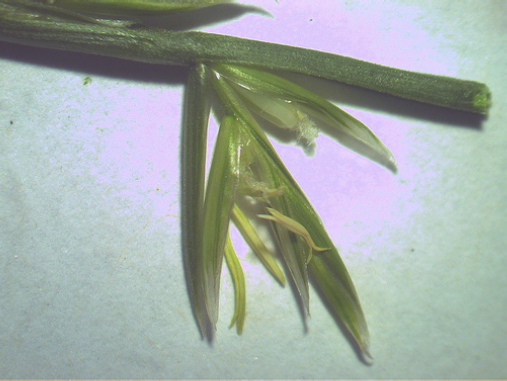
Annual Ryegrass (Lolium rigidum), courtesy of Macleay Grass Man (http://freeimagefinder.com/detail/7370410186.html).

