Review of WIC Food Packages: Improving Balance and Choice: Final Report (2017)
Chapter: Summary
Summary
THE SPECIAL SUPPLEMENTAL NUTRITION PROGRAM FOR WOMEN, INFANTS, AND CHILDREN
Among the nutrition assistance programs available to low-income families, the Special Supplemental Nutrition Program for Women, Infants, and Children (WIC) is the only one that specifically targets the nutritional needs of pregnant, breastfeeding, and postpartum women; infants; and children less than 5 years of age. WIC also includes nutritional assessment, nutrition education, breastfeeding support and referrals to health and social services, in addition to a prescribed food package. WIC participation has grown from 88,000 individuals served in 1974 to approximately 8 million women, infants, and children served in 2015 with services provided through 1,900 local agencies operating in 10,000 clinic sites across the United States and its territories.
The program’s goals have evolved to include promoting and supporting breastfeeding by providing the breastfeeding mother with benefits for up to 1 year; providing WIC participants with a wider variety of foods, including vegetables, fruits, and whole grains; and providing WIC state agencies greater flexibility in prescribing food packages to accommodate the food preferences of WIC participants. WIC, like some other nutrition assistance programs, has been aligned with the Dietary Guidelines for Americans (DGA). Additionally, the program goals align with two major Healthy People 2020 goals and nearly 30 health objectives, specifically those related to birth weight, childhood and adult weight, and breastfeeding prevalence. Congress has now mandated that an evaluation of the WIC food packages occur every 10 years.
WIC Food Package Changes
The WIC food packages remained relatively unchanged until the U.S. Department of Agriculture’s Food and Nutrition Service (USDA-FNS) asked the Institute of Medicine (IOM) to convene an expert committee to review and update the food packages in 2004. That committee’s report recommended wide-ranging revisions to the WIC food packages. Following issuance of the “Interim Rule” in 2007, the majority of the IOM report’s recommendations were implemented. These updates included providing whole wheat bread, several additional grain options, a cash value voucher (CVV) to purchase vegetables and fruits, a reduction in the amount of juice, eggs, milk, and formula, and the removal of whole milk for all participants except 1-year-old children.
Most local WIC agencies, vendors, and manufacturers adopted the food package revisions successfully. The variety of dairy and grain products in the marketplace and the availability of WIC-approved foods have improved since 2009. The increased flexibility offered to program participants was important for meeting their needs and preferences. For many participants, however, some foods (e.g., fluid milk, ready-to-eat cereals) may not align with personal or cultural preferences, leading to reduced redemption and consumption.
The Committee’s Task
In response to the congressional mandate, in 2014, USDA-FNS asked the National Academies of Sciences, Engineering, and Medicine to convene an expert committee to review and assess the nutritional status and food and nutritional needs of the WIC-eligible population and provide specific scientifically-based recommendations based on its review and grounded in the most recently available science. In addition, the committee was charged to ensure that recommendations for revising the WIC food packages are consistent with the DGA and address the health and cultural needs of the WIC participant population. Finally, the committee’s recommendations should operate efficiently and be effectively administered across the geographic scope of the program. The complete task is described in Chapter 1.
The committee has produced three reports. In An Evaluation of White Potatoes in the Cash Value Voucher: Letter Report, it recommended that white potatoes be allowed for purchase with the cash value voucher (CVV). In Review of WIC Food Packages: Proposed Framework for Revisions, the committee presented the evidence, analyses, and framework to be applied to develop the committee’s recommendations. In this third report, the committee provides its final analyses, recommendations, and the supporting rationale.
The Committee’s Process
To address its task, the committee formulated a strategy that included an ongoing comprehensive review of the published literature and other available evidence, consideration of information from public workshops and public comments, analyses of relevant data, and deliberation on topics related to its charge. This committee also benefitted from newly available data on redemption of WIC foods.
The committee designed a systematic and transparent process for identifying actions that could prompt consideration of a revision in the food packages, which included use of a decision tree to establish “priority nutrients” and “priority food groups” and to identify appropriate changes in the food packages (see Chapter 5, Figure 5-1). It also developed a set of criteria for inclusion of foods in the food packages (see Box S-1) and a framework to guide the decision-making process that included nutritional and cost trade-offs (see Figure S-1). Noteworthy among these criteria is the concept that the packages should provide a balanced supplement to participants’ diets. Guided by information gathered, the committee used an iterative process to identify potential food package changes. The committee then compared the impact of potential changes against the criteria, within the constraints of the cost-neutral requirement, to develop its
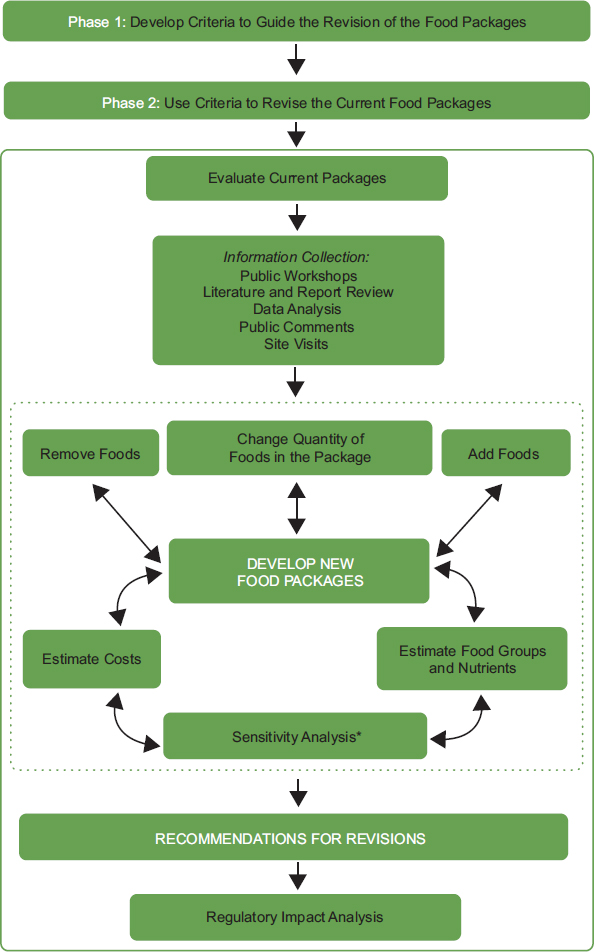
NOTES: The dotted line indicates components of the process that iterate until the criteria for food package revisions are met (see criteria 1 through 6 presented above). * The sensitivity analysis tests the assumptions applied to develop the cost-neutral revised food packages. A description of the sensitivity analysis is provided in Chapter 8.
recommendations. A sensitivity analysis (see Chapter 8) was conducted to test the committee’s assumptions and a regulatory impact analysis (see Chapter 10) was conducted to assess the projected impact of the recommended food packages changes on program participation, the value of the food packages as selected, and program costs and administration.
The committee’s analysis of data from the National Health and Nutrition Examination Survey (NHANES 2005–2012) was used to identify nutrients consumed in inadequate or excessive amounts and food groups consumed in less- or more-than-recommended amounts and to set nutrient and food group priorities.
The committee found that the current food packages provide 100 percent or more of the recommended intake of several nutrients and food groups. The committee considered these more-than-supplemental amounts (i.e., they provided more than a moderate proportion of an individual’s requirement or recommended intake) and reduced them to be able to address other nutritional priorities. As a result of the diversity of nutrients that can be provided through the CVV, and participants’ preference for this option, the committee considered it useful to increase the CVV to improve vegetable and fruit intakes. In other situations, the committee considered that an alternative form of food could be useful to promote intake of foods already included in the packages. The committee considered fish as a possible addition to the food packages because low-mercury seafood is recommended in the DGA and seafood intakes are below recommended amounts.
Available data also indicated that the current strategy of allowing breastfeeding women only two options in the first month (no formula or one can of formula) did not change breastfeeding initiation, but it did affect duration. While issuance of the partial breastfeeding package declined, there was an increased issuance of the fully formula-feeding package, along with an increased issuance of the fully breastfeeding package.
Challenges with the Process
The committee faced challenges that affected its ability to assess the data, meet the criteria, or revise the packages consistent with the potential actions identified from the decision tree. Briefly, these challenges included
- Some of the sample sizes in the NHANES dataset for population subgroups of interest were very small, so the committee combined survey years to obtain adequate numbers of participants for analysis. The need to combine survey years precluded fulfilling USDA’s request for a pre-post 2009 food package change comparison.
- For women coded as “breastfeeding” in NHANES, the duration and intensity of breastfeeding were unknown, thus partially
- Women coded as “pregnant” in NHANES were treated as a single group to increase the sample size, although this precluded full adjustment for their varying needs by trimester.
- There is no available analytical method to resolve differences in estimates of nutrient inadequacy derived from Dietary Reference Intakes (DRIs) (Estimated Average Requirement [EAR] and Adequate Intake [AI]) with estimates of under-consumption relative to the DGA food groups. The committee used both to identify possible targets for supplementation.
- The cost-neutral constraint precluded inclusion of several of the identified potential actions for food package changes.
breastfeeding women could not be distinguished from exclusively breastfeeding women.
THE REVISED FOOD PACKAGES
The proposed revisions to the food packages in this report are designed to contribute positively to dietary quality of WIC-participating women, infants, and children. Most aspects of the current food packages are unchanged in the proposed new packages. However, a few foods have been added or amounts increased to enhance the quality of the packages. To maintain cost neutrality, amounts of some foods, primarily those that were provided in excess of the DGA recommended amounts or those that were poorly redeemed, were decreased. Overall, the proposed packages provide better adherence to the DGA and further increase flexibility and choice.
Among the factors that the committee considered in making decisions were: the value of the food packages to the mother–infant dyad; the practical importance of the CVV and its value to participants; and participant preferences (both cultural and personal). Constraints to changing foods in the package relative to foods in the marketplace, the capacity of the vendors who provide foods to participants, and state-level administrative concerns were also considered. Final adjustments were made in an iterative fashion, weighing cost with all priorities and factors. Table S-1 presents the food packages for fully breastfeeding, partially breastfeeding, and formula-feeding mother–infant dyads. Table S-2 presents the food packages for children and for pregnant women.
Summary of Recommendations to Revised WIC Food Packages
In response to its task, the committee recommended revisions to the WIC food packages that align with the DGA and are more consistent with
the nutrition standards of other nutrition assistance programs that serve children. The committee targeted three primary areas: amounts of foods, specifications for foods, and additional substitution options for foods. To improve balance among food groups, most foods that are currently provided in more-than-supplemental amounts are reduced (i.e., juice, dairy [milk], peanut butter, legumes, and infant foods). Foods that are currently provided in lower amounts or were consumed in amounts below that recommended (i.e., whole grains, vegetables, fruits, and seafood) are increased. Food specifications are adjusted to increase the provision of whole grains (all breakfast cereals must meet the whole grain-rich criteria, all bread must be 100 percent whole wheat) and reduce the contribution of added sugars from foods that can substitute for milk (i.e., yogurt, soy beverage). The food choices allowed in the 2009 food package revisions were retained, and additional choices were added (i.e., a substitution of CVV for jarred infant fruits or vegetables or juice, some fish in place of some jarred infant food meats, an additional quart of yogurt for milk, additional grain choices, and options for vegan participants, including soy-based cheese and yogurt substitute products). The committee anticipates no increase in the administrative burden of these changes because the recommended revisions build upon the 2009 food package updates.
The overarching recommendations for revising the WIC food packages are presented below. Details about specific revisions to amounts of foods allowed and specifications are provided in Chapter 6.
6-1. The U.S. Department of Agriculture’s Food and Nutrition Service (USDA-FNS) should increase the dollar amount of the cash value voucher, add fish, and reduce the amounts of juice, milk, legumes, and peanut butter in all food packages for women and children (IV, V-A, V-B, and VII), to improve the balance of food groups in alignment with the 2015–2020 Dietary Guidelines for Americans. These changes also apply to food package VI, except that the amounts of milk are unchanged and the amounts of legumes are increased.
6-2. USDA-FNS should support the cultural food preferences and special dietary needs of WIC participants by requiring states to offer additional options for the WIC food categories, including substitution of a CVV in place of juice, additional forms and varieties of vegetables and fruits, both canned and dried legumes, and a range of options and sizes for grains and yogurt. A substitution of legumes for peanut butter or for eggs should be allowed for individuals who have a peanut allergy, or that are following a vegan diet, respectively.
TABLE S-1 The Revised WIC Food Packages: Maximum Monthly Allowances Presented as the Benefits to the Mother–Infant Dyad in Food Packages I, II, III, V-B, VI, and VII
| WIC Food Categories | Fully Breastfeeding Dyad | Partially (Mostly) Breastfeeding Dyad | Formula-Feeding Dyad | |||
|---|---|---|---|---|---|---|
| Infants 0 to 5 Months (FP I or III) | Infants 6 to 11 Months (FP II or III) | Infants 0 to 5 Months (FP I or III) | Infants 6 to 11 Months (FP II or III) | Infants 0 to 5 Months (FP I or III) | Infants 6 to 11 Months (FP II or III) | |
| For Infants | ||||||
| Formula | — | — | 0 to 3 months: up to 364 fl oz 4 to 5 months: up to 442 fl oz |
Up to 312 fl oz | 0 to 3 months: up to 806 fl oz 4 to 5 months: up to 884 fl oz |
Up to 624 fl oz |
| Infant cereal | — | 16 oz | — | 8 oz | — | 8 oz |
| Infant food vegetables and fruits | — | 128 oz or 64 oz and $10 CVV or 0 oz and $20 CVV | — | 128 oz or 64 oz and $10 CVV or 0 oz and $20 CVV | — | 128 oz or 64 oz and $10 CVV or 0 oz and $20 CVV |
| Infant food meats | — | 40 oz | — | — | — | — |
| For Women | Fully Breastfeeding Women (FP VII) | Partially (Mostly) Breastfeeding Women (FP V-B) | Postpartum Women (FP VI) | |||
| Vegetables and fruits | $35 CVV | $25 CVV | $15 CVV | No foods are provided to women after 6 months postpartum | ||
| Legumes | 2 lb every 3 months | 2 lb every 3 months | 2 lb every 3 months | |||
| Juice | 64 fl oz | 64 fl oz | — | |||
| Dairy (milk) | 16 qt | 16 qt | 16 qt | |||
| Breakfast cereal | 36 oz | 36 oz | 36 oz | |||
| Whole grains | 16 to 24 oz | 16 to 24 oz | — | |||
| Peanut butter | 16 to 18 oz every 3 months | 16 to 18 oz every 3 months | 16 to 18 oz every 3 months | |||
| Eggs | 2 dozen | 1 dozen | 1 dozen | |||
| Fish | 60 oz every 3 months | 30 oz every 3 months | 10 oz every 3 months | |||
NOTES: — = the WIC food category is not authorized in the corresponding food package; CVV = cash value voucher; FP = food package. Se Table 6-1 for additional details and all substitution options. See Table 6-4 for details related to WIC food specifications.
TABLE S-2 The Revised WIC Food Packages: Maximum Monthly Allowances Presented as the Benefits to Children and Pregnant Women in Food Packages IV, V-A, and III
| WIC Food Category | Children 1 to Less Than 2 Years (FP IV-A) | Children 2 to Less Than 5 Years (FP IV-B) | Pregnant Women (FP V-A) | Special Dietary Needs (FP III) |
|---|---|---|---|---|
| WIC formula | — | — | — | Up to 455 fl oz of liquid concentrate, if appropriate |
| Vegetables and fruits | $12.00 CVV | $12.00 CVV | $15.00 CVV | |
| Legumes | 1 lb every 3 months | 1 lb every 3 months | 2 lb every 3 months | Other foods in food packages IV and V-A are provided as appropriate |
| Juice | 64 fl oz | 64 fl oz | 64 fl oz | |
| Dairy (milk) | 12 qt | 14 qt | 16 qt | |
| Breakfast cereal | 36 oz | 36 oz | 36 oz | |
| Whole grains | 16–24 oz | 16–24 oz | 16–24 oz | |
| Peanut butter | 16–18 oz every 3 months | 16–18 oz every 3 months | 16–18 oz every 3 months | |
| Eggs | 1 dozen | 1 dozen | 1 dozen | |
| Fish | 10 oz every 3 months | 10 oz every 3 months | 10 oz every 3 months |
NOTES: — = the food is not authorized in the corresponding food package; CVV = cash value voucher; FP = food package. See Table 6-2 for additional details and all substitution options. See Table 6-4 for details related to WIC food specifications.
6-3. USDA-FNS, as a means of supporting breastfeeding of any duration and intensity, should allow individual tailoring of the infant food packages to best meet the needs of the mother–infant dyad.
6-4. USDA-FNS should reduce the amounts of infant cereal across food package II for all infants, and reduce the amounts of jarred infant food vegetables and fruits and jarred infant food meats provided in food package II for fully breastfed infants. Caregivers should be permitted to substitute all or part of the jarred infant food vegetables and fruits with a cash value voucher, and a portion of jarred infant food meat with canned fish.
6-5. USDA-FNS should no longer require provision of a WIC formula to all participants that are issued food package III. Participants should be permitted access to the foods in the package appropriate for their age, physiological state, and medical condition. The health care provider may refer to the WIC registered dietitian and/or qualified nutritionist for identifying appropriate foods (excluding WIC formula) and their prescribed amounts as well as the length of time the participant requires the foods.
6-6. USDA-FNS should issue food package V-B to women who are pregnant with multiple fetuses and food package VII to women who are partially breastfeeding multiple infants.
6-7. USDA-FNS should modify required specifications for some WIC foods to improve their alignment with dietary guidance.
COST EVALUATION OF THE REVISED FOOD PACKAGES
The committee generated nutrient and cost profiles for the current and revised food packages using detailed assumptions about participation, food choices, food prices, and redemption rates. The weighted average, per-participant cost of the revised set of food packages is $37.32, 5 cents more than the cost of the current set of food packages (see Chapter 7, Table 7-2). The revised food packages therefore meet the task requirement for cost-neutrality (see Chapter 7).
The committee considered the financial value of the food packages to the mother–infant dyads (fully formula-feeding, partially breastfeeding, and fully breastfeeding) to evaluate how the packages support them and the perceived value of the packages to these dyads. As redeemed, the value of the revised food packages for breastfeeding dyads is higher than that of the current packages. The committee found it difficult, within cost-neutral constraints, to lower the value of the formula-feeding dyad packages without decreasing the amounts of infant formula required to provide close to 100 percent of infant needs in the first 6 months.
THE REVISED FOOD PACKAGES MEET SPECIFIED CRITERIA
The Revised Food Packages Provide Supplemental Amounts of Most Food Groups
To meet the criterion of providing a balanced supplement to participants’ diets, the WIC packages were modified to reduce foods that provided more-than-supplemental amounts and increase foods needed to improve intakes of priority nutrients and food groups. The modifications accounted for participant preferences by evaluating available redemption data. For example, quantities of milk were reduced from providing 85 to 119 percent to 71 to 75 percent of recommended intakes. Juice was reduced and the CVV was increased correspondingly to shift the fruit consumption toward whole fruit, the preferred source of fruit in the DGA. In addition, the CVV was increased for all food packages to increase consumption of vegetables, which are poorly consumed, and fruit. Redemption of legumes and peanut butter is relatively low (approximately 50 percent), and the current food packages meet nearly 100 percent of the DGA recommended intake for several population subgroups, so amounts of legumes and peanut butter were reduced in several of the revised packages. Revisions to the whole grain requirement increase the ratio of whole-to-refined grains provided in the revised packages. Nearly all revised packages now provide some fish (although the amounts remain low).
The Revised Packages Provide at Least 50 Percent of the DRI of Most Priority Nutrients
Reductions in foods provided in more-than-supplemental amounts led to reductions in some nutrients in each food package. However, most nutrients prioritized by the committee are provided in amounts equivalent to at least 50 percent of the EAR or AI in the revised packages. However, potassium and fiber (higher priority across packages), choline (higher priority, pregnant women), vitamin D (lower priority, pregnant women), and copper (lower priority, postpartum women) are provided in amounts below 50 percent of the EAR or AI in the revised packages. The committee experienced the same limitations to meeting recommended amounts of all nutrients in a balanced diet as the DGAs did in developing their food patterns. The challenge was compounded by the committee’s cost-neutrality constraint.
The Revised Packages Are More Consistent with Dietary Guidance
The revised food packages provide some of all DGA food groups, provide more whole than refined grains, and provide more whole fruit than
fruit juice compared to the current packages. The amount of juice provided to children in the revised food packages is approximately 50 percent of the limit for juice that is recommended by the American Academy of Pediatrics. The amounts of “calories for other uses” (which include added sugars and saturated fat) were reduced across food packages. The specified limit for added sugars in yogurt was lowered but, nonetheless, the new yogurt option may increase added sugars. However, this is still in alignment with DGA guidance that some added sugars are appropriate in nutrient-dense foods to promote palatability. Sodium was reduced in all food packages.
The Revised Packages Enhance Options for Cultural Preferences and for Situations in Which Transportation, Storage, or Cooking Facilities Are Limited
The revised food packages include additional grain options suitable for various cultures (corn meal, corn masa flour, buckwheat, and teff), and allow additional yogurt, which may be more culturally suitable than fluid milk. The CVV offers the greatest degree of flexibility for meeting cultural needs and was increased in all food packages. The general increase in CVV as well as options to substitute additional amounts of CVV for juice or for jarred infant foods offers participants even more flexibility to meet their preferences. Volumes of foods difficult to transport have been reduced (e.g., milk, jarred infant foods) which lowers this burden. The requirement to provide canned legumes and a canned, frozen, or dried form of vegetable or fruit improves the suitability of the packages for various storage or cooking conditions.
The Revised Packages Consider WIC Agency and Vendor Burdens
Before changing the food specifications for yogurt and ready-to-eat cereal, the committee obtained information on market availability of these products to ensure vendors nationwide would be able to implement them. The revised food packages also consider that new food options are allowed in sizes commonly available to vendors and therefore accessible to participants.
RECOMMENDATIONS FOR IMPLEMENTATION AND RESEARCH
The committee was charged to outline recommendations for implementation of the revised food packages and research (including data collection) to support evaluation of the revised packages and the next 10-year review. These recommendations are outlined below, with the rationale supporting each provided in Chapter 11.
Recommendations for implementation are:
11-1. The U.S. Department of Agriculture’s Food and Nutrition Service (USDA-FNS) should develop the tools and strategies needed to assist state agencies, local agencies, and vendors to inform participants about and support them to make the best use of the expanded options of the revised food packages.
11-2. USDA-FNS should maximize the extent to which the revised food packages motivate the choice to initiate and continue breastfeeding among all racial and ethnic groups by enhancing and stabilizing the funding available (independent of the food packages) for peer counseling and other lactation support staff in WIC sites.
To close the identified research gaps of highest priority, the committee recommends funding of research in the following areas:
11-3. USDA-FNS should fund research to evaluate the effects of the recommended revisions to the WIC food packages on participant satisfaction, participation in the program, redemption of WIC foods, and participants’ diets and health.
11-3a. USDA-FNS should collect WIC state agency policies on an annual basis and establish a national database of electronic benefit transfer (EBT) expenditures by program participants.
11-3b. USDA-FNS and the Department of Health and Human Services should collaborate to achieve expansion of nationally representative collection of data on the dietary intakes for pregnant, breastfeeding, and postpartum women and breastfed infants in the National Health and Nutrition Examination Survey. USDA-FNS should request that the data on breastfeeding women include an indicator on the intensity of breastfeeding (i.e., exclusive or partial).
11-4. USDA-FNS should fund data collection and analysis of that data toward optimizing support for breastfeeding and increasing the proportion of WIC participants who choose to initiate and continue breastfeeding, and tailoring food package options to best meet the needs and goals of the breastfeeding dyad. USDA-FNS should examine how breastfeeding outcome data are captured in WIC Management Information Systems and work toward a set of universal breastfeeding indicators that can be captured across systems.
11-5. USDA-FNS should fund research to assess how inclusion of the cash value voucher as a component of WIC food packages affects: food package redemption rates, participant choice of vegetable and fruit varieties, overall diet quality, and vendor stocking practices.
11-6. USDA-FNS should fund research to evaluate the feasibility of adjusting the value of the cash value voucher in high-cost states and territories (Alaska, Guam, Hawaii, and the U.S. Virgin Islands).
USDA-FNS asked that the committee identify changes to the food packages that should be made if funding for the WIC food packages is 10 percent higher or is 10 percent lower than cost-neutrality. The following recommendations are offered in response:
11-7. The committee recommends that in the case that USDA-FNS has funding above cost-neutrality, the value of the CVV should be increased for all children on the program.
11-8. The committee recommends that in the case that USDA-FNS has funding below cost-neutrality, provision of juice should be further reduced or eliminated across food packages.
KEY MESSAGES FROM THE COMMITTEE FOR USDA AND FOR THE NEXT WIC REVIEW COMMITTEE
Although the committee completed its task, much work remains. Three major priorities emerged for future consideration: continued and improved support for breastfeeding, encouraging consumption of vegetables, and availability and use of WIC data.
Given the barriers to breastfeeding faced by low-income women, it is possible that WIC may be reaching nearly all those who are willing and able to breastfeed exclusively. To promote and encourage any breastfeeding, the committee maintained an enhanced food package for exclusively breastfeeding women. Moreover, it also enhanced the food package for partially breastfeeding women. This is essential for women who find exclusive breastfeeding incompatible with other constraints in their lives, but are nonetheless interested in and can be successful with partial breastfeeding. Reaching and supporting all breastfeeding women is a way for WIC to enhance its stated commitment to breastfeeding. This will require expansion and full coordination of the several WIC resources that promote and support breastfeeding, and the committee strongly encourages USDA-FNS to meet this challenge.
Although the committee was able to increase the amounts of the CVV, it remains a challenge to improve redemption of vegetables with it. This is because of WIC participants’ preference for fruits. Those participants who received the largest increase in the CVV should be able to satisfy their preference for fruits and begin to purchase more vegetables. However, to increase vegetable redemption, the CVV may have to be substantially increased for all participants and accompanied by appropriate nutrition education and perhaps further incentives. In a cost-neutral environment, this may require reductions in the amount of other high-cost items, such as dairy products and infant formula, which are provided in amounts at the high end of supplemental in the revised packages.
The limited information available to this committee on redemption of WIC foods was crucial for understanding how participants use the program, but more such data (as well as many other kinds of data) were unavailable, so the committee provided recommendations to address these data needs for future decision making. It is essential that WIC identify ways to increase the availability of program data so that interested researchers can contribute their expertise to determine what aspects of the program work and how and also what aspects are cost-effective and scalable.
The committee’s strategy for revisions includes several noteworthy innovations. These include the committee’s development of the concept of supplemental as applied to the WIC food packages and its use as a criterion for the revision of the packages, use of data on redemption and the distribution of redemption to inform estimates of actual use of the food packages, and consideration of the dyadic nature of infant feeding related to the contents of the food packages. These innovations permitted the committee to make important revisions to the food packages within the constraint of cost neutrality. In particular, the committee was able to balance the food packages to increase the variety of foods included, increase participants’ choices within food categories, and develop a comprehensive approach to the use of the packages to support breastfeeding of all intensities. To be fully effective, these revisions to the food package should be accompanied by the recommendations for implementation presented here. These revisions to the food packages are expected to improve both the attractiveness of the program to participants as well as its success in meeting the WIC program’s goals to promote and support breastfeeding and to safeguard the health of low-income women, infants, and children through the provision of foods that provide key nutrients.


