Regional Ballistic Missile Defense in the Context of Strategic Stability (2021)
Chapter: Appendix C: Impacts of Regional Missile Defense on U.S. and Russian Nuclear Deterrents
C
Impacts of Regional Missile Defense on U.S. and Russian Nuclear Deterrents
The ballistic missile defense (BMD) cooperation discussed in this report is intended to address relatively simple threats from nations with new or limited missile capabilities. As is described in this report, however, Russian and U.S. military planners today operate in a relationship that is often more adversarial than cooperative. In this environment, some regard regional missile defense as a potential threat to the strategic deterrents of the two states.
In this appendix, the joint committees analyze whether deployments of regional ballistic missile defense undermine the strategic retaliatory capability of the United States and the Russian Federation. In doing so, the committees consider only fixed, land-based strategic forces, that is, the silo-based intercontinental ballistic missile (ICBM) force (see the next section). Because the U.S. European Phased Adapted Approach has facilities near Russian territory and Russia has no planned regional BMD near U.S. territory, this analysis focuses only on the European Phased Adapted Approach and the ICBM component of Russia’s strategic deterrent.
To evaluate the hypothetical effectiveness of regional defenses against strategic ballistic missiles, the joint committees have used representative burnout velocities of both the attack missiles (i.e., ICBMs) and the interceptor missiles described in Chapter 4. The joint committees considered kinematic capability, specifically whether the interceptor would have the time to physically intercept the attack missile along its trajectory. For the purpose of this limited analysis, the joint committees set aside the question of how accurately defensive systems can measure and predict the trajectory of the attack missile, how well defensive missiles can intercept that trajectory in space and time (e.g., by using end-game guidance* to hit the target), and whether the defensive interceptor can effectively kill the attacking missile if it makes contact. In other words, the joint committees make no judgment on whether an interceptor that physically can reach a missile would actually hit and destroy the missile. The rationale for taking this approach is that if intercept is not possible, kill capability given intercept is irrelevant.
IMPORTANCE OF INTERCONTINENTAL BALLISTIC MISSILES
Both the United States and the Russian Federation structure their nuclear deterrents around a nuclear triad consisting of ICBMs, sea-launched ballistic missiles, and nuclear heavy bomber
___________________
* “End-game guidance” refers to guidance on board the interceptor itself.
forces (some of which carry air-launched cruise missiles). Mobile ICBMs have historically been emphasized by the Russian Federation. Given the centrality of ICBMs to Russia’s strategic deterrent, the analysis in this appendix is limited to ICBMs.
Effectiveness of European Deployment of Ballistic Missile Defense Interceptors Against Russian Intercontinental Ballistic Missiles Directed at the United States
The U.S. National Academies 2012 report Making Sense of Ballistic Missile Defense notes that “it is not a mission of U.S. BMD systems to defend against large-scale deliberate nuclear attacks by Russia or China.”107 The 2012 report goes on to say that “aside from political and stability effects, such defense is not practical, given the size, sophistication, and capabilities of Russian and Chinese forces and both countries’ potential to respond to U.S. defense efforts, including by increasing the size of the attack to the point at which defenses are simply overwhelmed by numbers.”108
In addition to policy and practical technical limitations, both the 2012 study and the current study examined the technical capabilities of U.S. interceptors against Russian ICBMs. The 2012 study concluded that “no interceptor with fly-out speeds less than or equal to 5.0 km/sec based in Poland or Romania or elsewhere in Europe can engage or interfere with Russia’s nuclear deterrent ICBMs or submarine-launched ballistic missiles.”109 The joint committees’ analyses show that interceptor missiles deployed in Redzikowo, Poland, will not have the kinematic possibility of intercepting Russian ICBMs flying from Vypolzovo to Washington, DC, unless the interceptors have a burnout velocity greater than 5.5 km/s (see Figure C-1).
The ballistic missile defense concept set forth by the George W. Bush administration would have deployed 10 ground-based interceptors in Poland to complement deployments in Alaska and California as part of a system designed to defend against future Iranian ICBMs. Such missiles would have had burnout velocities of 5.5 to 6.0 km/s and could, at least in theory, have had the kinematic possibility of interception. These plans were cancelled, however, and replaced with deployment of the Standard Missile-3 (SM-3) interceptor. To the joint committees’ knowledge, a burnout velocity greater than 5.5 km/s far exceeds the velocities that the SM-3 interceptors can attain.* Thus, it does not appear that European deployment of SM-3 interceptors will provide the technical capability to undermine Russian counterstrike capabilities.
___________________
* The actual SM-3 burnout velocity has not been formally released, although the United States has offered to allow experts from the Russian Federation to measure it with Russian equipment. The burnout velocity of the SM-3 Block IIA (the most capable variant, not yet deployed) is often assumed to be 4.5 km/s.
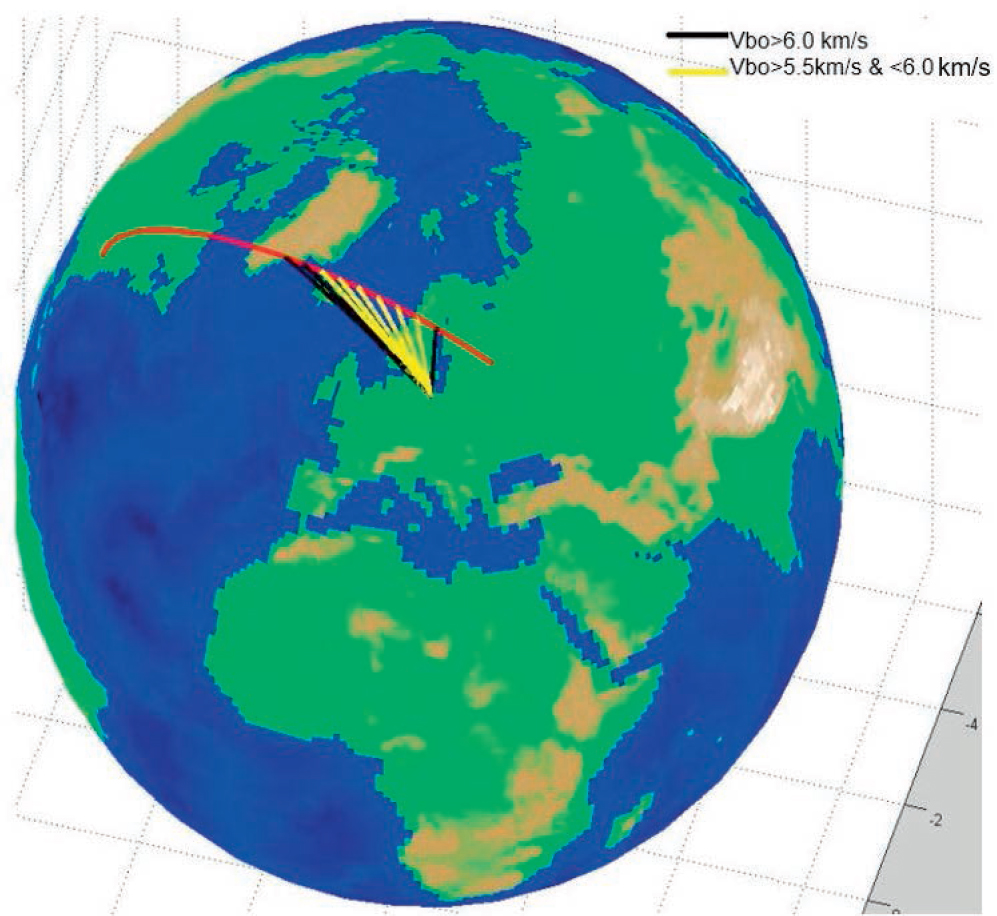
SOURCE: Created by J. Sankaran, consultant.
This page intentionally left blank.


