Review of the Inland Estimated Recovery System Potential (ERSP) Prototype Calculator (2022)

Chapter: Appendix B: USCG Inland ERSP Calculator Software Issues

Previous Chapter: Appendix A: Key Differences Between the Offshore Environment and the Inland Environment
Suggested Citation: "Appendix B: USCG Inland ERSP Calculator Software Issues." National Academies of Sciences, Engineering, and Medicine. 2022. Review of the Inland Estimated Recovery System Potential (ERSP) Prototype Calculator. Washington, DC: The National Academies Press. doi: 10.17226/26649.

Appendix B

USCG Inland ERSP Calculator Software Issues

Several software issues were discovered with the prototype version of the calculator provided to the committee. This appendix is not meant to detail all potential software issues. The committee did not test all possible configurations and did not record all errors observed. Screenshots are provided to show the configurations being tested.

COMPATIBILITY

The calculator is not compatible with the Apple operating system, which limited the committee members who were able to use the calculator.

SPILL VOLUME

Despite the ability to enter a spill volume, the daily ERSP output is constant from 1 to 999 bbl, 1,000 to 99,999 bbl, and 100,000 and greater bbl.

Image

Suggested Citation: "Appendix B: USCG Inland ERSP Calculator Software Issues." National Academies of Sciences, Engineering, and Medicine. 2022. Review of the Inland Estimated Recovery System Potential (ERSP) Prototype Calculator. Washington, DC: The National Academies Press. doi: 10.17226/26649.

Image

Image

Suggested Citation: "Appendix B: USCG Inland ERSP Calculator Software Issues." National Academies of Sciences, Engineering, and Medicine. 2022. Review of the Inland Estimated Recovery System Potential (ERSP) Prototype Calculator. Washington, DC: The National Academies Press. doi: 10.17226/26649.

Image

Image

SKIMMER SELECTION

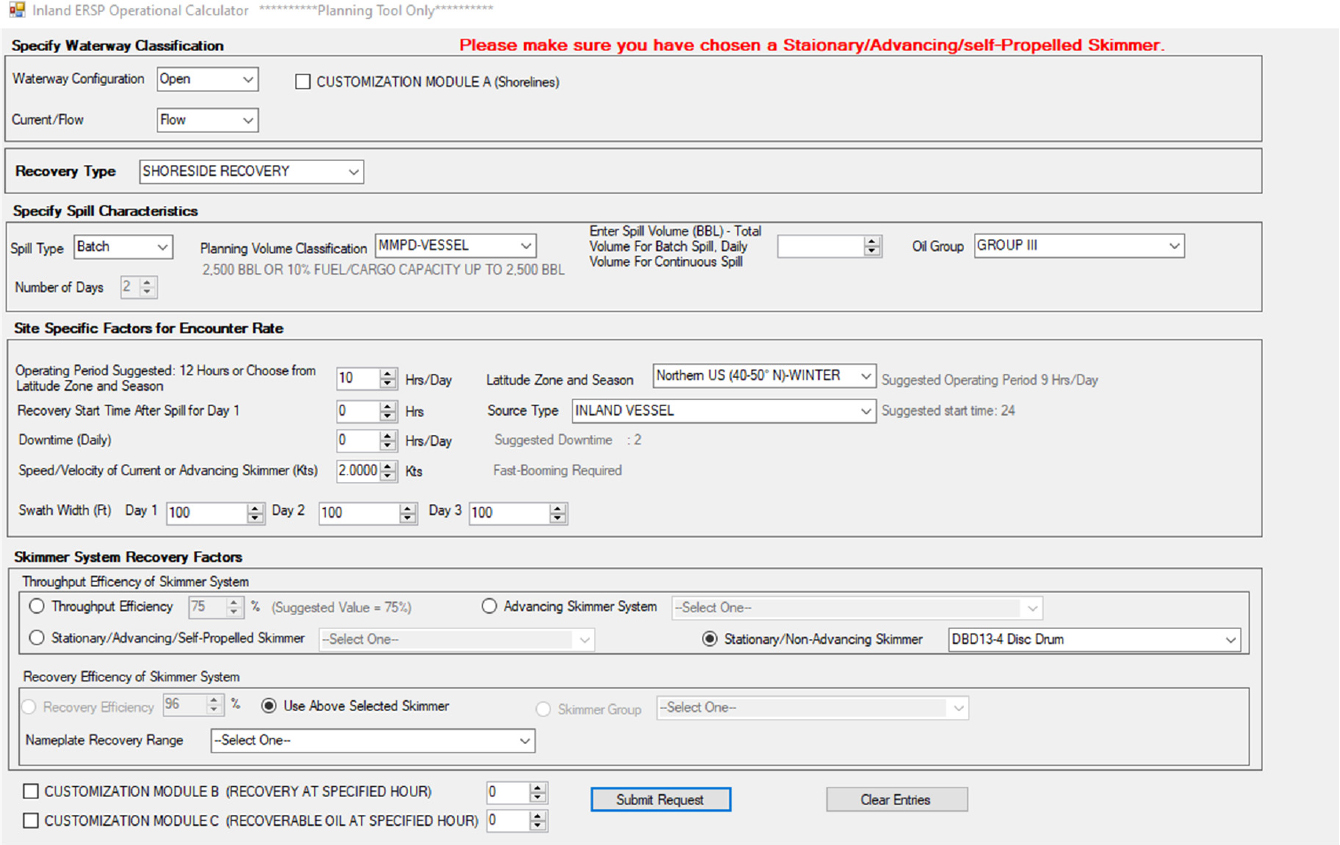
The software requires that a Stationary/Advancing/Self-Propelled Skimmer be selected to perform calculations. Selection of an Advancing Skimmer or Stationary Skimmer results in an error message.
Suggested Citation: "Appendix B: USCG Inland ERSP Calculator Software Issues." National Academies of Sciences, Engineering, and Medicine. 2022. Review of the Inland Estimated Recovery System Potential (ERSP) Prototype Calculator. Washington, DC: The National Academies Press. doi: 10.17226/26649.

Image

Once a Stationary/Advancing/Self-Propelled Skimmer has been selected, the user can shift to other categories of skimmers, but the characteristics of those skimmers do not update the Throughput or Recovery efficiencies. Those remain tied to the Stationary/Advancing/Self-Propelled Skimmer that was selected.

Image

Note that while the Elastec TDS 118G Drum Skimmer appears to be selected, the Throughput and Recovery efficiencies remain tied to the Minimax 12 W that had previously been selected.

Suggested Citation: "Appendix B: USCG Inland ERSP Calculator Software Issues." National Academies of Sciences, Engineering, and Medicine. 2022. Review of the Inland Estimated Recovery System Potential (ERSP) Prototype Calculator. Washington, DC: The National Academies Press. doi: 10.17226/26649.

PRIORITIZATION/MEMORY ISSUE

This occurs in a couple of sections. It is most noticeable in the Skimmer System Recovery Factors. If a number is entered into the Throughput Efficiency, it overrides any number that may be associated with the skimmer selected.

Image

In the run above, all parameters were the same as in the previous except the Throughput Efficiency was changed to 50 percent and then the skimmer was selected. At first look, it appears that any value entered into the Throughput Efficiency is used in the calculation, independent of the skimmer selection. However, the next panel shows that one can remove the Throughput Efficiency and the calculator will run using the last value that had been in that block.

Image

Suggested Citation: "Appendix B: USCG Inland ERSP Calculator Software Issues." National Academies of Sciences, Engineering, and Medicine. 2022. Review of the Inland Estimated Recovery System Potential (ERSP) Prototype Calculator. Washington, DC: The National Academies Press. doi: 10.17226/26649.

The Throughput Efficiency in the run above is blank, but the calculator provided results based on the 50percent efficiency that had been entered previously.

This issue also occurs with the Planning Volume Classification and Spill Volume. The calculator appears to take whatever was last entered in the Spill Volume. In the next two runs the Spill Volume was set to 1,000 bbl in the first run and deleted from the second run. Despite the deletion from the second run, the calculator provided the same result both times.

Image

Image

RECOVERY EFFICIENCY

The Recovery Efficiency does not appear to change results, as shown in the following panels. In the first, the Recovery Efficiency is set to 100 percent. In the second, it is set to 1 percent. The ERSP remains the same. In other tests, the Recovery Efficiency did change the recovery, so it is not clear when the problem occurs.

Suggested Citation: "Appendix B: USCG Inland ERSP Calculator Software Issues." National Academies of Sciences, Engineering, and Medicine. 2022. Review of the Inland Estimated Recovery System Potential (ERSP) Prototype Calculator. Washington, DC: The National Academies Press. doi: 10.17226/26649.

Image

Image

AMOUNT RECOVERED

The calculator does not stop when all of the oil is recovered. Since the thickness depends only on what is provided by the weathering model, it is possible to “recover” more oil than was spilled. This is more of a nuisance than an issue in the model, potentially confounding a user’s interpretation of the calculator’s results.

Suggested Citation: "Appendix B: USCG Inland ERSP Calculator Software Issues." National Academies of Sciences, Engineering, and Medicine. 2022. Review of the Inland Estimated Recovery System Potential (ERSP) Prototype Calculator. Washington, DC: The National Academies Press. doi: 10.17226/26649.

Image

In the above run, over 7,000 bbl were recovered over 3 days from a 1,000-bbl spill.

CONTINUOUS RELEASE

In the run below, the ERSP total is 1,000 bbl even though the release was 1,000/bbl per day for 2 days and the results indicated more than 1,000 bbl recovered.

Image

Suggested Citation: "Appendix B: USCG Inland ERSP Calculator Software Issues." National Academies of Sciences, Engineering, and Medicine. 2022. Review of the Inland Estimated Recovery System Potential (ERSP) Prototype Calculator. Washington, DC: The National Academies Press. doi: 10.17226/26649.

DOWNTIME

In initially setting up the scenarios, it was mistakenly thought that the operating day and downtime should be equal to a 24-hour day, and many tests provided a zero recovery before the error was discovered.

Image

SPEED OF SYSTEM

The calculator allows a user to select a speed up to 100 knots. This speed exceeds any vessel or ability to put boom in a current.

Image

Suggested Citation: "Appendix B: USCG Inland ERSP Calculator Software Issues." National Academies of Sciences, Engineering, and Medicine. 2022. Review of the Inland Estimated Recovery System Potential (ERSP) Prototype Calculator. Washington, DC: The National Academies Press. doi: 10.17226/26649.

CONSISTENCY IN SCENARIO

It is possible to mix vessels and facilities in the planning volumes and source types.

Image

RECOVERY EFFICIENCY

If a user selects a skimmer group and changes the oil type, the Recovery Efficiency does not change. The user must swap skimmer groups for it to change.

CUSTOMIZATION MODULE B

In the scenario below, the ERSP exceeds the amount spilled. However, the results indicate that it will be 57 hours until no more oil will be available to recover.

Image

Suggested Citation: "Appendix B: USCG Inland ERSP Calculator Software Issues." National Academies of Sciences, Engineering, and Medicine. 2022. Review of the Inland Estimated Recovery System Potential (ERSP) Prototype Calculator. Washington, DC: The National Academies Press. doi: 10.17226/26649.

CUSTOMIZATION MODULE C

In the same scenario as above, Module C claims that there is more oil to be recovered.

Image

FLOW AND STAGNANT

The recovery of oil is very different between flow and stagnant when all other conditions are the same. Surprisingly, the stagnant case, where the shoreline type is expected to retain more oil, is the one with the higher recovery. This is likely a result of the differences in the weather models used to determine thickness.

Image

Suggested Citation: "Appendix B: USCG Inland ERSP Calculator Software Issues." National Academies of Sciences, Engineering, and Medicine. 2022. Review of the Inland Estimated Recovery System Potential (ERSP) Prototype Calculator. Washington, DC: The National Academies Press. doi: 10.17226/26649.

Image

CUSTOMIZATION MODULE A

There is an error message that appears in many tests when using Customization Module A, but does not appear if the customization module is turned off. This error occurred whenever stagnant flow was used and Module A was activated. This may be because of the limited shoreline cases run for the stagnant flow scenario.

Image

When Module A is on versus off, and the percentage of wetland remains the same, the recovery results differ. Note that open-flow configuration should have 25 percent wetlands, but the recovery is closer to 75 percent wetland coverage.

Suggested Citation: "Appendix B: USCG Inland ERSP Calculator Software Issues." National Academies of Sciences, Engineering, and Medicine. 2022. Review of the Inland Estimated Recovery System Potential (ERSP) Prototype Calculator. Washington, DC: The National Academies Press. doi: 10.17226/26649.

Image

Image

Image

Suggested Citation: "Appendix B: USCG Inland ERSP Calculator Software Issues." National Academies of Sciences, Engineering, and Medicine. 2022. Review of the Inland Estimated Recovery System Potential (ERSP) Prototype Calculator. Washington, DC: The National Academies Press. doi: 10.17226/26649.
Page 37
Suggested Citation: "Appendix B: USCG Inland ERSP Calculator Software Issues." National Academies of Sciences, Engineering, and Medicine. 2022. Review of the Inland Estimated Recovery System Potential (ERSP) Prototype Calculator. Washington, DC: The National Academies Press. doi: 10.17226/26649.
Page 38
Suggested Citation: "Appendix B: USCG Inland ERSP Calculator Software Issues." National Academies of Sciences, Engineering, and Medicine. 2022. Review of the Inland Estimated Recovery System Potential (ERSP) Prototype Calculator. Washington, DC: The National Academies Press. doi: 10.17226/26649.
Page 39
Suggested Citation: "Appendix B: USCG Inland ERSP Calculator Software Issues." National Academies of Sciences, Engineering, and Medicine. 2022. Review of the Inland Estimated Recovery System Potential (ERSP) Prototype Calculator. Washington, DC: The National Academies Press. doi: 10.17226/26649.
Page 40
Suggested Citation: "Appendix B: USCG Inland ERSP Calculator Software Issues." National Academies of Sciences, Engineering, and Medicine. 2022. Review of the Inland Estimated Recovery System Potential (ERSP) Prototype Calculator. Washington, DC: The National Academies Press. doi: 10.17226/26649.
Page 41
Suggested Citation: "Appendix B: USCG Inland ERSP Calculator Software Issues." National Academies of Sciences, Engineering, and Medicine. 2022. Review of the Inland Estimated Recovery System Potential (ERSP) Prototype Calculator. Washington, DC: The National Academies Press. doi: 10.17226/26649.
Page 42
Suggested Citation: "Appendix B: USCG Inland ERSP Calculator Software Issues." National Academies of Sciences, Engineering, and Medicine. 2022. Review of the Inland Estimated Recovery System Potential (ERSP) Prototype Calculator. Washington, DC: The National Academies Press. doi: 10.17226/26649.
Page 43
Suggested Citation: "Appendix B: USCG Inland ERSP Calculator Software Issues." National Academies of Sciences, Engineering, and Medicine. 2022. Review of the Inland Estimated Recovery System Potential (ERSP) Prototype Calculator. Washington, DC: The National Academies Press. doi: 10.17226/26649.
Page 44
Suggested Citation: "Appendix B: USCG Inland ERSP Calculator Software Issues." National Academies of Sciences, Engineering, and Medicine. 2022. Review of the Inland Estimated Recovery System Potential (ERSP) Prototype Calculator. Washington, DC: The National Academies Press. doi: 10.17226/26649.
Page 45
Suggested Citation: "Appendix B: USCG Inland ERSP Calculator Software Issues." National Academies of Sciences, Engineering, and Medicine. 2022. Review of the Inland Estimated Recovery System Potential (ERSP) Prototype Calculator. Washington, DC: The National Academies Press. doi: 10.17226/26649.
Page 46
Suggested Citation: "Appendix B: USCG Inland ERSP Calculator Software Issues." National Academies of Sciences, Engineering, and Medicine. 2022. Review of the Inland Estimated Recovery System Potential (ERSP) Prototype Calculator. Washington, DC: The National Academies Press. doi: 10.17226/26649.
Page 47
Suggested Citation: "Appendix B: USCG Inland ERSP Calculator Software Issues." National Academies of Sciences, Engineering, and Medicine. 2022. Review of the Inland Estimated Recovery System Potential (ERSP) Prototype Calculator. Washington, DC: The National Academies Press. doi: 10.17226/26649.
Page 48
Suggested Citation: "Appendix B: USCG Inland ERSP Calculator Software Issues." National Academies of Sciences, Engineering, and Medicine. 2022. Review of the Inland Estimated Recovery System Potential (ERSP) Prototype Calculator. Washington, DC: The National Academies Press. doi: 10.17226/26649.
Page 49
Next Chapter: Appendix C: Potential Improvements to the USCG Inland ERSP Calculator
Subscribe to Email from the National Academies
Keep up with all of the activities, publications, and events by subscribing to free updates by email.