Advancing Antiracism, Diversity, Equity, and Inclusion in STEMM Organizations: Beyond Broadening Participation (2023)
Chapter: 9 Research Agenda
9
Research Agenda
The preceding chapters have covered many areas of existing research spanning various levels from the systemic level to individuals, teams, and organizations. The current chapter pivots from examining extant evidence to identifying the evidence that is missing. Thus, this chapter sets forth a research agenda, as directed by the committee’s Statement of Task, which states that the committee’s final consensus report will “define a research agenda to address gaps in knowledge in the evidence base to advance antiracism, diversity, equity, and inclusion.”
The committee developed this research agenda over the course of the study process. For each of the report’s chapters, the committee reviewed relevant areas of empirical research across multiple disciplines. Even though there is existing and ongoing research in this field, the committee identified numerous critical gaps. We found there is great need for more evidence-based research to better understand what produces sustainable antiracism, diversity, equity, and inclusion change in science, technology, engineering, mathematics, and medicine (STEMM). In addition to filling the gaps, the committee envisioned an agenda that could help facilitate a future line of transformational and groundbreaking work. Taken together, the committee sought to develop an aspirational research agenda that pushes the field forward in ways it identified as innovative, necessary, and challenging.
The research agenda includes priority areas for further examination. The order in which they are presented in this chapter corresponds to the organizational framework in Figure 9-1. The research agenda is organized first by the multiple levels that were discussed in previous chapters of the report, beginning with items that address the historical and contemporary
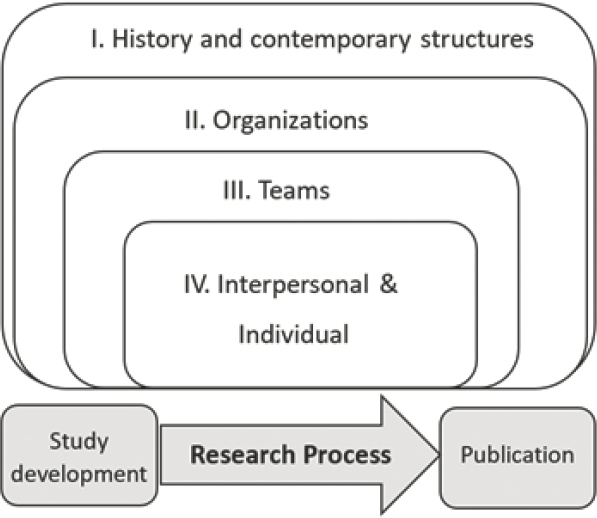
SOURCE: Committee generated.
societal structures of the United States. Subsequently, the research agenda covers items that address the organization level; questions around teams; and finally, the interpersonal and individual levels. There are several instances in which research agenda items may be located within a specific level, but actually span multiple levels due to the complexity of how these levels are overlapping. Therefore, the overall organizational structure of the research agenda by level is meant to help guide the reader; it is not meant to enforce strict ideological boundaries between the levels. The second half of the research agenda addresses the research process. The committee found that knowledge gaps persist for two primary reasons. First, the gaps exist because there is a need to expand on what is being studied. Second, the gaps exist because methodological research practices that are implemented inform how the research is conducted. Taken together, the types of research questions asked and the ways in which science is conducted can inform, create, and sustain the evidence gaps in the scientific literature. The committee believed that to address the knowledge gaps and develop an innovative agenda, each part of the research process starting
from study development through publication needed to be taken into consideration. The items discussed in the research process are meant to apply to all levels of analysis from historical structures to the individual level. By addressing these factors, the body of empirical science would continue to become a more authentic representation of the human experience and help to meaningfully advance antiracism, diversity, equity, and inclusion in STEMM.
Overall, this chapter has implications for many STEMM stakeholders who take part in research, including but not limited to students, trainees, faculty, staff, statistical analysts, ethicists, scientists, administrators, and leaders. The committee believes that many stakeholders in STEMM may consider prioritizing the entire agenda as these numerous and multi-level gaps can be addressed simultaneously.
HISTORY AND CONTEMPORARY STRUCTURES
Based on its examination of the historical context, the committee found that there needs to be a more complete and comprehensive national and international investigation of reparations from national governments to groups of people who have been harmed by historic policies and practices (Darity and Mullen, 2020; U.S. Congress, 2021). Part of the investigations could include how a system could be implemented, and ultimately test what kind of impact reparations may have on minoritized individuals and their ability to enter into and thrive in STEMM, as well as the impact on the White majority group. There needs to be greater examinations of the following (Darity and Mullen, 2020; U.S. Congress, 2021):
- Historical forms of reparations in the United States and internationally, and determining their impact on aiding minoritized individuals in entering spaces in which they remain underrepresented, including STEMM.
- The range of outcomes associated with the implementation of reparations. Outcomes include, but are not limited to, reducing disparities and systemic racism across multiple sectors that underlie entry into STEMM:
- Health outcomes and other metrics of quality of life
- Educational outcomes in STEMM
- Wealth—current and generational
- Career opportunities in STEMM
- Identification of the multiple institutions, including those in STEMM education and industry, that worked to support slavery, genocide, and continued White supremacy. The goal is to determine the institution(s) that are responsible for making reparations.
-
Identification of the full population of recipients. Identifying the complete population of individuals in the United States who have been harmed by slavery, genocide, and continued White supremacy.
- Examinations of additional and significant damages accrued from post-slavery forms of systemic racism. For instance, this may include considering the impacts of legalized segregation (Coates, 2014).
- Identifying what form reparations may take, and quantifying what could be given directly to those impacted, including those in STEMM contexts.
There needs to be a greater examination of the impact of structural financial investments in communities of minoritized individuals in the United States. As these sectors underlie entry into STEMM, it is important to examine whether financial investments in areas in which minoritized individuals have faced systemic disinvestment and disadvantage would ultimately help improve wether presentation and their ability to thrive in STEMM for generations to come. There needs to be greater examinations of the following:
- Novel or emerging investments to understand their scalability and impact on minoritized individuals.
- Historical investments to understand their impact on minoritized individuals.
- Structural investments that serve to address various inequalities that directly map onto the empirically supported historical and current legacies of structural racism. These are inclusive of, but not limited to the following:
- Community health investments: in both mental health and physical health resources.
- Neighborhood investments: in housing and living conditions of minoritized individuals’ neighborhoods.
- Educational investments: in schools, colleges, and universities that may still face inequities in funding.
- Climate change investments: in minoritized individuals’ neighborhoods and regions that may face a disproportionate burden of suffering from the consequences of climate change.
- Industry investments: in STEMM businesses that are owned and run by minoritized individuals. Investments may include entrepreneurial resources, and other financial mechanisms that support ownership and longevity of these STEMM businesses (McGee, 2020).
Similar to the previous point, there needs to be a greater examination of the impact of novel, emerging, existing, and historical policies that are
developed with the purpose of helping reduce racial hierarchy and remove structural barriers for minoritized individuals (e.g., Bailey et al., 2021). As these sectors listed below underlie entry into STEMM, it is important to examine whether policies that aim to help reduce inequality would ultimately help improve representation and ability to thrive in STEMM for generations to come. There needs to be greater examination of the following:
- Policies that directly map on to the empirically supported historical and current legacies of structural racism. These are inclusive of, but not limited to the following:
- Policies that reform incarceration
- Policies that reform policing
- Policies that reform healthcare
- Policies that reform housing
- Policies that reform education
- Policies that reform wealth accumulation and distribution
As stated previously in the report, Title VII of the Civil Rights Act of 1964 was a milestone in helping promote antiracism, diversity, equity, and inclusion in STEMM organizations. It made discrimination on the basis of race, along with other protected “classes,” unlawful. The committee encountered literature suggesting there may remain an exemption for small businesses, such that specific subsets (U.S. Equal Employment Opportunity Commission, n.d.) of small businesses may be exempt from following Title VII, and this may include small businesses in STEMM (Carlson, 2006; Chay, 1998; Lewallen, 2014; Roberson, 2019). There needs to be a greater empirical examination of the following:
- What fraction of the STEMM workforce is in small businesses, and what is the fraction of minoritized individuals in these spaces?
- Are there patterns of racial and ethnic discrimination over time in small exempt STEMM businesses?
- What are the workplace conditions like in small exempt STEMM businesses?
- Are there gaps between different levels and forms of discrimination protection? For example, federal-level, state-level, and other potential mechanisms?
ORGANIZATIONS
There needs to be a greater examination of how federal agencies, such as but not limited to the National Science Foundation and National Institutes of Health, could use their convening and grant-making powers to support fundamental change in STEMM organizations that use and depend
on their resources. There needs to be a greater empirical examination of the following:
- Tying federal financial resources to antiracism, diversity, equity, and inclusion goals to help increase institutional transparency and incentivize change.
- Assessment of the impact and sustained effect of prior and current programs aimed at increasing antiracism, diversity, equity, and inclusion in STEMM.
- Making funding requirements and terms of receiving research funding contingent on STEMM organizations and principal investigators achieving specified antiracism, diversity, equity, and inclusion goals.
- This may include rewards over penalty focus.
- This may also include penalties for non-compliance with limitations on acquiring future funding.
- Funding requirements may include expectations on continuous reporting and tracking of antiracism, diversity, equity, and inclusion efforts and outcomes.
As discussed in Chapter 2, the committee found that while minority serving institutions (MSIs) have faced significant underfunding, they have advanced representation by helping minoritized students obtain STEMM degrees. Since MSIs are a critical asset, there needs to be a continued and more robust empirical investigation that helps better understand the ways in which the strengths of MSIs can be advanced and leveraged. There needs to be a greater empirical examination of the following:
- Development and testing of interventions that help bring MSI-based programs and practices that are successfully helping minoritized individuals achieve STEMM degrees to predominantly White institutions.
- If continued or increasing financial investments to support MSIs help further increase the percentage of minoritized individuals who persist in acquiring a STEMM education.
There needs to be a greater assessment of persistence of students in the STEMM degrees, across all STEMM disciplines. This includes a strong focus on minoritized individuals. To accomplish this, it will be essential to know the demographics of the students entering college intending to study STEMM and their educational outcomes. There needs to be a greater empirical examination of the following questions:
- How many graduated with a STEMM bachelor’s degree?
- How many switched to a non-STEMM major?
- How many left college with no degree?
Minoritized individuals with STEMM training who have left STEMM at various points may represent an unused and yet valuable workforce (Rahman et al., 2020). However, there is not much research focused on how to reintegrate these individuals back into the STEMM workforce. There needs to be a greater examination of these minoritized individuals who have left with the goal of facilitating their reentry and retaining the pool of lost talent. There needs to be a greater empirical examination of the following:
- What are the factors, programs, policies, and practices that may help promote the reinclusion and reincorporation of minoritized individuals who have left?
- Development and empirical testing of interventions that may help promote reinclusion and reincorporation of minoritized individuals. Interventions could potentially be designed to target groups of individuals who left at different points (e.g., undergraduates who left, Ph.D.’s who left).
- What are the strengths, skills, resources, and perspectives that minoritized individuals bring back with them into the STEMM workforce?
Additional organizational psychology research is needed to examine the organizational systems, dynamics, and incentives that inform advancements in antiracism, diversity, equity, and inclusion across several STEMM contexts, including STEMM departments within universities and various business units within industry settings. There also needs to be greater investigation on the role of community accountability in helping advance and sustain antiracism, diversity, equity, and inclusion.
The committee encountered some scholarship that has supported the greater or more systematic use of positionality statements in research-based spaces (e.g., Roberts et al., 2020). Positionality is defined broadly as a reflexive practice, during which an individual conducts an internal self-examination to critically consider how their unique “position” informs the way they conduct science, research, and other STEMM activities. This may include a complete examination of an individual’s own identities (e.g., demographic identities), political leaning, worldviews, experiences, and relations to systemic privilege as well as their relations to marginalization (Secules et al., 2021).
Scholars have noted that during the practice of determining an individual’s positionality, the person is considering their unique social location and their unique perspective, as it informs the entire process of science, from developing research questions, to selecting and interacting with participants, to interpreting and analyzing the results (Hampton et al., 2021). While emerging as a potential tool of helping fostering antiracism, diversity, equity, and inclusion, it remains an empirical question whether these
statements have a measurable impact in improving antiracism, diversity, equity, and inclusion in STEMM. There needs to be a greater empirical examination of the following:
- Are positionality statements effective in helping gatekeepers reflect on, address, and ultimately reduce bias at the individual level?
- Are positionality statements effective as a teaching tool in helping promote structural racism awareness, increase knowledge of racism in STEMM, and foster ongoing antiracism, diversity, equity, and inclusion learning?
- Are positionality statements effective in promoting structural racism awareness at the leadership level, and a tool in helping initiate larger organizational culture change?
There needs to be a continued investigation focused on identifying which organization-level interventions, including policies, practices, procedures, opportunity structures, trainings, and interventions, work in producing measurable and sustainable change in advancing antiracism, diversity, equity, and inclusion in STEMM organizations. There needs to be a greater empirical examination of the following:
- Which novel interventions are effective in producing meaningful change in the short term? In the long term? And for whom?
- Under what conditions can diversity training be effective and for whom?
- How might different interventions target different groups of minoritized individuals over the course of their career trajectory to maximize antiracism, diversity, equity, and inclusion in STEMM?
- How personnel who hold power in these organizations can help advance antiracism, diversity, equity, and inclusion in STEMM.
- There needs to be increased research examining different models of leadership that work to de-center White individuals in power and help increase antiracism, diversity, equity, and inclusion in the highest ranks of STEMM. For instance, research could examine whether leadership term limits increase representation at the highest levels of STEMM (Beeler et al., 2019).
- Understanding how leadership roles are defined in different STEMM organizations may inform accountability for advancing antiracism, diversity, equity, and inclusion.
- What are the conditions and resources that DEI officers need to help promote measurable antiracism, diversity, equity, and inclusion change in a given organization?
-
- What are the conditions and resources that human resource departments need to help promote measurable antiracism, diversity, equity, and inclusion change in a given organization?
- How can leadership of organizations examine incentive structures at different levels of power? Along with research, teaching, and service, adding antiracism, diversity, equity, and inclusion to regular faculty responsibilities, with salaries dependent on quality of results, may potentially incentivize antiracism, diversity, equity, and inclusion efforts. This includes understanding how upper-level administrators could also be incentivized by adding antiracism, diversity, equity, and inclusion to their accountability.
There needs to be a more comprehensive examination of the organization-level White-centered “professionalism” standards that impact minoritized individuals. For instance, as discussed in Chapter 5, research has demonstrated that many minoritized individuals codeswitch in predominantly White contexts. However, further investigation into STEMM contexts is needed. There needs to be a greater empirical examination of the following:
- What are the conditions like in STEMM contexts that strongly adhere to White-centered “professionalism” standards?
- How minoritized individuals codeswitch and navigate within White-centered STEMM workplaces, and what impact this has on them.
- Examining hair (e.g., Powell, 2018) and hair covering discrimination as a mechanism of upholding White-centered professionalism standards in STEMM.
- Researchers could conduct a robust examination of this form of discrimination occurring within STEMM contexts to develop a broader understanding of the prevalence.
- How do hair and hair covering discrimination vary by states, STEMM institutions, and STEMM companies across the United States with differing levels of protection for minoritized individuals?
TEAMS
More robust investigations are needed to focus on identifying which team-based interventions—including policies, practices, procedures, opportunity structures, trainings, and interventions—are most effective in producing measurable and sustainable change that advances antiracism, diversity, equity, and inclusion in STEMM teams. Specifically, there needs to be a
greater examination of the contact hypothesis in STEMM organizations. Namely, researchers should continue to identify the team-based factors that help facilitate bias reduction and increase experiences of inclusion within STEMM teams.
Additional research is needed from the perspective of minoritized individuals. Furthermore, there needs to be an examination of what it means to build a critical mass of minoritized individuals on STEMM teams, and the impact that has on team performance and minoritized individuals.
INTERPERSONAL AND INDIVIDUAL DYNAMICS
Chapters 5 and 6 articulated how racism is experienced or perpetuated at an individual level. However, there are likely conditions under which a given individual may experience racism and also perpetuate it. There needs to be a greater examination of this phenomenon.
- What are the conditions under which individuals may perpetuate racism, and the conditions under which individuals may actively engage in antiracist behaviors?
The phenomenon of racism denial, while not a central focus of the report, needs a more robust examination as this may inform how interventions and strategies toward promoting antiracism, diversity, equity, and inclusion in STEMM are formed. There needs to be a greater empirical examination of the following:
- The incidence and impact of racism denial across various STEMM sectors.
- Racism denial among a range of STEMM leaders and stakeholders including those in universities, colleges, communities, industries, and funding agencies.
- The predictors and mechanisms that give rise to racism denial and how it resembles or differs from existing research and theory on aversive racism and modern racism.
- How racism denial beliefs at the individual level may inform interpersonal interactions, again relative to what is known.
In addition, there needs to be a continued, more robust, and more in-depth understanding of minoritized individuals’ sense of belonging and inclusion, beyond what is already known.
The committee determined that a continued examination of the factors, conditions, and mechanisms that predict a greater sense of belonging and inclusion across multiple STEMM contexts. Furthermore, there needs to
be a more robust body of qualitative and mixed-methods research capturing the lived experiences of minoritized individuals. This research should prioritize individuals that are not only minoritized in STEMM, but also minoritized in the empirical literature. These more in-depth data collection efforts may help provide a better understanding of the unique sets of barriers, opportunities, and points of interventions for specific individuals who remain at the furthest margins in STEMM.
Finally, there needs to be a more robust body of research examining both White identity and the emotions of White individuals. There needs to be a greater empirical examination of the following:
- How identity and various emotions are associated.
- How emotions inform intergroup contact, mentorship in STEMM, team cohesion and performance, developing and fostering ally ship in STEMM, and leadership quality.
- Do White identity and emotions operate to uphold systemic racism in STEMM?
The committee notes that additional research is needed to examine the potential impact of other high-status individuals beyond senior mentors, including sponsors and champions, in helping promote greater representation and inclusion of minoritized individuals in STEMM contexts. This includes research that examines which specific features of a physical environment are most inclusive for minoritized individuals. Furthermore, additional research is needed to identify the specific components of summer bridge programs that may be significant factors in producing specific positive outcomes for minoritized individuals.
The committee found that additional research is needed to examine the psychological impacts of perpetuating racism from the perspective of the gatekeeper in STEMM. In addition, additional research is needed to identify ways to reduce the negative impacts of racialized trauma.
The body of research on Indigenous individuals’ experiences in STEMM education spaces and the workforce is scarce. A much more robust program of research is needed.1 Specific points of empirical investigation based on the committee’s review of the literature are included below:
- There needs to be additional research that includes and examines the experiences of Indigenous individuals in a variety of STEMM contexts.
___________________
1 This section draws on an expert review commissioned by the committee (Smith, 2022).
- Deeper examinations of the factors that discourage Indigenous individuals from pursuing STEMM, and a deeper examination of factors that promote their full participation in STEMM environments.
- Greater examination of these factors across a range of STEMM disciplines.
- Continued examinations of the impact of Indigenous-centered mentoring programs on persistence and advancement in STEMM contexts.
A much more robust and nuanced body of research focused on Asian Americans in STEMM contexts is needed.2 Asian Americans are not a monolithic group, and persons who identify as Asian American may claim many different geographical, ethnic, and immigrant roots. There needs to be a greater empirical examination of the following:
- The representation in STEMM of different Asian American ethnic groups and nationalities.
- Identify and better understand the factors that can contribute to attrition and retention of Asian Americans in STEMM contexts, with a focus on the role of feelings of belonging and inclusion.
- Examinations of the experiences of Asian Americans in additional STEMM educational contexts, including public universities and community colleges (Kim et al., 2022).
- Continued research identifying the specific sectors and positions in STEMM that Asian Americans remain numerically underrepresented.
- Examinations of how immigration laws and immigration status may impact Asian American’s experiences in STEMM contexts.
In addition, a much more robust and nuanced body of literature focusing on Latine individuals in STEMM contexts is needed.3 Latine is not a monolithic identity, but rather a group that comprises persons who identify as Latine claiming many different geographical, racial, and immigrant roots. There needs to be a greater empirical examination of the following:
- Literature reviews and meta-analyses focusing on the experiences of Latine individuals navigating STEMM career pathways. These should be a priority in order to be able to track trends over time and identify whether policy advances have affected practices and outcomes.
___________________
2 This section draws on an expert review commissioned by the committee (Cobian et al., 2022).
3 This section draws on an expert review commissioned by the committee (Trujillo, 2022).
- Deeper examinations of the factors that deter Latine individuals from pursuing STEMM, and a deeper examination of factors that promote their full participation in STEMM environments.
- Greater examination of these factors across a range of STEMM disciplines.
- More studies focusing on how Hispanic Serving Institutions (HSIs) impact Latine individuals’ experiences of belonging and persistence outcomes in STEMM.
- More research focused on the Latine individual’s workforce experience in STEMM industry spaces outside the academy.
- More studies on how immigration policy impacts retention and persistence of Latine individuals, with special attention to first-generation students.
A much more robust and nuanced body of literature focused on Black individuals in STEMM is needed. There needs to be a greater empirical examination of the following:
- The benefits of optimizing Black individuals’ sense of belonging and inclusion.
- The costs of not optimizing Black individuals’ sense of belonging and inclusion.
- The policies, practices, procedures, opportunity structures, trainings, and interventions that work in producing measurable and sustainable change in increasing Black individuals’ representation across all STEMM sectors.
- The Black experience in STEMM careers. This research would benefit from quantitative and qualitative accounts that capture the full range of professional outcomes in different roles, career stages, and in different sectors.
RESEARCH PROCESS: ITEMS FOR ALL LEVELS
As discussed previously, the second half of the research agenda addresses the research process. The items discussed in the research process are meant to apply to all levels of analysis ranging from historical structures to the individual level.
Evaluation
Federal agencies have supported many programs aimed at increasing diversity in STEMM. What is needed is a retrospective evaluation of the effectiveness of these programs—under what conditions were goals
achieved or not achieved? What is the effectiveness tradeoff between term (e.g., number of years) of support and sustainable effect? Similar reports or research publications at the same magnitude of the current report are needed for each minoritized group (Latine, Indigenous, and Asian American groups) in STEMM.
Additional Populations
Much of the research examining minoritized individuals in STEMM (see Chapter 5) focuses heavily on those in the early training/career stages. Additional research examining the experiences and the consequences of racism among minoritized individuals in middle-stage and late-stages of their careers is needed.
Learners from minoritized populations may be likely to exit and reenter academic degree programs and start careers later in life. More robust data collection methods are needed to track minoritized individuals’ career pathways across institutions and life circumstances.
Theoretical Frameworks
Many gaps in the antiracism, diversity, equity, and inclusion STEMM literature persist, in part, because of the ways in which certain theoretical frameworks are used. The incorporation of more of the suggested frameworks below will help permit certain research questions to be asked and necessary data to be collected.
Many existing studies on minoritized individuals use a deficit-based framework to understand existing challenges (see Chapter 5). While deficits and challenges are important to understand, there are also many assets that exist in these populations that are ignored and underutilized as a resource. There needs to be a greater shift from an overreliance on the deficit framework to an asset-based framework in the production of new research. There also needs to be a shift away from the framework of the hero’s journey (of individual resilience) to a framework that focuses more on relevant structures and conditions that promote antiracist systems.
In addition, there needs to be greater use and inclusion of an intersectional framework (Crenshaw, 1989, 2012).
- Researchers need to consider the connections between identities and systems, and their implications for minoritized individuals in STEMM. This includes how multiple systems and structures of privilege and oppression that are connected to individuals’ multiple identities inform the lived experiences of minoritized individuals across various STEMM contexts.
Finally, the “leaky pipeline” metaphor is both false and harmful, and this framework should be abandoned (e.g., Cannady et al., 2014). Persons have agency and are not a commodity. Furthermore, the system through which the persons travel is not inert; rather, leaders have the responsibility for actively creating an inclusive environment. The “leaky pipeline” framework frequently describes the points where minoritized individuals exit STEMM. While it is critical to understand the factors that contribute to attrition and the points in which they occur, this framework limits empirical investigation. Like a leaking pipe, it is presumed that these individuals are lost forever, and there are no possibilities of reentry into the pipeline.
Ways of Conducting Science
There needs to be a greater consideration of how antiracism, diversity, equity, and inclusion STEMM researchers can shift their structures and paradigms of science and science education to be inclusive of Indigenous ways of knowing.4 This will help increase inclusive participation, advancement, and creation and education of science across STEMM sectors.
- In an effort to create dedicated and reciprocal relationships with tribal communities, researchers need to be transparent in their intentions in developing collaborations with them.
- There needs to be increased efforts that identify research practices of holism that capture the strengths of utilizing multiple knowledge systems. In doing so, this may help build capacity for tribal sovereignty and improve research practices for the broader research community.
- Researchers need to develop research questions that are central and important to Indigenous communities; they must focus on building lasting relationships with community members, and work on co-creating knowledge and science with these members.
Researchers need to examine how they can actively amplify alternative perspectives such as critical methodologies and standpoint epistemologies that actively center on challenging systems of oppressions in STEMM. Furthermore, antiracism is an emerging construct, and additional methodological research is needed to understand how to empirically measure this construct.
___________________
4 This section draws on an expert review commissioned by the committee (Smith, 2022).
Survey Building and Analytic Techniques
Researchers who want to conduct racial and ethnic antiracism, diversity, equity, and inclusion-related STEMM research should center race and ethnicity as a primary lens of their research plan.
- There is a greater need to make race and ethnicity central in the data collection and analysis of the research. Other factors by which diversity can occur on (personality, geography, etc.) should not necessarily be a central focus in these contexts.
- These studies need to include questions that permit the collection of demographic data, including various racial and ethnic identities.
- Qualitative measures can help give space for individuals to write in how they describe their own identities (Roberts et al., 2020). This may help permit greater nuance in data collection efforts.
In addition, there needs to be a greater incorporation of factors that may vary by race and ethnicity. These are essential in understanding minoritized individuals’ experiences, barriers, and opportunities in STEMM contexts. Researchers should consider including measures that assess the following factors:
- Skin color and other physical features
- Immigration status, national origin
- Perceptions of academic ability
- Language and other culturally relevant factors
- Family, social support, and tribal community ties/support
- Accessibility to important STEMM networks
- Socioeconomic status and or class
- Gender identity
- First-generation academic status
Data in STEMM contexts should be disaggregated by the following factors, when possible, to better understand the phenomenon of antiracism, diversity, equity, and inclusion in STEMM:
- Race and ethnicity
- Discipline or sector (physical sciences, life, math, engineering, etc.)
- Within race and ethnicity groups. Each group is not a monolith, and greater examination of patterns within a given minoritized group is needed.
- Immigration status
Additional research is needed that moves beyond using White participants as the only or primary comparator group. Many gaps would be filled if researchers in the areas of antiracism, diversity, equity, and inclusion and STEMM would include a robust description of the demographic data in sections of scientific papers (Roberts et al., 2020). Cross-sectional and longitudinal studies should continue to be conducted at each level of analysis (historical to individual).
Ethical Approval and Considerations
To accurately fill the gaps in the evidence base, there needs to be a critical consideration of research ethics and how they factor into the production of knowledge. Researchers also need to critically consider how missing data for race and ethnicity are handled. The implications, risks, and benefits, of conclusions drawn from imputed race and ethnicity data should be considered carefully (Randall et al., 2021).
When collaborating and working with minoritized communities (Randall et al., 2021), there needs to be ongoing communication about the data collection, ownership of data, and transparency of the outcomes. Efforts to prevent harm to minoritized communities should be built into the ethical practices of the research studies.
In addition, researchers need to critically consider and minimize the potential risk of identifying single minoritized individuals (Randall et al., 2021), including when studying non-numerically diverse STEMM spaces. For example, there may only be one Black woman in a given department of interest. In these cases, methods may be employed to examine more aggregate patterns and protect individuals.
Study leaders who are examining antiracism, diversity, equity, and inclusion across a variety of STEMM contexts need to develop diverse research teams when studying these issues, as research team representation informs the knowledge gaps that are being filled.
- There needs to be a critical and careful examination if an all-White research team is developing conclusions, recommendations, and/or speaking on behalf of a minoritized group of which they are not part (Roberts et al., 2020).
- There needs to be increased cross-disciplinary collaborations between social scientists who are experts in the fields of antiracism, diversity, equity, and inclusion, and those within STEMM fields who are not experts in antiracism, diversity, equity, and inclusion. This will help guide the formation of study designs that include valid, reliable, and gold-standard measures, and incorporate the
- necessary considerations of conducting antiracism, diversity, equity, and inclusion research in this area.
Publication and Distribution of Knowledge
Gaps in the body of literature can only be filled if spaces are actively constructed that allow these very gaps to be filled. These spaces exist in publication and distribution structures (see also Roberts et al., 2020).
- Journal editors and field leaders can generate more outlets for research on antiracism, diversity, equity, and inclusion in STEMM to be published.
- Space in existing mainstream STEMM and social science journals, especially those with the highest impact factors, can be allocated to the dedication of antiracism, diversity, equity, and inclusion-related research. Journal editors can consider what proportion of space could be dedicated.
- At the same time, journal editors can decrease space for research that perpetuates harm to minoritized communities in STEMM. Editors could consider how journal requirements and standards could be implemented to best achieve this.
- There needs to be greater federal infrastructure and outlets that permit the publication of federally supported research on antiracism, diversity, equity, and inclusion in STEMM.
CONCLUSION
The scientific evidence and lived experiences presented in this report offer critical insights and form a strong foundation for the committee’s research agenda. Stakeholders who conduct and fund STEMM research can use this research agenda to fill critical gaps in the empirical evidence base and improve how research is conducted. Attention to each of the priority areas identified by the committee will contribute to a more robust evidence base that is needed to advance antiracism, diversity, equity, and inclusion.
REFERENCES
Bailey, Z.D., Feldman, J.M., and Bassett, M.T. (2021). How structural racism works—racist policies as a root cause of US racial health inequities. New England Journal of Medicine, 384(8), 768–773.
Beeler, W.H., Mangurian, C., and Jagsi, R. (2019). Unplugging the pipeline—a call for term limits in academic medicine. The New England journal of medicine, 381(16), 1508–1511.
Cannady, M.A., Greenwald, E., and Harris, K.N. (2014). Problematizing the STEM pipeline metaphor: Is the STEM pipeline metaphor serving our students and the STEM workforce?. Science Education, 98(3), 443–460.
Carlson, R. (2006). The small firm exemption and the single employer doctrine in employment discrimination law. St. John’s Law Review, 80, 1197.
Chay, K.Y. (1998). The impact of federal civil rights policy on black economic progress: Evidence from the equal employment opportunity act of 1972. ILR Review, 51(4), 608–632.
Coates, T. (2014). The case for reparations. https://www.theatlantic.com/magazine/archive/2014/06/the-case-for-reparations/361631/
Cobian, K., Fang, J., and Poon, O. (2022). A Call for a Critical Intersectional Lens for DEI and Anti-Racist Strategies to Include Asian Americans. Unpublished paper commissioned by the Committee on Advancing Antiracism, Diversity, Equity, and Inclusion in STEMM Organizations, National Academies of Sciences, Engineering, and Medicine.
Crenshaw, K.W. (2012). From private violence to mass incarceration: Thinking intersectionally about women, race, and social control. UCLA Law Review, 59, 1418.
________. (1989). Demarginalizing the intersection of race and sex: A Black feminist critique of antidiscrimination doctrine, feminist theory and antiracist politics. University of Chicago Legal Forum, 139–167.
Darity Jr, W.A., and Mullen, A.K. (2020). From here to equality: Reparations for Black Americans in the twenty-first century. UNC Press Books.
Hampton, C., Reeping, D., and Ozkan, D.S. (2021). Positionality statements in engineering education research: A look at the hand that guides the methodological tools. Studies in Engineering Education, 1(2).
Kim, V., Alcantar, C.M., and Teranishi, R.T. (2022). The AANAPISI-funded STEM Program: An institutional response to the needs of Asian American community college students. Community College Journal of Research and Practice, 1–15.
Lewallen, D. (2014). Follow the leader: Why all states should remove minimum employee thresholds in antidiscrimination statutes. Indiana Law Review, 47, 817.
McGee, E.O. (2020). Interrogating structural racism in STEM higher education. Educational Researcher, 49(9), 633–644.
Powell, C. (2018). Bias, employment discrimination, and Black women’s hair: Another way forward. BYU Law Review, 933. https://digitalcommons.law.byu.edu/lawreview/vol2018/iss4/7
Rahman, F., Billionniere, E., Brown, Q., and Gates, A.Q. (2020). RESET (Re-Enter STEM through Emerging Technology) finding re-entry pathways for women. Proceedings of the 51st ACM Technical Symposium on Computer Science Education, 173–174.
Randall, M., Stern, A., and Su, Y. (2021). Five ethical risks to consider before filling missing race and ethnicity data. Urban Institute.
Roberson, A.B. (2019). The migrant farmworkers’ case for eliminating small-firm exemptions in antidiscrimination law. Texas Law Review, 98, 185.
Roberts, S.O., Bareket-Shavit, C., Dollins, F.A., Goldie, P.D., and Mortenson, E. (2020). Racial inequality in psychological research: Trends of the past and recommendations for the future. Perspectives on Psychological Science, 15(6), 1295–1309.
Secules, S., McCall, C., Mejia, J.A., Beebe, C., Masters, A.S.L., Sánchez-Peña, M., and Svyantek, M. (2021). Positionality practices and dimensions of impact on equity research: A collaborative inquiry and call to the community. Journal of Engineering Education, 110(1), 19–43.
Smith, T.D. (2022). Natives in STEM Literature Review. Unpublished paper commissioned by the Committee on Advancing Antiracism, Diversity, Equity, and Inclusion in STEMM Organizations, National Academies of Sciences, Engineering, and Medicine.
Trujillo, G. (2022). Hispanic/Latinx Anti-racism, Diversity, Equity, and Inclusion in STEM: A Commissioned Paper. Unpublished paper commissioned by the Committee on Advancing Antiracism, Diversity, Equity, and Inclusion in STEMM Organizations, National Academies of Sciences, Engineering, and Medicine.
U.S. Congress (2021). H.R.40 - Commission to Study and Develop Reparation Proposals for African Americans Act. https://www.congress.gov/bill/117th-congress/housebill/40
U.S. Equal Employment Opportunity Commission. (n.d.) Get the facts series: Small business information. https://www.eeoc.gov/publications/get-facts-series-small-business-information


