Rise and Thrive with Science: Teaching PK-5 Science and Engineering (2023)
Chapter: 1 Moving to "I Can Teach Like This"
1
Moving to “I Can Teach Like This”
If you teach science to children in preschool through fifth grade, or if you lead or support teachers, then you know that exciting changes are underway in science and engineering education. Perhaps your state’s science standards call on students to use the practices employed by scientists and engineers to build their knowledge of the crosscutting concepts and core ideas of science and engineering—an approach called “three-dimensional learning” (defined below). Perhaps your district or school is implementing a curriculum in which students ask questions, investigate real science phenomena or engineering problems, and leverage their growing knowledge to explain a phenomenon or design a solution.
This new approach weaves together all three dimensions of learning as laid out in the National Academies’ 2012 Framework for K–12 Science Education: Practices, Crosscutting Concepts, and Core Ideas1—scientific and engineering practices, crosscutting concepts, and disciplinary core ideas. When engaging in three-dimensional learning, students:
- Use practices (dimension 1) similar to those used by scientists and engineers.
- Learn and apply crosscutting concepts (dimension 2) of science and engineering.
- Develop and deepen their understanding of the disciplinary core ideas (dimension 3) of specific science disciplines and engineering.
Examples of how this looks in a classroom are given below.
This new approach is powerful, but it can be quite different from what many preschool and elementary educators are used to doing. Maybe you’re moving in the right direction but are unsure how to get there. If so, you’re in good company. Many
___________________
1 National Research Council. (2012). A framework for K–12 science education: Practices, crosscutting concepts, and core ideas. The National Academies Press. https://doi.org/10.17226/13165
preschool and elementary teachers feel invigorated by the possibilities of what they and their children can do with new approaches to science and engineering, but they have questions and a bit of apprehension about how to do it well.
What does this new approach to science instruction look like?
Consider the example of Ms. Ochoa, a fourth-grade teacher who teaches all subjects. She understands the value of science instruction in which students conduct their own investigations. But last year, her students weren’t as motivated about their science activities as she would have liked, and she wasn’t sure they really understood the disciplinary core ideas and crosscutting concepts she was teaching. For example, Ms. Ochoa taught students about the motion of waves by having them work at a water table where they created different-sized waves, floated small objects in the water, and


observed how the objects moved. Although the children enjoyed the hands-on activity, they couldn’t really articulate what they were trying to figure out.
This year, Ms. Ochoa is using some lessons from science instructional materials suggested by a colleague that are aligned to the NGSS and compatible with three-dimensional learning. Ms. Ochoa likes that the materials provide her with a structure for implementing three-dimensional learning while empowering students to identify questions and problems that matter to them and to plan, conduct, and refine their own investigations. She has already been using open-ended questions and prompts to guide student discussion, but this new approach enables her to sharpen those skills, as illustrated in the following case. Please note that the activities highlighted in the case are segments of a longer unit, designed to extend over 12 class periods of about 45 minutes each.
You may need time to become comfortable with and adept at these new strategies and role. But just as Ms. Ochoa learned from and improved on how she had taught in previous years, you, too, can build on things you already do as a teacher.
Why is three-dimensional learning effective?
The three-dimensional approach better reflects what scientists do than traditional instruction does. In three-dimensional learning, students are continually expanding and deepening their knowledge, rather than memorizing a collection of static science facts. The three-dimensional approach is also more rigorous—and vigorous!—than

I feel like elementary teachers are sometimes forgotten because we’re generalists, but it’s the most important time to really get kids pumped about science.
—Nikki Tanako, a kindergarten teacher in a Washington State suburban district3
traditional instruction because it recognizes that students need to do more than just learn the content (core ideas) of science disciplines; students also need to understand the crosscutting concepts that connect disciplines and be able to actively use their growing knowledge to answer questions and solve problems, as real scientists and engineers do. So, a three-dimensional approach shifts the goal of learning from “defining and understanding” science ideas to “developing and using” knowledge.
Is three-dimensional learning appropriate for younger children?
The answer is absolutely, as evidenced by the main source for this guide, the National Academies’ Brilliance and Strengths report.4 Three-dimensional learning leverages children’s intense curiosity about the world around them and their eagerness to investigate. Children as young as preschool age can think and act like scientists and engineers as a pathway to learning the concepts and core ideas of these fields.
What kinds of instruction make three-dimensional learning happen?
Research synthesized in the National Academies’ Science and Engineering in Preschool through Elementary Grades: The Brilliance of Children and the Strengths of Educators report has identified certain key features of instruction that help preschool and elementary teachers engage children in three-dimensional learning.
Box 1-1 summarizes these and other key features of effective science and engineering instruction.
___________________
3 National Academies of Sciences, Engineering, and Medicine. (2022, March 16). Taking stock of science standards implementation: A summit—supporting 3D instructional shifts coffee talk [Webinar]. https://www.nationalacademies.org/event/03-16-2022/taking-stock-of-science-standards-implementation-a-summit-supporting-3d-instructional-shifts-coffee-talk
4 National Academies of Sciences, Engineering, and Medicine. (2022). Science and engineering in preschool through elementary grades: The brilliance of children and the strengths of educators The National Academies Press. https://doi.org/10.17226/26215
As a central feature, effective science instruction is anchored in investigations of meaningful phenomena—observable circumstances, events, or processes in the natural or built world. High-quality engineering instruction is anchored in designs of objects, systems, or processes to solve a problem or meet a need.
This type of instruction may look different from how you’ve taught in the past. Or, you may have tried some of these strategies and are ready to continue refining your practice in this pedagogy. Implementing these approaches requires teachers to learn, plan, and practice. But take heart. You may already be doing some of this, and you can start with small steps, as discussed later in this chapter. Implementing instruction for three-dimensional learning is an ongoing, long-term process.
Moreover, there are many different ways to teach that are aligned to the Framework for K–12 Science Education and centered on investigation and design. The later chapters of this guide provide details to help you with that process.
What does instruction anchored in science investigation and engineering design look like?
To see the key features of three-dimensional teaching and learning in action, let’s look at a case from a K–2 curriculum designed to integrate science, engineering, and literacy development.5 The units are centered on a puzzling phenomenon. Each lesson is organized around five components: students ask questions, explore a phenomenon or problem, read (or are read aloud to), write, and synthesize what they have learned. Most of the lessons are 60 minutes and the components allow the teachers to break up a lesson to spread it across multiple days.
This case spotlights portions of a unit for kindergarteners called the Boxcar Challenge. In the unit, students investigate how soapbox derby cars move in different ways without engines. They also take on an engineering design challenge by building small model boxcars out of cardstock and determining how to make their cars move farther, move faster, and turn around an obstacle. Learning experiences such as these, chosen with specific outcomes in mind, help students understand different aspects of motion and the forces of push and pull.
The case is just a snapshot—the Boxcar Challenge unit consists of 10 lessons of carefully designed and sequenced activities.6 Box 1-2 shows the student activities for each lesson of the unit.
As you review the case below, notice how Ms. Bassi, the teacher, taps into young children’s curiosity by inviting them to wonder aloud and ask their own questions. Throughout the unit, she also uses her own questions to elicit children’s thinking and get them to clarify and build on their own and others’ ideas. She attends to their non-verbal gestures as well.
Note, too, how children of kindergarten age can do investigations and engineering design. They propose ideas about how to change the motion of the boxcars. Using the model boxcars they construct, children investigate and gather evidence about how different types of pushes and pulls affect the boxcars. Finally, they design and test various solutions to make a boxcar move faster and farther and turn around an obstacle.
Another remarkable aspect of this case is how the instruction integrates opportunities for children to develop their language skills and literacy while engaging in science and engineering. Through reading, writing, and drawing activities, children
___________________
5 SOLID Start (Science, Oral Language, and Literacy Development from the Start of School), a K–2 curriculum developed by Michigan State University professors Tanya Wright, who specializes in language and literacy, and Amelia Gotwals, who specializes in science education.
6 The full curriculum materials can be accessed at https://education.msu.edu/research/projects/solid-start/curriculum/
record their ideas and observations, develop models, and advance their understanding of how the boxcars move.
On a related note, you can teach children science vocabulary like force and motion not as “words on a wall,” but by first getting them to explore the concepts and practices represented by the vocabulary words. After students incorporate aca-
demic terms into their everyday language, these newly-learned academic words can then go on a word wall. This process helps students develop fluency with new vocabulary as they continue to grow their conceptual understanding through investigation.
Chapters 3 through 7 of this guide describe these and other practices in depth, using additional cases and examples.
How does this approach to instruction benefit preschool and elementary children?
Many arguments for elevating science education in elementary school focus on preparing children for the future. For decades, scientists, educators, political leaders, and others have emphasized that it’s critical to start science instruction in the elementary grades to prepare students to take more challenging courses later and eventually to find good STEM-related jobs. Advocates for early science education also point out that society as a whole benefits from scientifically literate citizens who can make informed decisions about issues related to topics such as health and the environment.
Science and engineering learning for children’s “now”
The above points about preparing children for their adult futures are valid. There are also other, equally compelling reasons why children need high-quality science and engineering education that focus on children’s immediate experiences.
From an early age, children deserve to experience the wonders of science and the satisfaction of engineering for their present selves. Instruction anchored in investigation and design is conceived to stoke children’s enthusiasm for science and engineering and nurture joy. It gives children the means to answer their own questions and solve problems that grab their interest.
These approaches hold more promise for engaging all children in science and maintaining a lifelong interest in the field than traditional instruction does, with its focus on amassing knowledge of science facts. The new approaches honor how students learn and retain information by building a robust conceptual understanding.
Positive identification with science and engineering
When children investigate phenomena and engage in design challenges, they begin to see themselves as people who know and can do science and engineering. This attitude will serve them well throughout their lives, whether or not they pursue careers in these fields. Adults, as well as children, who know and identify positively with science have the confidence to make personal decisions using science, can critically
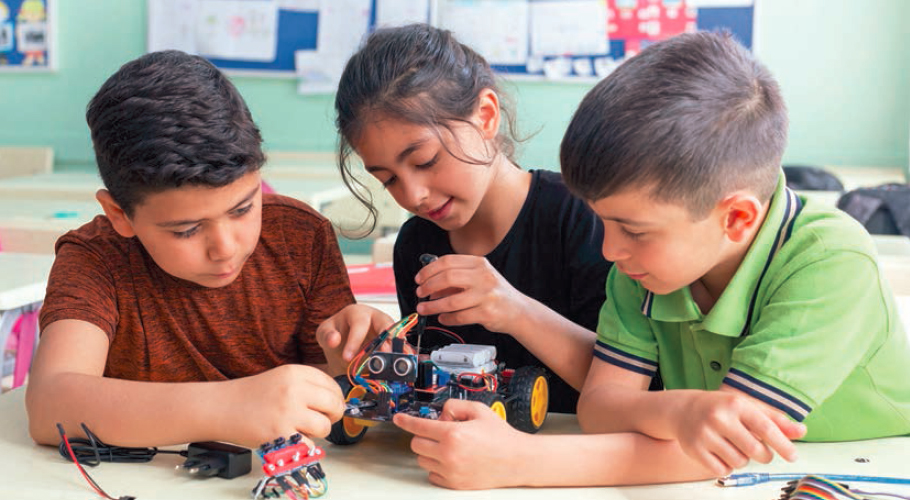
evaluate scientific information in the media, and can make informed decisions as community members.
Enhanced opportunities for engineering education
Opportunities for children to participate in engineering design are rare in preschool and elementary classrooms. This is much to the detriment of young children, because engineering education enhances their learning in several ways. Instruction centered on design problems can engage children’s curiosity much like informal play. It can strengthen children’s problem-solving and critical thinking and give them practice in fine motor skills and social skills. Creating something physical can help children make connections between the human-designed world and the core ideas and crosscutting concepts of science and engineering.
Equity and justice
Instruction anchored in investigation and design can advance equity and justice for all students. This type of instruction starts from the premise that all children, especially those from historically marginalized groups, can engage in scientific and engineering practices when they are supported and can learn and use core ideas and crosscutting concepts from these disciplines. This support takes many forms, such as connecting with children’s own interests and culture, recognizing their ideas and contributions

For elementary teachers, especially early elementary teachers, often they’re switching from not teaching science to some maybe quite challenging ways of teaching science—challenging in a good way . . . So what we’ll hear is, I don’t think my kids can do it. And we’ll say, well, we do think your kids can do it, in part because we’ve seen other kids do this and love it and be excited.
—Tanya Wright, associate professor of teacher education, Michigan State University12
as valid, providing multiple ways of demonstrating proficiency, and being thoughtful about teacher-student and student-student interactions. In Chapter 2 and subsequent chapters of this guide, you’ll find further discussion of ways to embed equity and address issues of justice throughout your science and engineering instruction. This can range from enhancing children’s opportunities and access in science and engineering to increasing representation and identity in science and engineering, and from expanding “what counts” as science and engineering to seeing science and engineering as a part of justice movements in your community.
How can I move toward teaching for three-dimensional learning?
Given the challenges, you may wonder, can I become effective and comfortable with instruction anchored in investigation and design? Can my students learn this way? The answers are yes and yes.
The purpose of this guide is not to intimidate you or add to your already heavy load, but to rejuvenate and inspire you, while building on your expertise and experience. In the chapters that follow, you’ll find further examples of practitioners at the preschool and elementary levels who have taken small and larger steps to transform
___________________
12 Interview, Dec. 10, 2021.
science and engineering instruction in ways supported by research. These educators work in different contexts and have varying levels of experience. Some have always loved science and were excited about trying new approaches, while others were more tentative. Some leaped all the way in, while others dipped a toe. Some started out alone and later found like-minded colleagues and mentors, while others entered as part of a professional development cohort. All of these practitioners have learned and grown alongside their students.
Rely on your strengths
Preschool and elementary teachers typically teach multiple subjects and may not have a specific background or expertise in science and engineering. As a result, you may feel somewhat overwhelmed by the vision of learning described in this chapter. Rest assured, however, that as a result of your breadth of experience, you bring many assets that can help you teach science and engineering subjects well. Among these assets are:
- An understanding of how children think and learn;
- An inclination to care for children and advocate for their well-being;
- Expertise in teaching reading and writing;
- A recognition of opportunities to connect across subjects;
- Repertoires for organizing small group work and whole class discussions;
- A capacity for building relationships with children and families;
- Inquisitiveness about the world and willingness to learn;
- Knowledge of a variety of teaching strategies;
- Experience with differentiating instruction for a variety of learners;
- Flexibility and resilience; and
- Other strengths that come from your own character and experiences.
Taking stock of your assets can give you the confidence to implement new approaches. And in building on your assets, you’ll find an entry point that works for you.
Recognize that both early-career and more experienced educators can make changes
Teachers of all experience levels have successfully implemented instruction anchored in investigation and design.
If you’re near the beginning of your teaching career, you may worry that you don’t have as much science experience or as many tried-and-true strategies as experienced teachers. But you may have a fresh outlook, a strong desire to try something promising with your students, and an open and creative mind.
Perhaps you can relate to the situation faced by Christopher Pritchard,13 when he was hired halfway through the school year by a Maryland school district. “We were still using the old curriculum, which was out of packets,” he said. And this old curriculum “wasn’t actually consistent with how we wanted to be teaching science.” The next year his school adopted a new curriculum. “Really, it was diving right in, because that’s all we had. And I didn’t have the experience of having the old lessons be something that I wanted to fall back on, to try and teach a lesson that I thought was really good from the packet days.”
That lack of experience worked in his favor. Mr. Pritchard and his principal took a course on the NGSS, where he met the district science specialists and was invited to join the district’s science cohort. “I dove in feet first,” he reported. “And it kind of just felt right—of all the curriculum that we teach, the science curriculum is the one that I think is most consistent across the board and feels put together and complete.”
Another new teacher from an urban New Jersey district, Lily Hamerstrom,14 had a similar experience when she was hired mid-year to teach fifth-grade science and mathematics. “I was just thrown into it,” she said. “And to be honest, science was on the back burner. I was a new teacher, and math was really what the district cared about at that point. And I didn’t have a background in science.”
With her district in the midst of implementing the NGSS, Hamerstrom was expected to teach an active-learning science curriculum adopted by the district. With limited opportunities for professional learning, she “winged it” by reading books and asking colleagues who taught all subjects. Eventually, her district became part of a pilot for a phenomenon-based curriculum developed at a university. After three years of professional development and support from the detailed curriculum and from other teachers and leaders, Hamerstrom was implementing phenomenon-based instruction with growing competence and confidence. She offers this advice to other new
___________________
13 Group interview, Jan. 12, 2022.
14 Interview, Mar. 7, 2021.
teachers: “The NGSS can be overwhelming if you look at it as a whole . . . But once you break it down, you can see it’s really nothing to be scared of . . . So, just dive into it.”15
If you’re a veteran teacher, you may face a different set of circumstances. You may have a reliable set of teaching strategies and lessons that you’ve polished over time and that have produced satisfactory results. You may be comfortable leading instruction and skilled at managing your classroom. These experiences may make you a bit wary about shifting more control to students.
Veteran teachers may recognize some commonalities in the experience of Barbara Germain,16 from Maryland. “It did take some time for me to realize that I’m not the one to just tell them what is happening—that it really should be more inquiry-based and more discovery-based,” she said. Her district’s approach encourages students to identify the questions to pursue. She responded in this way:
[W]e tried to lead [the students] in a certain direction. But ultimately, the students then get to plan their investigations. And that took me a while to really latch onto, because it’s hard to think, like, oh, they’re not going to get to this idea . . . I’ve learned over the years that they do get there, you know, in some way or another. And I think that is probably the biggest piece of growth that I’ve had as a teacher . . . giving students control.
To sum it up, whether you’re an early-career or veteran teacher, you have assets and tools that will help you implement new approaches to science and engineering education.
Start small and give it time
For a variety of reasons, you may not be able to implement a whole new approach all at once. The examples and advice in this guide can provide a starting point.
Teachers, researchers, and professional development providers offer these suggestions for easing into new approaches to instruction that integrate knowledge and practices of science and engineering:
- Use the structure and supports that come with your curriculum if it’s aligned to the three dimensions in the National Academies’ Framework for K–12 Science Education.
___________________
15 Interview, Mar. 7, 2022.
16 Group interview, Jan. 12, 2022.
- Focus on those strategies that you find inspiring, exciting, or promising and that draw on what you already know and can do. And then expand from there.
- Start with a lesson, activity, or strategy that you feel most comfortable with to build confidence and expertise, then move toward strategies that may have initially seemed intimidating.
- Take to heart this advice from Delia Harewood, a fifth-grade teacher in an urban district in the Northeastern U.S.: “If something didn’t work out really well, that is an opportunity to learn.”17
As you gain in confidence and experience, you will develop a broader repertoire of strategies that work for your classroom.
Remember that implementing instruction anchored in investigations and design problems is a long-term process of continual improvement. Recognize that it gets easier and better over time. Any curriculum that is aligned with the National Academies’ Framework for K–12 Science Education “is going to be rigorous and difficult in a good way, in an exciting way, but it’s not going to happen overnight,” said Alison Haas, project manager for the Science And Integrated Learning (SAIL) research lab at New York University. Teachers need time to learn a new approach and “play with it in their classrooms,” she explained.18
Adapt and differentiate
Within the broad elements of instruction anchored in investigation and design, not everyone will teach the same way. Even the best-designed approaches need to be adapted to your own context and your own students. Instructional strategies, content, activities, and types of support will vary by grade levels, based on the developmental level of the students. Implementation may also differ according to student strengths and needs, cultural and community contexts, geographic location, district policies, and more.
The chapters that follow provide guidance and examples for different grade levels, interests, and needs.
___________________
17 Interview, Jan. 3, 2022.
18 Interview, Mar. 7, 2022.
Seek out support to help overcome challenges
As you implement new or revised approaches, you’ll face the inevitable challenges. You can overcome some of these challenges yourself or with support from colleagues. Other systemic and policy challenges may require actions on a larger scale.
Many educators have already confronted and dealt with the same challenges you’re likely to face. Support can come from a variety of formal and informal sources—your teaching colleagues, your school or district instructional coaches and leaders, professional development providers, curriculum providers, local colleges and universities, and virtual communities, as well as science museums and other informal science learning environments. The epilogue to this guide talks about how educators can help each other move down the path toward three-dimensional instruction and get over the bumps.

Don’t be put off by systemic and policy challenges
Not all challenges can be addressed at the classroom level; some may be outside your immediate sphere of influence. In these situations, you can do as much as you can by thinking creatively and working collaboratively, but at some point, you’ll need to depend on leaders to address larger structural or policy issues.
One big systemic challenge in preschools and elementary schools is finding time to teach science and engineering well. In self-contained classrooms, just a small slice of the K–5 school day—about 20 minutes daily, on average—is typically devoted to science instruction.19 You want your students to pursue investigations and engineering design challenges, but you need a larger chunk of time. This situation is exacerbated by the pressure teachers at these levels face to meet testing and accountability requirements in English language arts (ELA) and mathematics. You would like to make time for high-quality science instruction, so what do you do?
Carefully and purposefully integrating instruction in science and engineering with ELA or math can help with the time crunch. Some teachers using the curriculum described in the Boxcar Challenge case have made time for a 60-minute science lesson by teaching science and social studies on alternate days, dividing longer investigation and design activities across two days, and shifting time from their reading/language arts block to teach aspects of a science or engineering unit that incorporate reading, writing, and language development. You can learn more about integrating across content areas in Chapter 7. That chapter emphasizes the importance of maintaining a focus on meaningful science instruction while supporting development of students’ proficiency in ELA and mathematics.
Enlightened principals and other leaders have made it a priority to organize school schedules to allow for more time and consistent time for science and engineering instruction. If your school schedule does not reserve enough time or your principal has not shown flexibility on this issue, you can sometimes collaborate with other teachers to bring up this issue with school leaders.
Teachers are also dealing with a host of broader workforce challenges. Teachers are expected to do more than ever and to persevere under pressure from a variety of sources, even as staff shortages have become more widespread. Because of this, many teachers and education leaders feel stressed and fatigued, and that must be acknowledged. Educators are generally resilient and have demonstrated their commitment and adaptability time and again. For this guide, the key question is how you can draw
___________________
19 Banilower, E. R., Smith, P. S., Malzahn, K. A., Plumley, C. L., Gordon, E. M., & Hayes, M. L. (2018). Report of the 2018 NSSME+. Horizon Research, Inc. https://horizon-research.com/NSSME/2018-nssme/research-products/reports/technical-report
on the capacity you have to teach science and engineering in the most effective ways to help children learn.
You can do this!
Moving toward this type of teaching and learning can be intimidating—and rewarding. The learning curve may be steep at first. Not every lesson will be a triumph, but that’s part of the process of teaching. Fifth-grade teacher Delia Harewood summed it up in this way:
There has been so much trial and error with how to adapt to the instruction. And I’ve had to get over my fear of failure, so to speak . . . But once you are comfortable, you have confidence. And because you’re confident now, you may feel like, ‘I can do better. I can now learn something that I may not know that much about and get support along the way.’20
___________________
20 Interview, Jan. 3, 2022.