Equity in K-12 STEM Education: Framing Decisions for the Future (2025)
Chapter: 3 Key Elements of the U.S. Education System
3
Key Elements of the U.S. Education System
In order to make the changes to the education system that are needed to overcome the legacy of the histories we discuss in Chapter 2, it is important to understand the complexity of the education system and identify what aspects of policy and practice can be leveraged to advance equity goals in science, technology, engineering, and medicine (STEM). In this chapter, we consider a number of key elements that make up the U.S. education system, as well as how these elements work together to enable the system in which STEM education takes place. In understanding the anatomy of this structure, we will be positioned to explain how to support efforts to improve equity in preK–12 STEM, which we will do later in this report.
The first section of this chapter describes the multiple, nested layers of the present education system, each of which may be responsible for originating policy, or interpreting and enacting policy originated at a “higher” level of the system. We turn then to four key policy domains that can be leveraged for making change within the U.S. education system and for supporting teaching and learning. Following this, we offer a brief description of our current policy context, with a primary focus on the federal policy landscape, which informs how STEM education plays out at all levels of the education system. We conclude with discussion of the role of funding in supporting efforts to enhance equity education.
In order to describe the key elements of the system as articulated above, it is critical to note that within this system, “policy” is the primary mechanism used to regulate, control, and support the implementation of education in the United States. For the purposes of this report, we define “policy” as the mandates, inducements, capacity-building, system changing,
and hortatory tools (McDonnell, 1994) that are used to “get people to do things they otherwise would not have done, or [… enable …] them to do things they might not have done otherwise” (Schneider & Ingram, 1990). Policy is a tool for shaping action in service of achieving a set of goals. The nested structure of the U.S. education system (described below) means that policy is both made and implemented at all levels—national, tribal, state, district, school, and classroom—and policy delineated at one level of the education system often “cascades” to other levels. Thus, within the complex structure that is the U.S. public education system, stakeholders at all levels design, implement, enact, and interpret policies intended to bring about desired ends.
The stakeholders are many. According to the National Center for Education Statistics (NCES), the U.S. public education system currently serves over 49.5 million preK–12 students in over 98,500 schools across the country (NCES, 2023), in districts ranging in size from one million students in New York City to the Bois Blanc Pines District in Michigan, which served five enrolled students in 2023 (NCES, Public School Review). The system employs over three million public school teachers, nearly 92,000 principals, and over 170,000 district-level employees. These various actors—students, teachers, parents, principals, school administrators, state departments of education, higher education stakeholders, advocacy organizations, think tanks, corporations, and a myriad of other entities involved in decision making—all have ideals, self-interests, and values. When they come into contact with public schools in the United States—whether as a student, employee, family member, or other role—each of these individuals interacts with one or more layers of a complex, layered system, and each has differing levels of power to elevate their priorities and achieve their goals within this system. Furthermore, as seen in the discussion of historical events and policy action in the previous chapter, different groups are differently impacted by the same policies.
While most of our discussion in this chapter focuses on the formal, public education system in the United States, there are other entities that also work to govern and support daily schooling. Indigenous nations—and their students, teachers, and schools—have their own policies that overlap but are not necessarily the same as non-Indigenous school, district, state, and national policy. While many Indigenous children attend traditional public schools, the Bureau of Indian Education (BIE) currently supports 183 elementary and secondary schools on 64 reservations in 23 states, serving approximately 40,000 Indian students. The BIE, which is part of the U.S. Department of the Interior, operates in the same capacity as a state education agency and administers and oversees the education programs in BIE-funded schools. The U.S. Department of Education “transfers funds to educate and provide services to students attending BIE-funded elementary
and secondary schools. Schools funded by the BIE are either operated by the BIE or by tribes under contracts or grants. BIE-operated schools are under the direct auspices of the BIE, and tribally operated schools are run by individual federally recognized tribes with grants or contracts from the BIE” (Bureau of Indian Education, n.d.).
Further, nearly 8,000 public charter schools serve over 3.5 million students in the United States. Governance of those charter schools varies by state and district, with some charter schools receiving their charter from (and therefore governed by) a state or district entity, and other charters existing completely independently of state or district regulation. Additionally, over 30,000 private schools operate in the United States, serving nearly 5.5 million students nationwide.
Lastly, we acknowledge that there are myriad organizations and partners outside the formal system that influence what happens in schools, ranging from lobbying and advocacy organizations at all levels, to informal and out-of-school-time education opportunities and organizations, to partners in other domains such as health care and juvenile justice. Moreover, we note that learning in STEM is not limited to what happens inside the walls of preK–12 school buildings; indeed, as we will discuss in Chapter 7 of this report, learning can happen in any setting at any time. Indeed, throughout this report, we discuss how STEM learning occurs in ecosystems that encompass schools, community settings such as afterschool and summer programs, science centers and museums, and informal experiences at home and in a variety of environments. A learning ecosystem harnesses the unique contributions of all these different settings in symbiosis to deliver within STEM learning a rich array of learning opportunities for all children.
THE NESTED LAYERS OF THE U.S. EDUCATION SYSTEM
In this section, we describe the layers of the U.S. education system: federal, tribal, state, district, and classroom. Although just under 8 percent of all money spent on public education comes from the federal government, federal education policy widely influences education through regulations and inducements. Policy made at the federal level can be made through congressional legislation, or through regulative or non-regulative guidance authored by the U.S. Department of Education, and other federal agencies are empowered to provide funding to other education entities (such as states or districts, or private education providers) to support education programming or research. Policy made at the federal level is often interpreted and implemented at other levels of the education system in varied and consequential ways.
The U.S. Constitution establishes public education as a function of the states, and as such, the vast majority of policymaking “action” in the
education system happens at the state level. States are responsible for developing and implementing the vast majority of policies governing education, including the instructional standards, curriculum adoption, student assessment, and teacher licensure, among many others. States shape education policy related to curricular standards, state assessments to track success of schools and students, graduation requirements, and teacher certification. They also provide funding to districts and schools. Because of this, the federal government has limited control and influence. States may elect to accept certain federal policy restrictions and regulations when they are attached to different federal funding streams.
In general, school districts are responsible for the implementation of education policy. States vary in how much decision-making and policy power rests with the state versus with the districts; in “local control” states, individual school districts have great autonomy and authority. Depending on the state, districts are generally responsible for determining how funds will be allocated, setting instructional priorities, and providing guidance for administrators and educators, among many other responsibilities. If districts are administering programs funded with federal or state dollars, they need to follow federal and state guidelines for those programs.
Districts are typically led by superintendents, who serve as the primary manager overseeing all school and district staff and operations. Often, districts employ directors or supervisors who oversee different district-level functions or specialty areas, such as curriculum and instruction, facilities, transportation, technology, and other areas. Within those domains, districts may also hire a series of roles designed to support the work of school administrators and educators, such as assessment support people, instructional coaches for professional learning, human resources individuals, and guidance and social work support staff, among many other roles. Districts often serve as the primary employer for administrators and educators: although educators may be hired to work in specific schools, the district often acts as the employment agent and therefore serves a human capital management function as well. The number of employees and the scope of their roles vary substantially from district to district across the United States. In smaller districts, the same educational leader may fill multiple roles that, in a larger district, would be each be filled by a separate employee.
In response to the guidance and regulations established at the district level, schools may also establish their own policies for both educators and students and families. School leaders are responsible for identifying instructional expectations, determining schedules, and establishing a climate that encourages (or discourages) different approaches to instruction. For students and families, schools are responsible for determining the policy that governs how students “show up” at schools, including what kinds of resources students are expected to bring with them into classrooms,
expectations regarding student behavior, norms and guidelines regarding homework and grading, expectations for family engagement, and other concerns.
Schools employ a range of professionals to support their work. School principals typically serve as the executive director of schools, and are pivotally important to the ongoing direction, function, and operation of schools and classrooms. Often, principals are supported by one or more assistant principals, who are responsible for carrying out the direction of the principals and may have specific content or grade-level responsibilities. School counselors and social workers are often employed for the express purposes of coordinating programming and providing services designed to address the ongoing socialemotional needs of a school’s student and family populations.
Teachers and students interact in the classroom, which represents a micro policy level in this nested system. Through the work of teaching, educators balance different policy demands, often made at all other levels of the system, in support of students’ learning. In many locations, educators have autonomy over how they teach (but not the standards to which they teach), though this is changing in places that adopt more didactic, “scripted” curricula that explicitly directs educators’ instructional moves. Educators are generally responsible for making their own classroom-level policy, which can include decisions around instruction, curriculum, and classroom management.
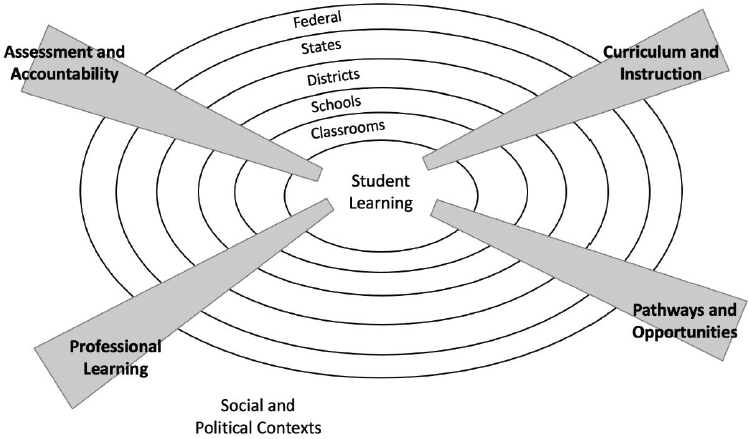
Policy may flow from one level of this nested system to another to eventually influence what and how students learn (see Figure 3-1). For example, a state might set a mathematics requirement that students pass three math courses to graduate from high school. Districts may determine the specific courses that “count” toward the three courses; district and school math curriculum coordinators then select the curriculum; and teachers enact the curriculum and determine the standards by which students pass courses. Thus, the lived experiences of students meeting the three-course state requirement for graduation are significantly impacted by policy that has been reshaped by actors at every level of this nested system. This is true of all preK–12 education policy: students’ opportunities to learn are shaped by the policies beyond their immediate learning environments and the interpretations and judgments actors make at every level of the nested system (e.g., Coburn, 2001; Spillane, 2000).
HOW POLICY OPERATES ACROSS THE EDUCATION SYSTEM
In the previous section, we described the nested layers of the U.S. education system. We turn now to the different domains of policy and practice that operate throughout the entire system: assessment and accountability,
SOURCE: Adapted from National Research Council, 2002.
curriculum and instruction, professional learning, and pathways and opportunities. These domains will become pertinent later in our report as we consider how to shift policy and practice toward greater equity in STEM education.
Four Major Domains of Policy and Practice
Across the layers of this system there are four major policy domains that have the potential to shift practice across the system and can be leveraged to advance equity in STEM. These domains are also relevant for tribal, charter, and private schools, though who establishes and interprets policy related to each domain can differ across these different contexts. These domains include assessment and accountability, professional learning, curriculum and instructional materials, and pathways and opportunities.
Within each of these four domains, policy may flow from one level of the system to another to eventually influence what and how students learn. Figure 3-1 illustrates the flow of policy within domains across the nested system.
Assessment and Accountability
Teachers, district or state agencies, private industry, or other entities design assessments that monitor student learning. The results of these assessments provide information for actors in the system to make decisions about how to support student learning. Based on assessment results, accountability mechanisms often establish consequences for students, teachers, and schools. An accountability system is the
set of policies and practices that a state uses to measure and hold schools and districts responsible for raising student achievement for all students, and to prompt and support improvement where necessary. Accountability systems have two closely related parts: 1) a way of signaling how well schools are doing (like A-F grades, or 1-5 stars) and 2) the actions that must result from those ratings, including rewards or recognition for high-performing schools and districts, and resources, supports, and interventions for those that are struggling. (Education Trust, 2024)
In responding to the results of assessments, actors may elect to shift resources to assessed content areas away from areas where assessment is less likely. (For more on how accountability functions in the current education policy context, see the following section of this chapter.)
Assessment happens at multiple scales and aggregations, and in multiple formats. Large-scale assessments are tools used to hold education entities accountable for student performance: administered at the system level, large-scale assessments may be aggregated by classroom, school, or district to summarize student performance or, in some cases, describe student growth over time. Across content areas, different states administer different kinds of assessments at specific grade levels and at specific moments of the academic year. The testing experience is standardized across a system in order to make comparisons within a tested population: within each assessment, the content, administration process, timing, and scoring procedures are uniform. Results from large-scale assessments are generally reported publicly, and are used to inform how and where schools, districts, and states make relevant policy decision and allocate resources.
Classroom-based assessments are tools used to assess students’ learning in real time. Educators may use classroom-based assessments diagnostically to determine a baseline understanding of a particular content area at the beginning of an academic year or unit. Alternatively, educators may use classroom-based assessments in a formative capacity to gauge students’ understanding of a particular concept or learning objectives. Results from classroom-based assessments are used to help educators make immediate decisions about instructional moves and to tailor instructional choices to the demonstrated needs of students.
Across types of assessments, the use of disaggregated data is a common strategy for addressing equity concerns across demographic groups. Disaggregated data parse student performance by different demographic categories in order to identify performance gaps across groups: prior to the use of disaggregated data, education entities were able to mask performance disparities within different racial, gender, or class groups by showing student achievement in the aggregate. To the extent that assessments are used to hold different education entities accountable for equitable achievement across different demographic groups, the use of disaggregated data are a critical tool in an accountability toolkit.
Professional Learning
School districts, institutions of higher education, state agencies, private industry providers, and other entities recruit, prepare, license, and evaluate teachers, as well as provide opportunities for continued professional development. These professional learning opportunities serve as one mechanism for supporting high-quality, rigorous instruction in the STEM disciplines.
Teacher licensure requirements are the primary policy mechanism by which states (and in some cases, districts) determine what kind of preservice preparation and in-service learning is necessary to qualify individuals to work as educators. Licensure requirements vary dramatically across states, with different states making different determinations about what kinds of preparation experiences “count” toward certification. Additionally, most states have adopted “alternative certification” pathways for educators in order to fast-track getting educators into classrooms in high-need areas.
Policy can also directly influence professional learning opportunities. Policymakers at different levels of the system may mandate or induce specific kinds of professional learning experiences for administrators and educators based on different beliefs about what kinds of experiences are most valuable for supporting student learning. For more information on professional learning for equity in STEM education, see Chapter 9 of this report.
Educator evaluation policies are an additional mechanism by which states and districts ensure educator quality. Policies in this vein vary dramatically across contexts and can include a series of different strategies for holding educators accountable for student performance. States and districts determine how often to evaluate educators, what aspects of an educator’s work to assess (i.e., student achievement data, in-classroom observations, etc.), and what evaluation results are used for.
Curriculum and Instruction
Mandates and resources from legislative bodies, and decisions and developmental work by teachers, school and district curriculum coordinators, and state education agencies all collectively define what teachers should teach and what students should learn. Policy surrounding curriculum and instruction governs what content students have access to within the STEM disciplines, as well as how educators are able to and are empowered to deliver that content. For more on how curriculum and instruction can support or constrain equity in STEM, see Chapter 10 of this report.
Pathways and Opportunities
State- and district-level policies set graduation requirements for students within different disciplines, as well as establish what course opportunities are available for students in different schools. Within the STEM disciplines, policy surrounding pathways and opportunities informs how and whether students will be able to pursue careers in the STEM fields, as well as engage with disciplinary content in the STEM domains as adults. For more on how policy around pathways and opportunities can support or constrain equity in STEM, please turn to Chapter 11 of this report.
Coherence Across the Policy Domains
In a functioning system, policies across domains should cohere around a clear, common vision for schooling. For example, assessment policies in a particular context should reflect that context’s curricular standards policies, which should then be supported in schools and classrooms through the use of aligned, relevant instructional materials. Professional learning requirements and opportunities should be designed to support educators in implementing and meeting those standards. When these policy domains all work in context with one another, policy determinations at all levels are oriented toward a clearly articulated, shared understanding of desired outcomes. Often, however, policies at various levels do not necessarily fit coherently together: in an incoherent policy context, higher-level policies may conflict with or distract from a local policy agenda. This conflict forces lower-level policy actors (such as district administrators, school administrators, and even classroom educators) to navigate how to meet policy mandates while also attending to local concerns.
The Importance of Funding and Resources
In the previous section, we described the nested layers that comprise the U.S. education system, and noted the four policy domains that exist across these layers. Across those domains, funding is one policy mechanism that can be deployed (or withheld) in order incentivize policy change. In this section, we describe how funding can be used to support specific equity efforts in education. The education of U.S. children and youth attending public schools is primarily funded by three sources: federal, state, and local revenues. On average, approximately 90 percent comes from a combination of state and local funds (Baker et al., 2022) with federal funds, on average 10 percent, earmarked for specific purposes (e.g., fulfilling special education regulations under the Individuals with Disabilities Education Act).
If—as defined above—policy is composed of mandates, inducements, plans for building capacity and changing systems, and hortatory messages (McDonnell, 1994) leveraged in pursuit of particular outcomes, funding often serves as the tool used to compel actors into taking action (i.e., a “carrot” or “stick”). Funding is a particularly powerful tool within the education policy landscape. Not only does funding impact what schools can or cannot do; an abundance or scarcity of funds also offer affordances or constraints in the development, implementation, and evaluation of policy itself. Furthermore, as can be expected in a nested system, numerous actors at different levels are involved in creating policy and are influenced and impacted by the abundance or scarcity of finances and resources. For example, although a teacher in the classroom may not view their work as political in nature, their job is directly influenced by finances and resources determined by political decisions made by federal, state, and district policies.
Evidence shows that the abundance or scarcity of funding and its associated resources—as determined by policy at any level—can affect education outcomes. Although there has been debate in research about the importance of funding in educational outcomes of children and youth, a body of research emerged in the 1990s indicating that funding for schools did, in fact, have a profound impact on educational outcomes, and a significant body of work showing how emerged in the 2000s. As it turns out, interventions designed to increase funding in schools showed positive results across a number of axes: research has shown that increasing funding to schools eliminates gaps between children from low-income backgrounds and their wealthier counterparts (Baker & Weber, 2016; Jackson et al., 2016); results in increased graduation rates (Candelaria & Shores, 2017; Hyman, 2017; Jackson et al., 2016; Lee & Polachek, 2018); and improves student performance (Gigliotti & Sorensen, 2018; Lafortune et al., 2018; Nguyen-Hoang & Yinger, 2014; Roy, 2011). Additionally, studies documented long-term effects in postsecondary outcomes like increased college
enrollment and degree completion (Hyman, 2017) and decreased adult poverty rates (Jackson et al., 2016).
Furthermore, funding is a resource that begets other resources (i.e., tangibles purchased by state officials, district leaders, and school administrators and utilized in the education of children and youth). These tangibles include, but are not limited to, instructional and administrative personnel, facilities, equipment, and instructional materials. Given the inequitable nature of school funding writ large, it follows that across layers of the education policy system there is also inequitable spending on resources across schools in the United States.
In general, research around funding and resources has produced a significant body of empirical evidence showing that increased funds and resources are plausible remedies to address unequal and inequitable educational outcomes among the nation’s children and youth. But neither funding nor resources have been broadly utilized and institutionalized in the United States for this purpose (see Chapter 4 for further discussion of funding, segregation, and unequal distribution of resources). Some states have established equalization initiatives to offset inequalities in local funding and to help districts reach levels of funding deemed adequate by governmental actors, but very few have continually remedied financing and resource disparities.
Policy Cascades
As described above, the experience of students in U.S. classrooms is deeply informed by the nested nature of the U.S. education policy system. Because the decisions of classroom educators are regulated and shaped by policy decisions made at the school level, which are in turn informed by policy decisions made at the district, and state, and federal levels, students’ experiences are all in some way shaped by the decisions made by entities at all levels of the system. That is, in a nested system decisions and policies made at one level have consequences at other levels of the system: this phenomenon is known as a “policy cascade.” In this section, we illustrate how federal and state policies can have particular and sometimes unintended consequences for STEM education at other levels of the system. Due to the inequities already present in the system, it is often the case that the unintended consequences perpetuate inequities or even exacerbate them. We conclude with two examples of policy cascades which illuminate how policy set at the federal level impacts STEM education at other levels in the education system.
Example: Federal Accountability Policies and Impacts on Equity in STEM Education
Federal policy has profoundly shaped equity in all areas of learning, including STEM areas, through the No Child Left Behind Act (2001; NCLB) and reauthorized as the Every Student Succeeds Act (2015; ESSA). At its founding, a stated purpose of NCLB was to “close the achievement gap” between racial, economic, language, and ability groups, while raising national levels of achievement overall. Accountability is central to the law’s approach to this goal of closing the achievement gap: NCLB set up an accountability structure wherein standardized test scores and state standards were used to measure progress and hold states, districts, schools, and teachers responsible for student achievement.
This policy was informed by an understanding of equity as found in equal outcomes, such that average achievement test scores of different groups on standardized tests were the primary metric of interest. Shortcomings of the policy notwithstanding (Sunderman, 2008), by requiring schools, districts, and states to report achievement test scores for different groups (students in special education, students in programs for English language learners, racially minoritized students, and economically disadvantaged students), NCLB also aided equity agendas by shining a “spotlight on longstanding inequalities and could trigger attention to the needs of students neglected in many schools” (Darling-Hammond, 2007, p. 1). While NCLB was silent on the need for equitable instruction or opportunities to learn relevant, engaging, and rigorous content in mathematics and language arts, it did include a “first-time-ever recognition of students’ rights to qualified teachers,” (Darling-Hammond, 2007, p. 2), meaning that instructors were required to have a degree, certification, and demonstrated expertise in their content area (NCLB, 2001).
This centering of accountability—based in standardized test scores—as a central mechanism for ensuring a form of educational equity was, in NCLB, coupled with an expanded sense of who was to be held accountable for what, and how. NCLB’s emphasis on achievement test scores set up not just students, but also schools, districts, and states as culpable actors who needed to be held accountable for their job of increasing student learning.
The linking of public accountability and standardized test scores that defines NCLB did not regularly yield desired results in making learning more equitable. There is little evidence that significant progress was made toward the goal of decreasing achievement gaps in math (see Chapter 4 for national trends), let alone toward the larger goal of eliminating them. For example, in mathematics, some studies found evidence of increases in math test scores among lower income and minoritized students (Dee et al., 2013; McCluskey, 2015); however, overall changes during the time period
were small in scope, and cannot be clearly attributed to the implementation of NCLB (Lee & Reeves, 2012). Further, students labeled as English language learners (ELLs) were often required to take tests in English, resulting in high failure rates and restrictions from graduation (Gándara & Baca, 2008; Menken, 2010). Accountability pressures for low-performing schools (shuttering schools, disrupting communities) led to some perverse outcomes antithetical to equity, including encouraging low-scoring students to leave school and reassigning low-scoring students to special education classes (Darling-Hammond, 2007).
When ESSA was passed in 2015, it relaxed many of the punitive consequences of NCLB related to assessment and accountability, and allowed states and districts more agency in how they used the results of standardized assessments in their decision-making processes. ESSA retains a focus on test score gaps and continues the mandate for states to administer and use test score data for accountability purposes; it does not allow for alternate systems for judging schools, such as inspectorate systems used in some countries, like Australia (Saultz et al., 2019). At the same time, some groups of districts and states made innovative use of ESSA’s provision for a “nonacademic indicator” to track statistics that are tied to equity (Buckley et al., 2017). For example, the CORE districts in California tracked and disaggregated suspension rates, which are and have disproportionately targeted students of color, particularly those with disabilities. In Georgia and Illinois, states tracked the quality of interpersonal relationships between teachers and students, students’ sense of belonging, and sense of students’ feeling valued.
Despite the changes ushered in with the passage of ESSA, NCLB yielded a number of persistent, unintended consequences for STEM education in the United States, in particular for mathematics and science instruction. While the required yearly testing in grades 3–8 appears to have resulted in an increase of instructional time in math, research has found that the curriculum emphasized recall and low-level procedural skills that were most likely to be assessed on the test, at the expense of more higher-order, critical-thinking skills and problem solving (Hunter, 2019; Jennings & Bearak, 2014). Research has documented that, as a result of the intense focus on increasing scores on state accountability tests, there has been an increased use of teacher-centered pedagogy, and a focus on math content that was “increasingly taught in isolated pieces and often learned only within the context of the tests themselves” (Au, 2007). And while there is some evidence that teachers in low-performing schools increased the rigor of the math tasks taught, nevertheless research found that the quality of lesson implementation and whole-class discussion was still lacking (Hunter, 2019). Importantly, the discussed shift in curriculum and pedagogy was most pronounced in schools that served racially minoritized, low-income,
and ELL students, populations often labeled by different actors in the policy arena as low performing and at risk of not meeting adequate yearly progress indicators.
At the same time, accountability pressures related to tested subject areas have pulled focus away from science education. Following the passage of NCLB, multiple entities expressed alarm that the need to demonstrate achievement in mathematics and reading was forcing schools to devote substantially more time to instruction in the tested subject (CEP, 2007; Griffith & Sharmann, 2008; McMurrer, 2008). Regardless of the cause, instructional minutes devoted to science education remain low, especially in elementary classrooms. The 2018 report from the National Survey of Science and Mathematics Education revealed that “grades K–3 self-contained classes spent an average of 89 minutes per day on reading instruction and 57 minutes on mathematics instruction, compared to only 18 minutes on science and 16 minutes on social studies instruction. The pattern in grades 4–6 is similar, with 82 minutes per day devoted to reading, 63 minutes to mathematics, 27 minutes to science” (Banilower et al., 2018, p. 77).
Example: School-Level Decision Making
To better understand the complex nature of decision making within this nested system, we describe a case of one elementary principal, Principal Loper,1 who is navigating the tensions of various policies (Marshall et al., 2024). Although the decisions of principals are often not discussed when considering science implementation in elementary schools, they play a critical role, and looking at their decision-making process within a nested system can shed light on how context matters for how the eventual impacts of policy. (In Chapter 6, we delve deeper into a discussion of decision making for equity in STEM education.) This case study reveals how peoples’ decisions and actions at the school level are shaped by federal policy in ways that have consequences for equity in the classroom. Note that the events described in the case took place starting in 2015, just as ESSA was being passed at the federal level, but before any of those legislative changes had translated into changes at the state, district and school level.
Principal Loper is a Black woman who has been an educator for over 20 years. Her teaching career includes ten years in the Great Lakes Schools (GLS) district, with the last two years at Leonhard Elementary (both are pseudonyms). Principal Loper prides herself in creating a school climate that echoes the familial and supportive environment of her revered Historically Black College and University alma mater, and hopes her presence as a principal inspires her students. She stated, “I think that my experience in
___________________
1 All names of people, the school, and district are pseudonyms in the following section.
school and not having seen an African American, other than the custodian, as a teacher, a sub, a principal, I can be that role model for our kids and I think that’s just why I’m here. I think that’s just where God has me.” Principal Loper is a confident leader—and more specifically, a confident instructional leader.
Principals in the GLS district were expected to be instructional leaders for science, but most did not have specific professional learning opportunities on leadership for science learning. Principal Loper recalled completing some coursework in science methods in college, but she had not had any professional development in science since. Despite limited experience in elementary science, Principal Loper believed she could “manage” when supporting elementary science. With limited professional learning opportunities specific to science, Principal Loper developed evaluation frameworks for science out of what she already knew, read, or learned from her network, and had specific ideas about what she expected to see during science instruction. When asked what she looks for when evaluating a science lesson, she shared,
I look for vocabulary, I look for engagement, I look to see if it’s an actual hands-on activity, if the students are engaged. Are the materials ready? […] Usually they’ll have their teaching guide. It’s not until they have taught something over and over and since this is so new, I’m not looking for perfect. I expect them to have their guide handy referring to that throughout the instruction. Checking for understanding and making sure that the kids are a part of the conversation.
Principal Loper shared it was not uncommon for her instructional coach to receive professional development in which she was not included. According to another GLS principal, Principal Matthews, “The instructional coaches will get the training before we do, and I kid you not, we are expected to be the instructional leaders in the building.” Under the new administration, professional learning for science was later offered. However, all district principals were unable to attend the professional development due to a principals’ meeting that was scheduled by central office at the same time. Principals Loper and Matthews were doing their best to lead for science, despite not being prepared to do so.
During the 2015–2016 academic school year, fifth-grade teachers at Leonhard Elementary School approached Principal Loper, seeking science materials because the state would soon adopt new standards, pilot a new science assessment, and assess student performance at the fifth grade in elementary school. This new policy would redefine at the state level the accountability system that helped to shape instruction, and thus necessitated rethinking curriculum and instructional practices at the district and
school levels. The elementary science curriculum had not been updated in over 15 years. Under the previous district administration, the curriculum director gave the directive to elementary principals that Achieve3000, a source of informational text with assessment questions, was to be the sole elementary science curriculum. Principal Loper believed this decision was made because,
We get focused on making sure they have those basic skills in math so they can move on to the next grade. I think we focus on all the things we’re evaluated on. The reading, the math, the writing, because no one wants to be a priority school [a school performing in the bottom five percent of schools]. So, I think the mandates from the state coming down […] causes us to really zoom in closer in those content areas.
Prioritization of content areas—those that were to be “zoomed in” on—by districts and schools was determined based on the assessments by which school performance was evaluated. This meant that subjects like science and social studies, which were not part of the state assessment program, were neglected. “Zooming in,” in this case, materialized as limited time allotted to and insufficient allocation of resources for science (e.g., curriculum, professional development).
According to Principal Loper, “we’re not really allocated that time to do a whole lot with science because we want our kids to be successful.” By “be successful,” Principal Loper was speaking to students performing well on the math and reading standardized assessments taken every year by students in grades three through five. School performance was largely measured through these standardized assessments of reading and math performance, which consequently compelled the attention of educators.
In the spring of 2016, a new superintendent who was supportive of elementary science began at GLS with a new central office team. Even with this administrative support to teach science at the elementary level and practical support in the form of new curriculum and district-allocated instructional time for science, science teaching during the 2016–2017 academic year did not always occur. On multiple occasions, Principal Loper arrived at a classroom to observe science instruction, and the classes were at recess, or science was not being taught. She began to email teachers in advance of arriving to observe science to ensure teachers were attempting to teach science. Principal Loper stressed she wanted teachers to at least try to implement the new curriculum. She believed teachers would gain more confidence as they implemented the curriculum, but this urging was proving insufficient as there were additional challenges to be understood (e.g., teacher’s science efficacy, etc.) and few opportunities to learn.
Principal Loper believed her elementary teachers needed additional support. The instructional coaches at Leonhard focused on math and reading,
and therefore provided limited instructional support for science. To balance this, she decided to hire a science paraprofessional for her school to offer additional assistance to teachers so that they could better prepare to teach science (e.g., support labs, gather materials for science instruction, etc.). During the spring of 2017, Principal Loper met with a representative from her intermediate school district (ISD) to review the 2017–2018 school year budget. The meeting began with the ISD representative going through the budget items one by one. Principal Loper asked that they return to the line item concerning Title I funding, federal funds earmarked for schools serving high percentages of students from economically disadvantaged backgrounds, at the end of the meeting. She then asked if that line item could be utilized to hire a science paraprofessional. The ISD representative stated she would get back to her once she inquired. Shortly after the meeting, Principal Loper was asked by researchers how she knew to seek a science paraprofessional from that line item in the budget. She responded, “[I]t took me three times asking” the ISD representative.
During the following academic year, Principal Loper stated, “I don’t think that I made the decisions honestly needed to move science [forward] only because the priority has been [other district initiatives].”
Being able to navigate the policies and people responsible for decision making was consequential to the opportunities for science learning at Leonhard Elementary. Principal Loper wanted to make decisions to support science; however, as mentioned above, she encountered various constraints within the nested policy environment. Local policies designed to foreground other state and federal policies diminished science goals and possibilities; at times, local, state, and federal expectations and policies conflicted. Limited science opportunities were rationalized because standardized assessments—as adopted by the state and mandated at the federal level—dictated content area priorities. Because of these realities, supporting science instruction was an incredibly challenging goal for Principal Loper to achieve, and her work to expand opportunities for science instruction, done as it was within the various constraints of this nested policy environment, required persistence.
There are many principals and educational leaders like Principal Loper. While this case was focused on science, there is a general need to support educational leaders in elementary-school content areas that are currently not well resourced—particularly due to the conjunction of assessment and funding as determined in federal and state policy. From this case, we learned about a principal doing her best to support science. However, much of her work depended upon others’ decisions and interpretation of policies. Working toward equity within a nested system means strategically navigating and advocating within the spaces, collaborating with others, and being persistent. Principal Loper’s decision making for science was framed by her policy
context as well as the politics of funding, human capital, and time for science education within a milieu in which math and literacy were prioritized.
BEYOND FORMAL SCHOOLING
So far in this chapter, we have focused on the system of formal schooling and the decision makers and actors who work within that system. It is also important to recognize that schools and schooling are situated within a broader set of contexts including specific school communities, towns, cities, states, and regions that all have particular histories, assets, needs, and values. These social, political, and economic contexts also shape the decisions made within the formal system.
In addition, at the level of individual learners and individual educators, the broader contexts of schooling have tremendous impact. As we discuss further in Chapter 7, children and youth do not only learn in school. Experiences in their families and communities also provide rich contexts for STEM-related learning. In many communities there are also learning opportunities in afterschool and summer programs, science centers and museums, and through hobbies or work settings. Taken together these contexts constitute a rich array of learning opportunities for young people outside of formal schooling. Often, however, these informal learning opportunities are disconnected from formal schooling and are not leveraged effectively by schools and districts. Further, the array of informal opportunities themselves are typically not organized in a systematic way and are loosely coupled, and sometimes even disjointed. This means that influencing this “non-system” of learning opportunities through policy and investments can present a challenge.
CONCLUSIONS
In this chapter, we described key features of the U.S. public education system. We noted first the nested nature of the system, and the way that policy that is made at one level of the system (i.e. federal, state, local, school, or classroom) can inform what happens at another level of the system in a phenomenon known as “policy cascade.” We also described how the current federal policy context has particular consequences in STEM education across the nation and explain the role of funding in support equity in education.
Conclusion 3-1: The education system is organized across multiple levels including federal-, state-, district-, and school-level policies and practices. Each of those levels interacts differently with policy domains
of curriculum, instruction, assessment, and professional development for teachers and administrators. Addressing equity within the preK–12 system involves addressing policy and practices, as well as funding and resources, at each level and across the different policy domains, and attending to links between levels and policy domains.
Conclusion 3-2: Education decision makers can find opportunities through interpretation and enactment of policy that allow them to advance equity in STEM education. Identifying these opportunities requires an understanding of the policies, the key actors in the context, potential resources to leverage, and a willingness to be creative.
REFERENCES
Au, W. (2007). High-stakes testing and curricular control: A qualitative metasynthesis. Educational Researcher, 36(5), 258–267. https://doi.org/10.3102/0013189X07306523
Baker, B. D., DiCarlo, M., & Weber, M. (2022). The adequacy and fairness of state school finance systems: School year 2019–2020 (5th ed.). Albert Shanker Institute. http://schoolfinancedata.org/
Baker, B., & Weber, M. (2016). Beyond the echo chamber: State investments and student outcomes in U.S. elementary and secondary education. Journal of Education Finance, 42(1), 1–27.
Banilower, E. R., Smith, P. S., Malzahn, K. A., Plumley, C. L., Gordon, E. M., & Hayes, M. L. (2018). Report of the 2018 NSSME+. Horizon Research, Inc.
Buckley, K., Gopalakirshnan, A., Kramer, E., & Whisman, A. (2017). Innovative approaches and measurement considerations for the selection of the school quality and student success indicator under ESSA. Council of Chief State School Officers.
Bureau of Indian Education. (n.d.). Tribally controlled schools. U.S. Department of the Interior. https://www.bie.edu/topic-page/tribally-controlled-schools
Candelaria, C., & Shores, K. (2017). Court-ordered finance reforms in the adequacy era: Heterogeneous causal effects and sensitivity. Center for Educational Policy Analysis. https://cepa.stanford.edu/content/court-ordered-finance-reforms-adequacy-era-heterogeneous-causal-effects-and-sensitivity
Center on Education Policy, (2007). Choices, changes, and challenges curriculum and instruction in the NCLB era.
Coburn, C. E. (2001). Collective sensemaking about reading: How teachers mediate reading policy in their professional communities. Educational Evaluation and Policy Analysis, 23(2), 145–170.
Darling-Hammond, L. (2007, May 21). Evaluating “No Child Left Behind.” The Nation, 1–6.
Dee, T. S., Jacob, B. A., & Schwartz, N. L. (2013). The effects of NCLB on school resources and practices. Educational Evaluation and Policy Analysis, 35(2), 252–279.
Education Trust. (2016). New school accountability systems in the states: Both opportunities and peril.
Every Student Succeeds Act, 20 U.S.C. § 6301. (2015). www.congress.gov/114/plaws/publ95/PLAW-114publ95.pdf
Gándara, P., & Baca, G. (2008). NCLB and California’s English language learners: The perfect storm. Language Policy, 7, 201–216.
Gigliotti, P., & Sorensen, L. C. (2018). Educational resources and student achievement: Evidence from the Save Harmless provision in New York State. Economics of Education Review, 66, 167–182.
Griffith, G., & Scharmann, L. (2008). Initial impacts of No Child Left Behind on elementary science education. Journal of Elementary Science Education, 20(3), 35–48.
Hunter, S. B. (2019). New evidence concerning school accountability and mathematics instructional quality in the No Child Left Behind era. Educational Assessment, Evaluation and Accountability, 31(4), 409–436.
Hyman, J. (2017). Does money matter in the long run? Effects of school spending on educational attainment. American Economic Journal: Economic Policy, 9(4), 256–280.
Jackson, C. K., Johnson, R. C., & Persico, C. (2016). The effects of school spending on educational and economic outcomes: Evidence from school finance reforms. Quarterly Journal of Economics, 131(1), 157–218.
Jennings, J. L., & Bearak, J. M. (2014). “Teaching to the test” in the NCLB era: How test predictability affects our understanding of student performance. Educational Researcher, 43(8), 381–389. https://doi.org/10.3102/0013189X14554449
Lafortune, J., Rothstein, J., & Schanzenbach, D. W. (2018). School finance reform and the distribution of student achievement. American Economic Journal: Applied Economics, 10(2), 1–26.
Lee, J., & Reeves, T. (2012). Revisiting the impact of NCLB high-stakes school accountability, capacity, and resources: State NAEP 1990–2009 reading and math achievement gaps and trends. Educational Evaluation and Policy Analysis, 34(2), 209–231.
Lee, K.-G., & Polachek, S. W. (2018). Do school budgets matter? The effect of budget referenda on student dropout rates. Education Economics, 26(2), 129–144.
Marshall, S. L., Forrester, J., & Tilsen, J. (2024). Science for our children: Othermothering leadership within an elementary science network. Journal of Research in Science Teaching, 61(3), 533–555. https://doi.org/10.1002/tea.21927
McCluskey, N. (2015, February 9). Has No Child Left Behind worked? Cato Institute. https://www.cato.org/testimony/has-no-child-left-behind-worked
McDonnell, L. M. (1994). Assessment policy as persuasion and regulation. American Journal of Education, 102(4), 394–420.
McMurrer, J. (2008). Instructional time in elementary schools: A closer look at changes for specific subjects. Center on Education Policy.
Menken, K. (2010). NCLB and English language learners: Challenges and consequences. Theory Into Practice, 49(2), 121–128.
National Center for Education Statistics. (2023). CCD Public school data 2022-2023 school year: Bois Blanc Pines School.
National Research Council. (2002). Investigating the influence of standards: A framework for research in mathematics, science, and technology education. The National Academies Press. https://doi.org/10.17226/10023
Nguyen-Hoang, P., & Yinger, J. (2014). Education finance reform, local behavior, and student performance in Massachusetts. Journal of Education Finance, 39, 297–322.
No Child Left Behind Act of 2001, Pub.L. No. 107-110, 20 U.S.C. § 6319 (2001).
Roy, J. (2011). Impact of school finance reform on resource equalization and academic performance: Evidence from Michigan. Education Finance & Policy, 6(2), 137–167.
Saultz, A., Schneider, J., & McGovern, K. (2019). Why ESSA has been reform without repair. Phi Delta Kappan, 101(2), 18–21. https://doi.org/10.1177/0031721719879149
Schneider, A., & Ingram, H. (1990). Behavioral assumptions of policy tools. Journal of Politics, 52(2), 510–529.
Spillane, J. P. (2000). Cognition and policy implementation: District policymakers and the reform of mathematics education. Cognition and Instruction, 18(2), 141–179.
Sunderman, G. L. (Ed.). (2008). Holding NCLB accountable: Achieving accountability, equity, & school reform. Corwin Press.
This page intentionally left blank.


