Substance Misuse Programs in Commercial Aviation: Safety First (2023)
Chapter: Appendix A: Other Alcohol and Drug Programs in the Transportation Sector
Appendix A
Other Alcohol and Drug Programs in the Transportation Sector
This appendix provides a general description of selected other alcohol and drug programs in the non-aviation industry within the U.S. Department of Transportation (DOT). Information covered is limited to the Federal Motor Carrier Safety Administration (FMCSA), Federal Railroad Administration (FRA), and the Federal Transit Administration (FTA) due to their programs providing the most complete and prompt responses to committee inquiries. The discussion highlights the salient characteristics of these drug and alcohol programs based on applicable rules and implementation guidelines under each transportation modal administration. Specific programs established within each administration were not reviewed.
REGULATORY CONTEXT: ALCOHOL AND DRUG PROGRAMS IN THE NON-AVIATION SECTOR
Title V of Public Law 102-143, known as the Omnibus Transportation Employee Testing Act of 1991,1 mandates that the Secretary of Transportation issue regulations in addressing workplace drug and alcohol misuse by testing employees in safety-sensitive positions. These DOT testing regulations are codified under 49 Code of Federal Regulations (CFR) § 40.2 The regulations spell out the procedures and requirements on how to conduct the tests, and the activities involving all concerned parties—employers, safety-sensitive transportation employees (including
___________________
1https://www.transportation.gov/odapc/omnibus-transportation-employee-testing-act-1991
self-employed, contractors, and volunteers), and service agents. A positive test result, refusal to test (including adulterating or substituting a urine specimen), and any other violation of the prohibition on the use of alcohol and drugs under DOT regulations require removal of covered employees from safety-sensitive duties.
In addition, under DOT regulations each of the federally regulated transportation administrations has established procedures and implementation guidelines that govern the alcohol and drug misuse programs specific to their workplace operations. The succeeding paragraphs highlight some of the program attributes.
FMCSA
FMCSA is the agency delegated with the authority and responsibility for issuing and implementing rules that address the drug and alcohol misuse in the commercial motor carrier transportation sector. Embodied in 49 CFR § 382, these FMCSA rules are to establish programs designed to help prevent accidents and injuries resulting from the misuse of alcohol or use of controlled substances by drivers of commercial motor vehicles (CMVs).3
The employer, a person (including an individual who is self-employed) or entity, has the overall responsibility of implementing the DOT and FMCSA drug and alcohol program requirements. DOT’s Office of Drug and Alcohol Policy and Compliance publication,4 What Employers Need to Know About DOT Drug and Alcohol Testing [Guidance and Best Practices], and FMCSA’s publication,5 Implementation Guidelines for Alcohol and Drug Regulations, are key resources for employers in establishing their alcohol and drug programs.
Employers are not the same as service agents:
A service agent is any person or entity, other than an employee of the motor carrier, used to help implement the DOT and FMCSA drug and alcohol testing regulations. These might include a urine collector, a breath alcohol technician, a screening test technician, a laboratory, a medical review officer, a substance abuse professional (SAP), or a consortium/third-party administrator in charge of coordinating the employer’s testing services. Service agents may be used to administer part or all of an employer’s DOT drug and alcohol testing program.6
___________________
3https://www.ecfr.gov/current/title-49/subtitle-B/chapter-III/subchapter-B/part-382
4https://www.transportation.gov/odapc/employer_handbook
5https://www.fmcsa.dot.gov/regulations/drug-alcohol-testing/implementation-guidelines-alcohol-and-drug-regulations
6https://www.fmcsa.dot.gov/regulations/drug-alcohol-testing/what-are-service-agents
Hiring service agents, however, does not relieve the employer of the oversight responsibility and accountability in carrying out the DOT and FMCSA testing regulations.
Drivers operating CMVs (e.g., trucks and buses), that is, commercial driver license and commercial learners permit holders, perform safety-sensitive functions and are subject to the DOT controlled substance and alcohol testing regulations. A driver is defined in the regulation to include but not limited to full-time, regularly employed drivers; casual, intermittent, or occasional drivers; leased drivers and independent owner-operator contractors. They are holders of commercial driving licenses (CDLs).
Drug and Alcohol Testing
DOT testing involves identifying a blood alcohol concentration of 0.04 or greater, resulting in the removal of the covered employee from performing any safety-sensitive functions until completion of the return to duty process. A driver with a blood alcohol concentration of 0.02 or greater, but less than 0.04, is removed from duty for 24 hours per FMCSA regulation.
FMCSA regulations also require testing in specific CMV accidents (49 CFR § 382.303) resulting in a fatality, bodily injury that requires immediate medical treatment, or one or more motor vehicles requiring to be towed away from the crash site.
FMCSA requires the DOT testing of the five classes of substances: marijuana, cocaine, opiates (opium and codeine derivatives), amphetamines and methamphetamines, and phencyclidine. However, motor carrier employers are not prohibited from instituting a “company authority” testing program (non-DOT program). The non-DOT program is in addition to and distinct from the required DOT testing. This means the employer may test additional substances or may use non-urine specimens but cannot be used in lieu of the DOT requirements.
Referral for Evaluation and Treatment
Drivers of commercial motor vehicles who admit to alcohol misuse or controlled substance use are not subject to the referral, evaluation, and treatment requirements if they meet the conditions specified in 49 CFR § 382.121(a), which include an admission made in accordance with a qualified voluntary self-identification program or policy established by the employer. The voluntary self-identification program or policy must be consistent with 49 CFR § 382.121(b).
Employers are required to refer any driver who has used controlled substances or misused alcohol to a substance abuse professional (SAP) for evaluation regardless of the consequences (e.g., employment termination)
specified in the employer’s policy. The SAP is required to recommend the appropriate treatment and/or education to a driver who has tested positive on a DOT-controlled substances or alcohol test. However, employers are not required to provide, or to pay for, rehabilitation and treatment programs.7
Depending on the SAP’s evaluation and recommendation, the following treatment types may be recommended: inpatient setting in a hospital or residential treatment center which includes supervised detoxification, group therapy, etc., and outpatient setting, including intensive outpatient services and outpatient follow-up services.
Return-to-Duty Procedure
FMCSA guidelines remain consistent with the return-to-duty procedure specified in 49 CFR § 40(o). The SAP certifies readiness of the employee to return to duty and fitness to perform safety-sensitive duties.
Program Oversight and Monitoring
Although the FMCSA regulation does not require employers to establish an Employee Assistance Program (EAP) through which most workplace drug and alcohol misuse is managed, the regulations encourage the use of either an internal EAP or external EAP by joining a consortium of small businesses to pool resources to purchase an EAP service for this purpose.
All drug and alcohol violations by commercial driver license and commercial learners permit holders, per DOT testing regulations, are reported in the FMCSA Commercial Clearinghouse. The Clearinghouse is “a secure online database that gives employers, FMCSA, State Driver Licensing Agencies, and State law enforcement personnel real-time information about CDL driver drug and alcohol program violations.”8
The clearinghouse serves as a multipurpose database depending on the user roles. For example, Medical Review Officers use it to verify test referrals and results; consortia or service agents use it to report drug violations; SAPs use it to verify initial assessment and eligibility to return to duty; state licensing agencies use it to complete the licensing process; employers use it to query the database as part of their pre-employment process, etc. Registration is required to access the database.
A sample of data contained in a monthly report generated by the clearinghouse is given in Figure A-1, reproduced exactly from the original.
___________________
7https://www.fmcsa.dot.gov/regulations/drug-alcohol-testing/implementation-guidelines-alcohol-and-drug-regulations-chapter-8
8https://clearinghouse.fmcsa.dot.gov/Resource/Index/Factsheet
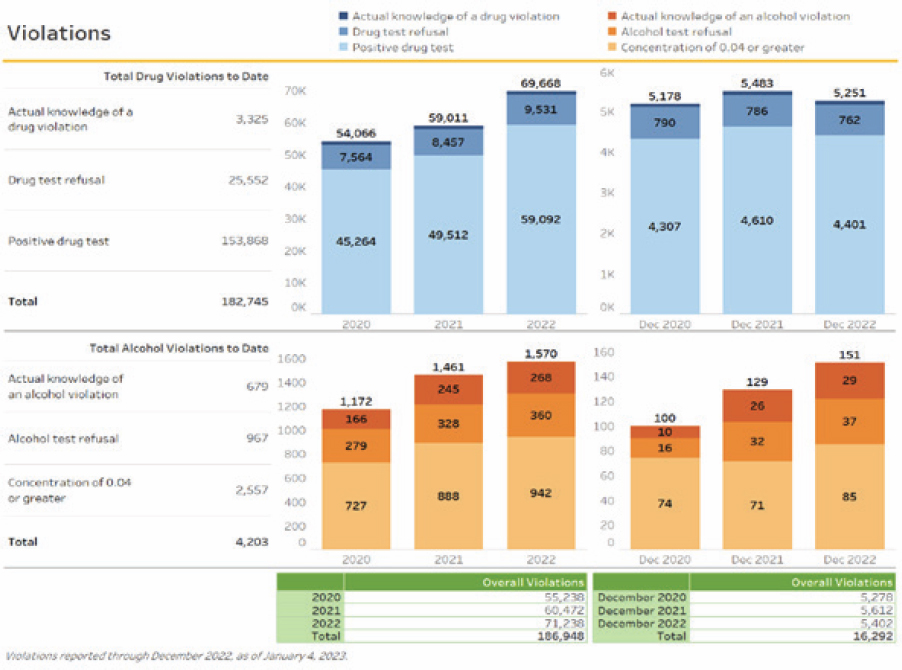
SOURCE: FMCSA Clearinghouse, December 2022 Monthly Summary Report, https://clearinghouse.fmcsa.dot.gov/Resource/Index/monthly-report-Dec2022
FRA
The FRA is the agency delegated with the authority and responsibility for issuing and implementing drug and alcohol misuse rules for inter-city passenger (i.e., Amtrak, commuter) and freight railroad systems of the rail transportation sector. 49 CFR § 219 applies to all railroads and contractors, with noted exceptions made under 49 CFR § 219.3.
Employees, volunteers, and probationary employees performing activities for a railroad or a contractor to a railroad who perform the following regulated services are subject to testing regulations:
- train and engine service (e.g., conductors, brakemen, switchmen, engineers, locomotive hostlers/helpers train service);
- dispatching service/operation (e.g., train dispatchers, control operators);
- signal service who inspects, repair, or maintain signal systems;
- maintenance-of-way employees performing duties of roadway workers as defined in 49 CFR § 214.7; and
- any employee who, on behalf of a railroad, performs mechanical tests or inspections required by 49 CFR § 215, 221, 229, 230, 232, or 238 on railroad rolling equipment, or its components, as defined in “Mechanical or MECH employee” in 49 CFR § 219.5, which became effective March 4, 2022.
Drug and Alcohol Testing
Section 219.101 stipulates that if a test result indicates a blood alcohol concentration below 0.02, the test is negative and is not evidence of alcohol misuse. However, while a federal test result of 0.02 or greater but less than 0.04 is a positive test and may be a violation of a railroad’s operating rules, it cannot be used to decertify an engineer under 49 CFR § 240 or a conductor under Part 242. A blood alcohol concentration of 0.04 or greater will affect the certification of the locomotive engineer (49 CFR § 240.119) or conductor (49 CFR § 242.115).
In addition to the five classes of drugs tested under the DOT regulations, FRA also monitors regulated employees’ use of prescription and over-the-counter (OTC) drugs. Section 219.103 requires, at a minimum, that a regulated service employee’s prescribing physician be made aware of the employee’s assigned duties and medical history and deem that the use of that substance (and dosage level) is consistent with the safe performance of the employee’s duties. In addition, 49 CFR § 219.103 allows for
an employer to require that employees notify the railroad of therapeutic drug use and/or obtain prior approval for such use.9
A refusal to test prohibits employees from performing regulated services at any railroad for a minimum of 9 months. Locomotive engineers and conductors will be subject to at least six unannounced drug and alcohol tests during the first 12 months.
Referral for Evaluation and Treatment
Referral for drug and alcohol evaluation and treatment may be coursed through either of the following paths as explained under 49 CFR § 219.1001(k): (a) self-referral, an opportunity given to the employee before the alcohol or drug misuse manifests itself into a detected violation of the rule, or (b) peer-to-peer referral, typically a management-labor partnership that allows an impaired employee to mark-off work, via a 24-hour phone number. Employment relationship with the railroad may be maintained if the covered employee sought assistance through the railroad’s voluntary referral program.
Additional referral pathways such as (c) non-peer referral program or (d) alternate programs that meet the specific requirements of 49 CFR § 219.1003 or complying with 49 CFR § 219.1007, or both, may also be made available by a railroad although not guaranteed.
The drug and alcohol counselor (DAC) performs an assessment and clinical evaluation and recommends a course of education and/or treatment facility or program. Treatment recommendations can include inpatient, partial inpatient, outpatient, education programs, and aftercare support services. Education, which may be taken face-to-face or online, may include bona fide drug and alcohol education classes, self-help groups, and community lectures. FRA does not have medical standards apart from aural and visual acuity for certification of locomotive engineers and conductors. A decision to take medication-assisted treatments depends on the DAC’s recommendation.
FRA encourages railroads to cover a percentage of the employee’s salary to further encourage voluntary self-referrals, but it is based upon the collective bargaining unit and the railroad. In one of the major railroads, for example, referred employees are covered at 80% salary. Otherwise, employees are covered through their company health insurance programs.
___________________
9https://railroads.dot.gov/railroad-safety/divisions/drug-and-alcohol/drug-and-alcohol
Return-to-Duty Procedure
The DAC makes the determination when a covered employee may return to duty. This means successful completion of the DAC’s recommended level of care to resolve the employee’s identified drug or alcohol abuse problem. Part of the DAC’s written notice on the employee’s readiness to return to duty consists of requirements for participation in aftercare services such as Alcoholics Anonymous/Narcotics Anonymous meetings and/or therapy. Many Class I rail employees are referred to a treatment provider with a railroad focus.
The employee must have a negative directly observed return-to-duty test, and a minimum of six directly observed follow-up tests in the next 12 months. Follow-up testing programs can last up to 60 months based on the recommended aftercare.
Program Oversight and Monitoring
For monitoring purposes, FRA collects information other than those required by DOT for reporting.10 The additional information tracks aggregate annual referrals (EAP directed and peer to peer), referral rate, and referral to total violations ratio.
Available data in the past five years are shown below:
TABLE A-1 Drug and Alcohol Referrals, Refusals, and Violations, 2017–2021
| Items | 2017 | 2018 | 2019 | 2020 | 2021 | Totals |
|---|---|---|---|---|---|---|
| EAP directed and peer-to-peer guided referrals | 1,188 | 1,238 | 1,797 | 1,399 | 1,399 | 7,021 |
| Drug and alcohol violations + refusals | 294 | 520 | 531 | 388 | 397 | 2,130 |
| Regulated employees | 127,888 | 133,328 | 132,196 | 121,024 | 121,233 | 127,134 |
| Referral rate (referrals/regulated employees) | 0.93% | 0.93% | 1.36% | 1.16% | 1.15% | 1.10% |
| Referrals to test violations ratio | 4.0 | 2.4 | 3.4 | 3.6 | 3.5 | 3.3 |
NOTE: Class I railroad + Amtrak + Commuters.
SOURCE: Jerry Powers presentation, Federal Railroad Administration; Office of Railroad Safety–Office of Railroad Systems, Technology and Innovation, RRS-19, U.S. Department of Transportation.
___________________
FRA also conducts a triennial audit of the drug and alcohol program, which includes a review of the DAC credentials, referral cases, educational materials, etc. Most recently, FRA started developing a website (currently accessible in a beta version) with interactive dashboards and safety datasets designed to inform citizens, industry, data users, and policy makers.11
FTA
FTA is the agency delegated with the authority and responsibility for issuing and implementing drug and alcohol misuse rules for the public mass transportation sector. 49 CFR § 655, in addition to the DOT regulations for drug and alcohol misuse, apply to all FTA employers (recipients and subrecipients of FTA grants) that provide public transportation services, including operators and their contractors.
FTA employers are grantees who receive formula funds through 49 USC § 5307 Urbanized Area Formula (operating and capital), 49 USC § 5309 Transit Capital Investment (capital), 49 USC § 5311 Formula Grants for Rural Areas (operating and capital), or 49 USC § 5339 Buses and Bus Facilities (capital). FTA employers implement the program and conduct testing of their safety sensitive employees. Compliance is a condition to receive financial assistance. On an annual basis, grant recipients are required to certify compliance with 49 CFR § 655 to applicable FTA Regional Office.
The categories of employees with safety-sensitive duties employed by FTA employers and contractors and are covered under the testing regulations, include the following:
- revenue vehicle operation;
- revenue vehicle and equipment maintenance;
- revenue vehicle control/dispatch;
- non-revenue vehicle required to be operated by employees with commercial driver license; and
- armed security personnel.
Drug and Alcohol Testing
Covered employees with blood alcohol concentration of 0.04 or greater or who refuse to submit to testing are prohibited to perform safety-sensitive functions. The employer is required to advise the employee of available resources for evaluating and resolving their alcohol and drug problems.
___________________
11https://railroads.dot.gov/safety-data/accident-and-incident-reporting/accidentincident-dashboards-data-downloads
This includes giving the names, addresses, and telephone numbers of SAPs and counseling and treatment programs.
As specified in 49 CFR § 655.35, an employee with a blood alcohol concentration of at least 0.02 but below 0.04 is prohibited to perform or continue to perform safety-sensitive duties. An employer may choose to permit a retest within eight hours of an alcohol test for confirmation. The covered employee may perform safety sensitive functions only until:
- The employee’s alcohol concentration measures less than 0.02; or
- The start of the employee’s next regularly scheduled duty period, but not less than eight hours following administration of the test.
Employers are not prohibited from adopting a drug-free workplace act or testing substances in addition to the five classes of substance under the DOT regulations. FTA employers may include prescription drugs and OTC drugs in their policy (encouraged). Starting January 18, 2022, four semi-synthetic opioids (hydrocodone, oxycodone, hydromorphone, and oxymorphone) were added while removing MDEA, an amphetamine similar to ecstasy, from the substance test panel. Covered employees may be tested any time before, during, and after performing safety-sensitive duties. 49 CFR § 655.44 of FTA regulations also require post-accident testing.
Referral for Evaluation and Treatment
Only company officials who are in contact with covered employees are authorized to make referrals. This includes dispatchers, street supervisors, and maintenance supervisors. Other employees who are not authorized should know who to contact and be able to substantiate a reasonable suspicion. Only one trained company official is sufficient to refer a covered employee for reasonable-suspicion testing.
Transit employer’s EAP serve an important role in FTA’s drug and alcohol testing program, particularly for self-referrals.
While FTA regulations require employers to comply with the DOT testing regulations, they are not required to provide or pay for rehabilitation and treatment programs. Two types of treatment are provided: inpatient and outpatient services. They include intensive inpatient (hospital or residential facility), intensive outpatient, and outpatient follow-up services. The SAP develop a treatment program that meets the needs of the employee.
Return-to-Duty Procedure
The return-to-duty procedures in 49 CFR § 40 is followed before an employee is allowed to perform safety-sensitive functions. Pursuant to
49 CFR § 40(o), employers are required to conduct follow-up testing of covered employees upon return to duty.
Program Oversight and Monitoring
FTA maintains an online management information system called DAMIS12 for drug and alcohol test data reporting. It is accessible only to grantees, states department of transportation, covered employees, contractors, and subrecipients.
SUMMARY
Given adequate time, a more in-depth analysis of the various models of drug and alcohol programs implemented across the transportation modal administrations would be helpful in determining the overall effectiveness of U.S. DOT efforts in addressing drug and alcohol impairment in transportation. From the foregoing discussions, the following program features are likewise underscored for consideration:
- Financial support: FRA’s practice of encouraging employers to cover a certain percentage of treatment cost and/or salary of covered employees may motivate covered employees to change their treatment-seeking behavior for early intervention.
- Increased panel of substances tested: Both FRA and FTA had identified the impairment effects of prescription and OTC drugs in the conduct of safety-sensitive functions. They are testing for them in addition to the panel of substances covered under the DOT regulations.
- Voluntary referral: FRA has a specific section requiring railroads to establish self-referral and peer-to-peer referral programs. While voluntary referral may be offered by employers of other modal administrations, they are only encouraged but not required.
- Online reporting and monitoring: While all modal administrations offer some variations of online test result reporting and monitoring, each system shows weaknesses and strengths. An examination of each may help strengthen the reporting system for oversight and decision support. The FMCSA Clearinghouse, for example, is a system developed for different users with varied purposes.
- Organized program management: Standardizing program implementation ensures that availability, accessibility, and equity in treatment is achieved. A national oversight of the drug and alcohol
___________________
12https://transit-safety.fta.dot.gov/DrugAndAlcohol/DAMIS/default.aspx
- programs within each administration could minimize variations. For example, FAA has established a national oversight by setting aside funds for this purpose.
- Inclusion of mental health evaluation and/or focus on co-occurring mental health and substance use disorders: Specific rules and regulations reviewed in this appendix have not specifically addressed the issue on mental health. It warrants attention and inclusion in existing regulations, rules, and procedures due to its confounding effects on impairment.
- Use of poly-substances: Similar to the mental health issue, poly-substance use and its impact on impairment should be addressed in the existing regulations, rules, and procedures. Poly-substance use impacts the duration and extent of impairment and thus the return-to-duty criteria may even need to be revisited.


