Ocean Acoustics Education and Expertise (2025)
Chapter: 2 Historical Perspective Leading to the State of Education and Expertise Today
2
Historical Perspective Leading to the State of Education and Expertise Today
Before considering the current state of education and expertise for ocean acoustics, it is important to examine the roots of the field and factors that have shaped current conditions. As touched on in Chapter 1, acoustics is multidisciplinary, not a fundamental discipline, such as physics, chemistry, and mechanical or electrical engineering. Historically, acoustics has never been a core component of undergraduate curriculum that often defines a distinct department in academia; rather, it has found a home in departments such as physics or the more applied versions of mechanical engineering. This, in part, is an important reason for the development of this report, as it provides a challenge in recruiting students during their undergraduate and early graduate careers. Many students are not aware of or drawn to the field until they participate in hands-on experiments and applications of ocean acoustics. Although ocean acoustics students may be increasing today in academic departments, they typically have their foundation in physics, engineering, mathematics, biology, or signal processing. The diversity of acoustics covers many fields, from psychology to structural acoustics, leading it to always need to find its support in academia as an interdisciplinary field living across departments.
Compared to visual or chemical signals, acoustic signals can propagate great distances in the ocean and provide the most long-ranging means for marine life and humans to gain information about the underwater environment. All aquatic animals studied can sense sound, even if they do not produce it themselves (Hawkins and Popper, 2017; Putland et al., 2019). Although land-based animals, with some exceptions, such as certain species of bats, use vision and electromagnetic energy as their dominant means for survival and foraging, aquatic animals heavily rely on sound. They acoustically sense their marine environment over ranges from a few meters at high frequencies to across the global oceans at lower frequencies. Remote sensing applications use underwater acoustics across the full spectrum of frequencies, from single hertz to megahertz, for sonar imaging, detection and tracking, measuring ocean states (i.e., temperatures, currents), and monitoring aquatic life. For example, high-resolution bathymetric systems chart the ocean depths using signals in the 10–100s kilohertz bands, and global acoustic tomography has transmitted signals below 100 Hz halfway around planet Earth to monitor the impact of climate change on deep ocean waters.
HISTORICAL FOUNDATIONS IN OCEAN ACOUSTICS EDUCATION
Before assessing the status of ocean acoustics education, the committee devoted a portion of its effort to understanding some history and milestones of ocean acoustics related to the evolution of the community’s workforce demands, education, and training (Appendix C provides a timeline of significant dates in the history of
ocean acoustics). Evidence of ocean acoustics can be found as far back as da Vinci in the 1490s. In the 1690s, Newton published a method for calculating the speed of sound from travel time and distance in Principia. The first measurement of the speed of sound in water occurred in 1826 in Lake Geneva by Colladon and Sturm.1 Acoustics advanced to its prime at the end of the 19th century, led by researchers of mathematical physics, such as Rayleigh, Gauss, Helmholtz, and Kelvin. Rayleigh published two volumes of The Theory of Sound in 1877, laying the foundation for the study of acoustics.
Early Use of Ocean Acoustics
Initial interest and investment in ocean acoustics was primarily related to ocean navigation and the military’s use of underwater sound. The field expanded to provide many civilian and research applications after the early development of sonar2 by Reginald Fessenden in the early 1910s (Hill, 1962). Early civilian and military use was for alerting ships about shoaling water and/or icebergs. For example, Fessenden’s sonar system detected an iceberg that was 450 feet long and 130 feet high above the waterline from more than 2 miles away. This successful demonstration catalyzed the widespread use of ocean acoustics by USN (URI, n.d.) for mine detection and deployment, and ASW and counter-ASW (detection avoidance). The severely damaging effect of German submarine attacks on shipping between the United States and Europe during WWI3 led to the widespread use of ocean acoustics tools for ASW. Then, in 1929, ASA was founded as part of the American Institute of Physics (AIP, n.d.), which allowed the acoustics community to gather and share research results. By the mid-1930s, USN work on sonar advances, and practically every submarine used a sonar system. Ocean acoustics became and still is a critical tool used in ASW, with both passive and active versions requiring on-the-job training in ocean acoustic technology operation. These advancements in applications and real-world uses were supported by growth in research and acoustics education.
Two texts describe the state of acoustics at their points in history and most notably cover the period between WWI and WWII. Origins of Acoustics by Frederick Vinton Hunt (1978) covers acoustics from Pythagoras to the 20th century. Hunt is also noted for coining the term “sonar” (sound navigation and ranging). Sounds of Our Times: Two Hundred Years of Acoustics by Robert Beyer (1999) is a comprehensive, encyclopedic text. Both Hunt and Beyer had their roots in physics departments, but the trend for acoustics to expand more widely than mathematical physics topics was becoming apparent.
U.S. courses and programs for acoustics at both the undergraduate and graduate levels were initially established in physics departments; the coursework included sound and vibrations, such as the pioneering work of Philip Morse4 in Vibration and Sound. Acoustics education, however, gradually moved from physics to engineering departments, especially electrical and mechanical engineering; subjects related to sound transduction and propagation physics were found in electrical engineering and in general subjects of sound and vibration, respectively. These subjects typically did not cover ocean waveguide propagation or the unique issues of sound in the ocean. Subjects on ocean acoustics were also not widespread in an oceanography curriculum. Courses and research on ocean acoustics did exist, but it was a piecemeal distribution of efforts spread among several departments and colleges; this persists (see Table 3-1 in Chapter 3 for a list of institutions and their departments that contain acoustics coursework).
The years between WWI and WWII saw an increase in ocean acoustics discoveries for both the military and energy sectors. Scientists discovered that low-frequency sound could penetrate the seafloor. Sound reflected differently from individual layers in the sediment. Scientists could, for the first time, use sound waves generated by seismic airguns to image what was beneath the seafloor. The airguns operate by releasing a pressurized volume
___________________
1Charles-Francois Sturm, who conducted the sound experiments in Lake Geneva, is better known for developing the Sturm Liouville wave equation.
2Sonar is defined as Sound Navigation and Ranging.
3Nearly 10 million tons of cargo was lost over 2 years, severely damaging the U.S. and European Allied Forces supply lines.
4Philip Morse was awarded the ASA Gold medal for his work in the field of vibrations (see https://acousticalsociety.org/acoustical-society-of-america-awards).
of air, generating waves that are reflected from geological layers and detected by hydrophones in a towed array (API, 2014). This picture of what was underneath the seafloor provided clues to the history of Earth and a means for prospecting for oil and gas.
Rise of Ocean Acoustics Research Laboratories
Responding to the need to better understand ocean environments and improve defense capabilities following WWI, there was enormous progress in oceanographic and classified laboratories focused on sound in the ocean. These discoveries and information about the interaction of sound and the ocean began to be shared with the larger scientific and academic communities. The discovery of the SOFAR5 channel (deep sound channel) by Maurice Ewing in 1944 was foundational for understanding long-range sound propagation in the deep ocean. Once the cover of classification was lifted, Western scientists learned that the Soviet Union’s Leonid Brekhovskikh had made the same discovery in 1946. Much of the classified work on ocean acoustics, including noise, reverberation, and scattering, and relevant structural acoustics and operations research, were compiled in the multivolume “Red Book,” Physics of Sound in the Sea, by the National Defense Research Committee (1946).
After WWII, oceanographic laboratories also shifted from wartime efforts to focus on basic research in oceanography, which included ocean acoustics. These laboratories included the Woods Hole Oceanographic Institution (WHOI), Lamont-Doherty Geophysical Observatory at Columbia University, Applied Research Laboratory at Pennsylvania State University, Applied Research Laboratories at the University of Texas at Austin, Scripps Institution of Oceanography (SIO), and Applied Physics Laboratory at the University of Washington. These laboratories typically did not offer formal degree programs but were often affiliated with universities, which afforded student education opportunities through research. Despite the lack of formal, classroom educational offerings in ocean acoustics, several research institutions made significant contributions to the field. From 1953 to 1981, the Lamont-Doherty Geophysical Observatory’s R/V Vema6 conducted bathymetric charting of ocean depths and seismic refraction experiments of the seafloor. Although these cruises were primarily associated with geophysics of the ocean basins, the data also provided fundamental measurements relevant to ocean acoustics, and notably the concepts of plate tectonics. Conductivity, temperature, and depth profiles, which are needed for modeling acoustic propagation in ocean volume, were also collected. From 1961 to 2023, SIO operated the R/P FLIP,7 which supported research from acoustic propagation to ocean surface and internal waves to ambient ocean sound, including bioacoustics. The cruises of R/V Vema and R/P FLIP advanced the education of the next generation of ocean acousticians by including students in research expeditions. Students acquired hands-on experience with acoustic recorders and other scientific instruments and analyzed the collected acoustic data in numerous theses. This on-the-job training of both graduates and undergraduates advanced many careers in ocean acoustics before material was organized into texts and formal subjects.
The first instructional text specifically covering ocean acoustics was Principles of Underwater Sound for Engineers in 1967 by Robert Urick (1983, 3rd ed.). Textbooks became more widely available a decade later, and a few examples include Waves in Layer Media (Brekhovskikh, 1976), Fundamentals of Ocean Acoustics (Brekhovskikh and Lysanov, 1982), and Fundamentals of Acoustical Oceanography (Medwin and Clay, 1998). These materials made ocean acoustics accessible to a wider range of students outside the engineering disciplines. As a complement to the ever-progressing textbooks, much of the ocean acoustics research is published in journals, including The Journal of the Acoustical Society of America, The IEEE Journal of Oceanic Engineering, and several other related IEEE transactions and journals.
___________________
5SOFAR, a SOund Fixing and Ranging transmission.
6See https://history.aip.org/exhibits/vema/index.html.
7The R/P FLIP (FLoating Instrument Platform) was a 108-m spar buoy that could “flip” between horizontal and vertical orientations by injecting air in the interior of the buoy. https://scripps.ucsd.edu/ships/flip.
Ocean Acoustics and USN After WWII
The relationship between education in ocean acoustics and USN is complicated due to national security concerns and the specialized knowledge needed for ASW. After WWII, the advantages gained for superior tactical performance by understanding ocean acoustics and the associated signal processing necessary to exploit this knowledge were very evident and led to a divergence between military needs and the development of academic programs. The 1950s and 1960s included the beginnings of many naval-related ocean acoustics programs and systems: SOSUS (Sound Surveillance System) arrays, related TAGOS8 ship towing arrays, ballistic missile submarines, attack submarines, and surface ship sonars. All of these systems required significant expertise and training in ocean acoustics, most of which took place within naval laboratories (see Box 4-1 for more information on these), academic institutions with classified facilities, or industrial labs, such as the Bell Laboratories. None of this training was coupled, however, with developing academic programs or ocean acoustics curricula, as naval personnel were educated through on-the-job training or USN-specific training programs.
Wartime developments after WWII also led to large-scale investigations of the ocean’s basins.
Coupled with advancements in technology (e.g., computers), ocean acoustics became an important means for uses such as seismic exploration, weather and climate research, and underwater communication. Its applications have also continued to play a significant role in navigation, shipping, and other marine operations.
Other Government Activities Affecting Ocean Acoustics
A notable action in expanding applied uses of ocean acoustics beyond USN included Congress establishing the National Sea Grant College Program Act in 1966. The program, designed to emulate the land-grant legislation of the 1860s, included ocean research and education, some of which focused on ocean acoustics. For example, it supported much of the basic research for bathymetric charting and the first underwater acoustic telemetry or communication. Although it was never able to provide funding at the level of DoD, Sea Grant has promoted education and research in unclassified ocean acoustics.
Another important action that affected ocean acoustics education and training was the implementation of the Stratton Commission’s recommendation to form a new U.S. ocean and atmosphere agency. In 1970, NOAA, in the Department of Commerce, was established through the congressional Reorganization Plan No. 4 (Merrell et al., 2001). In addition, funding for oceanographic laboratories was increased during the International Decade of Ocean Exploration (1971–1980). This period allowed for the growth of graduate education programs across all disciplines of ocean science, including physical oceanography and ocean engineering, where ocean acoustics courses could be offered.
Ocean Acoustics Cold War Era
The importance of ocean acoustics for surveillance systems reached its peak in USN in the late 1960s and 1970s. USN was encountering new problems affecting the submarine fleet, from the perspectives of both naval architecture and sound in the ocean. In addition, important questions arose related to ocean currents, internal and surface waves, and seabed acoustics. Very few academic ocean engineering departments existed, and for those schools offering the degree, the emphasis was on naval architecture (e.g., University of Michigan; Massachusetts Institute of Technology (MIT); University of California, Berkeley; Pennsylvania State University; Stevens Institute of Technology; and Texas A&M University). In addition, sections of applied physics and oceanography departments (e.g., the University of Washington, SIO at the University of California San Diego, URI, and the University of Miami) may have offered a course or course content on ocean acoustics, but not a formal academic program. One of the new programs established was the MIT-WHOI Joint Program in Ocean Engineering in 1970.
Although it was initially small, graduates included several high-ranking USN officers.
___________________
8TAGOS ship designation means Naval Auxiliary or General Ocean Surveillance Ships operated by the Military Sealift Command, see CRS (2023). They use towed arrays to gather ocean acoustics data.
During the 1980s, support increased for ocean acoustics. The Secretary of the Navy (SECNAV), John Lehman, became concerned about the overall health of the entire discipline of oceanography, not only ocean acoustics, and commissioned a threefold approach to invigorate research for the oceans:
- commissioning two new Auxiliary General Oceanographic Research (AGOR)-class ships, the R/V Knorr, operated by WHOI, and the R/V Melville, run by SIO;9
- funding SECNAV/Chief of Naval Operations (CNO) Chair of Oceanographic Sciences, a senior and nationally recognized oceanography professors of USN interest, and ONR/Institution Scholars, junior faculty pursuing the same fields and mentored by the chairs, and funding support for graduate students, at the rate of about one every 4 years;10 and
- supporting up to six USN officers to study oceanography and ocean engineering (acoustics, unmanned undersea vehicle control) in the MIT-WHOI Joint Program.11
This increased naval support was occurring at the height of the Cold War with the Soviet Union. As submarine operations were pivotal for control of the seas and safe marine commerce, components of ocean acoustics were incorporated to help ensure national security. This was complemented by rapid accumulation of data for the oceans. The demand for ocean acoustics research, innovation, and technology development stimulated the creation of many of the education programs discussed in this report. ONR, several USN laboratories (e.g., Naval Research Laboratory [NRL]),12 the Naval Oceanographic Office, Naval Undersea Warfare Center (NUWC),13 Naval Sea Systems Command, and Space and Naval Warfare Center, all provided both classified and unclassified internal USN support and external funding to many academic institutions to finance both research and education.
The 1980s reflected a positive trajectory for the field. Programs in academia and industry grew, research agendas were innovative, and significant numbers of people entered the field. The end of the Cold War in 1991 saw the DoD budget significantly decrease, causing programs in ocean acoustics to be curtailed. Concerns regarding the decrease in funding and support resulted in ONR technical director (TD) commissioning the Report of a Survey of U.S. Academic Programs in Ocean and Underwater Acoustics (Lackie, 1997), more commonly attributed to its author. The “Lackie report” (1997) recommendations are extensively referred to in this report (see Table 1-1 for a list of recommendations that are linked to this report). It had two major outcomes for ocean acoustics:
- The designation of ocean acoustics as an NNR in 1998. This meant that it was first in line for designated ONR funding,14 before other research areas. The designation did not necessarily increase the amount of funding, but it gave ocean acoustics prioritization. USN was (and remains) the major sponsor of this discipline.
- The ONR TD set aside funds for a very large research program (Acoustic Reverberation Special Research Program) focused on the ongoing problem of acoustic reverberation for the active sonars.15
The Task Force Ocean program, started in 2017 by then-CNO ADM John Richardson, was designed to advance naval ocean science interests through partnerships with academia and the private sector. It was meant to challenge the academic community to uncover knowledge about the ocean and had a profound impact upon the demand for
___________________
9USN owns the AGORs, but the oceanographic institutions operate them.
10In addition to the title, there was a grant of ~$400k per year for 4 years to be used by the chair and scholar for research and to support graduate students. ONR awarded 12 chairs over the course of the program.
11One of these officers became the Chief of Naval Operations, ADM John Richardson, 25 years later, certainly justifying the expense of educating him.
12NRL is one of the first military facilities for research and was developed by Thomas Edison in the 1920s.
13NUWC evolved from work at Columbia and Harvard during WWII.
14Five other fields (e.g., USN medicine) also received the NNR designation.
15Reverberation is a significant, if not the dominant, problem for active sonars. A transmitted signal receives echoes from not only the desired target but all the surrounding reflectors. The sonar attempts to separate the desired target by signal processing, implementing a high-resolution algorithm to resolve the target in range and track it in Doppler shift by its motions. Animals such as bats in air and dolphins and whales in water perform this resolution with uncanny accuracy. We are still perplexed as to how their “active sonars” do this.
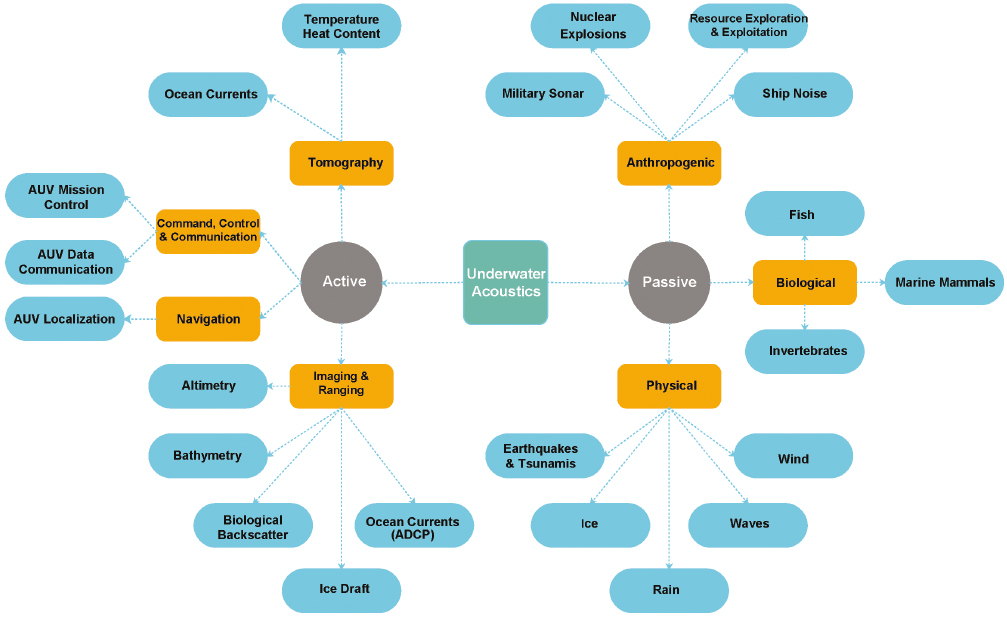
NOTE: Underwater acoustics is similar to ocean acoustics, but broader than marine environment.
SOURCE: Modified from Howe et al., 2019.
ocean acousticians. One display of that demand was several universities (e.g., MIT, Naval Postgraduate School, SIO, University of Hawaii, and WHOI) advertising open faculty positions in ocean acoustics, or ocean science and engineering with experience in acoustics in late 2018 and 2019.16
OCEAN ACOUSTICS TODAY
Motivation for the study underpinning this report, initiated by ONR, is largely twofold: (1) a concern that there may not be enough intellectual talent to support future USN needs and (2) development of the UN Ocean Decade Research Programme on the Maritime Acoustic Environment to grow scientific knowledge, technologies, and techniques that use sound to understand the marine environment. The Statement of Task (see Box 1-1) charged this committee to review ocean acoustics education and expertise, but it is difficult to completely tease apart the federal investment and priorities in research from investments in education, as support for education (particularly graduate education) is heavily influenced by USN investments in ocean acoustics research. The field of ocean acoustics extends far beyond its military origins and has applications in underwater navigation, communications, tomography, and sensing through modes of operation encompassing active transmission, passive listening, and information integration (see Figure 2-1; Box 2-1; Howe et al., 2019).
Ocean acoustics education is necessary to support all of these applications. Federal research funding often includes support for graduate and undergraduate research assistants, frequently providing an opportunity for
___________________
16Committee e-mail communications.
BOX 2-1
Selected Applications of Ocean Acoustics
Remote sensing in the ocean beyond a few hundred meters requires sound and ocean acoustics.
Numerous examples exist of ocean acoustics applications for the benefit of science and society.
- Ocean currents: Acoustic Doppler current profilers deliver real-time data on ocean current directions and magnitudes during ship operations or as a part of moorings or ocean observing platforms.
- Ocean temperature: Acoustic tomography uses controlled sound that propagates over very long distances to formulate three-dimensional maps of ocean temperature. Such approaches are particularly important for inferring temperature changes in the deep ocean, which is hard to monitor with techniques normally used at shallower water depths.
- Fish and invertebrate dynamics: Fishery echosounders inform management decisions about fishery stocks by providing data on the distribution and abundance of fish. These instruments can also detect invertebrates, such as zooplankton, which form the backbone of the marine food web, and gas bubbles in the water column.
- Remote sensing of marine mammals, vessels, and geologic events: Passive acoustic monitoring uses hydrophones to detect and track vocalizing marine mammals, yielding information about the distribution and movement of these top predators. Hydrophones are also used to track sounds from weather phenomena, ships, submarines, underwater volcanoes, and earthquakes.
- Ocean communications: Transponders are used to track ocean instrumentation or marine life (acoustic telemetry tags), and transceivers are used for communication and data transfer between instrumentation and a receiver. Nearly every instrument deployed in the ocean “pings” to indicate its position, and many instruments telemeter their data to a ship, a satellite, or another platform. Ocean communication is critical to tracking instrumentation in the water column, navigating vehicles and instrumentation in the absence of GPS fixes, collecting information from remotely operated and autonomous vehicles and sensors, and retrieving seafloor instrumentation after long deployments. Nearly all sectors of the economy that operate in the marine environment use ocean acoustics for one of these purposes.
- Ocean depth, seafloor bathymetry, and water column imaging: One of the most commonly used ocean acoustic instruments is the single-beam sonar, a critical navigational tool that supplies water depth immediately beneath a ship’s hull, protecting vessels, cargo, and lives. Multibeam sonars are used for mapping ocean depth in swaths of the seafloor and providing detailed information about its features, such as fault traces, seamounts, submarine landslides, and underwater volcanoes. Multibeam sonar data are critical for installing submarine telecommunication cables and siting of offshore energy infrastructure. Like sidescan sonars, multibeam sonars also acquire data to characterize the roughness of the seafloor and give clues about whether it is hard or soft. Such information can be used to identify habitats for deep-sea corals, certain fish, or chemosynthetic organisms; image shipwrecks; and locate critical seafloor minerals. Multibeam sonars can also detect the release of greenhouse gases, such as methane and CO2, from gas seeps and mud volcanoes.
- Imaging below the seafloor: Impulsive seismic instruments (e.g., airguns, sparkers, boomers, and bubble guns) and non-impulsive subbottom profilers (including hull-mounted and towed Chirp systems and parametric echosounders) image meters to kilometers below the seafloor. This provides information about sediment layers and rock interfaces, faults, salt bodies, and the distribution of gas. It has traditionally been used for energy exploration and scientific research but is now also critical for siting offshore renewable energy infrastructure and potential CO2 storage areas. Technologies are advancing rapidly, and marine vibroseis and subbottom profilers that are components of multibeam sonars are emerging as new instruments.
- Anti-submarine warfare (ASW): ASW and counter-ASW (detection avoidance) sonars use passive and active acoustics to protect naval assets. ASW and counter-ASW development was a driver of early advancement in ocean acoustics applications.
hands-on learning experiences within academia. Patterns and trends in ocean science, technology, and specifically ocean acoustics are shown in funding (see Figure 2-2), measured by proxies related to publication rate (see Figure 2-3), measures of countries’ research intensity relative to that of the world (specialization index, see Figure 2-4), and number of advanced degrees (see Figure 2-5). These trends are a window into the future of our nation’s capability and leadership.
At least 15 federal agencies17 have mandates related to or involving ocean science and ocean and coastal activities that may rely upon applications of ocean acoustics technologies and encompass basic research, resource management, conservation, infrastructure, and more (COL, 2018). Figure 2-2a shows funding for ocean science, of which ocean acoustics is a single subdiscipline, for the top five federal agencies investing in ocean science and technology from the early 1980s to the late 1990s. Their fiscal metrics (whether inflation adjusted or not) signal a trend that national investment in ocean science research has been stagnant (1982–1996) or even declining over the past 1–2 decades since 2010 (Figure 2-2b). Flat budgets result in an overall decline in investment and dollars available for research and education, as the cost of doing business rises. Increases in funding occurred only occasionally in specific years (and were likely linked to specific drivers, such as military threats or extreme weather) and are typically not sustained (COL, 2018; Lackie, 1997). The physical sciences, which encompass earth and ocean sciences, of which ocean acoustics is a subset, have experienced one of the largest declines in federal support for graduate students over the past 15+ years,18 (NSB, 2018), which may be a contributing factor in the lack of growth in ocean science doctoral degrees (Figure 2-5); that is not the only metric to measure growth or decline of a field but is used by the COL report.
Publication numbers and related indicators provide information that illuminate a country’s relative emphasis and strength in specific research areas where the number of publications is a proxy measure of its research capacity (COL, 2018). Growth is measured by an increase in papers published over time (see Figure 2-3). Assuming annual publication rates over the past 2 decades extend into the future, projections indicate that China will surpass the United States in publications including the subtopics of underwater acoustics (already surpassed) and autonomous ocean technology in the next 10 years (COL, 2018).
Figure 2-4 shows a comparison of selected countries’ specialization index in all selected ocean science fields (top), ocean acoustics (middle), and autonomous ocean technology (bottom). The United States has been at or above the world average over the past 20 years; however, it declined during 1996–2005 and 2007–2016. In 2016, it was below the world average, as are the EU-5 and United Kingdom. As U.S. specialization declines, other countries are increasing. China is well above the world level in the number of publications produced annually (since 2004), and its research capacity increased significantly during 1996–2005 and 2007–2016. India’s specialization has been low but has continued to increase over the past 20 years, especially since 2011. It is now close to or above the world level. Russia is by far the most specialized, at about double the world level (COL, 2018).
“The origins of new opportunities in science are diverse, but primarily they arise from ideas generated by individuals [communities of researchers,] or as a result of new capabilities provided by new technology or new vision provided by new instrumentation” (Hackerman et al., 1990, page 9). Education is essential in developing these opportunities and supplying the workforce with needed expertise. This is especially true for innovation and progress within the ocean acoustics community. The applied uses of ocean acoustics have evolved from a military-centric focus to larger societal applications related to the blue economy, ocean sustainability, and commercial ocean technology, which is likely contributing to the increase in Ph.D.s conferred after 2003 (see Figure 2-5). Acoustics expertise is being used in many marine applications outside of defense (e.g., energy exploration, ocean mapping, environmental monitoring, marine renewable energy) and has engaged a greater number of federal, for-profit, nonprofit, and academic organizations in the quest for education and training opportunities related to ocean acoustics. The evolution in ocean acoustics applications beyond DoD is evident in the following specific actions: (1) the addition of ocean sound as an Essential Ocean Variable in the Global Ocean Observation System (Tyack, 2018),
___________________
17Including Defense Advanced Research Projects Agency, DoD Department of the Navy, DoD ONR, Department of Energy, Department of the Interior (DOI) Bureau of Ocean Energy Management, DOI Bureau of Safety and Environmental Enforcement, DOI National Park Service, DOI U.S. Geological Survey, Department of State, Department of Transportation (DOT) Maritime Administration, Federal Energy Regulatory Commission, Marine Mammal Commission, NOAA, NSF, Army Corps of Engineers, and U.S. Coast Guard.
18Federal support of graduate students in the physical sciences declined from 35 percent in 2000 to 27 percent in 2015 (NSB, 2018).
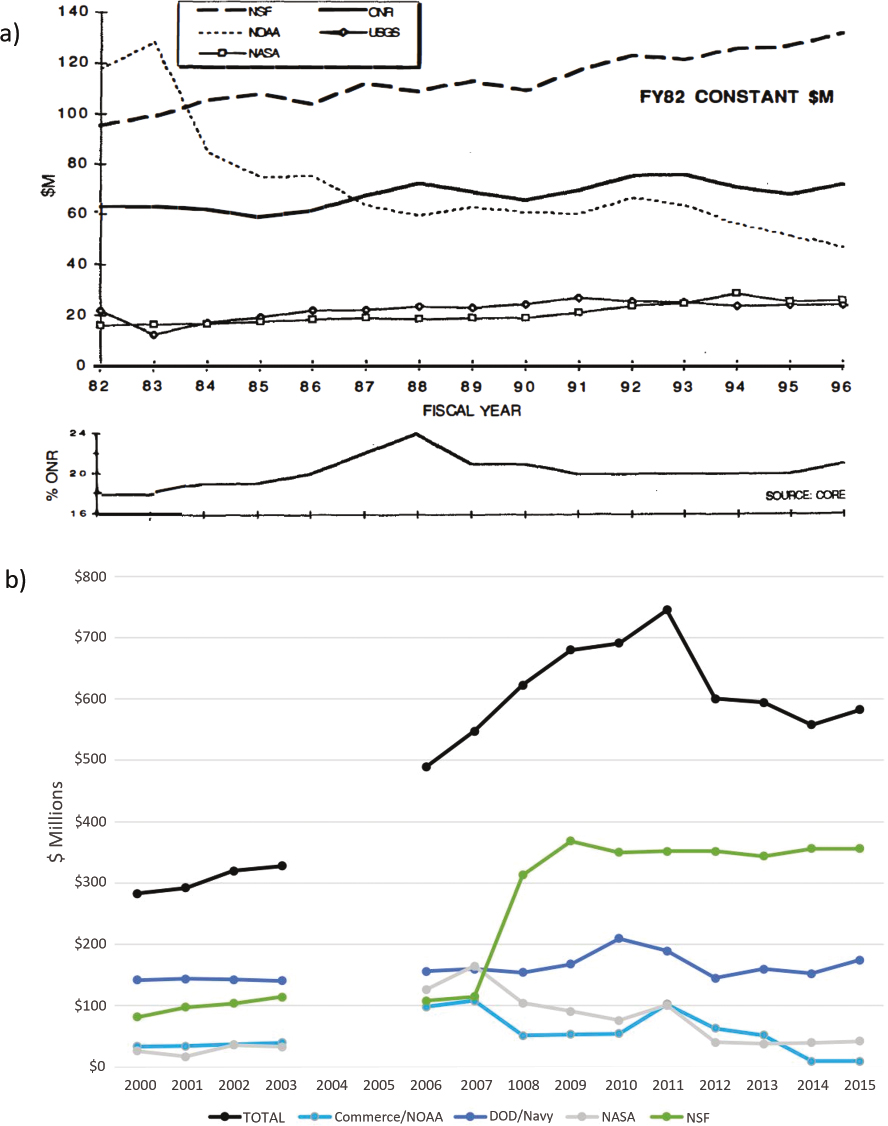
NOTE: Federal funding levels for ocean science, of which ocean acoustics is a subdiscipline, indicate that national investment in ocean science research has been stagnant (1982–1996) or even declining over the past 1–2 decades since 2010, hindering growth of the field.
SOURCES: (a) Lackie (1997), (b) COL (2018); ©2018 University Corporation for Atmospheric Research.
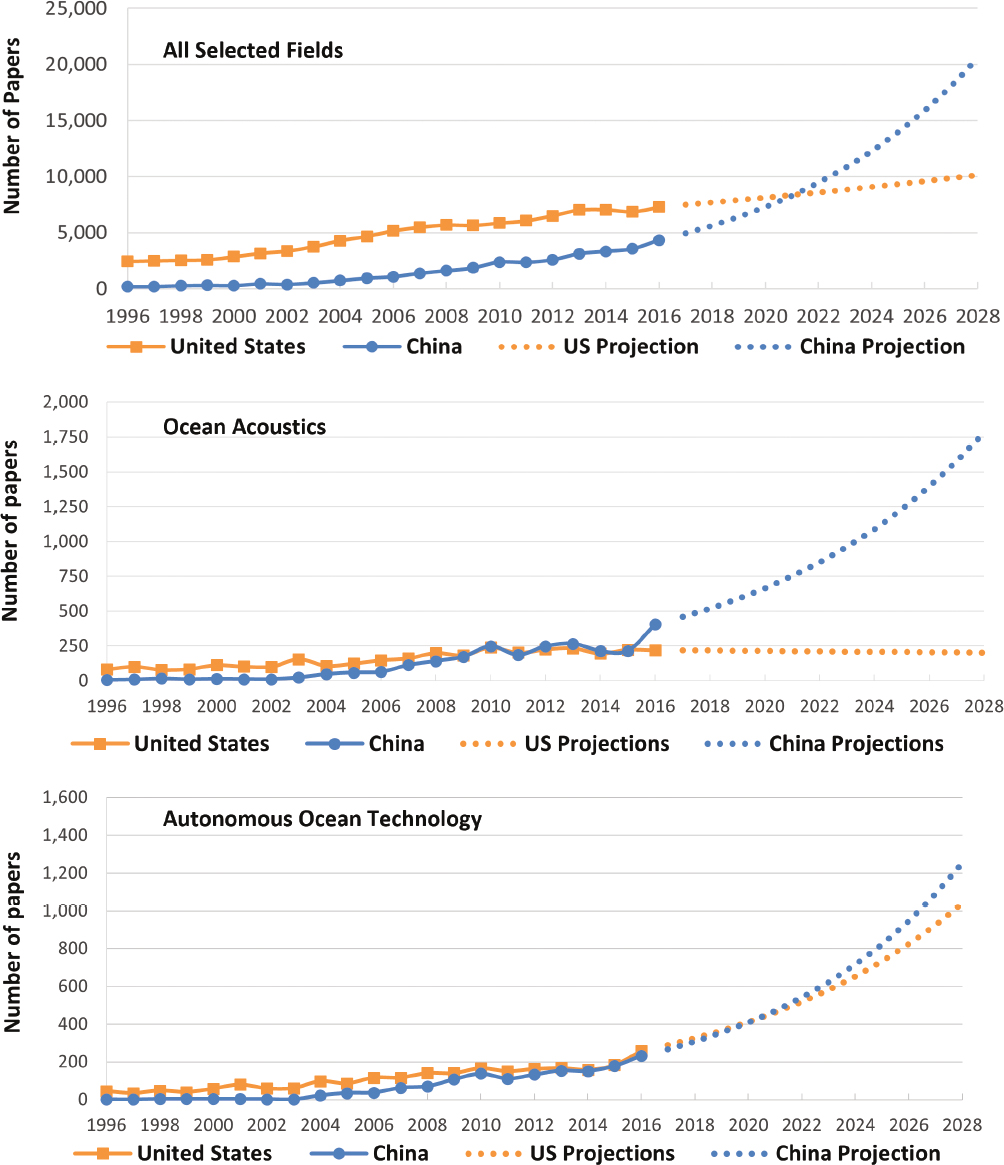
NOTES: Publication rates are a proxy for nations’ research capacity and relative importance of the field. Projections show China overtaking the United States in the number of publications produced in both ocean acoustics and ocean technology, indicating its greater emphasis on research in these fields.
SOURCE: Modified from Science-Metrix (2018).
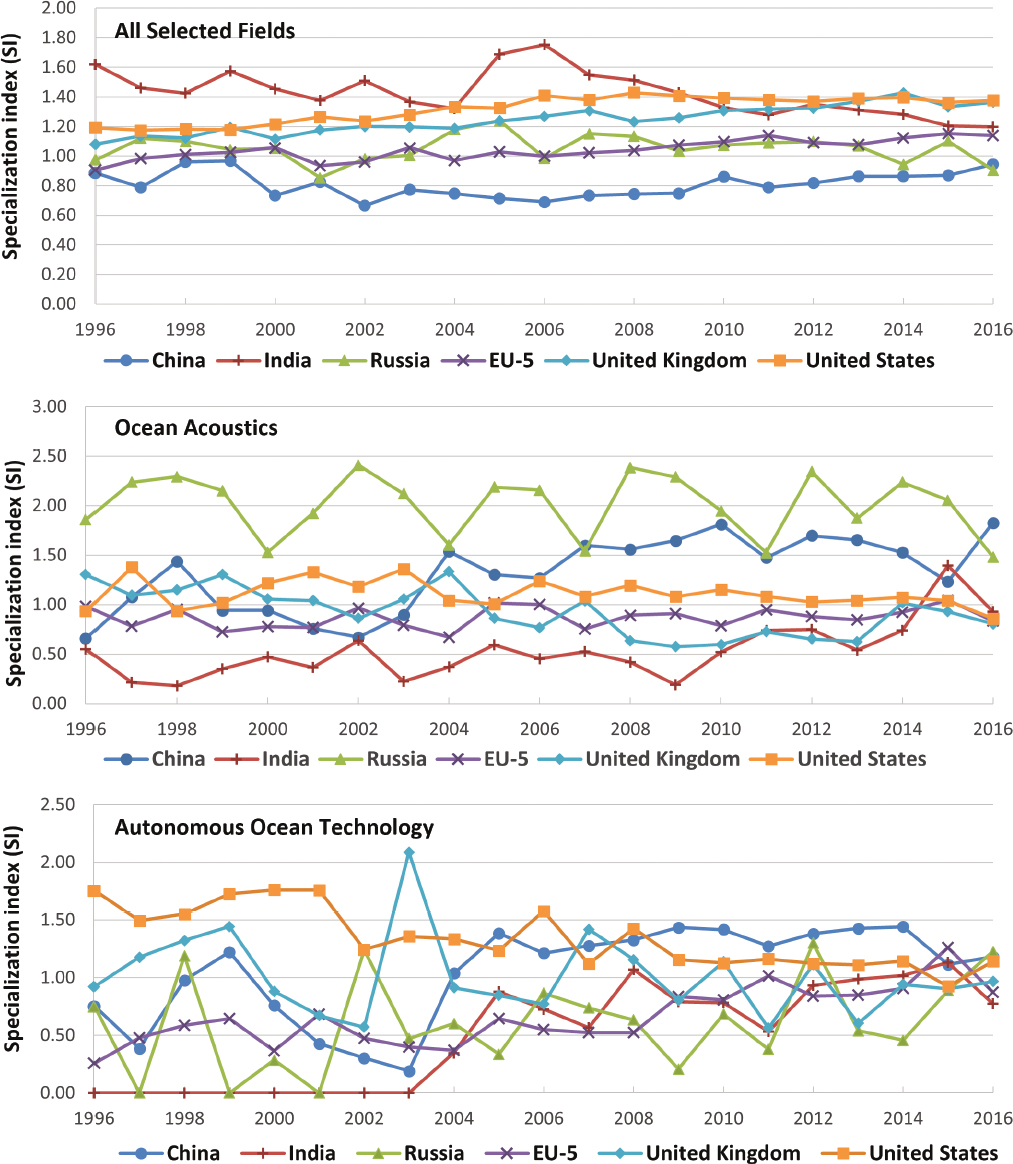
NOTES: SI is a measure of research intensity in each field of science relative to the intensity of a reference entity (the world in this study). An SI of 1.0 indicates an equal level of specialization relative to the world, an SI above 1.0 indicates higher specialization, and an SI below 1.0 indicates lower specialization. The world SI of approximately 1.22 for the selected subtopics indicates that the world specializes in these subtopics more than all ocean topics.
SOURCE: Modified from Science-Metrix (2018).
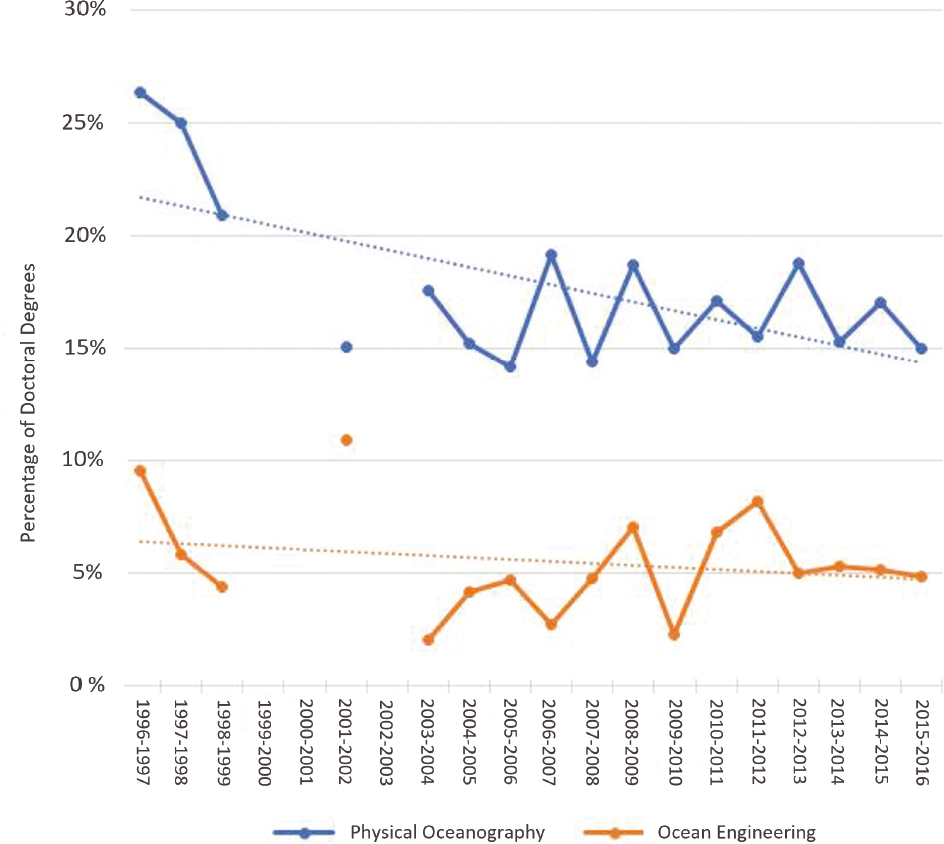
NOTE: The percentage of Ph.D.s conferred is a proxy to the ability for a country to display leadership within the field and also reflective of research funding availability.
SOURCE: Modified from COL (2018); © 2018 University Corporation for Atmospheric Research.
(2) creation of the Center for Marine Acoustics in the BOEM in 2020, (3) creation of the Interagency Working Group on Ocean Sound and Marine Life under the Subcommittee on Ocean Science and Technology that includes 16 federal agencies,19 (4) creation of the Sound and Marine Life Joint Industry Program funding academic research to address gaps in the understanding of interactions between marine life and anthropogenic sound related to the offshore energy sector,20 and (5) National Ocean Partnership Program (NOPP) projects focused on or implementing ocean acoustics to leverage investments from multiple federal and non-federal organizations toward shared goals (e.g., standardization of passive acoustic data collection, analysis, products, and reporting). Chapter 3 outlines the state of ocean acoustics education and training opportunities; Chapter 4 identifies the current and future workforce demands briefly stated here.
___________________
19See Chapter 4 for federal agencies involved in the working group.


