A New Vision for High-Quality Preschool Curriculum (2024)
Chapter: 3 The Science of Early Learning and Brain Development
3
The Science of Early Learning and Brain Development
The neurobiology of learning and the powerful influences of the early environment on brain development are central considerations in planning effective preschool curriculum. The principle that there are sensitive periods during early childhood when the capacity for learning is enhanced has been well established in specific domains (language, visual) and is the focus of ongoing investigation in cognitive, social, and emotional domains (Werker & Hensch, 2015; Woodard & Pollack, 2020). Broadly, the existence of sensitive periods and related high neuroplasticity during the early years of life represent a window of opportunity for enhancing early learning, as specific skills and abilities are known to be absorbed or learned more readily during these periods. In turn, because learning is a cumulative process, enhanced early learning can lead to long-term learning benefits. In contrast, when opportunities for environmental stimulation and expected experiential inputs are missed, the early years can be a period of unique vulnerability and can lead to learning challenges at later developmental periods.
Moreover, children’s early learning depends on strong starting points as well as the experiences children have in their environments. Across cultures, infant studies show evidence of strong initial states—termed “core knowledge.” Studies indicate that core knowledge is universal across disparate cultures (e.g., Spelke, 2022; Spelke & Kinzler, 2007). Core knowledge domains are evolutionarily ancient, are shared with other species, and have continuity across the human lifespan. They include knowledge about objects and their physical actions, such as their continuity and contact constraints (Aguiar & Baillargeon, 1999; Leslie & Keeble, 1987; Spelke, 1990);
knowledge about agents and their goal-directed actions and intentions (Spelke et al., 1995; Stavans & Csibra, 2023; Woodward, 2009); knowledge about what number is approximate for all but the smallest sets (Carey, 2004; Carey & Barner, 2019; Dehaene, 1997); knowledge about geometry, which allows infants and young children to navigate based on the geometry of spaces and to represent shapes based on angle and side length (Cheng & Newcombe, 2005; Dehaene et al., 2006; Izard & Spelke, 2009; Newcombe & Huttenlocher, 2003); and core social cognition, which enables babies to represent others with whom they interact and their social group (Kinzler & Spelke, 2011; Kinzler et al., 2007; Spelke, 2022). Importantly, core knowledge systems are malleable, and children’s initial states change depending on their experiences. For example, as early as 3 months of age, infants show an own-race preference for faces, but this is based on their exposures and is not seen in infants who grow up in environments where they are exposed to other races (Bar-Haim et al., 2006; Kinzler & Spelke, 2011). Somewhat later, at 11 months, infants growing up in Latine or White families exhibit a bias to looking at minority group faces (Singarajah et al., 2017), which may reflect the preference for novelty outweighing the preference for familiarity (Aslin, 2007). In this way, children build on their core knowledge through their lived experiences, which occur within their sociocultural contexts (Gutiérrez & Rogoff, 2003; Gutiérrez et al., 2017).
This chapter briefly reviews the neurobiological and sociobehavioral research that shows the influence of early life experiences on early childhood development, including brain development, that can impact outcomes later in life. It then describes the science of early learning, detailing the multiplicity of ways children learn, from active exploration and observation of others to adults’ explicitly sharing knowledge with them. Content and skills typically shared by adults with children include domain-general skills—social-emotional learning and executive function—as well as domain-specific skills—language, literacy, and math learning. The chapter concludes with a discussion of the implications of the science of early childhood development and early learning for preschool curriculum development, including cultural and linguistic variations in learning opportunities and learning.
NEUROBIOLOGICAL AND SOCIAL-EMOTIONAL DEVELOPMENT
The early developmental period is recognized as the most important developmental phase of the lifespan, during which the young child’s experiences and exposures sculpt the brain to ready it for learning and positive adaptation. Building on these principles of neuroplasticity, the preschool period and preschool experiences may have a particularly important impact on developmental trajectories and provide opportunities to build strong
foundational skills more efficiently than is the case later in development. Thus, the preschool period is a window of opportunity for enhanced learning, and the neuroscience of sensitive periods can be used to inform the content, timing, and pedagogical focus of early educational curricula. In other words, the neuroscience of sensitive periods provides a roadmap for the “what,” “when,” and “how” of early curricula.
Experiences across environmental contexts play a significant role in early development. As summarized in a recent report by the National Academies of Sciences, Engineering, and Medicine, Vibrant and Healthy Kids:
A large body of recent research provides insights into the mechanisms by which early adversity in the lives of young children and their families can change the timing of sensitive periods of brain and other organ system development and impact the “plasticity” of developmental processes [. . .] a wave of neurobiological studies in model systems and humans found that responses to pre- and postnatal early life stress are rooted in genetic and environmental interactions that can result in altered molecular and cellular development that impacts the assembly of circuits during sensitive periods of development. The demonstration that certain systems involved in cognitive and emotional development are more sensitive to early disturbances that activate stress response networks, such as the frontal cortex, hippo-campus, amygdala, and the hypothalamic-pituitary-adrenal axis, provided a basis for both short- and long-term functional consequences of early life stress. New research has clarified that altered nutrition, exposure to environmental chemicals, and chronic stress during specific times of development can lead to functional biological changes that predispose individuals to manifest diseases and/or experience altered physical, social-emotional, and cognitive functions later in life. (2019, p. 7)
This section reviews key features of early development with particular relevance for fostering positive outcomes for preschool-aged children, including the caregiving environment, the presence of stress, and access to resources.
Caregiving Environment
The early caregiving environment—including familial relationships; safe, stable, nurturing relationships and environments; healthy living conditions; economic security; nutrition and food security; neighborhood and community conditions; housing; and environmental exposures—is crucial for long-term development (National Academies, 2019). Importantly, children learn optimally when they feel safe and secure in their home and neighborhood environment before arriving at preschool. Critical for this sense of basic security and readiness to learn and thrive is the presence of at least one nurturing and reliable primary caregiver upon whom a child
can rely for protection and necessary physical and emotional support and assistance (Brown et al., 2020). This is necessary under all circumstances but particularly critical in environments with high rates of early adversity, where buffering factors are of paramount importance to ensuring positive developmental trajectories (Brown et al., 2020).
Certain supports within the caregiving environment are also necessary to enable young children to benefit optimally from learning experiences. Along this line, one key prerequisite is regular daily rhythms, central to which is the opportunity for restful sleep, which has been shown to be a necessary precondition for optimizing learning and memory in early childhood, as well as throughout life (Spencer et al., 2017). A related finding is that unpredictable parenting signals (e.g., parents behaving erratically) are associated with poorer executive function in middle childhood (Davis et al., 2022; Granger et al., 2021), a phenomenon also seen in animal models, where alterations in the development of subserving brain circuitry have been demonstrated (Davis et al., 2022). The basic forms of adversity in early childhood that have been shown to impact brain development and learning negatively are deprivation, threat, and unpredictability; therefore, these key domains need to be addressed prior to school entry if learning is to be optimized (McLaughlin & Sheridan, 2016). Importantly, when children live in chaotic households and/or neighborhoods that are impoverished and have high rates of violent crime, their basic sense of security and regularity is undermined. More obvious is the need for adequate nutrition to maintain energy, focus, and alertness. These prerequisites within the caregiving environment—sleep, predictability, and nutrition—are often either overlooked or assumed to be available to all children. In fact, many children do not have these foundational biological supports, a social reality highly relevant, and representing a major impediment, to many developing children’s ability to learn.
Early Exposure to Stress
Related to these prerequisites of security, safety, adequate protection, and necessary resources, studies have demonstrated that children exposed to trauma and chronic stress have physiological responses that impact brain development and functioning in ways that interfere with the learning process. High levels of chronic stress impact both brain and behavior in ways that put the child on “high alert” for ongoing and expected threats, which of necessity diverts their attention from the learning process and alters cognitive processes that allow consolidation of memory, executive function, and other elements essential to learning (Gunnar, 2020). These conditions elevate circulating stress hormones, notably cortisol, with receptors in brain regions key to learning and memory. Chronic exposure to elevated stress hormones without external buffers, such as supportive caregivers, has been shown to alter brain development and related cognitive capacities
negatively over time (Lupien et al., 2007). Accordingly, children with these exposures may require additional supports before and in concert with their entry into preschool environments to facilitate their development of the basic prerequisites for their ability to learn.
In addition to psychosocial stressors, children living in low-resource environments also have greater exposure to environmental toxins (National Academies, 2023). It has become clear over the past several decades that exposures to low levels of a growing list of environmental toxins found in air and water contribute to poor outcomes including low birth weight, shorter gestation, and intellectual disability, as well as increased risk for psychopathology (Lanphear, 2015; National Academies, 2023). The detrimental effects of these exposures in utero and in early childhood is underscored by the fact that the blood–brain barrier is more permeable during this period and that growing organs are more susceptible to the negative effects of toxins. Based on these facts, these exposures, which are ubiquitous but more common in underresourced neighborhoods, pose a major threat to the young child’s ability to learn (Kumar et al., 2023).
Minoritized children and families face structural inequities, unequal treatment, and acts of discrimination and racism that add to the cumulative burden of stress and require focused attention (Shonkoff et al., 2021). Researchers have recently turned their attention to the unique impacts of racism on the foundations of physical and mental health. Studies of residential segregation by race as they affect risk exposures and health have, for example, linked poorer pregnancy outcomes among women of color to disproportionate exposures to environmental toxins (Miranda et al., 2009). At the family level, parents’ self-reported experiences of discrimination have been associated with their children’s social and emotional problems, as well as with increased levels of cortisol and proinflammatory cytokines—indicators of disrupted stress-response systems (Bécares et al., 2015; Condon et al., 2019; Gassman-Pines, 2015, as cited in Shonkoff et al., 2021, p. 123). And Black children are three times more likely than their White counterparts to lose their mother by age 10 (Umberson et al., 2017). These are among the experiences of adversity arising from racism, and their impacts, that minoritized children bring with them into their early childhood settings. To facilitate learning for these children, then, early educators need to be sensitized to and prepared to buffer these experiences. Toward this end, knowledge of trauma-informed approaches is a critical component of the professional preparation of early educators (de la Osa et al., 2024).
Access to Resources
Related to these basic prerequisites for early learning, neurodevelopmental research has shown that family socioeconomic status, particularly poverty, is negatively associated with differences in brain structure
and function in multiple domains, including language, cognition, executive function, memory, and social-emotional processes (e.g., Brooks-Gunn & Duncan, 1997; Hackman et al., 2015; Noble et al., 2007; Stevens et al., 2009). Moreover, experiences that include those discussed above, as well as differences in opportunities to learn, have been found to account for a significant portion of the relationship between socioeconomic status and learning and development (Brooks-Gunn & Duncan, 1997; Capron & Duyme, 1989; Duncan et al., 1994; Jimerson et al., 2000; Noble et al., 2007; Schiff et al., 1982). Recent data from the Child Opportunity Index, which ranks neighborhoods on multiple dimensions of opportunity, such as access to early childhood centers and healthy food outlets, reveal that a majority of Black, Latine, and Native American children reside in low- or very low–opportunity communities, compared with one in five White and Asian children (Acevedo-Garcia et al., 2020). In addition, there is increasing evidence that exposure to “green space” and outdoor spaces are important for multiple developmental domains, including emotional well-being (McCormick, 2017).
HOW CHILDREN LEARN: THE SCIENCE OF EARLY LEARNING
Children learn in a multiplicity of ways—through active exploration and play; through observation of others, notably older children and adults; and through adults’ explicitly sharing knowledge with them. This section reviews each of these types of learning in turn.
While these three types of learning occur across all cultures, their prevalence differs depending on cultural context. For example, children from U.S.–Mexican heritage families in which mothers had experience with Indigenous ways were found to be much more likely to learn from observing a toy construction activity directed to another child than were Mexican heritage children whose mothers had extensive experience going to Western schools (Silva et al., 2010). Further, as discussed later in this chapter in the section on language learning, children learn through child-directed speech, as well as through listening to adult conversations, with the prevalence of these learning opportunities differing depending on cultural context (e.g., Casillas et al., 2020; Shneidman & Goldin-Meadow, 2012).
Exploration and Play
Exploration and play have long been recognized as universal aspects of childhood, and they are found in every culture that has been studied (e.g., Hughes, 1999; see Vandermaas-Peeler, 2002, for review). At the same time, play varies across cultural contexts in multiple ways, including the nature of play activities children engage in, reflecting the diversity of children’s
experiences and the materials that are available, the degree to which adults and older children are involved in the play, and the nature of their involvement (e.g., Haight et al., 1999; Roopnarine et al., 1998; Vandermaas-Peeler, 2002, for review). There is also cultural variation in the degree to which play is viewed as being tied to learning or as differing from learning, which is viewed as linked to work more directly (Metaferia et al., 2021).
Environmental factors can also affect the extent to which children have access to safe environments for play. As noted in the 2023 National Academies report Closing the Opportunity Gap for Young Children, children from families with lower incomes and children from minoritized populations are more likely to live in environments where there is a risk of exposure to environmental contaminants than are children from other backgrounds. In addition, children in disadvantaged neighborhoods are more likely to live in environments where there is poor urban planning, increased risk of injury from roadways and traffic, and higher rates of neighborhood violence (National Academies, 2023).
Various constructivist theorists have highlighted the importance of play and exploration in the development of children’s thinking, language, and social skills (e.g., Bruner, 1983; Piaget, 1962; Vygotsky, 1967, 1978). These theorists posit that the information children gain through play and exploration is not just received passively but rather is integrated actively with their prior concepts and ideas (see Narayan et al., 2013, for review). They also characterize play as a joyful activity with an important role in development and learning. For example, Bruner (1983) characterized play as a joyful way of solving problems and as a testbed for trying out and combining ideas and skills without worrying about consequences of failing to achieve a goal. Dewey (1910) emphasized the importance of a playful attitude toward the process of learning, coupled with the serious attitude of work toward goals of learning. These theories differ in the emphasis they place on adults and older children as promoting children’s learning through explorations and play. Piaget (1970), for example, focused on the role of the child’s own explorations of the world, characterizing the child as a little scientist who actively gathers information by exploring the world. In contrast, Vygotsky, Dewey, and Bruner considered the role of adults and older children in supporting children’s development during play and other activities via the provision of materials and through language interactions (e.g., Bruner, 1983; Dewey, 1910; Vygotsky, 1967, 1978). Notably, Vygotsky (1978) highlighted the role of adults in extending children’s learning by providing scaffolding that allows them to extend their learning into their zone of proximal development.
Contemporary researchers have built on and extended the work of these theorists. A growing body of research shows that children engage in and learn from active exploration as early as infancy. For example, as early
as 11 months of age, babies learned more and engaged in more relevant exploratory behaviors when objects violated their expectations than from nearly identical experiences that were consistent with their expectations (Stahl & Feigenson, 2015). Follow-up studies replicated these findings and showed that infants explored more after an event that violated their expectations (e.g., an object that appeared to float) because they sought an explanation for why objects behaved in this manner (Perez & Feigenson, 2022).
Studies involving preschool children provide compelling evidence that children learn from exploration and explore more than adults even when they know that exploration carries risks (e.g., Gopnik, 2012, 2020; Liquin & Gopnik, 2022; Schulz, 2012; Xu & Kushnir, 2013). For example, in a task that involved discovering how stimuli were classified differently, Liquin & Gopnik (2022) found that preschool children were more likely to explore than adults, and children’s propensity to explore enhanced their success on this task. Another study showed that 4- to 6-years-olds learned more when active exploration was encouraged and when adults did not fill in all the gaps in children’s knowledge. In one study, Bonawitz et al. (2011) gave preschool children (48–72 months; mean age 58 months) a novel toy with four different functions. Children were randomized into one of four conditions that varied in terms of the pedagogical support the adult provided. Two critical conditions were the pedagogical condition, where an adult showed them one function of the toy (that it squeaked) and a baseline condition in which the adult merely gave them the toy without demonstrating any of its functions. Strikingly, the children discovered significantly more of the functions of the toy in the nonpedagogical baseline condition (M = 4.0) than in the pedagogical condition (M = 5.3). Moreover, children played with the toy significantly longer in the nonpedagogical condition.
In another study, 4- to 5- year-old children were presented with finding out the “secret of shapes” (e.g., triangles), and were randomly assigned to one of three conditions. In the didactic, pedagogical condition the adult taught the attributes of triangles directly; in the guided play condition the child was encouraged to do the discovering with teacher scaffolding; and in the free play condition, children were simply given the shapes to play with. Strikingly, children learned more about the defining features of shapes when they were in the guided play condition compared with both the direct instruction and the free play conditions; this was true both immediately after the training and 1 week later.
Considered together, these findings highlight the benefits of guided play in supporting children’s learning and persistence. Guided play provides the child with agency to test their nascent theories about the world. It also provides them with adult-guided situations and language that support their learning (Hirsh-Pasek et al., 2020). Contemporary researchers, aligned
with the Vygotskian view, emphasize the role of guided play in supporting the child’s active exploration of their environment and their learning. Research findings indicate that guided play supports not only the growth of content knowledge (the “what” of learning) but also the learning process (the “how” of learning), which together enable them to pursue their questions, problem solve, and collaborate. With the exponential growth of information in contemporary society, it is important that children’s experiences help them gain content knowledge, confidence, curiosity, creativity, communication, and collaborative skills—known as the 6 Cs; each is valued in the 21st century (Hirsh-Pasek et al., 2020).
Aligned with research and theory highlighting the connection of play to children’s learning, preschool teachers rate children who display curiosity as having higher learning ability/skills; and teachers’ ratings of children’s curiosity in preschool are associated with children’s achievement levels at kindergarten entry (Shah et al., 2018). However, despite these documented benefits of exploration and play, preschool environments vary in terms of whether exploration and question asking are encouraged or discouraged in favor of more structured activities that emphasize correct answers and adults providing children with information (Reid & Kagan, 2022). This may be linked to the belief that play and learning are separate, a false dichotomy discussed in Chapter 4. As pointed out by Zosh et al. (2018), there are many different kinds of play, and failure to recognize the nuanced spectrum of types of play can lead to confusion about how play relates to and supports learning. Play ranges from adult-directed play activities, in which the adult has a learning goal in mind; to guided play, in which the adult gives the child agency but provides scaffolding and guidance with a learning goal in mind; to free play, in which the child both initiates and constructs play without a specific learning goal (Zosh et al., 2018). Zosh et al. (2018) point out that play can be characterized by three attributes: the level of adult involvement, the extent to which the child creates the play, and whether a learning goal is present (Figure 3-1).

SOURCE: Zosh et al., 2018.
Hirsh-Pasek and colleagues propose that guided play provides a sweet spot for supporting children’s learning, as well as their curiosity, creativity, and collaborative skills (e.g., Hirsh-Pasek et al., 2008, 2020, 2022; Zosh et al., 2018). In guided play, the teacher plays the role of facilitator, which allows for intentional learning goals that can be tuned to the child’s current skill levels. At the same time, the light-touch hand of the teacher in guided play activities provides the child with agency, which is positively associated with academic outcomes and interests (e.g., Bruner, 1983; Hirsh-Pasek et al., 2020, 2022). For example, one study examined parents’ use of spatial language when playing with their 4-year-old children in three conditions—(1) free play with blocks, (2) guided play with blocks with a goal of building a particular structure, and (3) play with a preassembled structure (Ferrara et al., 2011). Parents in the guided play condition produced more spatial language than those in the free play or preassembled conditions. This finding is important because spatial language supports children’s spatial thinking, which in turn predicts success in the disciplines of science, technology, engineering, and mathematics (e.g., Casasola et al., 2020; Hawes & Ansari, 2020; Mix et al., 2016, 2021; Pruden et al., 2011; Wai et al., 2009).
Related to these findings, pretend play and guided play are associated with oral language and literacy outcomes, likely because the language in which children engage during play is complex and contains rich vocabulary, including many mental-state verbs (e.g., Bruner, 1982; Dickinson & Tabors, 2001; Pellegrini & Galda, 1990; Roskos & Christie, 2001; Toub et al., 2018). Further, play activities support knowledge of mathematical language and thinking. Notably, play with a variety of materials provides opportunities to think about spatial relationships and patterns, either imagined or built; to compare magnitudes and shapes; and to enumerate sets (Eason et al., 2021, 2022; Fisher et al., 2013; Ramani & Siegler, 2008; Seo & Ginsburg, 2004; Siegler & Ramani, 2008).
While play-based learning is increasingly emphasized in research and practice in Western Euro-American contexts, a rich literature documents differences in the nature of play, the involvement of parents in play, and the amount of play children engage in depending on culture (see Vandermaas-Peeler, 2002, for review). Using three contrasting examples, Gaskins et al. (2007) highlight the fact that play is socially constructive and that adults’ roles in children’s play depend on culture. Whereas urban, educated American and Taiwanese adults cultivate children’s pretend play, in Liberia, the Kpelle, who are subsistence horticulturists, accept but do not participate in children’s play, as they need to conserve their time and energy to provide food and maintain their own strength. Instead, other children, including older children, are the playmates of younger children. Finally, in the Yucatec-Mayan culture, where people live in subsistence farming communities, development is seen as the unfolding of one’s inner abilities
and character. Consistent with this view, play is viewed as a distraction for children when they cannot help. Play still occurs, with older children taking the lead in pretend play, which typically involves pretending to do the work of adults rather than fantasy play. Additionally, the peak of pretend play in Yucatec-Mayan children is between ages 6 and 8, much later than the 3- to 6-year-old peak in Euro-American families. Rather than encouraging play, in the Yucatec-Mayan culture, children are encouraged to observe and work alongside adults in their community, as their work can eventually contribute to the overall productivity of the society. These cultural differences serve to illustrate the sociocultural nature of play.
Despite these cultural differences, the preschool landscape around the globe is currently undergoing rapid change, with many countries embracing play-based early education curricula. These changes are not without challenges, and they often mismatch with teacher and parent beliefs and lead to inequities; furthermore, professional development for teachers and large student–teacher ratios make these changes challenging to implement (Gupta, 2011; Yee et al., 2022). For example, in India, play-based private schools are equated with developmentally appropriate practices. Importantly, Gupta questions the appropriateness of Western, play-based approaches within a culture that prioritizes examination scores for access to higher education and advocates for approaches to early childhood education that emerge from Indian cultural values. Gupta (2011) records a teacher’s statement that “it rains so children can play in the water,” which connects a child-centered approach to the scarcity of water and the spirituality of the Monsoon season. In Korea, the revised Nuri curriculum (2019) put a heavy emphasis on free play, which has led to confusion among teachers about their role in supporting children’s learning (Lee et al., 2023). The lack of professional development around play is a factor in this confusion, and the emphasis on free play is at odds with research findings showing that guided play is more conducive to supporting many learning goals.
The studies discussed above highlight the importance of considering play in a culturally responsive manner, not as something in which all children engage in a uniform manner. Viewed in this way, children’s play has the potential to contribute to the cultural relevance of early education, as child-initiated play reflects children’s cultural experiences and how they see themselves within the larger society, providing teachers with an important lens into children’s lived experiences (Adair & Doucet, 2014). Moreover, children’s play provides teachers with a way to engage in guided play, enabling the teacher to build on children’s interests and skills, which, as we have discussed, may be one of the most effective ways to support learning.
A 2022 study involving interviews with 31 early childhood experts from different fields provides some relevant information with respect to play in early childhood education contexts that serve children from
different demographic backgrounds (Reid & Kagan, 2022). The experts were broadly supportive of the importance of play in early childhood curricula and, relatedly, were supportive of autonomy-granting approaches that give young children a voice in how they learn. Their support for this kind of approach recognizes the importance of children’s interests, curiosity, and explorations in the learning process and aligns with the research base. Nonetheless, the experts disagreed about the amount and nature of play that best supports children’s learning. Roughly half called for more play in curricula, whereas others noted that play-based approaches have gone too far in some schools. A potential explanation for disagreements about the role of play in early childhood curricula may be the cultural differences in how play is valued and practiced, as discussed previously.
Many of the experts interviewed by Reid & Kagan (2022) also expressed the belief that the amount of play children experience varies by the socioeconomic status of the children in the classroom, such that children from a background of lower socioeconomic status experience less play. Consistent with this belief, Adair & Colegrove (2021) provide evidence that there is “segregation by experience” in educational settings, such that young children in classrooms characterized by higher socioeconomic status have more opportunities to be agents in their learning and are provided with more opportunities to carry out explorations of their world compared with children in classrooms characterized by lower socioeconomic status, who are disproportionately children of color. Instead, young children of color are more often required to sit with their legs folded and hands placed together in silence, not because they need to attend to pedagogical content but for the purpose of practicing valued behaviors (Adair & Colegrove, 2021).
Similarly, an influential paper utilizing two waves of the Early Childhood Longitudinal Study, Kindergarten Class data (1998 and 2011) reports evidence that, of the two, kindergarten was more like first grade (more structured with less play) in the 2011 cohort, influenced by the No Child Left Behind Act and increased accountability and testing. Bassok et al. (2016) found that this was more starkly the case in settings serving children eligible for free or reduced-price lunch or children who were non-White (Bassok et al., 2016). For example, kindergarten teachers serving a larger percentage of children eligible for free or reduced-price lunch (in the highest quartile of representation of this group) were significantly more likely to endorse the importance of children’s knowing the alphabet at the time of kindergarten entry than was the case for kindergarten teachers serving students from backgrounds of higher socioeconomic status (51% versus 34%, respectively). These beliefs, whether implicit or explicit, are likely to have downstream consequences in terms of the nature of the pedagogy and curricula adopted in different early childhood settings, resulting in inequities in early learning opportunities.
The focus on more direct pedagogy and basic skills in classrooms serving children of lower socioeconomic status, racially minoritized, and immigrant backgrounds stems from deficit models, which incorporate the belief that minoritized children need direct instruction to build basic academic skills (e.g., vocabulary, letter recognition, counting) in order to narrow achievement gaps. Moreover, inequities in agentic learning stem from views about what children from different groups can handle, based, for example, on ideas about a “word gap” in children of Latine immigrants (Adair et al., 2017). When shown videos of Latine children engaging in agentic learning, teachers and school administrators said these practices are valuable but would not work in their classrooms because their students lacked vocabulary knowledge necessary for these practices to work. Moreover, children who viewed the videos were consistent in their evaluations of the children in the videos as being bad, not learning, being too noisy, and not listening to their teachers. While well meaning, limiting children’s agency in early education contexts based on perceived shortcomings denies children the kinds of experiences they need to build advanced language and thinking skills, as well as skills necessary for pursuing learning in which they are interested and collaborating and conversing with other children. Differential access to autonomy-granting, play-based pedagogy in early education is potentially harmful and is typically rooted in stereotypes about weaknesses of children and their families instead of being attributed to systemic factors that contribute to group differences (Adair, 2015; Adair & Colegrove, 2021; Adair et al., 2017; National Academies, 2023).
Young children need to gain both basic skills and higher-order thinking skills and be afforded the opportunities to acquire these skills in early education settings. Focusing on basic skills through direct instruction to the exclusion of agentic play-based activities may have unintended negative consequences because such gains have been found to fade over time (Bailey et al., 2016, 2017, 2020). In contrast, instruction that includes more play-based activities designed to foster exploration, curiosity, complex language skills, and higher-order thinking (e.g., acting out child-created narratives; exploring the conditions that lead plants to grow at different rates) are associated with positive long-term effects on children’s learning, as well as on their learning dispositions (e.g., Frausel et al., 2020, 2021). Thus, differences in pedagogical approaches that are related to biased perceptions about children’s sociocultural and linguistic backgrounds may be harmful, as they are likely to contribute to the very disparities in achievement they are intended to close.
A shortcoming of the current research base examining the prevalence and benefits of play and exploration is that play-based curricula and learning have not been examined systematically in early education settings of different types, and in settings that serve children from differing cultural
and socioeconomic backgrounds. While existing research suggests that there is a lack of equity in play-based approaches to learning in early education settings, more research is needed to confirm that this is the case and if so, to understand why this is happening. Further, research is needed to examine the benefits of play-based learning for children from different backgrounds. An essential step in addressing these gaps is conducting systematic research on children’s experience with agentic learning in early education settings serving children from diverse backgrounds, and studying the benefits of this approach for children’s learning as well as for culturally affirming practices that foster the belonging of children and families. In view of evidence from the science of learning, it is important that all children are provided with engaging, agentic learning experiences. With content knowledge exploding exponentially, educational approaches that support not only the “what” but the “how” of learning are of increasing importance. Children need to learn how to gain new knowledge, how to find answers to their questions, how to problem solve, how to communicate their ideas, and how to collaborate. These active, agentic, and playful approaches to learning, when implemented well, can serve to nurture children’s excitement about learning.
Observation of Others
Beginning with Bandura’s (1977) pioneering work on social learning, observational learning and imitation have been important for development and learning. Bandura posited that children observe and imitate role models and that this kind of learning requires attention, memory, reproduction, and motivation. More recent research has shown that humans, beginning in infancy, are astute observational learners. As early as 14 months of age, children engage in “overimitation,” highlighting their sensitivity to the culture they experience. For example, when they see an adult turn a light on by bending forward from the waist and touching a panel with their head, they imitate this behavior (Meltzoff, 1988). Although it would have been easier and less awkward to turn on the light with their hands, the infants turned on the light with their heads, imitating not only the goal but the means by which the adult turned the light on. Additionally, findings show that infants do not imitate what they perceive to be accidental behaviors or actions carried out by inanimate devices, but rather imitate intentional behaviors, even when those behaviors fail to achieve the intended goal (Carpenter et al., 1998; Meltzoff, 1995). In other words, children imitate the intention of the agent as well as the means by which they achieved their goal. Moreover, as early as the second year of life, children are more likely to imitate the actions of a linguistic ingroup-member than an to imitate an agent who speaks a foreign language (Buttelmann et al., 2013; Howard et al., 2015). Preschool children are also less likely to imitate an onscreen robot than an
onscreen human agent (Sommer et al., 2021). The proclivity of humans to imitate other humans, particularly members of their ingroup, represents a powerful way in which culture is shared intergenerationally. Thus, observation and imitation contribute to the accumulation and growth of knowledge across generations (e.g., Tomasello, 2020; Tomasello et al., 1993).
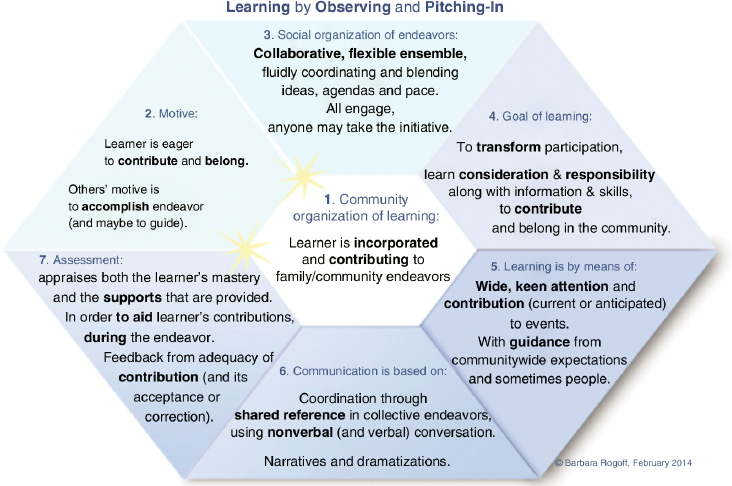
Building on findings showing that young children are astute cultural learners, Rogoff et al. (2015) studied the learning behaviors of children in Indigenous American communities, documenting differences in the learning behaviors and experiences of children growing up in different cultural contexts. Their Learning by Observing and Pitching In (LOPI) model characterizes a kind of learning that is common in, but not exclusive to, Indigenous American communities (Rogoff et al., 2015; Figure 3-2). LOPI consists of seven related facets, with the central facet being that the learner is incorporated in, and contributing to, meaningful family and community endeavors. LOPI involves wide-lens observing and listening-in on mature, purposive adult activities and conversations, being guided by members of the community to contribute meaningfully to communal goals and cultural activities, which increases their sense of belonging. Building on the LOPI model, Bang et al. (2015) highlight the more-than-human ecological interactions of Menominee Indian communities in Wisconsin, extending the
SOURCE: Rogoff et al., 2015.
LOPI model to include human–nature as well as human–human interactions (e.g., extending component 5 of the LOPI model [see Figure 3-2] to include wide-lens attention to human interactions with animals, plants, and nonanimate natural kinds, such as water).
The LOPI model is concordant with basic research findings highlighting the early sensitivity of children to the purposeful behaviors of adults around them and their selective imitation of their behaviors. Importantly, as pointed out by Rogoff et al. (2015), LOPI is deeply embedded in the cultures of Indigenous American communities and is consistent with many other practices and values of these communities.
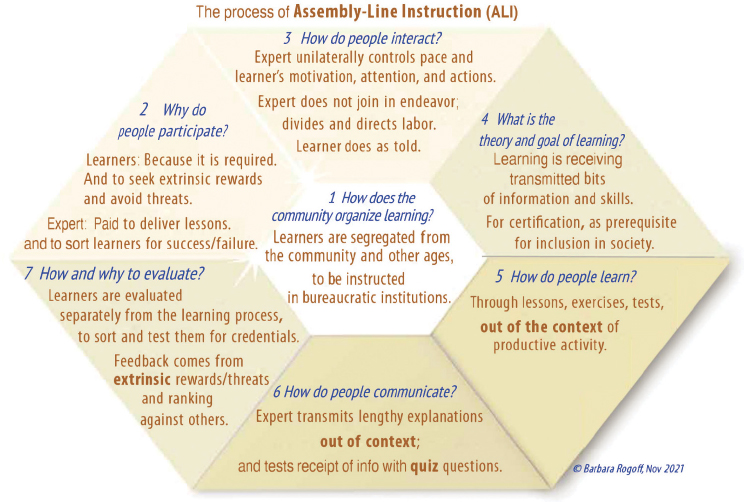
Rogoff et al. (2015) contrast LOPI learning to Assembly Line Instruction (ASI; Figure 3-3). ASI typically involves providing instruction outside of the context of adult activities, often at school (Rogoff et al., 2015). As pointed out by Pellegrini (2009), the type of instruction detailed in the ASI model is relatively recent and is associated with industrialized societies.
The careful work of these researchers shows that the ways children learn, as well as what they learn, are deeply connected to their cultural contexts. These findings hold important implications for early childhood education, as the kinds of learning that children experience may be very different from what they experience in their homes and communities.
SOURCE: Rogoff & Mejía-Arauz, 2022.
Sharing Knowledge Through Verbal Exchanges
Much of what children know and learn is influenced by the transmission of knowledge across generations. Indeed, the uniqueness of human cognition, including the human ability to innovate, depends on this intergenerational sharing, referred to as the “ratchet effect” (e.g., Tennie et al., 2009). Sharing knowledge with children occurs in a variety of ways, including via language, or “learning from testimony” (see Harris et al., 2018). This sharing occurs for multiple kinds of information but is particularly important for types of knowledge that are not accessible to children through their own explorations or firsthand observations. These include, for example, information about distant countries, historical events, microscopic entities, and the solar system (e.g., Harris, 2012; Harris et al., 2018).
Aligned with the views of constructivist theorists, young children are active participants in this sharing. That is, they do not just passively accept information that others share with them. Instead, they evaluate new information with respect to their preexisting knowledge and curate information based on whether the informant is credible (see Harris et al., 2018, for review). Koenig & Echols (2003) found that as early as 16 months of age, children are sensitive to the credibility of an informant—for example, looking longer at an informant that labeled a dog as a “cup.” Similarly, 3- and 4-year-olds who were able to identify accurate and inaccurate labelers of objects showed trust in novel information provided by the accurate labeler (Koenig et al., 2004). In three meta-analyses, Tong et al. (2020) found that 3- to 6-year-old children trust the testimony of credible informants as well as the testimony of informants with more positive social characteristics (e.g., information provided by characters they perceive as nicer). In addition, they identified an important developmental change between ages 3 and 4 years: 4-years-olds weigh informants’ knowledge more heavily than their social characteristics, while 3-year-olds do not, possibly because of increases in theory of mind at age 4 (Tong et al., 2020).
Children’s Learning During the Preschool Years
This section briefly considers the kinds of skills children begin to acquire in the early years of life, including skills considered to be domain general and those considered to be domain specific. “Domain-general skills” include social-emotional learning and executive functioning skills. They also include language skills, which of course support communication and literacy, but provide tools for understanding relational concepts, (e.g., de Villiers & de Villiers, 2014; Gentner, 2016). “Domain-specific skills,” such as numerical thinking and understanding the physical world, begin with core sensitivities that are present from birth onward, but require acquisition
of knowledge (e.g., the count system) to transcend these starting points (e.g., Carey & Barner, 2019; Spelke & Kinzler, 2007). Importantly, learning in all of these domains predicts academic learning as well as important life outcomes, including health, income, and life satisfaction (e.g., Diamond, 2016; Moffitt et al., 2011; Ritchie & Bates, 2013; Watts et al., 2014).
As reviewed in Chapters 2 and 4, early childhood curricula can be broadly separated into comprehensive or whole-child curricula or focused, domain-specific curricula. Most multidomain preschool curricula address the domains of literacy/language, mathematics, science, social-emotional learning, and the arts. Importantly, during the preschool years, instructional activities often support multiple domains of learning. To take just one example, experiencing a book about sharing may support children’s social-emotional learning, math learning, and language and literacy development. In the sections that follow, we provide a brief overview of research on young children’s learning in key domains that are included in early education curricula, including social-emotional learning, executive function, language/literacy learning, and math learning.
Social-Emotional Development as Foundational for Learning
Decades of research have made clear that early emotional development—evidenced by the ability to identify and express one’s own emotional states, accurately recognize emotions expressed by others, and adaptively regulate intense emotions—is key to adaptive success in childhood and later life (National Research Council [NRC] & Institute of Medicine [IOM], 2000). Evidence also shows that these skills can be fostered and enhanced in early childhood learning environments (Denham, 2019). These features of emotional competence—emotion knowledge; understanding of the causes, consequences, and display rules of an emotion (Izard et al., 2011); and the ability to regulate emotion—then foster the development of social skills. Together, social-emotional skills facilitate meaningful interpersonal relationships and interactions characterized by prosocial behavior, empathy, and interpersonal connectedness with peers. It also has become clear that these social-emotional competencies set the stage for enhanced learning trajectories, a finding validated by a meta-analysis showing that interventions focused on social-emotional learning increased academic performance by 11 percentile points (Durlak et al., 2011). Those children with better social-emotional skills also showed reduced conduct problems and emotional distress, more prosocial behaviors, and more positive social attitudes toward self and others. In keeping with this finding, greater social-emotional competence has been associated with less psychopathology and more adaptive and academic success broadly within early childhood and beyond (Finlon et al., 2015).
At preschool age or earlier, children are able to infer basic emotions from expressions and situations (Bell et al., 2019; Denham, 2019). Increased early exposure to language has been shown to support emotional development (Lindquist et al., 2015). More broadly, a supportive relationship with a primary caregiver has been established as foundational for social-emotional development (National Academies, 2023). The supportive primary caregiver may provide emotion language to aid in emotion knowledge. Perhaps more important, the caregiver serves as the child’s external emotion regulator and emotion coach (also referred to as coregulation in infancy), and models and validates the appropriate expression of emotion in context. Further, evidence indicates that greater language skills support the young child’s ability to regulate emotion autonomously instead of relying on caregiver-supported regulation (Eisenberg et al., 2005; NRC & IOM, 2000). Accordingly, many early childhood interventions designed for the prevention of later psychopathology target this element of the child–caregiver relationship and facilitate the child’s emotion knowledge and competence (Bohlmann et al., 2015; Salmon et al., 2016; Shonkoff & Fisher, 2013). Furthermore, the importance of this focus on social-emotional development for early education is underscored by how predictive these skills are of later academic achievement. Thus, the preschool teacher (through curriculum and teacher–child relationship dynamics) can also play an important role in facilitating social-emotional development and should be an important focus of curriculum development and prioritization.
In summary, early social-emotional development represents foundational skills that are necessary for healthy learning trajectories. Furthermore, these skills are important beyond their role as foundational for cognitive development, having interactive effects across developmental domains: cognition and emotion are dynamic developmental processes, with the maturation of one serving as a catalyst for enhancement of higher-level skills in the other (Bell & Wolfe, 2004; Bell et al., 2019; Davidson et al., 2014).
Executive Function as Foundational for Learning
Executive functioning skills include working memory, inhibitory control, attention shifting, and cognitive flexibility (Miyake et al., 2000). These skills develop rapidly during the preschool years, with their development being related to the maturation of the prefrontal cortex (Diamond, 2020). Prior to about 4.5 years of age, the various components of executive functioning load on one factor and are less differentiated than at older ages (e.g., Wiebe et al., 2011). Early executive functioning and self-regulation skills are related to concurrent and future academic achievement (e.g., Alloway & Alloway, 2010; Blair, 2016; Bull et al., 2008; Schmidt et al., 2022; Zelazo et al., 1997).
Executive functioning skills are related to children’s socioeconomic background by 54 months of age, and this relation is stable across development (Hackman et al., 2015; Lawson et al., 2018). Moreover, executive functioning skills partially mediate the relation of socioeconomic status to academic achievement in young children (Lawson & Farah, 2017; Waters et al., 2021). Additionally, family stress and family investment are related—that is, the emotional support (e.g., warmth) and cognitive stimulation families provide are positively related to children’s executive functioning skills, whereas their intrusiveness and control are negatively related to children’s executive functioning skills (see Koşkulu-Sancar et al., 2023, for review). Importantly, executive functioning skills are malleable; they improve when family economic circumstances improve, consistent with neurobiological evidence from animal models (Hackman et al., 2015; McEwen & Morrison, 2014).
A large body of research has examined the effects of various kinds of training on executive functioning skills (e.g., curricular/educational approaches, activities targeting particular executive functioning skills, multilingual exposure in the first years of life, computer games, physical activities; see Clements & Sarama, 2019; Diamond & Ling, 2016; and National Academies, 2017, for review). These efforts show mixed results and many questions remain about the kinds and intensity of training that are required to yield positive results, and particularly what determines generalizability and durability of training effects that are found. Diamond & Ling (2016) review existing evidence and conclude that many kinds of training enhance the trained skill in the same and similar contexts, but that generalization of trained executive functioning skills is narrow. That is, training does not extend beyond contexts that are highly similar to those used in training. Moreover, positive effects of training fade over time as is true for other cognitive skills (Diamond & Ling, 2016). There is also evidence that interventions may be more effective for children with low executive functioning skills, including children growing up in poverty and those diagnosed with attention deficit hyperactivity disorder (e.g., Diamond & Ling, 2016; Klingberg et al., 2005; Tominey & McClelland, 2011).
As mentioned above, preschool children’s executive functioning skills relate to their academic achievement, including later literacy (e.g., Bierman et al., 2008) and math skills (e.g., Clark et al., 2010). The relation of early executive function to mathematics is stronger than its relation to literacy, perhaps because of greater executive functioning demands of early mathematics (e.g., Blair et al., 2011; Fuhs et al., 2015; McClelland et al., 2014; Monette et al., 2011; see Clements et al., 2016, for review). Of course, correlational evidence leaves the directionality of the executive function–academic achievement relation ambiguous, and experimental evidence is needed to determine the causal direction of these relations (e.g., Van der Ven et al., 2012; see Clements et al., 2016, for review). One study
used this approach to examine the effects of different preschool curricula on children’s kindergarten executive functioning skills. Findings of this randomized experiment showed that children who received the Building Blocks math curriculum in preschool had stronger executive functioning skills in kindergarten compared with both children in the Building Blocks plus Scaffolding Executive Functioning condition and the Business-as-Usual condition (Clements et al., 2020). These findings suggest that curricula that engage children in mathematical thinking have spillover effects that are beneficial to executive function, and in fact work better than a curriculum that focuses on both mathematics and executive functioning skills.
There is also some evidence that early education programs that directly support children’s executive functioning skills are beneficial. For example, Montessori and Tools of the Mind curricula, where teachers are trained to exercise children’s executive functioning skills, improve these skills more effectively than did curricula in control classrooms (Diamond et al., 2019; Lillard & Else-Quest, 2006).
Relatedly, research is needed to develop curricula and pedagogical approaches that support the learning of preschool children who display a wide range of executive functioning skills. This is particularly important as executive functioning skills develop rapidly during this period. Moreover, these settings often include children of different ages, further contributing to the variability in the executive functioning skills of children in the same classroom.
Language Learning
Young children are prodigious language learners from birth; this is true across cultural contexts (see Chapter 7 for a detailed discussion of multilingual learning). Of course, language learning depends on having access to language experiences, which vary both quantitatively and qualitatively within and across cultural contexts. A key takeaway from research on language learning is that it is resilient: across cultural contexts, children have capacity to learn their native language and multiple other languages (National Academies, 2017).
Language learning begins during the first year of life. An important early aspect of language learning is a perceptual narrowing of phonemic discrimination, which is characterized by an increase in native phoneme perception and a decrease in nonnative phoneme perception in the second half of the first year of life, as a result of language experience (Kuhl et al., 1992, 2006; Werker & Tees, 1984). Moreover, this narrowing is associated with more advanced language development at later ages during the preschool period, providing evidence that it is an important step in the commitment of the brain to a child’s native period, and may represent a sensitive or critical period in language development (Kuhl et al., 2005).
As noted, the rate at which young children learn language is related to the quantity and quality of their language experiences. For example, preschool children who hear more words and a more diverse set of words show higher levels of vocabulary knowledge (e.g., Huttenlocher et al., 1991). Similarly, Huttenlocher et al. (2002) found that when teachers used more complex sentences in school (defined as sentences including more than one clause), children had better comprehension of complex sentences at the end of the school year, after controlling for the overall quality of the classroom environment and children’s comprehension of complex sentences at the beginning of the year.
Other studies have focused on qualitative aspects of children’s language interactions, including parents’ responsiveness to children’s vocalization, turn taking, and question asking, and how these interactions relate to language learning. Findings show that parents’ responsiveness to children’s early vocalizations (at 9 and 13 months of age) predicts children’s vocabulary growth over and above their earlier milestones (Tamis-LeMonda et al., 2001). Parents’ responsiveness is hypothesized to increase young children’s pragmatic understanding that language is a tool for sharing intentions, which propels their language learning (Tamis-LeMonda et al., 2014).
Sociopragmatic approaches to language development emphasize the role of both members of the parent–child dyad and their joint attention in language interactions and in children’s language learning (e.g., Bruner, 1983; Nelson, 2007; Tomasello, 2003). Research within this framework has examined how turn taking between an adult and child influences the child’s language development. As shown in a meta-analysis, turn taking and adult word counts predict children’s language proficiency independently (Wang et al., 2020). In addition, turn taking is related not only to the language skills of 4- to 6-year-olds, but also to neural activation in the left inferior frontal gyrus (Broca’s area), which is implicated in language processes (Romeo et al., 2018). Taken together, these findings support the role of language interaction and active child involvement in the growth of language skills.
Tomasello (2020) theorizes that understanding a communicative partner as an intentional agent with whom one can share attention and collaborate is fundamental to symbolic communication and hence to the acquisition of language, which requires that the child understand that words are used to communicate with others intentionally. The importance of understanding and relating to others for language acquisition is supported by the difficulty that some children with autism spectrum disorder have with language learning (Hobson, 1993; Tomasello, 2000).
Relatedly, asking children open-ended questions supports their language development as well as their autobiographical memory skills; this is the case in the context of both play and book reading (Boland et al., 2003; Fivush et al., 2006; Rowe et al., 2016). Open-ended questions actively
engage children in conversations, with positive effects on their language development and on their learning more generally. Further, open-ended questions provide adults with a window into children’s language skills and thinking, which can guide the scaffolding of language development.
Research on shared book reading provides additional evidence supporting the importance of children’s taking an active role in language learning. Dialogic reading, characterized by questions and prompts that evoke participation by children, has been shown to benefit children’s language skills, including their vocabulary and narrative skills, both immediately after interventions and after delays. Positive effects of interventions involving dialogic reading have been found in studies involving parent–child dyads as well as those involving early childhood educators and their students (Beals et al., 1994; Whitehurst et al., 1988; Zevenbergen et al., 2003). These beneficial effects have been found for both native English speakers and children who are English language learners (Brannon & Dauksas, 2014). There is also evidence that this approach benefits the language development of preschool children with language learning disabilities (Crain-Thoreson & Dale, 1999; Dale et al., 1996). Moreover, even though shared book reading represents a relatively small percentage (9%) of young children’s overall language input, evidence shows that it supports the language development of children between 1 and 2.5 years of age, after controlling for the language children hear in non–book reading contexts (Demir-Lira et al., 2019). This may be the case because books contain more diverse vocabulary and more complex syntactical structures than language shared outside of the book reading context (Demir-Lira et al., 2019; Montag et al., 2015).
Another aspect of shared book reading that is important in supporting children’s identity development and sense of belongingness is seeing themselves depicted in the books (discussed in more detail in Chapter 4). However, racially minoritized (Adukia et al., 2021) and female characters are underrepresented in children’s books (Casey et al., 2021). These findings are important, as depictions in books provide children with cues as to what is possible for them, and the underrepresentation of certain groups serves to limit possibilities for children in those groups.
Cultural context is another important dimension of language learning. Although children in all cultures hear both child- and adult-directed speech (also referred to as overheard speech), the relative amounts of these kinds of input vary markedly across cultural contexts. On average, for example, 65% of the language heard by young North American children aged 3–20 months is child directed (range 17–100%), with this percentage increasing with increasing maternal education (Bergelson et al., 2019). Moreover, research found no significant change in the amount of child-directed speech over this age range, but a decrease in adult-directed speech. In contrast, children in certain cultural contexts (e.g., Mayan cultures in Mexico) hear much less
child-directed speech than do children in the United States. A longitudinal study compared the amount of child- and adult-directed speech heard by Yucatec Mayan children growing up in rural villages in southern Mexico and urban American children during the second and third years of life. At 13 months of age, only 21% of utterances heard by the Mayan children were child-directed, compared with 69% for 14-month U.S. children. By 35 months of age, however, 60% of the speech heard by the Mayan children was child directed, compared with 62% for the U.S. children at 30 months (Shneidman & Goldin-Meadow, 2012). This convergence in the amount of child-directed speech by 3 years of age may reflect that by this time, adults in both cultures consider children to be conversational partners.
Despite these differences in exposure to child-directed speech in different cultural contexts, there is evidence that children who hear less child-directed speech achieve language milestones, including first words and first word combinations, at the same age as U.S. children who hear more child-directed speech, supporting the resilience of language development (Casillas et al., 2020). This may be the case because children hearing low amounts of child-directed speech increase their attention to adult-directed speech, or because child-directed speech occurs in routine contexts with repetition—in other words, in bursts—which makes it more interpretable by young children. Hypotheses for how children in environments with little child-directed speech achieve language milestones at about the same ages as children who hear large amounts of child-directed speech include its burstiness and children’s increased attentiveness to others-directed speech (Casillas et al., 2020; Schwab & Lew-Williams, 2016).
Although early language milestones are resilient, and children in diverse cultural contexts become fluent speakers of the language(s) to which they are exposed, there is also evidence that child-directed speech is more closely related to vocabulary size than is overheard speech in and across disparate cultural contexts. This is likely the case because child-directed speech focuses on aspects of the world to which children are attending, and that they therefore are more likely to understand (Shneidman et al., 2013). Nonetheless, and importantly, it is possible that learning language in contexts in which overheard speech predominates may build important strengths in deploying attentional capacities (e.g., Casillas et al., 2020).
Math Learning
Building on core knowledge about number and space, children’s mathematical thinking and skills grow rapidly during the preschool years. Moreover, children’s mathematical knowledge at kindergarten entry is related to long-term learning trajectories in mathematics, as well as academic achievement more broadly (Claessens et al., 2009; Duncan et al., 2007;
Watts et al., 2014, 2018). These relations hold after controlling for other likely predictors of mathematics achievement, including socioeconomic status, which underscores the importance of gaining greater understanding of young children’s math learning and how to support it.
Broadly, early math skills include numerical skills, spatial skills, understanding of patterns, and understanding of data and measurement (NRC, 2009). Within the numerical domain, children typically learn the count list and how to use it to enumerate the number of objects in a set. Notably, during the preschool years, children gain an understanding of key counting principles, including (1) the one-one principle (each item should be tagged by a count word once and only once), (2) the stable-order principle (count words must be ordered in the same sequence each time a count is carried out, (3) the cardinal principle (the number word used to tag the last item is the summary symbol for the set size, (4) the abstraction principle (any set can be counted), and (5) the order-irrelevance principle (the items in a set can be tagged in any order; Gelman & Galistel, 1978). They also gain the ability to order sets, to compare the magnitude of sets, to compose and decompose sets, and to carry out simple calculations (e.g., Clements & Sarama, 2014; Feigenson et al., 2004; Fuson, 1988; Le Corre & Carey, 2007; Litkowski et al., 2020; Sarama & Clements, 2009; Wynn, 1992).
Although the attainment of early math skills is often viewed as synonymous with learning numerical skills and perhaps the names of shapes, these important aspects of mathematics do not represent the entirety of children’s foundational math concepts. Notably, early math skills include two core areas: numerical thinking, which includes understanding whole numbers, operations, and relations; and geometry, spatial thinking, and measurement. Additionally, young children learn to notice relations and patterns, to reason about these relations, and to communicate their mathematical ideas (see NRC, 2009, for review). During the preschool years, for example, children gain foundational spatial skills, including the ability to categorize shapes based on their defining features; to compose and decompose shapes; to mentally manipulate shapes; and to represent relations among environmental entities, as well as the self and environmental entities (e.g., Casasola et al., 2020; Fisher et al., 2013; Hawes et al., 2015; Levine et al., 1999; Newcombe & Huttenlocher, 2003; Pruden et al., 2011). Moreover, children’s numerical and spatial skills are highly related, and some researchers argue that mathematics is inherently spatial (e.g., Clements & Sarama, 2011; Dehaene, 1997; Verdine et al., 2017). Teaching young children spatial skills—either mental transformation skills or visuospatial working memory skills—also leads to improvements in performance on numerical tasks (Cheng & Mix, 2014; Mix et al., 2021).
Mathematical activities, both formal and informal, and “math talk” (talk about number and spatial relations) in the early home environment
vary widely and are related to children’s mathematical knowledge at preschool entry and beyond (Baroody & Ginsburg, 1990; Blevins-Knabe & Musan-Miller, 1996; Casey et al., 2018; Gunderson & Levine, 2011; LeFevre et al., 2009; Levine et al., 2010; Pruden et al., 2011; Ramani et al., 2015; Susperreguy & Davis-Kean, 2016). Opportunities to learn mathematics in early education settings also vary widely and are correlated to both math learning over the preschool year and achievement in mathematics through at least eighth grade (e.g., Claessens & Engel, 2013; Claessens et al., 2009; Duncan et al., 2007; Klibanoff et al., 2006).
Beyond studies reporting correlations between math learning opportunities and outcomes, several experimental studies have found that math learning opportunities are causally related to preschool children’s early mathematics skills (e.g., Gibson et al., 2020; Ramani & Siegler, 2008; Siegler & Ramani, 2008). Consistent with these findings, preschool math interventions have been found to lead to gains in mathematics over the school year and to higher math skills as late as fifth grade (e.g., Raudenbush et al., 2020; Watts et al., 2018). Thus, children’s math learning opportunities play an important role in their early mathematical development.
Qualitative aspects of the math learning opportunities young children experience are also related to their math learning. For example, Gunderson & Levine (2011) found that parents’ number talk, when focused on actions such as counting or labeling visible sets, predicted children’s understanding of cardinal numbers; but number talk referring to more abstract sets or concepts (e.g., being 3 years old) did not. Additionally, in a parent-delivered number book intervention study, books focused on small set sizes (1–3) resulted in gains in cardinal number understanding for children who understood the meanings of only the first two number words, whereas number books focused on larger set sizes (4–6) did not (Gibson et al., 2020). This finding is consistent with research showing the power of scaffolding in the child’s zone of proximal development (Vygotsky & Cole, 1978). In an experimental study, Mix et al. (2012) found that children’s understanding of the cardinal meanings of number words was enhanced when children were provided with the cardinal label of a set and the set was then counted, but not when the set was just labeled or just counted.
Another study found that when parents used a number word accompanied by a number gesture during naturalistic interactions with 14- to 58-month-old children, the children were more likely to respond with a number word, and with the correct number word, than when parents said a number word without an accompanying number gesture (Oswald et al., 2023). Further, parents’ talk about more advanced math concepts for preschoolers attending Head Start—including the cardinal value of numbers, the ordinal relations of numbers, and arithmetic—predicted children’s understanding of these more advanced concepts better than did simpler math
talk consisting of counting and number identification. In addition, as for language development, actively engaging children in mathematical thinking through prompting and question asking has been found to be an effective way to support children’s math learning (Eason et al., 2021). These studies suggest that beyond the quantity of math learning experiences, quality also matters.
Given the heterogeneity of young children’s mathematical knowledge, connected to variations in their opportunities to learn math concepts and skills in the early home environment, teachers face an instructional challenge in supporting children’s math development in early education settings. Formative assessments can help teachers provide instruction that is tuned to children’s skill levels. To assess whether such assessment would result in positive learning results, Raudenbush et al. (2020) randomly assigned 49 classrooms serving children mainly from low-income backgrounds to a treatment or a business-as-usual control group. Teachers in the treatment classrooms implemented an assessment–instruction system, consisting of three cycles of formative assessments linked to instructional strategies. The researchers found positive effects of the intervention on children’s foundational numerical skills, as well as their verbal comprehension skills. These findings are consistent with the positive effects found for the Building Blocks system, which encourages formative assessment, on mathematics outcomes, as well as on language and literacy (Clements & Sarama, 2008; Sarama & Clements, 2003; Sarama et al., 2012). They also mirror findings with elementary school children showing positive effects of this kind of approach (Connor et al., 2018; Hassrick et al., 2017). Taken together, these findings suggest that young children’s math learning benefits when input is tuned to their knowledge levels, and that such a focus on math learning does not take away from but benefits their learning of language and literacy skills.
The above findings from naturalistic observations and experimental studies in laboratory, home, and school environments provide important information on effective ways to support children’s number knowledge. However, this research has focused mainly on middle-income families from Western cultures and countries and needs to be extended to more diverse samples. Emerging evidence, mainly from studies of older students, indicates that math learning is strengthened with a culturally responsive, strengths-based approach. Such an approach attends to the meaningfulness of math learning activities, which increases interest in learning mathematics. This is the case both in classrooms and in engaging families in their children’s math learning (e.g., Civil et al., 2008; Hunter et al., 2022). More research is needed to examine culturally responsive, strengths-based math instruction with young children, although existing evidence indicates that this instructional approach is likely to be beneficial.
Science and Engineering Learning
Related to the way they strive to understand their world, infants and young children are frequently characterized as “little scientists” who form intuitive theories about how physical and social aspects of their world operate. Supporting this view, by preschool age children can make inferences and predictions and carry out explorations that allow them to infer causal structures (Gopnik & Wellman, 2012; Kuhn, 2012; Lapidow & Walker, 2020; Shtulman & Walker, 2020; Sobel & Legare, 2014). They do this by exploring the world independently (Cook et al., 2011; Lapidow & Walker, 2020), by asking discriminating questions (Chouinard et al., 2007; Ruggeri et al., 2019), and by observing others (Mills, 2013; see Shtulman & Walker, 2020, for a comprehensive review). Beyond this behavioral evidence that children’s acquisition of knowledge resembles that of scientists (Carey, 2013; Gopnik, 2012), computational models and Bayesian inferencing have provided evidence that young children’s theory building and change are based on their prior understandings and the statistics of the new evidence they gather, much like the activities involved in scientific theory building (Gopnik, 2012; Gopnik & Tenenenbaum, 2007; Griffiths et al., 2011; Xu, 2019).
Of course, the intuitive theories (also referred to as folk theories) that young children construct are not identical in content or process to evidence-based scientific theories. Notably, the theories young children form are based largely on information that is perceptually available rather than on data that cannot be perceived by the senses (e.g., that matter consists of particles; that the earth is round; that animals and plants are both living things; for example, Shtulman & Walker, 2020). In addition, in contrast with the process of science, young children’s theories are largely intuitive rather than explicit. As Shtulman & Walker (2020) explained, young children tend to think with a theory rather than about a theory, the latter involving meta-cognitive skills and practices such as controlling variables other than the variable of interest (Klahr & Nigam, 2004). Thus, while young children’s intuitive theories provide them with starting points for science learning, these nascent theories may even impede the learning of actual scientific theories unless knowledgeable adults provide the child with guidance (Shtulman & Walker, 2020). Of note, engagement in science and engineering learning shares many features with play-based learning—notably, the involvement of agency, exploration, collaboration, and creativity. The power of guided play is also important, as well-designed curricular activities can help children explore and build on their intuitive theories more explicitly (e.g., Shtulman & Walker, 2020). A recent National Academies (2022) report provides four big ideas about early engineering and science learning in preschool through fifth grade; these are broadly applicable to learning in all domains: “(1) learning is a social and
cultural process, (2) learning is a process of identity development, (3) children move through a range of cultural contexts where they learn science and engineering and variations in these contexts shape what and how children learn, and (4) learning in these disciplines is not neutral because the disciplines themselves are not neutral” (p. 53).
Taking a strengths-based, culturally responsive approach to science and engineering learning in preschool environments not only helps children learn science but also helps them build identities, among which are self-concepts that include their capability to engage in science and engineering. With respect to building positive science identities, recent research shows that describing science learning actively in terms of “doing science” rather than “being a scientist” supports the interest in science of preschool girls, a group that is often negatively stereotyped in this regard (Rhodes et al., 2019). The importance of providing science learning opportunities in preschool curricula is highlighted by recent theories suggesting that engaging in science and engineering learning benefits not only learning and interest in these domains but also learning in the language arts, social-emotional learning, and mathematics, as well as the acquisition of critical domain-general skills, including executive function and approaches to learning (Bustamante et al., 2018).
According to the above-referenced National Academies report (2022), however, despite the strong potential of science and engineering instructional activities to broadly support children’s early learning, a paucity of science and engineering instruction in preschool and early elementary school represents a missed opportunity to support young children’s curiosity about and interest in the world; to build foundational skills that are important for later learning; and to support their full participation as citizens in a democratic society, which requires problem solving, critical thinking, collaboration, and an ability to interpret data. The report adopts an equity approach to science learning and provides evidence that the lack of science learning opportunities is exacerbated in underresourced settings, impacting primarily underrepresented minorities and children of color (National Academies, 2022). While this finding highlights a problem, it also presents an opportunity to address inequities.
Another important conclusion of the National Academies (2022) report is that science learning is not neutral, but influenced by culture and community practices. Indeed, problems that are highly salient to young children are influenced by their lived experiences (e.g., the issue of clean drinking water). In addition, what constitutes evidence is influenced by children’s lived experiences. Developing science and engineering instruction that relates to children’s interests and lived experiences enhances learning (National Academies, 2022).
Pressing areas for research on early science and engineering education include effective ways to engage children in science and engineering learning and how to do so in culturally responsive ways. Two more specific areas highlighted in the National Academies (2022) report are particularly relevant: First, little is known about science and engineering learning among children with disabilities. Moreover, when children with disabilities are removed from mainstream classrooms, they may miss learning opportunities that other children experience. This is particularly the case for science and engineering instructional activities because they occur rarely compared with learning opportunities in other domains. Second, little is known about how best to engage children with particular disabilities in science learning.
IMPLICATIONS FOR PRESCHOOL CURRICULUM: CULTURAL VARIATIONS IN LEARNING OPPORTUNITIES AND LEARNING
As described in this chapter, a large body of evidence demonstrates that what and how young children learn are shaped by experiences and environments and therefore vary with cultural context. This phenomenon is often described in the literature as cultural learning, which is considered a unique feature of human learning even though it is observed to a limited extent in other species (see Tomasello et al., 1993, for review). A well-known example is the greater focus of Western cultures on independence and the greater focus of Eastern cultures on interdependence (e.g., Markus & Kitayama, 1991; Masuda & Nisbett, 2001; Nisbett et al., 2001). Consistent with these cultural differences, by 4 years of age Asian children are often more relational and American children are more objects focused (Kuwabara & Smith, 2012; Richland et al., 2010).
Importantly, different cultural contexts do not lead to better overall performance (Kuwabara & Smith, 2012). Rather, performance depends on the overlap of task demands and the lived experiences of children growing up in different contexts. For example, Kuwabara and Smith (2012) found that Japanese children outperformed American children when the task involved matching relations, whereas American children outperformed Japanese children when the task involved object search.
These findings support a strengths-based approach to understanding and valuing cultures and the experiences they afford for learning. This approach represents an important step forward compared with the deficit view of cultures that differ from “mainstream” American cultures, which reflect Euro-centric, largely White cultural values and practices. Accumulating research shows that strengths-based approaches, such as culturally and linguistically relevant pedagogy, have positive effects on
children’s learning (Gay, 2000; Ladson-Billings, 2014). Thus, there is an urgent need for culturally responsive, anti-bias pedagogy based on the increasing cultural and linguistic diversity of the children being taught in the United States, including in early childhood education settings (see Chapter 5). Culturally and linguistically responsive teaching increases learning, belongingness, and the meaningfulness of the learning process for all children. Additionally, it increases family engagement in children’s learning, which is associated with children’s higher achievement (Gay, 2000; Ladson-Billings, 2014).
Theorists also warn, however, that characterizing individuals, including young children, based on their membership in particular cultural, racial, or ethnic groups poses its own dangers. It is important to recognize that the lived experiences of individuals within and across cultural groups vary, and it is these variations that influence what children know and how they learn (Gutiérrez & Rogoff, 2003; Rogoff, 2016). Further, cultures shift dynamically over time. Notably, immigrant families in the United States are exposed to cultural and linguistic practices that are prevalent in this country and are likely to change their lived experiences across generations (Gutiérrez & Rogoff, 2023). Rogoff et al. (2018) call for a paradigm shift in studying children’s developmental learning, based on the fact that all children learn through their everyday experiences embedded within cultural contexts. In the United States, moreover, many children experience a variety of cultural contexts, which they navigate and integrate. Thus, it is essential to recognize and understand young children’s lived experiences and not limit their learning experiences in early education settings based on stereotypes about their cultural or linguistic groups. Doing so entails celebrating, discussing, and incorporating the diversity of experiences, languages, and cultures that children bring to the early education setting and to the implementation of curricula.
CONCLUSION
The early childhood period represents a window of opportunity for development and learning. Because neuroplasticity is heightened, specific skills and abilities are more readily absorbed and learned during the preschool period. Pre-K experiences may therefore have a particularly important impact on developmental trajectories and provide opportunities to build strong foundational skills more efficiently than is the case later in development. Conversely, when opportunities for environmental stimulation and expected experiential inputs are missed, the early years can be a period of unique vulnerability and developmental trajectories can be altered in a way that may lead to learning challenges throughout the life course.
Drawing on the science of early childhood development and learning, the committee summarizes the following core concepts that are critical for informing the development of preschool curricula:
- The interaction of the brain, biology, and environments shapes early childhood development and learning.
- The early caregiving environment, exposure to trauma and stress, and access to resources affect long-term development.
- Children learn in multiple ways—through active exploration; through observation of others, notably older children and adults; and through adults’ explicitly sharing knowledge with them.
- Children learn from play, exploration, and pedagogy that are responsive to their interests. Children’s play has the potential to contribute to the cultural relevance of early education, as child-initiated play reflects children’s cultural experiences and how they see themselves within the larger society, providing teachers with an important lens into their lived experiences.
- Young children play an important role in their interactions and development and are active participants in sharing knowledge. Autonomy-granting, play-based pedagogy in early education builds advanced language and thinking skills as well as skills that involve pursuing learning in which young children are interested and collaborating and conversing with other children. Limiting children’s agency in early education contexts is typically rooted in stereotypes about weaknesses of children and their families, rather than being attributed to systemic factors that contribute to group differences, such as differences in vocabulary size.
These core concepts from the literature point to the need for a strengths-based approach to understanding and valuing cultures and the experiences they afford for learning. Variations in the lived experiences of children influence what children know and how they learn, as all children learn through their environments and experiences, which are embedded within cultural contexts. Accordingly, celebrating, discussing, and incorporating this diversity of experiences and cultures within early education settings is critical to promoting positive early development and learning and setting young children on a positive trajectory for lifelong learning.
REFERENCES
Acevedo-Garcia, D., Noelke, C., McArdle, N., Sofer, N., Huntington, N., Hardy, E., Huber, R., Baek, M., & Reece, J. (2020). The geography of child opportunity: Why neighborhoods matter for equity. Brandeis University Heller School for Social Policy and Management, diversitydatakids.org. https://www.diversitydatakids.org/sites/default/files/file/ddk_the-geography-of-child-opportunity_2020v2_0.pdf
Adair, J. K. (2015). The impact of discrimination on the early schooling experiences of children from immigrant families. Migration Policy Institute. https://www.migrationpolicy.org/sites/default/files/publications/FCD-Adair.pdf
Adair, J. K., & Colegrove, K. S.-S. (2021). Segregation by experience: Agency, racism, and learning in the early grades. University of Chicago Press.
Adair, J. K., & Doucet, F. (2014). The impact of race and culture on play in early childhood classrooms. In L. Brooker, M. Blaise, & S. Edwards (Eds.), The SAGE handbook of play and learning in early childhood (pp. 354–365). SAGE Publications Inc. https://doi.org/10.4135/9781473907850.n30
Adair, J. K., Colegrove, K. S.-S., & McManus, M. E. (2017). How the word gap argument negatively impacts young children of Latinx immigrants’ conceptualizations of learning. Harvard Educational Review, 87(3), 309–334. https://eric.ed.gov/?id=EJ1164890
Adukia, A., Eble, A., Harrison, E., Runesha, H., & Szasz, T. (2021). What we teach about race and gender: Representation in images and text of children’s books. SSRN. https://doi.org/10.2139/ssrn.3901587
Aguiar, A., & Baillargeon, R. (1999). 2.5-month-old infants’ reasoning about when objects should and should not be occluded. Cognitive Psychology, 39(2), 116–157. https://doi.org/10.1006/cogp.1999.0717
Alloway, T. P., & Alloway, R. G. (2010). Investigating the predictor roles of working memory and academic achievement. Journal of Experimental Child Psychology, 106(1), 20–29. https://doi.org/10.1016/j.jecp.2009.11.003
Aslin, R. N. (2007). What’s in a look? Developmental Science, 10(1), 48–53. https://doi.org/10.1111/j.1467-7687.2007.00563.x
Bailey, D., Duncan, G. J., Odgers, C. L., & Yu, W. (2017). Persistence and fadeout in the impacts of child and adolescent interventions. Journal of Research on Educational Effectiveness, 10(1), 7–39. https://doi.org/10.1080/19345747.2016.1232459
Bailey, D. H., Duncan, G. J., Cunha, F., Foorman, B. R., & Yeager, D. S. (2020). Persistence and fade-out of educational-intervention effects: Mechanisms and potential solutions. Psychological Science in the Public Interest, 21(2), 55–97. https://doi.org/10.1177/1529100620915848
Bailey, D. H., Nguyen, T., Jenkins, J. M., Domina, T., Clements, D. H., & Sarama, J. S. (2016). Fadeout in an early mathematics intervention: Constraining content or preexisting differences? Developmental Psychology, 52(9), 1457.
Bandura, A. (1977). Social learning theory (Vol. 1). Prentice Hall.
Bang, M., Marin, A., Medin, D., & Washinawatok, K. (2015). Learning by observing, pitching in, and being in relations in the natural world. Advances in Child Development and Behavior, 49, 303–313. https://doi.org/10.1016/bs.acdb.2015.10.004
Bar-Haim, Y., Ziv, T., Lamy, D., & Hodes, R. M. (2006). Nature and nurture in own-race face processing. Psychological Science, 17(2), 159–163. http://www.jstor.org/stable/40064387
Baroody, A. J., & Ginsburg, H. P. (1990). Chapter 4: Children’s mathematical learning: A cognitive view. Journal for Research in Mathematics Education, 4, 51–210. https://doi.org/10.2307/749912
Bassok, D., Latham, S., & Rorem, A. (2016). Is kindergarten the new first grade? AERA Open, 2(1). https://doi.org/10.1177/2332858415616358
Beals, D. E., De Temple, J. M., & Dickinson, D. K. (1994). Talking and listening that support early literacy development of children from low-income families. In D. K. Dickinson (Ed.), Bridges to literacy: Children, families, and schools (pp. 19–40). Blackwell Publishing.
Bécares, L., Nazroo, J., & Kelly, Y. (2015). A longitudinal examination of maternal, family, and area-level experiences of racism on children’s socioemotional development: Patterns and possible explanations. Social Science & Medicine, 142, 128–135. https://doi.org/10.1016/j.socscimed.2015.08.025
Bell, M. A., & Wolfe, C. D. (2004). Emotion and cognition: An intricately bound developmental process. Child Development, 75(2), 366–370. https://doi.org/10.1111/j.1467-8624.2004.00679.x
Bell, M. A., Wolfe, C. D., Diaz, A., & Liu, R. (2019). Cognition and emotion in development. In V. LoBue, K. Pérez-Edgar, & K. A. Buss (Eds.), Handbook of emotional development (pp. 375–403). Springer Nature. https://doi.org/10.1007/978-3-030-17332-6_15
Bergelson, E., Casillas, M., Soderstrom, M., Seidl, A., Warlaumont, A. S., & Amatuni, A. (2019). What do North American babies hear? A large-scale cross-corpus analysis. Developmental Science, 22(1), e12724. https://doi.org/10.1111/desc.12724
Bierman, K. L., Nix, R. L., Greenberg, M. T., Blair, C., & Domitrovich, C. E. (2008). Executive functions and school readiness intervention: Impact, moderation, and mediation in the Head Start REDI program. Development and Psychopathology, 20(3), 821–843. https://doi.org/10.1017/s0954579408000394
Blair, C. (2016). Executive function and early childhood education. Current Opinion in Behavioral Sciences, 10, 102–107. https://doi.org/10.1016/j.cobeha.2016.05.009
Blair, C., Protzko, J., & Ursache, A. (2011). Self-regulation and early literacy. In S. B. Neuman & D. K. Dickinson (Eds.), Handbook of early literacy research (Vol. 3, pp. 20–35). Guilford Press.
Blevins-Knabe, B., & Musun-Miller, L. (1996). Number use at home by children and their parents and its relationship to early mathematical performance. Early Development and Parenting, 5(1), 35–45. https://doi.org/10.1002/(SICI)1099-0917(199603)5:1%3C35::AID-EDP113%3E3.0.CO;2-0
Bohlmann, N. L., Maier, M. F., & Palacios, N. (2015). Bidirectionality in self-regulation and expressive vocabulary: Comparisons between monolingual and dual language learners in preschool. Child Development, 86(4), 1094–1111. https://doi.org/10.1111/cdev.12375
Boland, A., Haden, C., & Ornstein, P. (2003). Boosting children’s memory by training mothers in the use of an elaborative conversational style as an event unfolds. Journal of Cognition and Development, 4(1), 39–65. https://doi.ord/10.1207/S15327647JCD4,1-02
Bonawitz, E., Shafto, P., Gweon, H., Goodman, N. D., Spelke, E., & Schulz, L. (2011). The double-edged sword of pedagogy: Instruction limits spontaneous exploration and discovery. Cognition, 120(3), 322–330. https://doi.org/10.1016/j.cognition.2010.10.001
Brannon, D., & Dauksas, L. (2014). The effectiveness of dialogic reading in increasing English Language Learning preschool children’s expressive language. International Research in Early Childhood Education, 5(1), 1–10. https://files.eric.ed.gov/fulltext/EJ1150938.pdf
Brooks-Gunn, J., & Duncan, G. J. (1997). The effects of poverty on children. The Future of Children, 7(2), 55–71. https://pubmed.ncbi.nlm.nih.gov/9299837/
Brown, S. M., Schlueter, L. J., Hurwich-Reiss, E., Dmitrieva, J., Miles, E., & Watamura, S. E. (2020). Parental buffering in the context of poverty: Positive parenting behaviors differentiate young children’s stress reactivity profiles. Development and Psychopathology, 32(5), 1778–1787. https://doi.org/10.1017/S0954579420001224
Bruner, J. (1982). The formats of language acquisition. American Journal of Semiotics, 1(3), 1–16. https://www.proquest.com/scholarly-journals/formats-language-acquisition/docview/213746394/se-2
———. (1983). Play, thought, and language. Peabody Journal of Education, 60(3), 60–69. https://doi.org/10.1080/01619568309538407
Bull, R., Espy, K. A., & Wiebe, S. A. (2008). Short-term memory, working memory, and executive functioning in preschoolers: longitudinal predictors of mathematical achievement at age 7 years. Developmental Neuropsychology, 33(3), 205–228. https://doi.org/10.1080/87565640801982312
Bustamante, A. S., Greenfield, D. B., & Nayfeld, I. (2018). Early childhood science and engineering: Engaging platforms for fostering domain-general learning skills. Education Sciences, 8(3), 144. https://doi.org/10.3390/educsci8030144
Buttelmann, D., Zmyj, N., Daum, M., & Carpenter, M. (2013). Selective imitation of in-group over out-group members in 14-month-old infants. Child Development, 84(2), 422–428. https://doi.org/10.1111/j.1467-8624.2012.01860.x
Capron, C., & Duyme, M. (1989). Assessment of effects of socio-economic status on IQ in a full cross-fostering study. Nature, 340(6234), 552–554. https://doi.org/10.1038/340552a0
Carey, S. (2004). Bootstrapping & the origin of concepts. Daedalus, 133(1), 59–68. http://dx.doi.org/10.1162/001152604772746701
———. (2013). Are children fundamentally different kinds of thinkers and learners than adults? In S. F. Chipman, J. W. Segal, & R. Glaser (Eds.), Thinking and learning skills (pp. 485–518). Routledge.
Carey, S., & Barner, D. (2019). Ontogenetic origins of human integer representations. Trends in Cognitive Sciences, 23(10), 823–835. https://psycnet.apa.org/doi/10.1016/j.tics.2019.07.004
Carpenter, M., Akhtar, N., & Tomasello, M. (1998). Fourteen- through 18-month-old infants differentially imitate intentional and accidental actions. Infant Behavior and Development, 21(2), 315–330. https://doi.org/10.1016/S0163-6383(98)90009-1
Casasola, M., Wei, W. S., Suh, D. D., Donskoy, P., & Ransom, A. (2020). Children’s exposure to spatial language promotes their spatial thinking. Journal of Experimental Psychology: General, 149(6), 1116–1136. https://doi.org/10.1037/xge0000699
Casey, B. M., Lombardi, C. M., Thomson, D., Nguyen, H. N., Paz, M., Theriault, C. A., & Dearing, E. (2018). Maternal support of children’s early numerical concept learning predicts preschool and first-grade math achievement. Child Development, 89(1), 156–173. https://doi.org/10.1111/cdev.12676
Casey, K., Novick, K., & Lourenco, S. F. (2021). Sixty years of gender representation in children’s books: Conditions associated with overrepresentation of male versus female protagonists. PLoS One, 16(12), e0260566. https://doi.org/10.1371/journal.pone.0260566
Casillas, M., Brown, P., & Levinson, S. C. (2020). Early language experience in a Tseltal Mayan village. Child Development, 91(5), 1819–1835. https://doi.org/10.1111/cdev.13349
Cheng, K., & Newcombe, N. S. (2005). Is there a geometric module for spatial orientation? Squaring theory and evidence. Psychonomic Bulletin & Review, 12(1), 1–23. https://doi.org/10.3758/BF03196346
Cheng, Y. L., & Mix, K. S. (2014). Spatial training improves children’s mathematics ability. Journal of Cognition and Development, 15, 11–12. https://files.eric.ed.gov/fulltext/ED580905.pdf
Chouinard, M. M., Harris, P. L., & Maratsos, M. P. (2007). Children’s questions: A mechanism for cognitive development. Monographs of the Society for Research in Child Development, 72(1). https://doi.org/10.1111/j.1540-5834.2007.00412.x
Civil, M., Díez-Palomar, J., Menéndez, J. M., & Acosta-Iriqui, J. (2008). Parents’ interactions with their children when doing mathematics. Adults Learning Mathematics, 3(n2a), 41–58. https://files.eric.ed.gov/fulltext/EJ1068257.pdf
Claessens, A., & Engel, M. (2013). How important is where you start? Early mathematics knowledge and later school success. Teachers College Record, 115, 1–29. https://doi.org/10.1177/016146811311500603
Claessens, A., Duncan G., & Engel, M. (2009). Kindergarten skills and fifth-grade achievement: Evidence from the ECLS-K. Economics of Education Review, 28, 415–427. http://dx.doi.org/10.1016/j.econedurev.2008.09.003
Clark, C. A., Pritchard, V. E., & Woodward, L. J. (2010). Preschool executive functioning abilities predict early mathematics achievement. Developmental Psychology, 46(5), 1176. https://doi.org/10.1037/a0019672
Clements, D. H., & Sarama, J. (2008). Experimental evaluation of the effects of a research-based preschool mathematics curriculum. American Educational Research Journal, 45, 443–494. http://dx.doi.org/10.3102/0002831207312908
———. (2011). Early childhood mathematics intervention. Science (New York), 333(6045), 968–970. https://doi.org/10.1126/science.1204537
———. (2014). Learning trajectories: Foundations for effective, research-based education. In A. P. Maloney, J. Confrey, & K. H. Nguyen (Eds.), Learning over time: Learning trajectories in mathematics education (pp. 1–30). Information Age.
———. (2019). Executive function and early mathematical learning difficulties. In A. Fritz, V. G. Haase, & P. Räsänen (Eds.), International handbook of mathematical learning difficulties: From the laboratory to the classroom (pp. 755–771). Cham: Springer International Publishing.
Clements, D. H., Sarama, J., & Germeroth, C. (2016). Learning executive function and early mathematics: Directions of causal relations. Early Childhood Research Quarterly, 36, 79–90. https://psycnet.apa.org/doi/10.1016/j.ecresq.2015.12.009
Clements, D. H., Sarama, J., Layzer, C., Unlu, F., & Fesler, L. (2020). Effects on mathematics and executive function of a mathematics and play intervention versus mathematics alone. Journal for Research in Mathematics Education, 51, 301–333. https://doi.org/10.5951/jresemtheduc-2019-0069
Condon, E. M., Holland, M. L., Slade, A., Redeker, N. S., Mayes, L. C., & Sadler, L. S. (2019). Associations between maternal experiences of discrimination and biomarkers of toxic stress in school-aged children. Maternal and Child Health Journal, 23(9), 1147–1151. https://doi.org/10.1007/s10995-019-02779-4
Connor, C. M., Mazzocco, M. M., Kurz, T., Crowe, E. C., Tighe, E. L., Wood, T. S., & Morrison, F. J. (2018). Using assessment to individualize early mathematics instruction. Journal of School Psychology, 66, 97–113. https://doi.org/10.1016/j.jsp.2017.04.005
Cook, C., Goodman, N. D., & Schulz, L. E. (2011). Where science starts: Spontaneous experiments in preschoolers’ exploratory play. Cognition, 120(3), 341–349. https://doi.org/10.1016/j.cognition.2011.03.003
Crain-Thoreson, C., & Dale, P. S. (1999). Enhancing linguistic performance: Parents and teachers as book reading partners for children with language delays. Topics in Early Childhood Special Education, 19(1), 28–39. https://doi.org/10.1177/027112149901900103
Dale, P. S., Crain-Thoreson, C., Notari-Syverson, A., & Cole, K. (1996). Parent-child book reading as an intervention technique for young children with language delays. Topics in Early Childhood Special Education, 16(2), 213–235. https://doi.org/10.1177/027112149601600206
Davidson, D., Vanegas, S. B., & Hilvert, E. (2014). A cognitive-developmental approach to emotion processing in children. In R. Chen (Ed.), Cognitive development: Theories, stages and processes and challenges (pp. 33–58). Nova Science Publishers.
Davis, E. P., McCormack, K., Arora, H., Sharpe, D., Short, A. K., Bachevalier, J., Glynn, L. M., Sandman, C. A., Stern, H. S., Sanchez, M., & Baram, T. Z. (2022). Early life exposure to unpredictable parental sensory signals shapes cognitive development across three species. Frontiers in Behavioral Neuroscience, 16. https://doi.org/10.3389/fnbeh.2022.960262
de la Osa, N., Navarro, J.-B., Penelo, E., Valentí, A., Ezpeleta, L., & Dadvand, P. (2024). Long-term exposure to greenspace and anxiety from preschool and primary school children. Journal of Environmental Psychology, 93, 102207. https://doi.org/10.1016/j.jenvp.2023.102207
de Villiers, J. G., & de Villiers, P. A. (2014). The role of language in theory of mind development. Topics in Language Disorders, 34(4), 313–328. https://psycnet.apa.org/doi/10.1097/TLD.0000000000000037
Dehaene, S. (1997). The number sense: How the mind creates mathematics. Oxford University Press.
Dehaene, S., Izard, V., Pica, P., & Spelke, E. (2006). Core knowledge of geometry in an Amazonian Indigene group. Science (New York), 311, 381–384. https://doi.org/10.1126/science.1121739
Demir-Lira, Ö., Applebaum, L. R., Goldin-Meadow, S., & Levine, S. C. (2019). Parents’ early book reading to children: Relation to children’s later language and literacy outcomes controlling for other parent language input. Developmental Science, 22(3), e12764. https://doi.org/10.1111/desc.12764
Denham, S. A. (2019). Emotional competence during childhood and adolescence. In Handbook of emotional development (pp. 493–541). Springer Nature. https://doi.org/10.1007/978-3-030-17332-6_20
Dewey, J. (1910). How we think. D C Heath. https://doi.org/10.1037/10903-0000
Diamond, A. (2016). Why improving and assessing executive functions early in life is critical. In J. A. Griffin, P. McCardle, & L. Freund (Eds.), Executive function in preschool-age children: Integrating measurement, neurodevelopment, and translational research. APA Books.
Diamond, A. (2020). Executive functions. In J. L. Michaud, C. Bulteau, D. Cohen, & A. Gallagher (Eds.), Handbook of clinical neurology (Vol. 173, pp. 225–240). Elsevier.
Diamond, A., & Ling, D. S. (2016). Conclusions about interventions, programs, and approaches for improving executive functions that appear justified and those that, despite much hype, do not. Developmental Cognitive Neuroscience, 18, 34–48, https://doi.org/10.1016/j.dcn.2015.11.005
Diamond, A., Lee, C., Senften, P., Lam, A., & Abbott, D. (2019). Randomized control trial of Tools of the Mind: Marked benefits to kindergarten children and their teachers. PLoS One, 14(9), e0222447. https://doi.org/10.1371%2Fjournal.pone.0222447
Dickinson, D. K., & Tabors, P. O. (Eds.) (2001). Beginning literacy with language: Young children learning at home and school. Brookes Publishing.
Duncan, G. J., Brooks-Gunn, J., & Klebanov, P. K. (1994). Economic deprivation and early childhood development. Child Development, 65(2), 296–318. https://doi.org/10.2307/1131385
Duncan, G. J., Dowsett, C. J., Claessens, A., Magnuson, K., Huston, A. C., Klebanov, P., Pagani, L. S., Feinstein, L., Engel, M., Brooks-Gunn, J., Sexton, H., Duckworth, K., & Japel, C. (2007). School readiness and later achievement. Developmental Psychology, 43(6), 1428–1446. https://doi.org/10.1037/0012-1649.43.6.1428
Durlak, J. A., Weissberg, R. P., Dymnicki, A. B., Taylor, R. D., & Schellinger, K. B. (2011). The impact of enhancing students’ social and emotional learning: A meta-analysis of school-based universal interventions. Child Development, 82(1), 405–432. https://doi.org/10.1111/j.1467-8624.2010.01564.x
Eason, S. H., Hurst, M. A., Kerr, K., Claessens, A., & Levine, S. C. (2022). Enhancing parent and child shape talk during puzzle play. Cognitive Development, 64, 101250. https://doi.org/10.1016/j.cogdev.2022.101250
Eason, S. H., Nelson, A. E., Dearing, E., & Levine, S. C. (2021). Facilitating young children’s numeracy talk in play: The role of parent prompts. Journal of Experimental Child Psychology, 207, 105124. https://doi.org/10.1016/j.jecp.2021.105124
Eisenberg, N., Sadovsky, A., & Spinrad, T. L. (2005). Associations of emotion-related regulation with language skills, emotion knowledge, and academic outcomes. New Directions for Child and Adolescent Development, 2005(109), 109–118. https://doi.org/10.1002%2Fcd.143
Feigenson, L., Dehaene, S., & Spelke, E. (2004). Core systems of number. Trends in Cognitive Sciences, 8(7), 307–314. https://doi.org/10.1016/j.tics.2004.05.002
Ferrara, K., Hirsh-Pasek, K., Newcombe, N. S., Golinkoff, R. M., & Lam, W. S. (2011). Block talk: Spatial language during block play. Mind, Brain, and Education, 5(3), 143–151. https://doi.org/10.1111/j.1751-228X.2011.01122.x
Finlon, K. J., Izard, C. E., Seidenfeld, A., Johnson, S. R., Cavadel, E. W., Krauthamer Ewing, E. S., & Morgan, J. K. (2015). Emotion-based preventive intervention: Effectively promoting emotion knowledge and adaptive behavior among at-risk preschoolers. Development and Psychopathology, 27(4-1), 1353–1365. https://doi.org/10.1017/S0954579414001461
Fisher, K. R., Hirsh-Pasek, K., Newcombe, N. S., & Golinkoff, R. M. (2013). Taking shape: Supporting preschoolers’ acquisition of geometric knowledge through guided play. Child Development, 84, 1872–1878. https://doi.org/10.1111/cdev.12091
Fivush, R., Haden, C. A., & Reese, E. (2006). Elaborating on elaborations: Role of maternal reminiscing style in cognitive and socioemotional development. Child Development, 77(6), 1568–1588. https://doi.org/10.1111/j.1467-8624.2006.00960.x
Frausel, R. R., Richland, L. E., Levine, S. C., & Goldin-Meadow, S. (2021). Personal narrative as a “breeding ground” for higher-order thinking talk in early parent-child interactions. Developmental Psychology, 57(4), 519–534. https://doi.org/10.1037/dev0001166
Frausel, R. R., Silvey, C., Freeman, C., Dowling, N., Richland, L. E., Levine, S. C., Raudenbush, S., & Goldin-Meadow, S. (2020). The origins of higher-order thinking lie in children’s spontaneous talk across the pre-school years. Cognition, 200, 104274. https://doi.org/10.1016/j.cognition.2020.104274
Fuhs, M. W., Farran, D. C., & Nesbitt, K. T. (2015). Prekindergarten children’s executive functioning skills and achievement gains: The utility of direct assessments and teacher ratings. Journal of Educational Psychology, 107(1), 207.
Fuson, K. (1988). Children’s counting and concepts of number. Springer-Verlag. https://doi.org/10.1007/978-1-4612-3754-9
Gaskins, S., Haight, W., & Lancy, D. F. (2007). The cultural construction of play. In A. Göncü, & S. Gaskins (Eds.), Play and development: Evolutionary, sociocultural, and functional perspectives (pp. 179–202). Erlbaum.
Gassman-Pines, A. (2015). Effects of Mexican immigrant parents’ daily workplace discrimination on child behavior and family functioning. Child Development, 86(4), 1175–1190. https://doi.org/10.1111/cdev.12378
Gay, G. (2000). Culturally responsive teaching: Theory, research, and practice. Teachers College Press.
Gelman, R., & Gallistel, C. R. (1978). The child’s understanding of number. Harvard University Press.
Gentner, D. (2016). Language as cognitive tool kit: How language supports relational thought. American Psychologist, 71(8), 650. https://groups.psych.northwestern.edu/gentner/papers/Gentner_2016-Toolkit.pdf
Gibson, D. J., Gunderson, E. A., & Levine, S. C. (2020). Causal effects of parent number talk on preschoolers’ number knowledge. Child Development, 91(6), e1162–e1177. https://doi.org/10.1111/cdev.13423
Gopnik, A. (2012). Scientific thinking in young children: Theoretical advances, empirical research, and policy implications. Science, 337, 1623–1627. https://doi.org/10.1126/science.1223416
———. (2020). Childhood as a solution to explore–exploit tensions. Philosophical Transactions of the Royal Society B: Biological Sciences, 375, 20190502. https://doi.org/10.1098/rstb.2019.0502.
Gopnik, A., & Tenenbaum, J. B. (2007). Bayesian networks, Bayesian learning and cognitive development. Developmental Science, 10(3), 281–287. https://psycnet.apa.org/doi/10.1111/j.1467-7687.2007.00584.x
Gopnik, A., & Wellman, H. M. (2012). Reconstructing constructivism: Causal models, Bayesian learning mechanisms, and the theory theory. Psychological Bulletin, 138(6), 1085. https://psycnet.apa.org/doi/10.1037/a0028044
Granger, S. J., Glynn, L. M., Sandman, C. A., Small, S. L., Obenaus, A., Keator, D. B., Baram, T. Z., Stern, H., Yassa, M. A., & Davis, E. P. (2021). Aberrant maturation of the uncinate fasciculus follows exposure to unpredictable patterns of maternal signals. Journal of Neuroscience, 41(6), 1242–1250. https://doi.org/10.1523%2FJNEUROSCI.0374-20.2020
Griffiths, T. L., Sobel, D. M., Tenenbaum, J. B., & Gopnik, A. (2011). Bayes and blickets: Effects of knowledge on causal induction in children and adults. Cognitive Science, 35(8), 1407–1455. https://doi.org/10.1111%2Fj.1551-6709.2011.01203.x
Gunderson, E. A., & Levine, S. C. (2011). Some types of parent number talk count more than others: Relations between parents’ input and children’s cardinal-number knowledge. Developmental Science, 14(5), 1021–1032. https://doi.org/10.1111/j.1467-7687.2011.01050.x
Gunnar, M. R. (2020). Early adversity, stress, and neurobehavioral development. Development and Psychopathology, 32(5), 1555–1562. https://doi.org/10.1017/s0954579420001649
Gupta, A. (2011). Play and pedagogy framed within India’s historical, socio-cultural and pedagogical context. In S. Rogers (Ed.), Rethinking play and pedagogy in early childhood education: Concepts, contexts and cultures (pp. 86–99). Routledge.
Gutiérrez, K. D., Cortes, K., Cortez, A., DiGiacomo, D., Higgs, J., Johnson, P., Ramón Lizárraga, J., Mendoza, E., Tien, J., & Vakil, S. (2017). Replacing representation with imagination: Finding ingenuity in everyday practices. Review of Research in Education, 41(1), 30–60. https://www.jstor.org/stable/44668686
Gutiérrez, K. D., & Rogoff, B. (2003). Cultural ways of learning: Individual traits or repertoires of practice. Educational Researcher, 32(5), 19–25. https://doi.org/10.3102/0013189X032005019
Hackman, D. A., Gallop, R., Evans, G. W., & Farah, M. J. (2015). Socioeconomic status and executive function: Developmental trajectories and mediation. Developmental Science, 18(5), 686–702. https://doi.org/10.1111/desc.12246
Haight, W. L., Wang, X. L., Fung, H. H., Williams, K., & Mintz, J. (1999). Universal, developmental, and variable aspects of young children’s play: A cross-cultural comparison of pretending at home. Child Development, 70(6), 1477–1488. https://doi.org/10.1111/1467-8624.00107
Harris, P., Koenig, M., Corriveau, K., & Jaswal, V. (2018). Cognitive foundations of learning from testimony. Annual Review of Psychology, 69, 1–23. https://doi.org/10.1146/annurev-psych-122216-011710
Harris, P. L. (2012). Trusting what you’re told: How children learn from others. Harvard University Press.
Hassrick, E. M., Raudenbush, S. W., & Rosen, L. (2017). The ambitious elementary school: Its conception, design and contribution to educational equity. University of Chicago Press.
Hawes, Z., & Ansari, D. (2020). What explains the relationship between spatial and mathematical skills? A review of evidence from brain and behavior. Psychonomic Bulletin & Review, 27(3), 465–482. https://doi.org/10.3758/s13423-019-01694-7
Hawes, Z., Tepylo, D., & Moss, J. (2015). Developing spatial thinking: Implications for early mathematics education. In B. Davis & Spatial Reasoning Study Group (Eds.), Spatial reasoning in the early years: Principles, assertions and speculations (pp. 29–44). Routledge.
Hirsh-Pasek, K., Blinkoff, E., Golinkoff, R., & Hadani, H. (2020). A new path to education reform: Playful learning promotes 21st-century skills in schools and beyond. Brookings. https://www.brookings.edu/articles/a-new-path-to-education-reform-playful-learning-promotes-21st-century-skills-in-schools-and-beyond
Hirsh-Pasek, K., Golinkoff, R., Berk, L. E., & Singer, D. (2008). A mandate for playful learning in preschool: Presenting the evidence. Oxford University Press.
Hirsh-Pasek, K., Golinkoff, R. M., Nesbitt, K., Lautenbach, C., Blinkoff, E., & Fifer, G. (2022). Making schools work: Bringing the science of learning to joyful classroom practice. Teachers College Press.
Hobson, R. P. (1993). The emotional origins of social understanding. Philosophical Psychology, 6(3), 227–249. https://doi.org/10.1080/09515089308573090
Howard, L. H., Henderson, A. M., Carrazza, C., & Woodward, A. L. (2015). Infants’ and young children’s imitation of linguistic in-group and out-group informants. Child Development, 86(1), 259–275. https://doi.org/10.1111/cdev.12299
Hughes, F. P. (1999). Children, play and development. Allyn & Bacon.
Hunter, J., Hunter, R., Tupouniua, J., & Leach, G. (2022). Bringing the home into school: Learning and connecting through mathematics education during the time of a pandemic. Educational Studies in Mathematics, 111(2), 207–224. https://doi.org/10.1007/s10649-022-10157-1
Huttenlocher, J., Haight, W., Bryk, A., Seltzer, M., & Lyons, T. (1991). Early vocabulary growth: Relation to language input and gender. Developmental Psychology, 27(2), 236–248. https://doi.org/10.1037/0012-1649.27.2.236
Huttenlocher, J., Vasilyeva, M., Cymerman, E., & Levine, S. (2002). Language input and child syntax. Cognitive Psychology, 45(3), 337–374. https://doi.org/10.1016/S0010-0285(02)00500-5
Izard, C. E., Woodburn, E. M., Finlon, K. J., Krauthamer-Ewing, E. S., Grossman, S. R., & Seidenfeld, A. (2011). Emotion knowledge, emotion utilization, and emotion regulation. Emotion Review, 3(1), 44–52. https://doi.org/10.1177/1754073910380972
Izard, V., & Spelke, E. S. (2009). Development of sensitivity to geometry in visual forms. Human Evolution, 23(3), 213–248. https://www.ncbi.nlm.nih.gov/pmc/articles/PMC3045057/
Jimerson, S., Egeland, B., Sroufe, L. A., & Carlson, B. (2000). A prospective longitudinal study of high school dropouts examining multiple predictors across development. Journal of School Psychology, 38(6), 525–549. https://doi.org/10.1016/S0022-4405(00)00051-0
Kinzler, K. D., & Spelke, E. S. (2011). Do infants show social preferences for people differing in race? Cognition, 119(1), 1–9. https://doi.org/10.1016/j.cognition.2010.10.019
Kinzler, K. D., Dupoux, E., & Spelke, E. S. (2007). The native language of social cognition. Proceedings of the National Academy of Sciences, 104(30), 12577–12580. https://doi.org/10.1073/pnas.0705345104
Klahr, D., & Nigam, M. (2004). The equivalence of learning paths in early science instruction: Effects of direct instruction and discovery learning. Psychological Science, 15(10), 661–667. https://psycnet.apa.org/doi/10.1111/j.0956-7976.2004.00737.x
Klibanoff, R. S., Levine, S. C., Huttenlocher, J., Vasilyeva, M., & Hedges, L. V. (2006). Preschool children’s mathematical knowledge: The effect of teacher “math talk.” Developmental Psychology, 42(1), 59–69. https://doi.org/10.1037/0012-1649.42.1.59
Klingberg, T., Fernell, E., Olesen, P., Johnson, M., Gustafsson, P., Dahlström, K., Gillberg, C., Forssberg, H., & Westerberg, H. (2005). Computerized training of working memory in children with ADHD—A randomized, controlled trial. Journal of the American Academy of Child and Adolescent Psychiatry, 44, 177–186. https://doi.org/10.1097/00004583-200502000-00010
Koenig, M. A., & Echols, C. H. (2003). Infants’ understanding of false labeling events: The referential roles of words and the speakers who use them. Cognition, 87(3), 179–208. https://doi.org/10.1016/s0010-0277(03)00002-7
Koenig, M. A., Clément, F., & Harris, P. L. (2004). Trust in testimony: Children’s use of true and false statements. Psychological Science, 15(10), 694–698. https://doi.org/10.1111/j.0956-7976.2004.00742.x
Koşkulu-Sancar, S., van de Weijer-Bergsma, E., Mulder, H., & Blom, E. (2023). Examining the role of parents and teachers in executive function development in early and middle childhood: A systematic review. Developmental Review, 67, https://doi.org/10.1016/j.dr.2022.101063
Kuhl, P. K., Conboy, B. T., Padden, D., Nelson, T., & Pruitt, J. (2005). Early speech perception and later language development: Implications for the “critical period.” Language Learning and Development, 1(3–4), 237–264. https://doi.org/10.1207/s15473341lld0103&4_2
Kuhl, P. K., Stevens, E., Hayashi, A., Deguchi, T., Kiritani, S., & Iverson, P. (2006). Infants show a facilitation effect for native language phonetic perception between 6 and 12 months. Developmental Science, 9(2), F13–F21.
Kuhl, P. K., Williams, K. A., Lacerda, F., Stevens, K. N., & Lindblom, B. (1992). Linguistic experience alters phonetic perception in infants by 6 months of age. Science (New York), 255(5044), 606–608. https://doi.org/10.1126/science.1736364
Kuhn, D. (2012). The development of causal reasoning. Wiley Interdisciplinary Reviews: Cognitive Science, 3(3), 327–335. http://dx.doi.org/10.1002/wcs.1160
Kumar, N. N., Chan, Y. L., Chen, H., & Oliver, B. G. (2023). Editorial: Effects of environmental toxins on brain health and development. Frontiers in Molecular Neuroscience, 16, 1149776. https://doi.org/10.3389/fnmol.2023.1149776
Kuwabara, M., & Smith, L. B. (2012). Cross-cultural differences in cognitive development: Attention to relations and objects. Journal of Experimental Child Psychology, 113(1), 20–35. https://doi.org/10.1016/j.jecp.2012.04.009
Ladson-Billings, G. (2014). Culturally relevant pedagogy 2.0: A.k.a. the remix. Harvard Educational Review, 84(1), 74–84. https://doi.org/10.17763/haer.84.1.p2rj131485484751
Lanphear, B. P. (2015). The impact of toxins on the developing brain. Annual Review of Public Health, 36, 211–230. https://doi.org/10.1146/annurev-publhealth-031912-114413
Lapidow, E., & Walker, C. M. (2020). Informative experimentation in intuitive science: Children select and learn from their own causal interventions. Cognition, 201, 104315. https://psycnet.apa.org/doi/10.1016/j.cognition.2020.104315
Lawson, G. M., & Farah, M. J. (2017). Executive function as a mediator between SES and academic achievement throughout childhood. International Journal of Behavioral Development, 41(1), 94–104. https://doi.org/10.1177/0165025415603489
Lawson, G. M., Hook, C. J., & Farah, M. J. (2018). A meta-analysis of the relationship between socioeconomic status and executive function performance among children. Developmental Science, 21(2). https://doi.org/10.1111/desc.12529
Le Corre, M., & Carey, S. (2007). One, two, three, four, nothing more: An investigation of the conceptual sources of the verbal counting principles. Cognition, 105(2), 395–438. https://doi.org/10.1016/j.cognition.2006.10.005
Lee, J. Y., Wright, C. A., Golinkoff, R. M., & Hirsh-Pasek, K. (2023). Another case of the theory to practice gap: South Korean early childhood education and care. Early Childhood Research Quarterly, 65, 385–395. https://doi.org/10.1016/j.ecresq.2023.07.008
LeFevre, J.-A., Skwarchuk, S.-L., Smith-Chant, B., Fast, L., Kamawar, D., & Bisanz, J. (2009). Home numeracy experiences and children’s math performance in the early school years. Canadian Journal of Behavioural Science, 41, 55–66. https://doi.org/10.1037/a0014532
Leslie, A. M., & Keeble, S. (1987). Do six-month-old infants perceive causality? Cognition, 25(3), 265–288. https://doi.org/10.1016/S0010-0277(87)80006-9
Levine, S. C., Huttenlocher, J., Taylor, A., & Langrock, A. (1999). Early sex differences in spatial skill. Developmental Psychology, 35(4), 940–949. https://doi.org/10.1037//0012-1649.35.4.940
Levine, S. C., Suriyakham, L. W., Rowe, M. L., Huttenlocher, J., & Gunderson, E. A. (2010). What counts in the development of young children’s number knowledge? Developmental Psychology, 46(5), 1309–1319. https://doi.org/10.1037/a0019671
Lillard, A., & Else-Quest, N. (2006). Evaluating Montessori education. Science, 313(5795), 1893–1894. https://psycnet.apa.org/doi/10.1126/science.1132362
Lindquist, K. A., Satpute, A. B., & Gendron, M. (2015). Does language do more than communicate emotion? Current Directions in Psychological Science, 24(2), 99–108. https://doi.org/10.1177/0963721414553440
Liquin, E. G., & Gopnik, A. (2022). Children are more exploratory and learn more than adults in an approach-avoid task. Cognition, 218(C), 104940. https://doi.org/10.1016/j.cognition.2021.104940
Litkowski, E. C., Duncan, R. J., Logan, J. A. R., & Purpua, D. J. (2020). When do preschoolers learn specific mathematics skills? Mapping the development of early numeracy knowledge. Journal of Experimental Child Psychology, 195, 104846. https://doi.org/10.1016/j.jecp.2020.104846
Lupien, S. J., Maheu, F., Tu, M., Fiocco, A., & Schramek, T. E. (2007). The effects of stress and stress hormones on human cognition: Implications for the field of brain and cognition. Brain and Cognition, 65(3), 209–237. https://doi.org/10.1016/j.bandc.2007.02.007
Markus, H. R., & Kitayama, S. (1991). Culture and the self: Implications for cognition, emotion, and motivation. Psychological Review, 98, 224–253. https://doi.org/10.1037/0033-295X.98.2.224
Masuda, T., & Nisbett, R. E. (2001). Attending holistically versus analytically: Comparing the context sensitivity of Japanese and Americans. Journal of Personality and Social Psychology, 81(5), 922–934. https://doi.org/10.1037/0022-3514.81.5.922
McClelland, M. M., Cameron, C. E., Duncan, R., Bowles, R. P., Acock, A. C., Miao, A., & Pratt, M. E. (2014). Predictors of early growth in academic achievement: The head-toes-knees-shoulders task. Frontiers in Psychology, 5, 81720. https://doi.org/10.3389%2Ffpsyg.2014.00599
McCormick, R. (2017). Does access to green space impact the mental well-being of children?: A systematic review. Journal of Pediatric Nursing, 37, 3–7. https://doi.org/10.1016/j.pedn.2017.08.027
McEwen, B. S., & Morrison, J. H. (2013). The brain on stress: Vulnerability and plasticity of the prefrontal cortex over the life course. Neuron, 79(1), 16–29. https://doi.org/10.1016/j.neuron.2013.06.028
McLaughlin, K. A., & Sheridan, M. A. (2016). Beyond cumulative risk: A dimensional approach to childhood adversity. Current Directions in Psychological Science, 25(4), 239–245. https://doi.org/10.1177/0963721416655883
Meltzoff, A. N. (1988). Infant imitation after a 1-week delay: Long-term memory for novel acts and multiple stimuli. Developmental Psychology, 24(4), 470–476. https://doi.org/10.1037/0012-1649.24.4.470
———. (1995). Understanding the intentions of others: Re-enactment of intended acts by 18-month-old children. Developmental Psychology, 31(5), 838–850. https://doi.org/10.1037/0012-1649.31.5.838
Metaferia, B. K., Futo, J., & Takacs, Z. K. (2021). Parents’ views on play and the goal of early childhood education in relation to children’s home activity and executive functions: A cross-cultural investigation. Frontiers in Psychology, 12, 646074. https://doi.org/10.3389%2Ffpsyg.2021.646074
Mills, C. M. (2013). Knowing when to doubt: Developing a critical stance when learning from others. Developmental Psychology, 49(3), 404. https://doi.org/10.1037%2Fa0029500
Miranda, M. L., Maxson, P., & Edwards, S. (2009). Environmental contributions to disparities in pregnancy outcomes. Epidemiologic Reviews, 31, 67–83. https://doi.org/10.1093/epirev/mxp011
Mix, K. S., Levine, S. C., Cheng, Y.-L., Stockton, J. D., & Bower, C. (2021). Effects of spatial training on mathematics in first and sixth grade children. Journal of Educational Psychology, 113(2), 304–314. https://doi.org/10.1037/edu0000494
Mix, K. S., Levine, S. C., Cheng, Y.-L., Young, C., Hambrick, D. Z., Ping, R., & Konstantopoulos, S. (2016). Separate but correlated: The latent structure of space and mathematics across development. Journal of Experimental Psychology: General, 145(9), 1206–1227. https://doi.org/10.1037/xge0000182
Mix, K. S., Sandhofer, C. M., Moore, J. A., & Russell, C. (2012). Acquisition of the cardinal word principle: The role of input. Early Childhood Research Quarterly, 27(2), 274–283. https://psycnet.apa.org/doi/10.1016/j.ecresq.2011.10.003
Miyake, A., Friedman, N., Emerson, M., Witzki, A., Howerter, A., & Wager, T. (2000). The unity and diversity of executive functions ad their psychological contributions to complex “frontal lobe” tasks: A latent variable analysis. Cognitive Psychology, 41(1), 49–100. https://doi.org/10.1006/cogp.1999.0734
Moffitt, T. E., Arseneault, L., Belsky, D., Dickson, N., Hancox, R.J., Harrington, H., Houts, R., Poulton, R., Roberts, B. W., Ross, S., & Sears, M. R. (2011). A gradient of childhood self-control predicts health, wealth, and public safety. Proceedings of the National Academy of Sciences, 108(7), 2693–2698. https://doi.org/10.1016/j.ecresq.2011.10.003
Monette, S., Bigras, M., & Guay, M. C. (2011). The role of the executive functions in school achievement at the end of grade 1. Journal of Experimental Child Psychology, 109(2), 158–173. https://doi.org/10.1016/j.jecp.2011.01.008
Montag, J. L., Jones, M. N., & Smith, L. B. (2015). The words children hear: Picture books and the statistics for language learning. Psychological Science, 26(9), 1489–1496. https://doi.org/10.1177/0956797615594361
Narayan, R., Rodriguez, C., Araujo, J., Shaqlaih, A., & Moss, G. (2013). Constructivism: Constructivist learning theory. In B. J. Irby, G. Brown, R. Lara-Alecio, & S. Jackson (Eds.), The handbook of educational theories (pp. 169–183). Information Age Publishing.
National Academies of Sciences, Engineering, and Medicine (National Academies). (2017). Promoting the educational success of children and youth learning English: Promising futures. National Academies Press. https://doi.org/10.17226/24677
———. (2019). Vibrant and healthy kids: Aligning science, practice, and policy to advance health equity. National Academies Press. https://doi.org/10.17226/25466
———. (2022). Science and engineering in preschool through elementary grades: The brilliance of children and the strengths of educators. National Academies Press. https://doi.org/10.17226/26215.
———. (2023). Closing the opportunity gap for young children. National Academies Press. https://doi.org/10.17226/26743
National Research Council (NRC). (2009). Mathematics learning in early childhood: Paths toward excellence and equity. National Academies Press. https://doi.org/10.17226/12519
National Research Council (NRC) & Institute of Medicine (IOM). (2000). From neurons to neighborhoods: The science of early childhood development. National Academies Press. https://doi.org/10.17226/9824
Nelson, K. (2007). Young minds in social worlds: Experience, meaning, and memory. Harvard University Press. https://doi.org/10.4159/9780674041400
Newcombe, N. S., & Huttenlocher, J. (2003). Making space: The development of spatial representation and reasoning. MIT Press.
Nisbett, R. E., Peng, K., Choi, I., & Norenzayan, A. (2001). Culture and systems of thought: Holistic versus analytic cognition. Psychological Review, 108(2), 291–310. https://doi.org/10.1037/0033-295X.108.2.291
Noble, K. G., McCandliss, B. D., & Farah, M. J. (2007). Socioeconomic gradients predict individual differences in neurocognitive abilities. Developmental Science, 10(4), 464–480. https://doi.org/10.1111/j.1467-7687.2007.00600.x
Oswald, M., Goldin-Meadow, S., & Levine, S. C. (2023). Iconic number gestures increase talk about cardinal number. Mathematics Cognition and Learning Society.
Pellegrini, A. D. (2009). The role of play in human development. Oxford University Press. https://doi.org/10.1093/acprof:oso/9780195367324.001.0001
Pellegrini, A. D., & Galda, L. (1990). Children’s play, language, and early literacy. Topics in Language Disorders, 10(3), 76.
Perez, J., & Feigenson, L. (2022). Violations of expectation trigger infants to search for explanations. Cognition, 218, 104942. https://doi.org/10.1016/j.cognition.2021.104942
Piaget, J. (1962). Play, dreams and imitation. Norton.
———. (1970). Science of education and the psychology of the child. Orion Press.
Pruden, S. M., Levine, S. C., & Huttenlocher, J. (2011). Children’s spatial thinking: Does talk about the spatial world matter? Developmental Science, 14(6), 1417–1430. https://doi.org/10.1111/j.1467-7687.2011.01088.x
Ramani, G. B., & Siegler, R. S. (2008). Promoting broad and stable improvements in low-income children’s numerical knowledge through playing number board games. Child Development, 79(2), 375–394. https://doi.org/10.1111/j.1467-8624.2007.01131.x
Ramani, G. B., Rowe, M. L., Eason, S. H., & Leech, K. A. (2015). Math talk during informal learning activities in Head Start families. Cognitive Development, 35, 15–33. https://doi.org/10.1016/j.cogdev.2014.11.002
Raudenbush, S. W., Hernandez, M., Goldin-Meadow, S., Carrazza, C., Foley, A., Leslie, D., Sorkin, J. E., & Levine, S. C. (2020). Longitudinally adaptive assessment and instruction increase numerical skills of preschool children. Proceedings of the National Academy of Sciences, 117(45), 27945–27953. https://doi.org/10.1073/pnas.2002883117
Reid, J. L., & Kagan, S. L. (2022). Reaching for consensus about preschool curricula. Phi Delta Kappan, 104(2), 50–55. https://doi.org/10.1177/00317217221130634
Rhodes, M., Leslie, S. J., Yee, K. M., & Saunders, K. (2019). Subtle linguistic cues increase girls’ engagement in science. Psychological Science, 30(3), 455–466. https://doi.org/10.1177/0956797618823670
Richland, L. E., Chan, T. K., Morrison, R. G., & Au, T. K. F. (2010). Young children’s analogical reasoning across cultures: Similarities and differences. Journal of Experimental Child Psychology, 105(1–2), 146–153. https://doi.org/10.1177/0956797618823670
Ritchie, S. J., & Bates, T. C. (2013). Enduring links from childhood mathematics and reading achievement to adult socioeconomic status. Psychological Science, 24(7), 1301–1308. https://doi.org/10.1177/0956797612466268
Rogoff, B. (2016). Culture and participation: A paradigm shift. Current Opinion in Psychology, 8, 182–189. https://doi.org/10.1016/j.copsyc.2015.12.002
Rogoff, B., Dahl, A., & Callanan, M. (2018). The importance of understanding children’s lived experience. Developmental Review, 50. https://doi.org/10.1016/j.dr.2018.05.006
Rogoff, B., & Mejía-Arauz, R. (2022). The key role of community in Learning by Observing and Pitching In to family and community endeavours (El papel clave de la comunidad en Aprender por medio de Observar y Acomedirse en las actividades de la familia y la comunidad). Journal for the Study of Education and Development, 45(3), 494–548. https://doi.org/10.1080/02103702.2022.2086770
Rogoff, B., Mejía-Arauz, R., & Correa-Chávez, M. (2015). A cultural paradigm—Learning by observing and pitching in. Advances in Child Development and Behavior, 49, 1–22. https://doi.org/10.1016/bs.acdb.2015.10.008
Romeo, R. R., Segaran, J., Leonard, J. A., Robinson, S. T., West, M. R., Mackey, A. P., Yendiki, A., Rowe, M. L., & Gabrieli, J. D. E. (2018). Language exposure relates to structural neural connectivity in childhood. Journal of Neuroscience, 38(36), 7870–7877. https://doi.org/10.1523/JNEUROSCI.0484-18.2018
Roopnarine, J., Laskar, J., Sacks, M., & Stores, M. (1998). The cultural contexts of children’s play. In O. N. Saracho & B. Spodek (Eds.), Multiple perspectives on play in early childhood education (pp. 194–219). State University of New York Press.
Roskos, K., & Christie, J. (2001). Examining the play–literacy interface: A critical review and future directions. Journal of Early Childhood Literacy, 1(1), 59–89. https://doi.org/10.1177/14687984010011004
Rowe, M. L., Leech, K. A., & Cabrera, N. (2016). Going beyond input quantity: Wh-questions matter for toddlers’ language and cognitive development. Cognitive Science, 41(Suppl 1), 162–179. https://doi.org/10.1111/cogs.12349
Ruggeri, A., Xu, F., & Lombrozo, T. (2019). Effects of explanation on children’s question asking. Cognition, 191, 103966. https://psycnet.apa.org/doi/10.1016/j.cognition.2019.05.003
Salmon, K., O’Kearney, R., Reese, E., & Fortune, C. A. (2016). The role of language skill in child psychopathology: Implications for intervention in the early years. Clinical Child and Family Psychology Review, 19, 352–367. https://doi.org/10.1007/s10567-016-0214-1
Sarama, J., & Clements, D. (2009). Early childhood mathematics education research: Learning trajectories for young children. Routledge. https://doi.org/10.4324/9780203883785
Sarama, J., & Clements, D. H. (2003). Building blocks of early childhood mathematics. Teaching Children Mathematics, 9, 480–485. http://dx.doi.org/10.1016/j.ecresq.2004.01.014
Sarama, J., Lange, A. A., Clements, D. H., & Wolfe, C. B. (2012). The impacts of an early mathematics curriculum on oral language and literacy. Early Childhood Research Quarterly, 27, 489–502. https://psycnet.apa.org/doi/10.1016/j.ecresq.2011.12.002
Schiff, M., Duyme, M., Dumaret, A., & Tomkiewicz, S. (1982). How much could we boost scholastic achievement and IQ scores? A direct answer from a French adoption study. Cognition, 12(2), 165–196. https://doi.org/10.1016/0010-0277(82)90011-7
Schmidt, H., Daseking, M., Gawrilow, C., Karbach, J., & Kerner auch Koerner, J. (2022). Self-regulation in preschool: Are executive function and effortful control overlapping constructs? Developmental Science, 25(6), e13272.
Schulz, L. (2012). The origins of inquiry: Inductive inference and exploration in early childhood. Trends in Cognitive Sciences, 16(7), 382–389.
Schwab, J. F., & Lew-Williams, C. (2016). Language learning, socioeconomic status, and child-directed speech. WIREs Cognitive Science, 7(4), 264–275. https://doi.org/10.1002/wcs.1393
Seo, K.-H., & Ginsburg, H. P. (2004). What is developmentally appropriate in early childhood mathematics education. Lessons from new research. In D. H. Clements, J. Sarama, & A. M. Dibiase (Eds.), Engaging young children in mathematics: Standards for early childhood mathematics. Lawrence Erlbaum Associates.
Shah, P. E., Weeks, H. M., Richards, B., & Kaciroti, N. (2018). Early childhood curiosity and kindergarten reading and math academic achievement. Pediatric Research, 84(3), 3. https://doi.org/10.1038/s41390-018-0039-3
Shneidman, L. A., & Goldin-Meadow, S. (2012). Language input and acquisition in a Mayan village: How important is directed speech? Developmental Science, 15(5), 659–673. https://doi.org/10.1111/j.1467-7687.2012.01168.x
Shneidman, L. A., Arroyo, M. E., Levine, S. C., & Goldin-Meadow, S. (2013). What counts as effective input for word learning? Journal of Child Language, 40(3), 672–686. https://doi.org/10.1017/S0305000912000141
Shonkoff, J. P., & Fisher, P. A. (2013). Rethinking evidence-based practice and two-generation programs to create the future of early childhood policy. Development and Psychopathology, 25, 1635–1653.
Shonkoff, J. P., Slopen, N., & Williams, D. R. (2021). Early childhood adversity, toxic stress, and the impacts of racism on the foundations of health. Annual Review of Public Health, 42, 115–134. https://doi.org/10.1146/annurev-publhealth-090419-101940
Shtulman, A., & Walker, C. (2020). Developing an understanding of science. Annual Review of Developmental Psychology, 2, 111–132. http://dx.doi.org/10.1146/annurev-devpsych-060320-092346
Siegler, R., & Ramani, G. (2008). Playing linear numerical board games promotes low-income children’s numerical development. Developmental Science, 11, 655–661. https://doi.org/10.1111/j.1467-7687.2008.00714.x
Silva, K., Correa-Chávez, M., & Rogoff, B. (2010). Mexican-heritage children’s attention and learning from interactions directed to others. Child Development, 81, 898–912. https://doi.org/10.1111/j.1467-8624.2010.01441.x
Singarajah, A., Chanley, J., Gutierrez, Y., Cordon, Y., Nguyen, B., Burakowski, L., & Johnson, S. P. (2017). Infant attention to same- and other-race faces. Cognition, 159, 76–84. https://doi.org/https://doi.org/10.1016/j.cognition.2016.11.006
Sobel, D. M., & Legare, C. H. (2014). Causal learning in children. Wiley Interdisciplinary Reviews: Cognitive Science, 5(4), 413–427. http://dx.doi.org/10.1002/wcs.1291
Sommer, K., Slaughter, V., Wiles, J., Owen, K., Chiba, A. A., Forster, D., Malmir, M. and Nielsen, M. (2021). Can a robot teach me that? Children’s ability to imitate robots. Journal of Experimental Child Psychology, 203, 105040. https://psycnet.apa.org/doi/10.1016/j.jecp.2020.105040
Spelke, E. S. (1990). Principles of object perception. Cognitive Science, 14(1), 29–56. https://doi.org/10.1207/s15516709cog1401_3
———. (2022). What babies know: Core knowledge and composition (Vol. 1). Oxford University Press.
Spelke, E. S., & Kinzler, K. D. (2007). Core knowledge. Developmental Science, 10(1), 89–96. https://doi.org/10.1111/j.1467-7687.2007.00569.x
Spelke, E. S., Phillips, A., & Woodward, A. L. (1995). Infants’ knowledge of object motion and human action. In D. Sperber, D. Premack, & A. J. Premack (Eds.), Causal cognition: A multidisciplinary debate (pp. 44–78). Clarendon Press/Oxford University Press.
Spencer, R. M. C., Walker, M. P., & Stickgold, R. (2017). Sleep and memory consolidation. In S. Chokroverty (Ed.), Sleep disorders medicine: Basic Science, technical considerations and clinical aspects (pp. 205–223). Springer. https://doi.org/10.1007/978-1-4939-6578-6_13
Stahl, A. E., & Feigenson, L. (2015). Observing the unexpected enhances infants’ learning and exploration. Science, 348(6230), 91–94. https://doi.org/10.1126/science.aaa3799
Stavans, M., & Csibra, G. (2023). The observation of social interactions helps infants track agents across contexts. https://doi.org/10.31234/osf.io/p5aue
Stevens, C., Lauinger, B., & Neville, H. (2009). Differences in the neural mechanisms of selective attention in children from different socioeconomic backgrounds: An event-related brain potential study. Developmental Science, 12(4), 634–646. https://doi.org/10.1111/j.1467-7687.2009.00807.x
Susperreguy, M. I., & Davis-Kean, P. E. (2016). Maternal math talk in the home and math skills in preschool children. Early Education and Development, 27(6), 841–857. https://doi.org/10.1080/10409289.2016.1148480
Tamis-LeMonda, C. S., Bornstein, M. H., & Baumwell, L. (2001). Maternal responsiveness and children’s achievement of language milestones. Child Development, 72(3), 748–767. https://doi.org/10.1111/1467-8624.00313
Tamis-LeMonda, C. S., Kuchirko, Y., & Song, L. (2014). Why is infant language learning facilitated by parental responsiveness? Current Directions in Psychological Science, 23(2), 121–126. https://doi.org/10.1177/0963721414522813
Tennie, C., Call, J., & Tomasello, M. (2009). Ratcheting up the ratchet: On the evolution of cumulative culture. Philosophical Transactions of the Royal Society of London, Series B: Biological Sciences, 364(1528), 2405–2415. https://doi.org/10.1098/rstb.2009.0052
Tomasello, M. (2000). Culture and cognitive development. Current Directions in Psychological Science, 9(2), 37–40. https://doi.org/10.1111/1467-8721.00056
———. (2003). Constructing a language: A usage-based theory of language acquisition. Harvard University Press.
———. (2020). The adaptive origins of uniquely human sociality. Philosophical Transactions of the Royal Society B: Biological Sciences, 375(1803), 20190493. https://doi.org/10.1098/rstb.2019.0493
Tomasello, M., Kruger, A. C., & Ratner, H. H. (1993). Cultural learning. Behavioral and Brain Sciences, 16(3), 495–511. https://doi.org/10.1017/S0140525X0003123X
Tominey, S. L., & McClelland, M. M. (2011). Red light, purple light: Findings from a randomized trial using circle time games to improve behavioral self-regulation in preschool. Early Education and Development, 22(3), 489–519. https://doi.org/10.1080/10409289.2011.574258
Tong, Y., Wang, F., & Danovitch, J. (2020). The role of epistemic and social characteristics in children’s selective trust: Three meta-analyses. Developmental Science, 23(2), e12895. https://doi.org/10.1111/desc.12895
Toub, T. S., Hassinger-Das, B., Nesbitt, K. T., Ilgaz, H., Weisberg, D. S., Hirsh-Pasek, K., Golinkoff, R. M., Nicolopoulou, A., & Dickinson, D. K. (2018). The language of play: Developing preschool vocabulary through play following shared book-reading. Early Childhood Research Quarterly, 45, 1–17. https://doi.org/10.1016/j.ecresq.2018.01.010
Umberson, D., Olson, J. S., Crosnoe, R., Liu, H., Pudrovska, T., & Donnelly, R. (2017). Death of family members as an overlooked source of racial disadvantage in the United States. Proceedings of the National Academy of Sciences, 114(5), 915–920. https://doi.org/10.1073/pnas.1605599114
Van der Ven, S. H., Kroesbergen, E. H., Boom, J., & Leseman, P. P. (2012). The development of executive functions and early mathematics: A dynamic relationship. British Journal of Educational Psychology, 82(1), 100–119. https://doi.org/10.1111/j.2044-8279.2011.02035.x
Vandermaas-Peeler, M. (2002). Variations in parent support of children’s play. Psychology and Culture, 6(1). https://doi.org/10.2307-0919.1054
Verdine, B. N., Golinkoff, R. M., Hirsh-Pasek, K., & Newcombe, N. S. (2017). Spatial skills, their development, and their links to mathematics. Monographs of the Society for Research in Child Development, 82(1), 7–30. https://doi.org/10.1111/mono.12280
Vygotsky, L. S. (1967). Play and its role in the mental development of the child. Soviet Psychology, 5(3), 6–18. https://doi.org/10.2753/RPO1061-040505036
———. (1978). Mind in society. Cambridge University Press.
Vygotsky, L. S., & Cole, M. (1978). Mind in society: Development of higher psychological processes. Harvard University Press.
Wai, J., Lubinski, D., & Benbow, C. P. (2009). Spatial ability for STEM domains: Aligning over 50 years of cumulative psychological knowledge solidifies its importance. Journal of Educational Psychology, 101(4), 817. https://psycnet.apa.org/doi/10.1037/a0016127
Wang, Y., Williams, R., Dilley, L., & Houston, D. M. (2020). A meta-analysis of the predictability of LENATM automated measures for child language development. Developmental Review, 57, 100921. https://doi.org/10.1016/j.dr.2020.100921
Waters, N. E., Ahmed, S. F., Tang, S., Morrison, F. J., & Davis-Kean, P. E. (2021). Pathways from socioeconomic status to early academic achievement: The role of specific executive functions. Early Childhood Research Quarterly, 54, 321–331. https://doi.org/10.1016/j.ecresq.2020.09.008
Watts, T. W., Duncan, G. J., Clements, D. H., & Sarama, J. (2018). What is the long-run impact of learning mathematics during preschool? Child Development, 89(2), 539–555. https://doi.org/10.1111/cdev.12713
Watts, T. W., Duncan, G. J., Siegler, R. S., & Davis-Kean, P. E. (2014). What’s past is prologue: Relations between early mathematics knowledge and high school achievement. Educational Researcher (Washington, DC, 1972), 43(7), 352–360. https://doi.org/10.3102/0013189X14553660
Werker, J. F., & Hensch, T. K. (2015). Critical periods in speech perception: New directions. Annual Review of Psychology, 66(1), 173–196. https://doi.org/10.1146/annurev-psych-010814-015104
Werker, J. F., & Tees, R. C. (1984). Phonemic and phonetic factors in adult cross-language speech perception. Journal of the Acoustical Society of America, 75(6), 1866–1878. https://doi.org/10.1121/1.390988
Whitehurst, G. J., Falco, F. L., Lonigan, C. J., Fischel, J. E., DeBaryshe, B. D., ValdezMenchaca, M. C., & Caulfield, M. (1988). Accelerating language development through picture book reading. Developmental Psychology, 24(4), 552–559. https://doi.org/10.1037/0012-1649.24.4.552
Wiebe, S. A., Sheffield, T., Nelson, J. M., Clark, C. A., Chevalier, N., & Espy, K. A. (2011). The structure of executive function in 3-year-olds. Journal of Experimental Child Psychology, 108(3), 436–452. https://doi.org/10.1016/j.jecp.2010.08.008
Woodard, K., & Pollak, S. D. (2020). Is there evidence for sensitive periods in emotional development? Current Opinion in Behavioral Sciences, 36, 1–6. https://doi.org/10.1016/j.cobeha.2020.05.004
Woodward, A. L. (2009). Infants’ grasp of others’ intentions. Current Directions in Psychological Science, 18(1), 53–57. https://doi.org/10.1111/j.1467-8721.2009.01605.x
Wynn, K. (1992). Children’s acquisition of the number words and the counting system. Cognitive Psychology, 24, 220–251. https://psycnet.apa.org/doi/10.1016/0010-0285(92)90008-P
Xu, F. (2019). Towards a rational constructivist theory of cognitive development. Psychological Review, 126(6), 841. https://psycnet.apa.org/doi/10.1037/rev0000153
Xu, F., & Kushnir, T. (2013). Infants are rational constructivist learners. Current Directions in Psychological Science, 22(1), 28–32. https://psycnet.apa.org/doi/10.1177/0963721412469396
Yee, L. J., Radzi, N. M. M., & Mamat, N. (2022). Learning through play in early childhood: A systematic review. International Journal of Academic Research in Progressive Education and Development, 11(4), 985–1031. https://doi.org/10.3389%2Ffpsyg.2022.995164
Zelazo, P. D., Carter, A., Reznick, J. S., & Frye, D. (1997). Early development of executive function: A problem-solving framework. Review of General Psychology, 1(2), 198–226. https://doi.org/10.1037/1089-2680.1.2.198
Zevenbergen, A. A., Whitehurst, G. J., & Zevenbergen, J. A. (2003). Effects of a shared-reading intervention on the inclusion of evaluative devices in narratives of children from low-income families. Journal of Applied Developmental Psychology, 24(1), 1–15. https://doi.org/10.1016/S0193-3973(03)00021-2
Zosh, J. M., Hirsh-Pasek, K., Hopkins, E. J., Jensen, H., Liu, C., Neale, D., Solis, S. L., & Whitebread, D. (2018). Accessing the inaccessible: Redefining play as a spectrum. Frontiers in Psychology, 9. https://www.frontiersin.org/articles/10.3389/fpsyg.2018.01124


