Statewide Approaches to the Development of Comprehensive Transit Information Systems (2023)
Chapter: Appendix D - GTFS Production

APPENDIX D
GTFS Production
The survey distributed during the study produced ancillary data on GTFS production among transit agencies that may be of interest. Figures 5 and 6 display reporting data from 52 agencies. Of the 52 agencies reporting that they were already producing or planning to produce GTFS, the means to produce are shown in Figure 5.
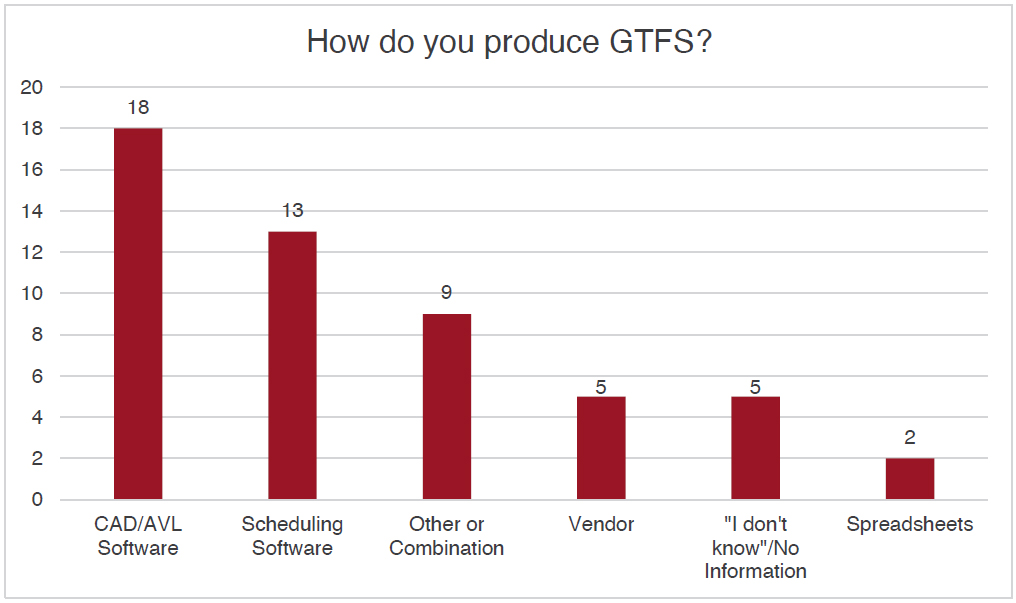
Again, because the survey was distributed to committees and groups dedicated to transit-data technology, it is unlikely this sample is typical. It may not be possible to meaningfully distinguish agencies answering “CAD/AVL Software” as opposed to “Scheduling Software,” since in some cases, “Scheduling Software” will essentially be folded into the suite of tools or services provided by a vendor who provides both CAD/AVL and scheduling services.
Of the 52 transit agencies describing some GTFS reporting or intended reporting, many described more than one mode being reported, as shown in Figure 6.
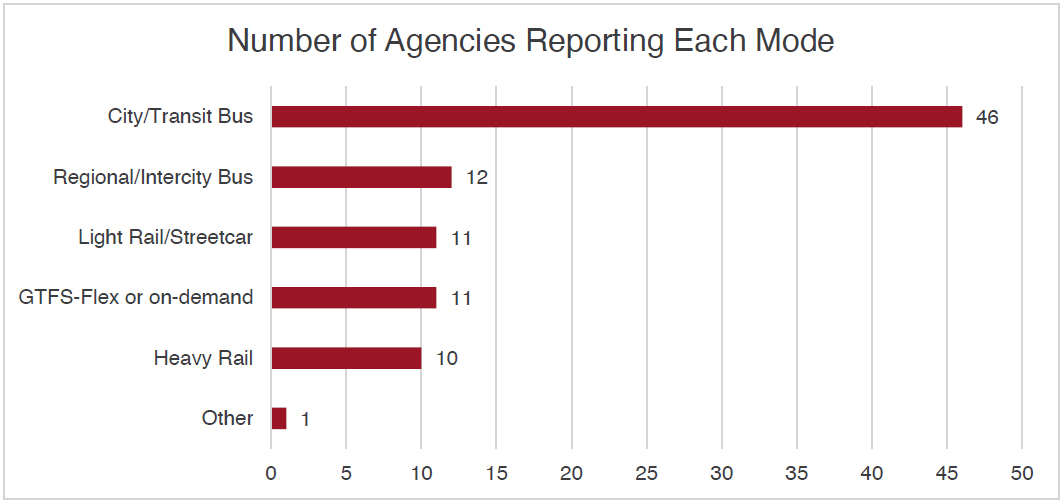
The survey responses reinforced the challenges of documenting demand-response service and utilizing GTFS-Flex. Of the 61 transit agencies responding, 12 offered insight into the services for which they were not providing GTFS support. Demand-response, paratransit, and “on-demand” services were cited most frequently in the free responses. Of the 52 agencies delivering or intending to deliver some kind of GTFS, 38 had demand-response services that could be represented by GTFS-Flex, but only five agencies provided a GTFS-Flex feed.
This page intentionally left blank.
This page intentionally left blank.
This page intentionally left blank.
Abbreviations and acronyms used without definitions in TRB publications:
| A4A | Airlines for America |
| AAAE | American Association of Airport Executives |
| AASHO | American Association of State Highway Officials |
| AASHTO | American Association of State Highway and Transportation Officials |
| ACI–NA | Airports Council International–North America |
| ACRP | Airport Cooperative Research Program |
| ADA | Americans with Disabilities Act |
| APTA | American Public Transportation Association |
| ASCE | American Society of Civil Engineers |
| ASME | American Society of Mechanical Engineers |
| ASTM | American Society for Testing and Materials |
| ATA | American Trucking Associations |
| CTAA | Community Transportation Association of America |
| CTBSSP | Commercial Truck and Bus Safety Synthesis Program |
| DHS | Department of Homeland Security |
| DOE | Department of Energy |
| EPA | Environmental Protection Agency |
| FAA | Federal Aviation Administration |
| FAST | Fixing America’s Surface Transportation Act (2015) |
| FHWA | Federal Highway Administration |
| FMCSA | Federal Motor Carrier Safety Administration |
| FRA | Federal Railroad Administration |
| FTA | Federal Transit Administration |
| GHSA | Governors Highway Safety Association |
| HMCRP | Hazardous Materials Cooperative Research Program |
| IEEE | Institute of Electrical and Electronics Engineers |
| ISTEA | Intermodal Surface Transportation Efficiency Act of 1991 |
| ITE | Institute of Transportation Engineers |
| MAP-21 | Moving Ahead for Progress in the 21st Century Act (2012) |
| NASA | National Aeronautics and Space Administration |
| NASAO | National Association of State Aviation Officials |
| NCFRP | National Cooperative Freight Research Program |
| NCHRP | National Cooperative Highway Research Program |
| NHTSA | National Highway Traffic Safety Administration |
| NTSB | National Transportation Safety Board |
| PHMSA | Pipeline and Hazardous Materials Safety Administration |
| RITA | Research and Innovative Technology Administration |
| SAE | Society of Automotive Engineers |
| SAFETEA-LU | Safe, Accountable, Flexible, Efficient Transportation Equity Act: A Legacy for Users (2005) |
| TCRP | Transit Cooperative Research Program |
| TEA-21 | Transportation Equity Act for the 21st Century (1998) |
| TRB | Transportation Research Board |
| TSA | Transportation Security Administration |
| U.S. DOT | United States Department of Transportation |