Enhancing EPA Science Capability for a Complex Future: Recommendations for Use of Title 42 Special Hiring Authority (2024)
Chapter: 2 Evaluating Title 42 Program Implementation
2
Evaluating Title 42 Program Implementation
Since obtaining Title 42 authority in 2006, the Environmental Protection Agency (EPA) has developed an extensive set of policies and practices to guide its implementation of this authority (EPA, 2006).1 That set has included the development of a detailed operations manual, which the Office of Research and Development (ORD) follows closely and updates regularly (last updated in August 2022) (EPA, 2022). The operations manual covers nearly all EPA Title 42 activities, from identification of positions, to selection and hiring procedures, to management and performance review of the 46 positions currently filled under Title 42, as well as guidance for managers, supervisors, and human resources specialists implementing the authority (EPA, 2022). In comparing EPA’s operations manual to manuals from other agencies, such as the ones used by the U.S. Department of Health and Human Services (HHS, 2012), the substantial level of detail and effective organization of the EPA manual stood out prominently.
This chapter will discuss several aspects of the manual in which enhanced attention could improve the program’s impact and success. These include:
- The process by which EPA ORD translates the hiring priorities identified in its strategic planning into identification of highest-priority Title 42 positions to be filled.
- The decision-making process for determining whether a position is to be filled competitively or noncompetitively and the implications of that decision for the strength of the Title 42 program and contribution to larger efforts to build a broadly diverse scientific workforce.
- The degree to which ORD has an ongoing process for evaluating the success of the overall program, above and beyond its well-established procedures for evaluating the performance of individual Title 42 employees for appointment renewal.
SETTING TITLE 42 PRIORITIES
In using its Title 42 authority to fill critical scientific technical and leadership positions, ORD relies on requests from its research center directors and executive council to determine when and where the Title 42 mechanism will be deployed. While the Title 42 program initially emphasized filling leadership positions, ORD conveyed to the committee explicitly that it has recently shifted its hiring plans (EPA, 2023d). ORD’s intention now is to fill about 75 percent of
___________________
1The Public Health and Welfare (2021), 42 U.S.C. § 209.
available Title 42 positions at the scientist and senior scientist levels, allocating the remaining positions for leadership roles. Chapter 3 will describe the organization of Title 42 positions within ORD.
NASEM (2023) recommended that ORD bolster its robust process for strategic research planning through specific measures, including strategic foresight and more inclusive planning, to better identify and address critical gaps in personnel expertise using Title 42 authority. With improvements to its operations manual, ORD can enhance the integration of its strategic planning and future decisions regarding Title 42 hires. This would provide a more systematic and informed approach to filling crucial positions that is in line with ORD’s overarching strategic goals.
Salary Competitiveness
The Title 42 program allows ORD to recruit candidates swiftly, typically completing the process within a time frame of 4–6 months.2 In following the operations manual, ORD uses a streamlined hiring process to strengthen EPA’s capacity to attract highly qualified experts from various institutions, including the private sector. By facilitating the recruitment of top-tier talent, this mechanism reinforces EPA’s pivotal role in safeguarding the environment and public health in the United States. However, the current cap on salaries—a key facet of the program—significantly limits EPA’s ability to succeed in the recruitment of high-priority scientists and engineers. The current compensation structure for Title 42 employees, spanning all categories, imposes a yearly limit of $275,000 including annual pay, cash awards (excluding patents and royalties), and incentive payments. The annual pay portion of compensation is constrained to General Schedule 15, step 10, for Category A employees and capped at $250,000 for Category B, C, and D employees (see Table 1-1 in Chapter 1), inclusive of locality pay (EPA, 2023e). The committee notes a long-term pattern of stagnation in EPA’s Title 42 salary awards, spanning almost two decades starting from 2006. For example, in fiscal year (FY) 2010, the mean salaries for existing Title 42 appointees varied between $149,000 and $209,904. In FY 2023, the mean salary range was from $128,647 to $226,770 (NRC, 2010).3
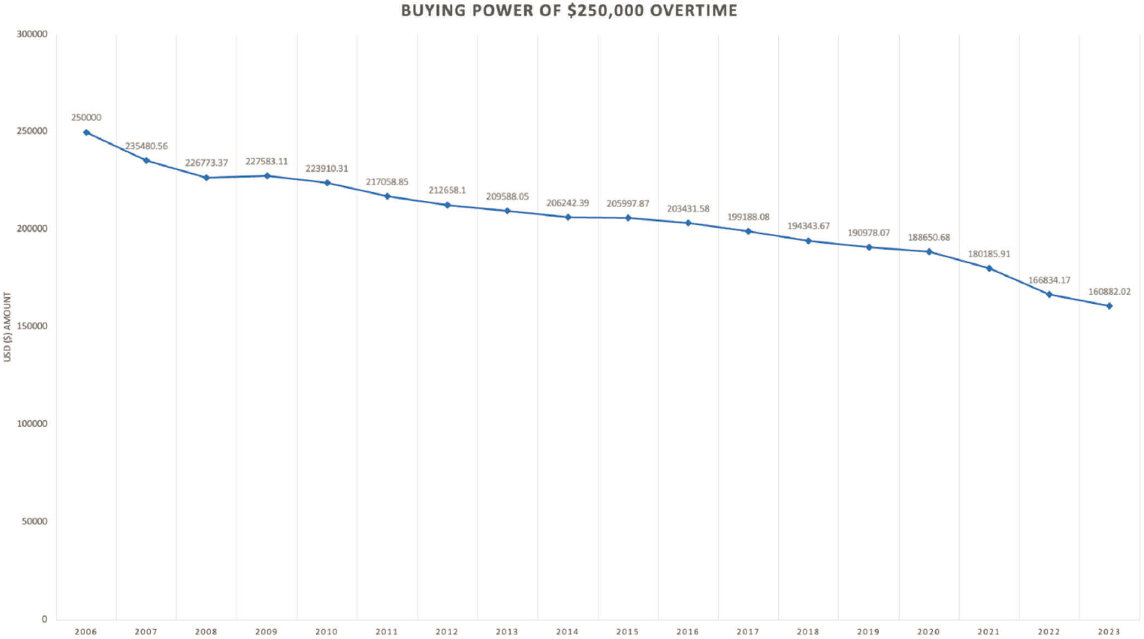
As illustrated in Figure 2-1, the current cap, which has not been adjusted since 2006, now has 35 percent lower “buying power” than when it was first instituted. In contrast, the National Institutes of Health (NIH) raised its cap to $350,000 as of FY 2023 (NIH, 2023). Transitioning from a $250,000 to a $350,000 salary cap equates to a 40 percent increase, which will also increase competitiveness with private-sector salaries. See Chapter 4 for further discussion on salary recommendations.
___________________
2Email to National Academies staff by Ashley Ramsey, Human Capital Program Analyst, U.S. EPA. November 14, 2023.
3Email to National Academies staff by Ashley Ramsey, Human Capital Program Analyst, U.S. EPA. November 14, 2023.
RECRUITING, EVALUATING, AND SELECTING JOB APPLICANTS
A key element in ensuring the overall success of the Title 42 program is identifying and recruiting the best possible candidates from a broad and diverse pool. EPA’s Title 42 Operations Manual lays out a series of detailed steps and quality checks for identifying and recruiting Title 42 candidates. In doing so, the manual describes two approaches to recruitment: noncompetitive (sometimes referred to as strategic) and competitive (sometimes referred to as open) recruiting. The competitive recruiting process involves announcing the Title 42 position publicly on the USAJobs website.4 In contrast, the noncompetitive recruiting process facilitates the evaluation and appointment of candidates who are identified without advertising. A schematic illustration of each mechanism is provided in Figure 2-2.
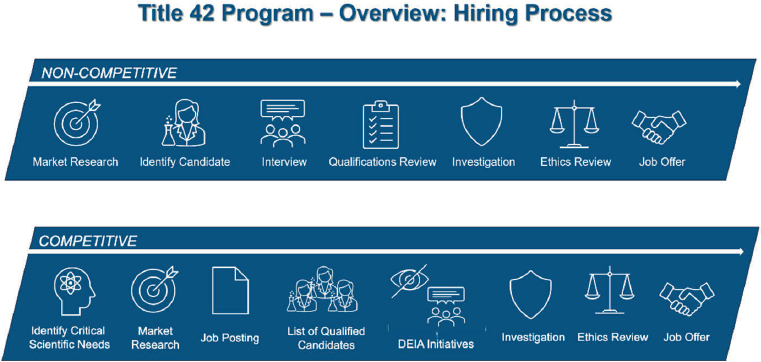
NOTES: DEIA = diversity, equity, inclusion, and accessibility; EPA = Environmental Protection Agency; ORD = Office of Research and Development.
SOURCE: ORD presentation to the committee, June, 22, 2023.
As indicated in Figure 2-3, as of the end of FY 2023, approximately 59 percent of ORD’s Title 42 positions have been filled through noncompetitive (strategic) hiring, and 41 percent have been filled through competitive (open) hiring (EPA, 2023c).
___________________
4See https://www.usajobs.gov (accessed January 22, 2024).
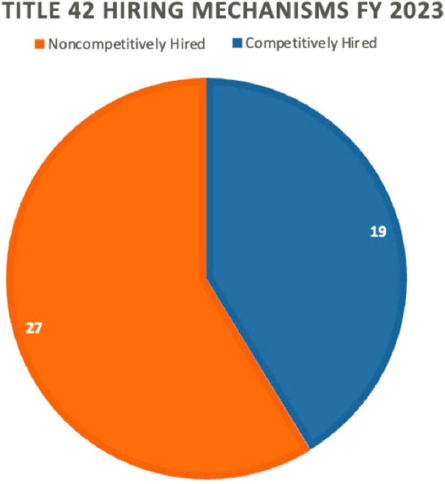
NOTES: EPA = Environmental Protection Agency; FY = fiscal year; ORD = Office of Research and Development.
SOURCE: EPA (2023c).
Noncompetitive hiring holds value in specific circumstances in that it enables the identification and rapid recruitment of candidates possessing a crucial, unique set of skills that may not be widely available. The range of skills of the current group of Title 42 personnel demonstrates the program’s effectiveness in attracting individuals from various specialties. Furthermore, the program provides opportunities to recruit a diverse pool of candidates amid heightened competition between public and private employers for individuals with specialized skills.
However, relying too heavily on noncompetitive hiring may be perceived by outside observers of the agency as reducing the fairness of the process. And it may run counter to the agency’s efforts to identify the most diverse pool of qualified candidates, a goal EPA is striving to address in all hiring through its diversity, equity, inclusion, and accessibility (DEIA) plans (CSST, 2021; Executive Office of the President, 2021; UCS, 2023). Diverse opportunity pathways within the federal STEM (science, engineering, mathematics, and engineering) workforce can have lasting positive effects on public and environmental health (UCS, 2023). Notably, NIH does not use noncompetitive recruiting for Title 42 positions (see Chapter 4).
At the same time, there is value in looking beyond basic differences between competitive (i.e., using USAJobs) and noncompetitive approaches. In the experience of the committee, there are a number of ways to search for a broad range of potential candidates (e.g., establishing search committees, announcing position availability at relevant technical meetings) even in processes that stop short of the full USAJobs approach. These broader efforts, which are also competitive, aim to ensure that Title 42 hires are selected from a pool of the absolute best candidates available at that particular time. Refer to Appendix D for a number of considerations to enhance equity and fairness in Title 42 recruitments.
REVIEW AND RENEWAL OF TITLE 42 APPOINTMENTS AT TERM
Initial appointments under 42 U.S.C. §§ 209(f)–(g) range from 1 year and 1 day to 5 years. Title 42 employees are eligible for term renewals, contingent upon approval by the respective office. Additionally, the office determines the length of the renewal term, ranging anywhere from 1 to 5 years.
According to the operations manual and EPA presentations to the committee, decisions about whether to renew the appointment of a scientist or engineer under Title 42 are typically based on a combination of considerations, including results from a performance evaluation, assessment of continuing EPA priorities and needs, budget and resource considerations, and other factors (EPA, 2022, 2023b). All Title 42 personnel are eligible for a term renewal provided there are no official citations for conduct issues throughout their ongoing term. The decision to renew can begin 9 months prior to a Title 42 employee’s term expiration date (EPA, 2023e). In specific cases, further expedited renewals may be considered, requiring documented approval by the ORD assistant administrator or designee. The full expedited review process is expected to conclude within 120 days.
In practice, ORD has implemented the process effectively in accordance with the operations manual, with the majority of appointees receiving renewals, except in cases of departures from the agency, mainly for reasons other than a decision to not reappoint. An important consideration in this context is whether the particular position and type of work of the Title 42 employee continues to be essential and high priority for EPA. While appointment terms of 5 or fewer years may be considered short, this time frame prompts a thoughtful examination of whether these skills have sustained their cutting-edge status over time.
EVALUATION OF THE OVERALL TITLE 42 PROGRAM
EPA’s Title 42 Operations Manual describes detailed processes for evaluating the annual performance of each Title 42 employee, as well as careful processes for evaluating the sum of an employee’s individual performance as ORD considers whether to renew the appointment at term’s end. Information from presentations and submissions to the committee indicates that these policies have been implemented consistently (EPA, 2023d, e).
However, the operations manual does not address how ORD should systematically evaluate the overall program, assess its successes, or identify areas for improvement. The manual could involve, for example, a timetable and framework for such evaluations, a set of a priori goals for the program, a process for the regular collection of data to inform periodic assessments of the contributions of Title 42 employees to the overall quality of EPA science and environmental decision-making, a procedure for assessing the program’s contribution to achieving EPA’s DEIA goals, and a mechanism for gathering the viewpoints of Title 42 and other employees within EPA toward the program and how it is being implemented. A comprehensive evaluation framework may enhance transparency, accountability, and the overall effectiveness of the Title 42 program.
FINDINGS
Based on its review of the implementation of EPA’s Title 42 Operations Manual and the program to date, the committee presents the following findings. Recommendations are provided in Chapter 4.
Finding 2-1: Overall, EPA has implemented its Title 42 program in a well-organized and effective manner, laying out and following its operations manual, and following an approach that appears to ensure that ORD research centers and national research programs can respond to rapidly emerging technical needs. The focus on cutting-edge technical positions is a strong value of the Title 42 program.
Finding 2-1a:EPA’s shift to using Title 42 to hire more candidates with exceptional expertise in cutting-edge technical areas is generally positive. Considering the program’s flexible recruitment options, the committee supports the agency’s proposal to reserve approximately a quarter of the positions for leadership. This ensures the agency’s ability to identify crucial leadership roles essential for steering entire teams in the realm of innovative science.
Finding 2-1b:NIH’s use of its Title 42 authority to create temporary (i.e., time-limited, nonrenewable) positions enables it to fill critical science gaps with international postdoctoral fellows (who otherwise cannot be hired). A similar use of EPA’s authority may help fill key technical gaps.
Finding 2-2:EPA’s Title 42 Operations Manual and hiring procedures would benefit from revisions focused on integrating the overall priorities for Title 42 positions into ORD’s evolving research strategic planning.
Finding 2-3: The EPA Title 42 program has not revised its salary caps since the program’s inception. As the “buying power” of the salaries offered by the program, especially for recruiting key leaders, has decreased significantly, the current salary cap is in urgent need of thorough review and adjustment.
Finding 2-4: Although strategic, less competitive hiring will be necessary in some cases, the use of competitive processes when possible would help to ensure the broadest credibility for EPA’s Title 42 program both inside and outside the agency.
Finding 2-5: In order to maximize the opportunities for recruiting highly qualified candidates, ORD would be well served by a broader search approach for all Title 42 positions, either through informal mechanisms for identifying candidates or by exploring ways in which the competitive process could be pursued with the greatest speed and efficiency.
Finding 2-6: For most recruitments, using a search committee would help ensure the broadest possible outreach. A search committee could help develop the position description, identify potential candidates, and interview and screen the candidate. Such a committee would be valuable in any recruitment but may be especially helpful in ensuring the most rigorous recruitment of the noncompetitive positions identified by EPA leadership. The use of such search committees is common practice in other agencies (e.g., NIH) and academic institutions.
Finding 2-7: The evaluation of Title 42 term renewals appears to be effective; however, the expedited renewal process is concluded within 120 days of approval from the ORD assistant administrator. That time frame may be too short for conducting a full evaluation of an individual’s work spanning an appointment of up to 5 years.
Finding 2-8: As ORD’s Title 42 program grows to include up to 75 (and possibly more) employees, EPA can monitor the program on an ongoing basis and request that a thorough program evaluation be conducted periodically by an independent organization (e.g., EPA’s Board of Scientific Counselors). These measures will ensure that ORD can learn from its experience continuously, identify and replicate successes, and amend the program to address any limitations. This is important especially if EPA obtains permanent authority for the program.


