Enhancing EPA Science Capability for a Complex Future: Recommendations for Use of Title 42 Special Hiring Authority (2024)
Chapter: 3 Scientific Capacity Building: An Overview of Current Title 42 Initiatives
3
Scientific Capacity Building: An Overview of Current Title 42 Initiatives
Advancements in environmental research have driven technological progress and enhanced policies, contributing significantly to substantial improvements in environmental quality and public health. Nevertheless, numerous intricate environmental challenges persist, and novel issues are emerging, intertwined with complex technological, sociological, and economic factors. The National Academies (NASEM, 2023) has identified current scientific areas—such as exposomics, biotechnology, data science, artificial intelligence and machine learning, geospatial techniques, risk and exposure assessment, and social and behavioral sciences—that are of high priority for research and development by the Environmental Protection Agency (EPA). EPA’s Title 42 program is geared strategically toward recruiting specialized appointees in these high-priority research areas; these appointees are expected to not only contribute significantly to scientific advancement, but also uphold the mission of EPA’s Office of Research and Development (ORD) to safeguard human health and ecosystems from environmental pollutants. What has been the quality and impact of the engineering and scientific work of ORD’s Title 42 program, taken as a whole? To answer this question, the committee first examined the organizational distribution and makeup of EPA’s current Title 42 program and positions.
ORGANIZATIONAL OVERVIEW OF CURRENT TITLE 42 POSITIONS
Using data provided by EPA, the committee examined the number, placement, and organizational roles of the current appointees; the agency’s engineering and science priorities; and the programmatic and scientific impact of its Title 42 program. The evaluation focused on ORD. To note, EPA’s Office of Chemical Safety and Pollution Prevention (OCSPP) was granted Title 42 hiring authority in fiscal year (FY) 2022 and has not yet onboarded any Title 42 candidates. For this reason, the committee did not consider the impact of OCSPP’s Title 42 implementation in this chapter. Guidance regarding OCSPP and its future implementation of the Title 42 program can be found in Chapter 4.
Placement of Title 42 Appointees Within ORD
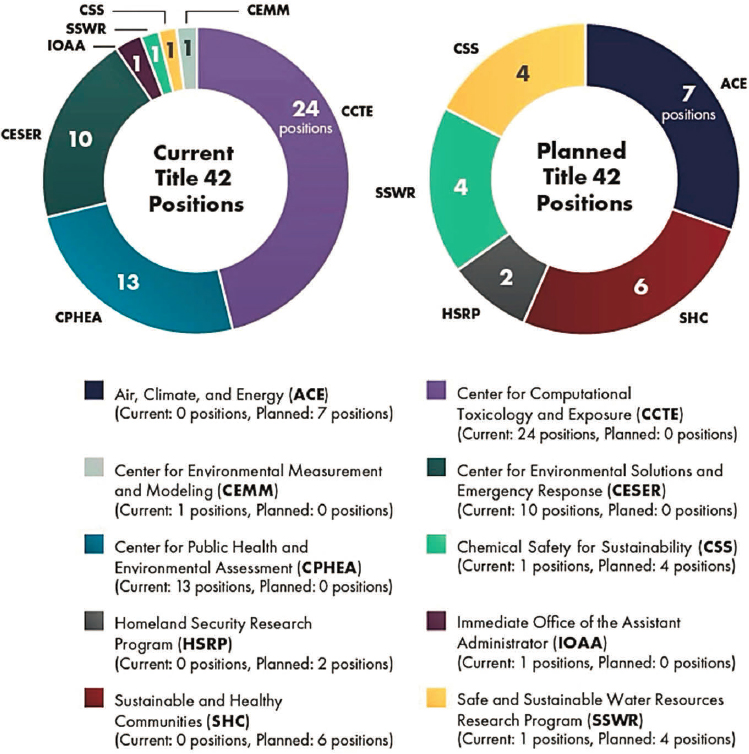
With 46 appointees and 5 hires in progress as of FY 2023, ORD is recruiting for an additional 23 positions in FY 2024 for a planned total of 74 positions (EPA, 2023c). Figure 3-1 depicts the placements of the current and planned Title 42 positions within each program and center of ORD.
NOTES: EPA = Environmental Protection Agency; ORD = Office of Research and Development.
SOURCE: EPA (2023c).
The current positions are situated predominantly within EPA’s national centers. The Center for Computational Toxicology and Exposure (CCTE) has 47 percent of the current Title 42 positions, and the Center for Public Health and Environmental Assessment has 25 percent. The planned FY 2024 Title 42 positions, however, reflect a more distributed placement, guided by ORD’s Strategic Research Action Plans (StRAPs) for meeting strategic needs within ORD’s national research programs. Such programs include the Safe and Sustainable Water Resources (SSWR) program, which is slated to recruit 17 percent of the planned FY 2024 Title 42 positions, an increase from only 2 percent of Title 42 positions.
Through this strategic hiring shift, the Title 42 program is poised to address prioritized environmental and health research issues outlined by the agency in its StRAPs, coupled with priorities outlined by national program leadership.
Scientific Domains of Title 42 Positions
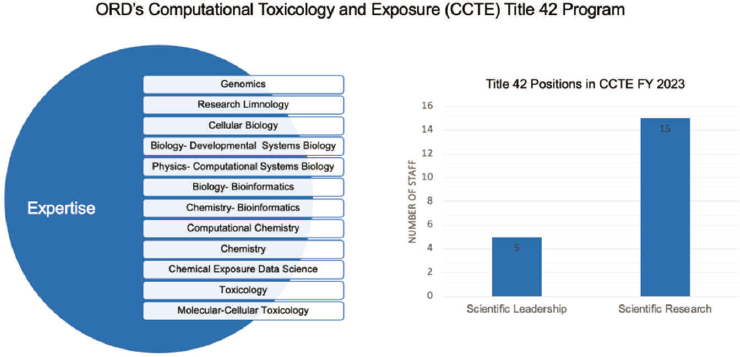
The committee’s review revealed that the current 46 appointees hold multifaceted scientific and engineering backgrounds, impressive credentials, and extensive experience. These appointees have brought a necessarily broad range of disciplines to crucial applied and basic research areas. The following list of areas of expertise is not exhaustive but highlights the importance of the Title 42 program in developing and maintaining a dynamic scientific workforce to fulfill ORD’s guiding mission and promote scientific advancements within evolving fields, many of which were highlighted in the 2023 report by the Futures Committee (NASEM, 2023) (see Appendix F for a complete list of all current positions). Key expertise of FY 2023 Title 42 appointees includes:
- Exposure science, (cumulative) risk assessment, and human health
- Data science, modeling, data visualization, machine learning
- Climate resilience
- Disaster preparedness and response
- Community engagement
- Environmental justice
- Social and behavioral sciences
- Computational toxicology
- Genomics, exposomics, and systems biology
- Geospatial techniques
- Cheminformatics and bioinformatics
- High-priority environmental contaminants (PFAS, phthalates, perchlorate)
- New approach methodologies
- Air pollution and respiratory health
- Water quality and wastewater surveillance
- Ecosystems modeling
Each of ORD’s research programs can, and do, hold Title 42 positions that span across several different fields listed above. For example, please see the scientific distributions within the CCTE (see Figure 3-2).
NOTES: CCTE = Center for Computational Toxicology and Exposure; EPA = Environmental Protection Agency; FY = fiscal year.
SOURCE: EPA presentation to the committee, June 22, 2023.
Position Levels and Placement
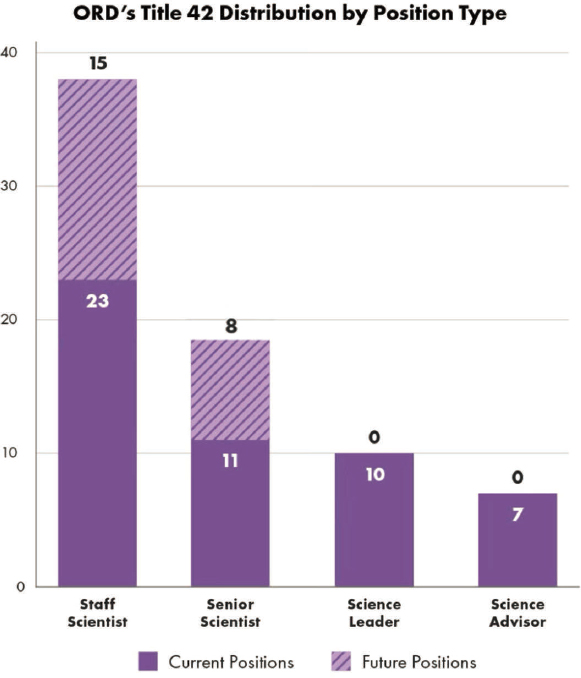
The committee further evaluated the level and placement of each position within ORD. See Figure 3-3 for Title 42 appointees within ORD as of FY 2023 and prospective FY 2024 Title 42 hires by position level. Science leaders and advisors offer strategic direction and provide specialized expertise for the agency. Senior and staff scientists strengthen EPA’s scientific enterprise by advancing cutting-edge methodologies, tools, and techniques through versatile research and development. Appointees in each of these positions enable EPA to branch into new multidisciplinary efforts.
ORD uses its Title 42 authority predominately to hire staff and senior scientists; in fact, all of the new Title 42 positions planned for FY 2024 are either senior or staff scientist positions. No single factor has driven the use of Title 42 authority to fill senior and staff scientist positions. All Title 42 appointees fill critical needs that require highly qualified persons who have the required training and skills, which are typically in high demand in the private and public sectors.
The Title 42 program is focused on hiring the most qualified scientists within high-priority areas, regardless of level of seniority. The distribution of Title 42 positions allows ORD to support EPA science and engineering, convene specialized experts, and advance the applied and basic research needs of the agency.
NOTES: Average salaries as of FY 2023: Staff scientist (Category A), $128,647; senior scientist (Category B), $228,829; science leader (Category C), $227,780; science advisor (Category D), $226,770. EPA = Environmental Protection Agency; FY = fiscal year; ORD = Office of Research and Development.
SOURCE: EPA (2023c).
OVERALL IMPACT OF EPA’S TITLE 42 PROGRAM
The 2000 report Strengthening Science at the U.S. Environmental Protection Agency recommended that EPA seek Title 42 authority to attract and retain outstanding research leaders (NRC, 2000). Since EPA was granted authority for its first Title 42 hires in FY 2006, this authority has been critical to its scientific mission, impacting leadership and capacity building; driving innovation; and providing scientific and technical guidance to EPA programs, EPA regions, and the states.
Leadership
Title 42 authority has enabled ORD to recruit research leaders who strengthen the core of EPA’s science capacity. These hires include two center directors, two national program directors, five division directors, and others in research leadership roles (EPA, 2023d). They have led capacity building in high-priority areas including computational toxicology, human health assessment, climate science, and disaster response. They have built programs, mentored staff, and participated in ORD’s senior leadership and management decision-making.
Innovation and Advancing Environmental Science and Engineering
The 2023 report of the National Academies Futures Committee stressed the importance of innovation and recommended the expansion of ORD to better support EPA’s mission (NASEM, 2023). Title 42 enables the agency to recruit innovation leaders and respond to changing priorities, enhancing the agency’s overall capacity. Title 42 appointees provide the foundation for many of ORD’s scientific advancements, respond to program needs, and advance the field of environmental science.
ORD is recognized as a global leader in human health assessments. With leadership from Title 42 scientists, EPA’s Integrated Science Assessments1 provide the foundation for implementing the agency’s core statutory responsibilities. Continual innovations to strengthen the scientific evidence include improved risk assessment methods, including systematic reviews, dose–response methods, and strengthening of the causality framework. ORD has also advanced the science of environmental toxicology, developing rapid-screening methods and new tools for evaluating the potential health impacts of data-poor chemicals. Additional innovations include new, real-time methods for measuring population exposure; advancing nontargeted analysis; and developing, evaluating, and deploying new sensors.
Supporting EPA Programs and the States
Title 42 strengthens ORD’s capacity to meet the emerging science and technical assistance needs throughout EPA and among the states. Virtually all major agency programs draw on ORD expertise and guidance. Examples include long-established collaborative relationships between EPA and the states, supporting such areas as hazardous waste, clean air and water quality standards, pesticides, and toxic chemical assessments. The states, through the Environmental Council of the States, regularly meet with ORD to discuss their research needs and share advances and new tools for environmental protection.
___________________
1 For more information on EPA’s Integrated Science Assessments program, see https://www.epa.gov/isa (accessed November 22, 2023).
An even more crucial role has been the leadership and technical assistance provided by ORD in responding to emerging threats. With increasing frequency, Title 42 scientists are a resource during emergencies and extreme events, providing technical assistance and emergency response for a wide range of ecological and health issues, including COVID-19; wildfires; hazardous chemical releases; per- and polyfluorinated substances, also known as PFAS, exposure and response; and climate impacts on water resources, such as harmful algal blooms.
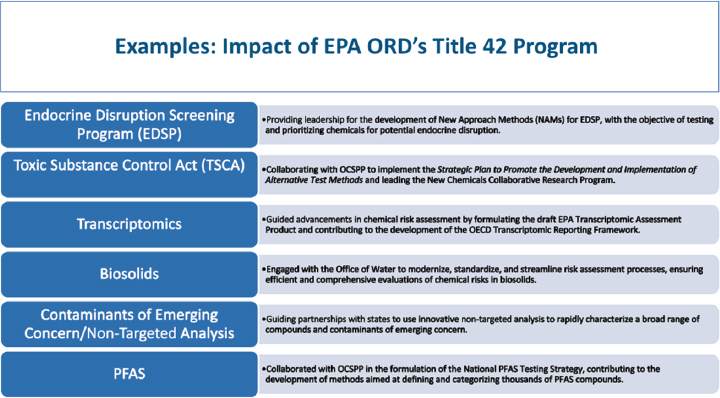
Figure 3-4 provides examples of the contributions of the Title 42 program in developing new scientific tools to meet emerging public health and environmental needs and to inform national and state policy decisions (EPA, 2023d). See Appendix E for a full summary of how the Title 42 program strengthens ORD’s initiatives.
NOTES: EPA = Environmental Protection Agency; FY= fiscal year; OCSPP = Office of Chemical Safety and Pollution Prevention; OECD = Organization for Economic Cooperation and Development; ORD = Office of Research and Development.
SOURCE: EPA (2023d).
Building for the Future
EPA’s ORD faces the same recruitment challenges that many other agencies, universities, and private-sector research groups experience when confronted with a high demand for and limited supply of qualified applicants. Needs for expertise are evolving constantly and often cannot be met by training and developing the existing workforce. Meeting the emerging and future challenges of environmental protection will require a continual evolution of EPA science. Title 42 has
provided ORD with a pathway for building the essential science leadership for present needs and future paradigms. The 2023 report of the Futures Committee identified key areas for future research and capacity building, including biotechnology, artificial intelligence and big data, new techniques for environmental exposure monitoring, capacity in social and behavioral sciences, and the application of systems thinking to a One Environment–One Health approach (NASEM, 2023).
ORD has used its Title 42 authority to lay groundwork for the future. For example, ORD Title 42 hires are applying big data approaches to advance understanding of the health effects of particulate air pollution, working with electronic health records and building on research by the National Institutes of Health. They are developing new approach methodologies for assessing the impacts of contaminants on vulnerable populations; advancing cumulative risk assessment; and applying a systems approach to addressing the global challenge of PFAS contamination, exposures, impacts, and remediation. Chapter 4 discusses in greater length the path forward for Title 42 priorities.
Overall, the committee determined that EPA’s current Title 42 program has strengthened ORD’s evolving scientific enterprise and has helped advance the agency’s guiding mission.
FINDINGS
Based on its review of the scientific and programmatic impact of the Title 42 program to date, the committee presents the following findings, with recommendations to follow in Chapter 4:
Finding 3-1: Although only 2.6 percent of ORD’s current workforce are Title 42 hires, Title 42 authority has enabled the hiring of strong scientific leadership, advanced innovation, and improved the scientific capability and capacity to support EPA’s mission.
Finding 3-2: The future placement of the planned Title 42 positions throughout the national research programs will enhance the capacity of ORD to develop state-of-the-art research and tools, addressing pressing environmental and health research issues and further solidifying its role in strengthening EPA’s scientific foundation.
Finding 3-3: Title 42 scientists are a resource for the states, providing technical assistance and emergency response for a wide range of issues including wildfires, hazardous chemical releases, and threats to water resources such as harmful algal blooms.
Finding 3-4: Title 42 scientists are working in all EPA priority areas, conducting research, developing new tools, and providing technical assistance across the agency and to the states.
Finding 3-5: Continued support and expansion of EPA’s Title 42 program is essential to ensuring that the agency has the scientific capability to implement its statutory mandates, address today’s and tomorrow’s environmental challenges, and provide global leadership in innovative solutions for the future.


