Building Capacity for the U.S. Mineral Resources Workforce: Proceedings of a Workshop (2024)
Chapter: 4 Disciplines and Skills for a Future Mineral Resources Workforce
4
Disciplines and Skills for a Future Mineral Resources Workforce
The mineral resources industry is evolving—and so are the skills that will drive its future success. For the workshop’s second session, John Metesh, Montana Bureau of Mines and Geology, moderated a panel discussion on disciplines and skills for a future minerals workforce. Proposing that tomorrow’s workforce will likely need not just traditional technical expertise but also a holistic understanding of sustainability, innovation, and global demand, panelists suggested a wide range of disciplines and skills (Figure 4-1) that can equip those entering the field to succeed in navigating the complexities of mineral resource extraction and management.
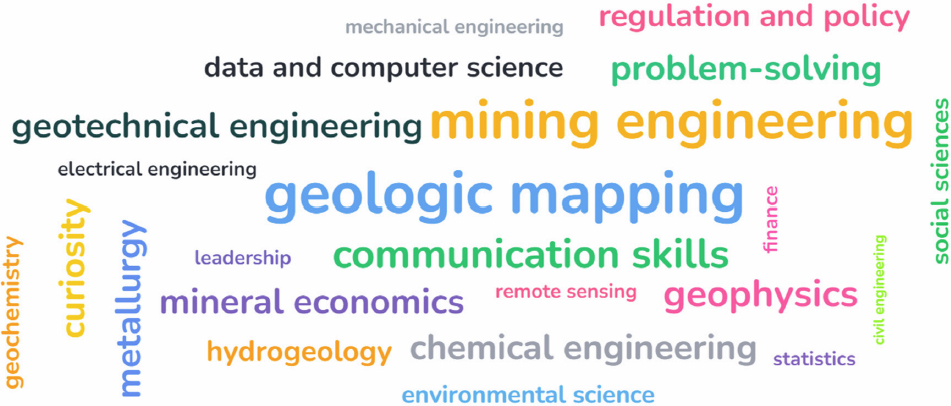
NOTE: Size of the words roughly correlates with the number of mentions during this session of the workshop.
KEY SKILLS AND DISCIPLINES
To launch the discussion, panelists were asked to discuss the disciplines and skills they seek in their recruitment efforts. The panelists included Christine Whetten, Barrick/Nevada Gold Mines; Mike Timmons, New Mexico Bureau of Geology & Mineral Resources; Anita Bertisen, Brooks and Nelson; Fio Giana, Freeport; Teresa Kirschling, U.S. Geological Survey (USGS); and Greg Nottingham, U.S. Department of the Interior’s Environmental Compliance and Cleanup Division.
Attributes for Success
While the mining industry needs a wide variety of skills, Whetten said, the most successful workers are those with several key attributes: an entrepreneurial mindset, an adventurous spirit, and the ability to collaborate with others. She added that there is a need for people who are willing to challenge each other, question current practices, and try new things, which also requires a willingness to accept the fact that new
things will sometimes fail. Giana added that curiosity and problem-solving capabilities are also important skills, along with the ability to understand data and how data transform into information.
Whetten noted that success in the mineral resources industry also requires a willingness to work in the field, on site in rural areas. It is simply not a career that can be pursued in an urban environment or via telework, she said, and this is unlikely to change even though it may be a limiting factor for some people.
Technical Skills
In terms of technical skills, Kirschling said that USGS, which provides Earth, water, biological, and mapping data and expertise to support decision making on environmental, resource, and public safety issues, needs geoscientists who not only look at the quantity, quality, and location of resources but also look at potential impacts of developing resources. This includes characterizing supply chains and forecasting potential disruptions, as well as collecting and disseminating the nation’s official statistics on mineral commodities. Additional needs include scientists who can work with land managers to understand the full potential of how minerals can be reclaimed from mine waste, she said. She added that there is a need for people with laboratory and modeling experience, data literacy and the ability to work with data scientists, and the ability to understand the legal framework that USGS works within. USGS, therefore, recruits from a wide range of geoscience disciplines, including geologists, economic geologists, geochemists, geophysicists, mineral economists, physical scientists, remote sensing experts, statisticians, supply chain analysts, data scientists, social scientists, and more.
Giana added that while mining engineering degrees are a cornerstone, there is also a need for people with geotechnical expertise—especially for tailings examination—and extractive metallurgists. Whetten added that engineers need to be prepared to help bring autonomous/artificial intelligence approaches forward. With the trend toward underground mining in the United States, she also pointed to a need for underground mine planning, ventilation, and geotechnical skills.
Bertisen added that expertise in environmental sciences is important, and pointed specifically to a need for hydrogeology, permitting, and tailings experts. Along similar lines, Giana said that deep expertise in hydrogeology is sought after, and she also noted that expertise in waste management is needed to support reclamation efforts. “We need folks who are passionate about how ‘do we manage our dust,’ ‘how do we manage our waste,’ ‘how do we manage our water,’” she said.
Social Skills
Many panelists highlighted the importance of social or “soft” skills, such as communication, adaptability, and cross-cultural collaboration. Bertisen said that the ability to navigate local laws and legal language and an understanding of governance, finance, public relations, communications, and leadership can be extremely valuable to mining companies. Giana underscored the importance of social awareness and skills relevant to attending to the needs and concerns of the communities near mining operations. “We don’t operate because we want to; we get to operate because our neighbors allow us to do that,” she said. She added that the environmental compliance area of a business cannot be separated from community engagement. “Every permitting process that we do, whether it’s a greenfield or a brownfield [project], has a number of public engagement sessions within local communities, and a lot of those times . . . you’re educating the public as much as you’re informing them,” she said.
Nottingham said that after two decades of being a National Park Service remedial project manager, the hardest skill set to find is not merely a chemical engineer, but a chemical engineer who can write and speak and communicate effectively. In particular, he said, there is a need for people who can effectively communicate technical material with attorneys and the public, in addition to engineers and chemists.
Whetten suggested that one easy and inexpensive way to impart social skills is for universities to ask their communications professors to give workshops. She also suggested that industry could help with this need. “We’re starting to recognize more that we are part of that mentorship process,” she said. “We need to help with that gap as they go from learning how to present for academic purposes to learning how
to present for business purposes.” As an example, she said that Barrick/Nevada Gold Mines has started in-house workshops for interns and new graduates to teach them how to speak in a more solution-based manner than they did in school, including learning how to market an idea to leadership or provide information to a community member.
THE VALUE OF HANDS-ON EXPERIENCES
Several panelists said that practical experience is appealing to hiring managers. Whetten noted that the COVID-19 pandemic meant that many recent students were not able to experience field camps, which has led to a dearth of key field skills and experiences. Like Whetten, Giana emphasized the need for technical skills, including geologic mapping skills, that can only be obtained in on-site field camps. Many early-career geologists and geological engineers lack these hands-on skills after the last decade or so of programs merging and shrinking.
Nottingham said that an internship or experiential requirement associated with a degree can set graduates apart, and suggested that there is a need for more paid internships and programs that can help fund these types of engagements. Whetten similarly suggested that student co-ops and externships in which professors spend a summer at a mine can help students and faculty relate what they are studying to real-world issues while benefiting the university. “It creates that circle of connection between industry, the student, and the university,” she said, and it supports transfer of students and faculty between industry and academic jobs.
Timmons described how the New Mexico Bureau of Geology and Mineral Resources supports hands-on experiences for students. He noted that state geological surveys, which can come in all shapes, forms, and sizes, have different roles within various states. While some are attached to a department of natural resources division, others are attached to university environments. “State geological surveys, especially the ones located in the university environment, play a critical role in this workforce development issue,” he said. As a research division of the New Mexico Institute of Mining and Technology, the New Mexico Bureau of Geology and Mineral Resources often trains university students in the geological sciences, including minerals sciences, and also employs a portion of those students after they graduate. He reported that they have 72 staff members and around the same number of student employees, with up to one-quarter of those students working in the minerals group. The bureau has a robust suite of analytical facilities, which provides students the opportunity to learn various analytical techniques. Students receive direct experience in geological mapping, as well as other important techniques, such as sample characterization and data management.
Building on other panelists’ comments about the importance of field experiences and internships, Timmons commented that these experiences give students the chance to work in a team environment, interact with an industry partner, and participate in interactions with the local community. “Part of the relevance of the science and getting interest and engagement from the students is recognizing the impact that research has on local communities or the local economy,” he said. “Those early field experiences are absolutely critical, and any programs that introduce some of those experiences [are] really important.”
BRIDGING ACROSS DISCIPLINES
Giana, the general manager at a large copper mine in Arizona, said that mining is a cross-discipline industry. Nottingham noted that an interdisciplinary background can be especially useful for work in cleaning up contaminated sites. “We have a real dearth of practitioners in the area of contamination cleanup,” he said. “A lot of our mining engineers and folks with hands-on field experience in mining have retired. We are seeing a lot of folks come in who are interdisciplinary or multidisciplinary.” Similarly, Kirschling said that USGS looks for deep discipline expertise, as well as the ability to connect between different geoscience fields. She said that the USGS Energy Resources and Mineral Resources programs are consistently asked challenging questions such as, where across the country could we sustainably develop a particular mineral?
These types of questions require complex resource assessments and an understanding of the interface between resources and environmental sciences. “This requires a lot of those interdisciplinary and bridging skill sets,” she said. “It requires a willingness to step outside of the boundaries that maybe you came in with as a geologist in the USGS and be able to partner across with folks who have other specialties.”
BUILDING ON GROWING MOMENTUM
Panelists also discussed general trends in the demand for geoscientists and engineers in light of an increased focus on critical minerals and the energy transition. Nottingham said he sees a lot of interest in critical minerals across federal agencies, including interest in figuring out how to meet domestic resource needs in a changing energy sector and in issues such as how to make productive use of tailings piles.
Kirschling added that within the federal government, hiring tends to follow appropriations. “We are at a really fantastic moment in time when it comes to critical minerals because we’ve seen investments like the Bipartisan Infrastructure Law boost up some of our foundational data collection, and with that, it helps to build momentum,” she said. She emphasized that to build on the momentum, it is important to keep emphasizing what the data are showing and how the data can change the nation’s trajectory. She also highlighted that investments in the disciplines that will support a strong mineral resources workforce will also be impactful for other energy fields, including subsurface energy storage. To build on the current momentum, “we need to weave together a bigger picture than just the single critical minerals picture,” she said.
Bertisen, who works at a global human resource management and recruiting consulting firm, said she first became interested in mining through a European mining course, a partnership model in which industry supports students who take various courses at different universities. She said that such a model could also work in the United States. “There’s an opportunity for us to work together in a much bigger way than I think we’ve ever done before,” she said.


