Building Capacity for the U.S. Mineral Resources Workforce: Proceedings of a Workshop (2024)
Chapter: 7 Growing Interest Among University and 12th-Grade Students
7
Growing Interest Among University and 12th-Grade Students
To facilitate in-depth discussions about opportunities to grow interest in the mineral resources field among university and 12th-grade students, participants were invited to join one of three simultaneous breakout sessions. The first focused on the topic of building student interest by improving the perception of mining. Franek Hasiuk, Sandia National Labs, delivered an opening presentation followed by a discussion moderated by Antonio Arribas, The University of Texas at El Paso. The second focused on building student interest through university and 12th-grade recruitment. It began with a presentation from Isabel Barton, University of Arizona, and the discussion was moderated by Simon Jowitt, University of Nevada, Reno. The third focused on building student interest through partnerships. It began with a presentation by Jacqueline Huntoon, National Science Foundation, and the discussion was moderated by Priscilla Nelson, Colorado School of Mines.
OPENING PRESENTATIONS
Each breakout group started with a brief presentation, which was followed by a moderated discussion aimed at eliciting suggestions for strategies and actions to grow interest in mineral resources fields.
A Rock and a Hard Place: Geology’s Fundamental Tension Between Industry and Environment1
Franek Hasiuk, Sandia National Laboratories, discussed how fundamental tensions in the way society and geologists think and communicate about resource extraction have impeded mining activities and recruitment to the field, and proposed potential opportunities to overcome these tensions. Many people are aware of the environmental legacy of mining in America, where landscapes are dotted with abandoned wells, unreclaimed mine lands, tailings piles, and acid mine drainage pools. When considering a proposed resource extraction activity, risk is often a top consideration for communities. These can include health and safety, financial, environmental, and political risks. Such risks are difficult to quantify and uncertainty is often high, and for many communities, it is easiest to simply say no.
To overcome these negative perceptions and barriers, Hasiuk posited that quantifying risk and uncertainty—and, critically, communicating about it more effectively—can help society weigh the risks against the benefits of responsible resource extraction. He suggested that the field of uncertainty analysis could be leveraged to help quantify the risks and uncertainties of resource extraction activities.
To communicate more effectively about mining practices and their risks, he highlighted the importance of engaging diverse groups and attending to priorities such as environmental justice, respect for Native peoples’ lands, and effective governmental engagement. As examples, he pointed to successful outreach activities and field trips organized for state and federal legislators, leaders, and regulators, as well as outreach to Tribal communities.
How Do We Get Students into Minerals Careers?
Isabel Barton, University of Arizona, provided insights into the factors that steer students away from minerals-related college majors and offered suggestions on opportunities to attract more students to the field. The low number of minerals or geology majors is a well-known, long-standing problem. University of Arizona surveys show that students choose majors based on comfort, low entry barriers, and prior knowledge. As a result, if they are not already familiar with mineral resources coming into college, it
___________________
1 Presentation modified from Franciszek (2023).
is highly unlikely they will choose it as a major, even when informed about the opportunities for jobs and advancement in mining and minerals careers (Barton et al., 2021). In addition, minerals professions have a very small public profile (Figure 7-1), and most people may be unaware of the connection between mining and the everyday materials upon which society depends.
Barton suggested several ways that academic, industry, and government stakeholders can overcome this challenge and help to attract a future workforce to the field. First, incorporating the importance of minerals in everyday life into state K–12 educational standards could help to raise awareness among students before they enter college. Second, universities can raise the profile of minerals-related programs by removing barriers for nonmajors to take classes, making double majors and minors easier, and encouraging students and faculty to participate in campus-wide career fairs and recruiting events. Third, she suggested that mineral resources faculty could develop engaging content for inclusion in crosscutting, interdisciplinary first-year courses to reach new students, especially those pursuing subjects the mining industry needs, such as business, data analytics, or law. Finally, she cautioned that the emphasis should not be on numbers of students alone but on developing high-quality programs, on the basis that “high-quality programs lead to high-quantity student bodies.”
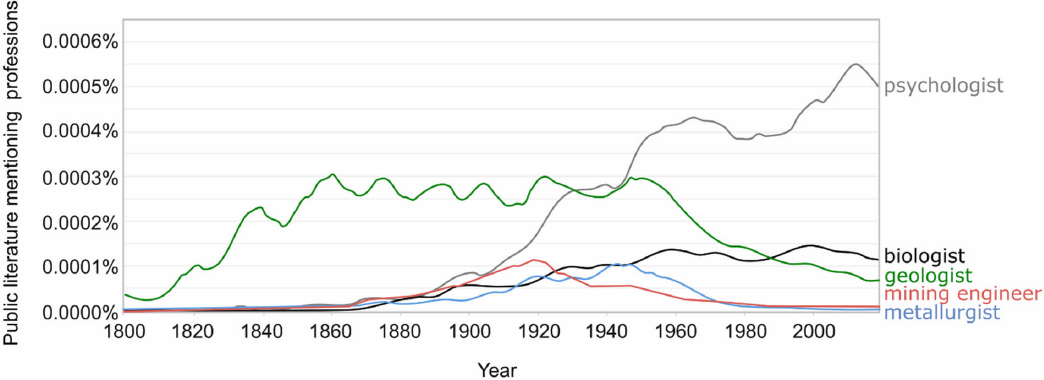
SOURCE: Modified figure presented by Isabel Barton, January 24, 2024; data from Google Books Ngram Viewer.
Building Interest Through Partnerships
Jacqueline Huntoon, National Science Foundation (NSF), highlighted ways in which partnerships can help to address many of the challenges in attracting students into minerals-related fields. Partnerships go beyond merely facilitating connections—they create time for mutually beneficial activities. Huntoon discussed how partnerships can be leveraged to address common student challenges and concerns, including the return on investment of education, the difficulties finding engaging careers with advancement paths, and a lack of awareness of what careers exist and how to prepare for them. Huntoon proposed that the traditional model of a straight, sequential line from education to work to life is no longer relevant, having been replaced by a more fluid model in which the barriers between work and education are more permeable, with multiple on- and off-ramps and increased flexibility, affordability, and accessibility. This has enabled more diverse and complex potential relationships between sources of talent; seekers of talent; and venues for connection, such as professional societies, student clubs, and community groups.
Partnerships can support many different types of mutually beneficial activities, such as dual enrollment, outreach programs, internships and externships, earning while learning, credit for experience, competency-based education, and stackable credentials (Figure 7-2). While the benefits differ—some reduce
cost and time to degree, some provide direct experience, some enable employers to develop and strengthen connections with talent—they can all help to reduce barriers and address workforce demands. Huntoon outlined many ways in which creative, mutually beneficial partnerships can be incorporated into the workforce pipeline to enhance social mobility, economic growth, and retention, from early education to college, job training programs, and the workplace.

SOURCE: Presented by Jacqueline Huntoon, January 24, 2024.
BREAKOUT DISCUSSION REPORT-OUTS
Representatives from each breakout group shared ideas that emerged from their discussions related to examples of actions that could be taken by stakeholders in academia, agencies, and industry.
Building Student Interest by Improving the Perception of Mining
Several participants in the first breakout group discussed the benefits of more educational outreach, including through social media, to raise the profile of the mineral resources field and improve perceptions of it. For example, some suggested that academia and the minerals industry could collaborate to educate legislators, nonprofit organizations, and the public about improved techniques and new technologies that can reduce the social and environmental harms wrought by past mining projects. To facilitate this, some participants suggested that companies could hire more public relations staff to support public and academia field visits to mine sites. For academic programs, a participant suggested supporting a more holistic education by incorporating disciplines such as public policy, humanities, social sciences, and communications into the course lineup for mineral resources majors, as well as delving into examples of humanitarian issues in other countries to provide a more nuanced understanding of the mining industry globally.
Participants also offered several ideas for ways federal and state governments could support workforce development. One suggestion was to reinstate and sustainably support a centralized agency overseeing the mineral resources industry, like the former U.S. Bureau of Mines. Other ideas include empowering the development of robust state regulatory programs; reinvesting tax dollars into research, outreach, and capacity building; and supporting effective waste cleanup and reclamation programs. After all, one participant noted, “A mine is a terrible thing to waste—but waste is a wonderful thing to mine!”
Building Student Interest Through University and 12th-Grade Recruitment
Many participants in the second breakout group discussed multiple ways academia, industry, and agencies can become more aligned, raise awareness, and create a sense of belonging within the mining workforce. For academics, several people suggested aligning recruitment practices and sharing challenges with industry and other nonacademic stakeholders. Government agencies relevant to mining could collaborate to identify, promote, and support road maps for sustainable enrollment frameworks. Mining companies could better align with universities by offering internships to students (perhaps in their first year) who are considering, but not necessarily committed to, mineral resources–facing fields.
Some participants posited that integrating critical mineral resources materials into Advanced Placement classes could help to raise student awareness of the mining industry and suggested targeting outreach activities toward community colleges and small liberal arts schools to expose students to possible pathways into the minerals industry. For their part, participants suggested, industry could help to raise awareness by enabling current employees to act as recruiters, supporting recruiters at universities, and potentially collaborating with celebrity influencers to expand their reach.
Finally, a sense of belonging is an important metric for employee success. Several participants suggested ways for academia, industry, and agencies to collaborate on developing a genuine, relatable marketing campaign that emphasizes the role of the mining industry and its workers within larger societal missions. To complement this effort, some participants also suggested that companies could work to ensure their workplace culture cultivates a sense of belonging and promotes retention.
Building Student Interest Through Partnerships
Several participants in the third breakout group highlighted how partnerships among academia, funding agencies, and industry can help to engage more students and expand the future workforce. For example, trusted academic–industry partnerships can be leveraged to promote the wide spectrum of mining careers, reform coursework to be more relevant to students and more responsive to industry needs (perhaps through the NSF Improving Undergraduate STEM Education initiative), and sponsor student contests that encourage multidisciplinary thinking and real-world solutions. Additionally, better academia–industry partnerships will enable student access to mining sites, which some participants viewed as an important tool in student recruitment. “A geologist who is able to finally seek ore, copper ore, gold ore at the mine, or an engineer who sees an operation . . . that will make a huge difference in cementing the interest in the industry for them,” said Arribas during the report-out session. “It’s not just training; it’s allowing exposure.”
Some participants also underscored the importance of more overall collaboration and less competition. The participants suggested that academic programs could coordinate coursework and student recruitment with other departments and other mining schools, while mining companies could collaborate—rather than competing—to sponsor student contests, on-site training and visits, and meaningful student internships.
Funding is one important component for establishing sustainable partnerships and programs, as many participants noted. Some group members suggested that industry could offer sustained research funding and engagement across all career levels. Government agencies could offer dedicated funding for piloting innovative programs, recruitment, marketing, internships, and research. Finally, several participants suggested that federal government agencies could also create partnerships with state and local agencies, improve their workforce’s technical knowledge and regulatory understanding, and better facilitate professional connections across the field.


