Practices to Identify and Mitigate PFAS Impacts on Highway Construction Projects and Maintenance Operations (2024)
Chapter: 3 State of the Practice

CHAPTER 3
State of the Practice
This chapter presents the findings of the state DOT survey questionnaire regarding PFAS impacts and mitigation approaches within highway construction and maintenance operations. The objective of this survey was to gather current state DOT practices for identifying locations of potential PFAS contamination and for mitigating the effects of PFAS related to highway construction and maintenance operations.
The survey was distributed to the voting membership of the AASHTO CES, and this list was supplemented when applicable with members of the CES Hazmat Working Group. This distribution list constituted state DOT members from each of the 50 U.S. states and the District of Columbia. The recipients were also asked to distribute the survey to individuals with knowledge of their DOT’s PFAS policies and processes.
Responses were collected from 44 DOTs, providing an 86% response rate (Figure 3.1). Aggregated graphical representations of the survey responses and associated discussion are presented in this chapter.
Respondents were not required to respond to every question in the survey.
As a result, the sample size (n) of each question varies and is less than 44 for the numerous questions not answered by every respondent. Appendix A provides the complete survey questionnaire, and Appendix B compiles all agency responses to each survey question. The following sections discuss the key findings from the survey in detail.
PFAS Policy, Guidance, and Action Plans
The survey began with a collection of demographic information followed by questions regarding policies and guidance on PFAS contamination. The intent was to determine whether the DOT has formal or informal procedures, policies, or guidance for identifying and mitigating locations of potential PFAS contamination. Questions also determined whether the state DOTs or other state agencies had developed any guidance. Figure 3.2 presents that 39% of the respondents (17 states) have state-level formal or informal procedures, policies, or guidance for identifying or mitigating locations of potential PFAS contamination. However, 50% of the respondents (22 states) do not have such procedures, policies, or guidance.
Figure 3.3 shows that 77% of the responding state DOTs (34) do not have procedures, policies, or guidance on PFAS contamination within the DOT itself. Of those states that do have state DOT-specific guidance on PFAS, 70% (7 out of 10) noted that the guidance was informal. The three state DOTs that had formal procedures, policies, or guidance on PFAS were Montana, Pennsylvania, and Wisconsin.

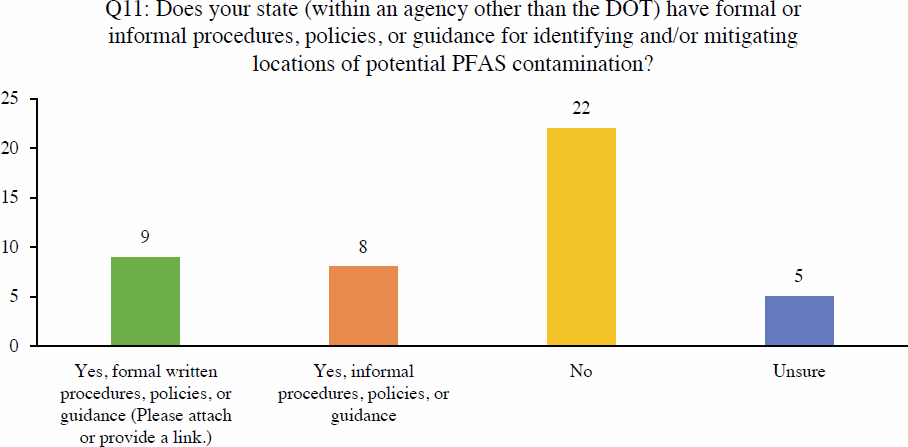
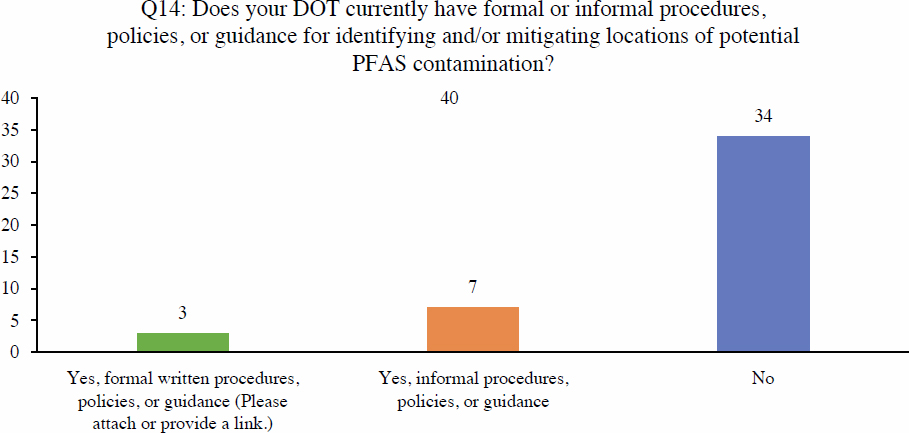
Figure 3.4 shows that nine state DOT respondents had knowingly encountered PFAS contamination on a project or in a right-of-way: Alaska, Colorado, Illinois, Maine, Michigan, Minnesota, New Hampshire, New York, and Oregon.
Three of those nine cases that had encountered PFAS (Alaska, Illinois, and Maine) indicated that the instance set a precedent for addressing PFAS contamination in construction project sites or areas of maintenance operations.
The survey respondents with policies or procedures indicated that the most common methodologies for identifying and mitigating PFAS impacts related to highway construction and maintenance operations included sampling soils or water for PFAS contamination and pollutant source assessments (i.e., evaluation of nearby PFAS sources and potential PFAS migration). Figure 3.5 presents the recommendations and requirements state DOT respondents mentioned.
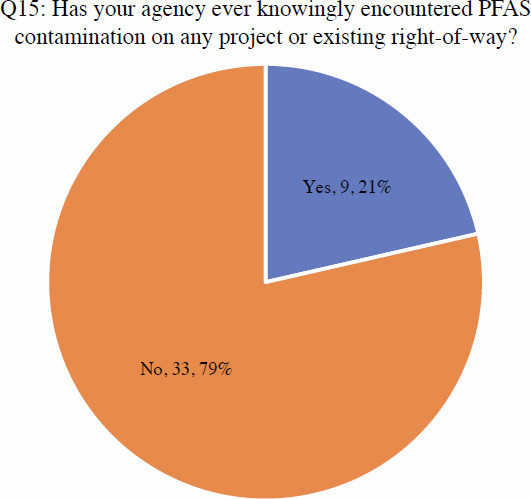
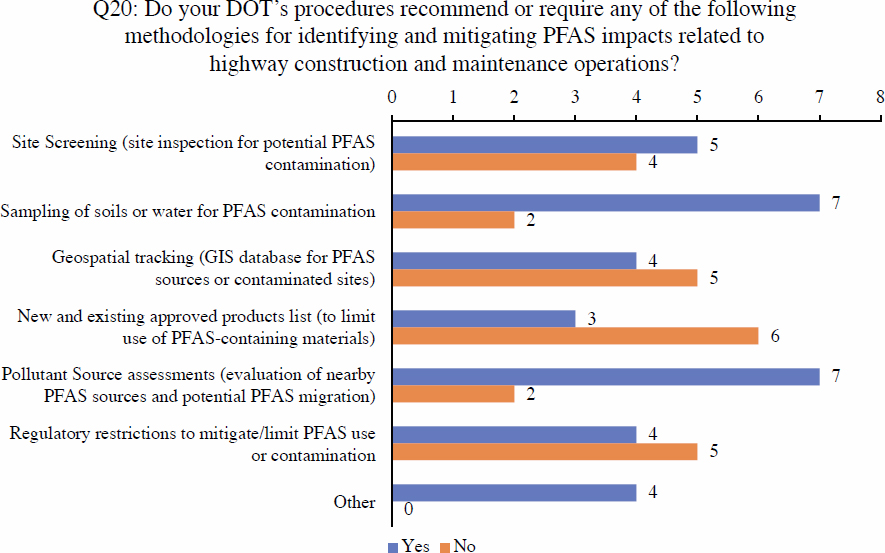
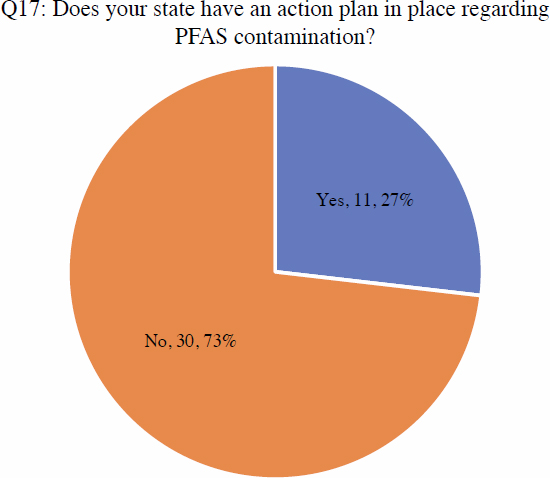
Figure 3.6 reports that 73% of states do not have action plans in place to address PFAS contamination. The states that do have action plans (27%, 11 states) are Alabama, Alaska, Arkansas, Connecticut, Illinois, Michigan, Minnesota, Montana, New Hampshire, Utah, and Wisconsin.
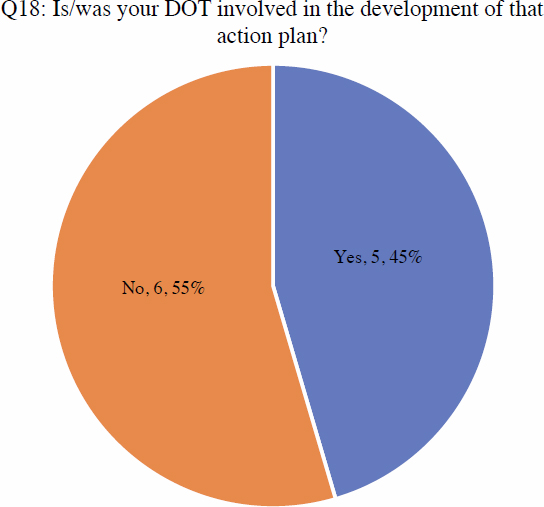
Of the 11 states that have action plans, five respondents noted that their state DOT was involved in the development of that action plan: Alaska, Connecticut, Illinois, Michigan, and Wisconsin (Figure 3.7).
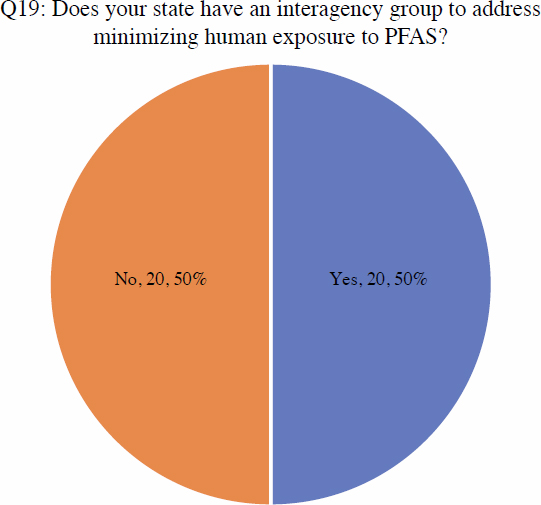
Twenty respondents also noted that their state had an interagency group addressing human exposure to PFAS (Figure 3.8).
Figure 3.9 notes that of the 20 states with interagency groups addressing human exposure to PFAS, eight (40%) indicated their state DOT is involved in this interagency group.
These interagency groups often aid in setting procedures or practices regarding PFAS remediation and mitigation at state DOTs.

PFAS Remediation and Mitigation
The next series of questions within the survey was related to remediation or mitigation of PFAS contamination. Seven respondents with DOT PFAS procedures noted that their state DOTs require special considerations for management or disposal of PFAS-contaminated soil or water from construction or maintenance projects, while two noted that they do not.
The survey respondents were also asked about any restrictions on forms of disposal of PFAS-contaminated materials. A similar percentage of respondents, between 21% and 26% (i.e., 8 to 10 respondents), have disposal restrictions for environmental discharge, land application, or landfilling of PFAS-contaminated materials (Figure 3.10).

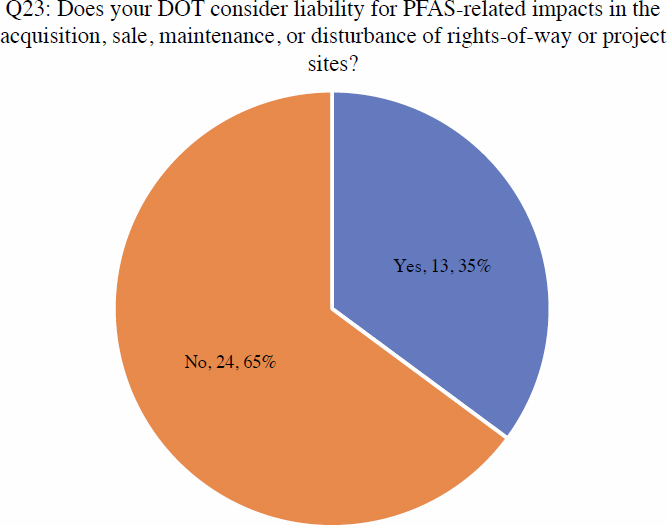
Liability for PFAS contamination has also been a concern of state DOTs. Thirteen respondents (35%) noted that their DOTs consider liability for the effects of PFAS in the acquisition, sale, maintenance, or disturbance of rights-of-way or project sites. These responses are reported in Figure 3.11.
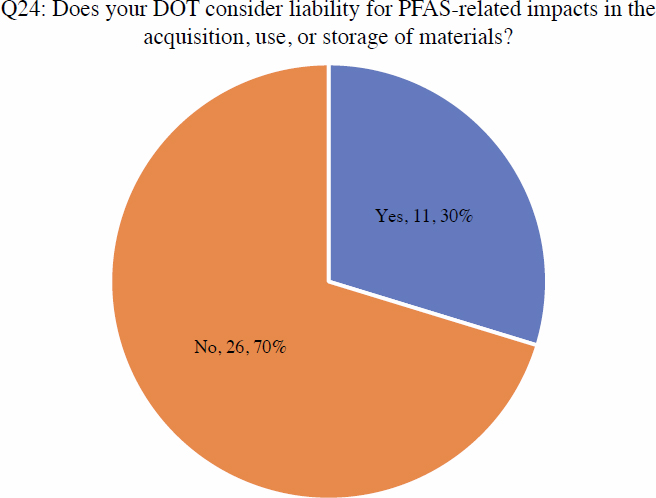
Liability can also be a concern with PFAS-related impacts in the acquisition, use, or storage of materials. Figure 3.12 shows that 11 respondents (30%) consider this liability.
State DOT respondents were also asked whether they consider active remediation or removal of PFAS-containing materials or media at DOT construction, maintenance, or storage sites. Per Figure 3.13, 11 state DOTs (30%) make such considerations.

PFAS Screening and Testing
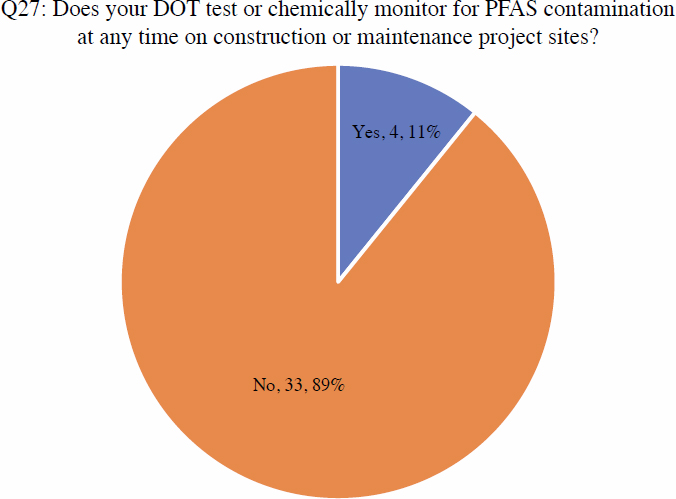
The state DOT respondents were also asked about their practices in screening and testing for PFAS contamination. Four state DOTs, or 11% of respondents, test or chemically monitor for PFAS contamination on construction or maintenance project sites (Figure 3.14). These states are Alaska, Illinois, Minnesota, and New Hampshire.
The four state DOTs that test or chemically monitor for PFAS contamination investigate soil, groundwater, or both, as presented in Figure 3.15.

All four state DOTs that monitor PFAS contamination conduct this assessment before a project is awarded.
Additionally, while all four state DOTs that test for PFAS contamination use private or contract laboratories, only one (Minnesota) mentioned the use of public or state laboratories for testing. Three of the four state DOT respondents reported paying between $200 and $500 per sample, while one noted paying more than $500 per sample.
The state DOTs also reported how quickly PFAS testing results were returned. Two state DOTs noted that results were returned within 3 weeks, and two state DOTs noted results were returned within 6 weeks.
Considering the minimal PFAS regulations, state DOTs that conducted testing were asked which PFAS they test. One state tests for some PFAS even though there is no regulation, one state tests only for the PFAS regulated in their state, and two state DOTs test for more PFAS than are regulated by the state.
Finally, Figure 3.16 presents the PFAS for which state DOTs monitor.
Inventorying and Monitoring PFAS Substances
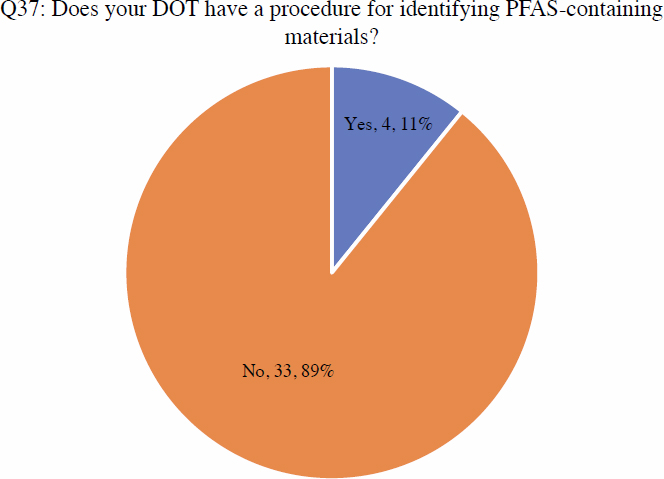
Beyond screening and testing, state DOTs were also asked about the substances they use or store that may contain PFAS. State DOTs were asked whether they identify, inventory, and monitor these substances and how they are stored. Figure 3.17 presents that four (11%) state DOTs have procedures in place for identifying PFAS-containing materials.
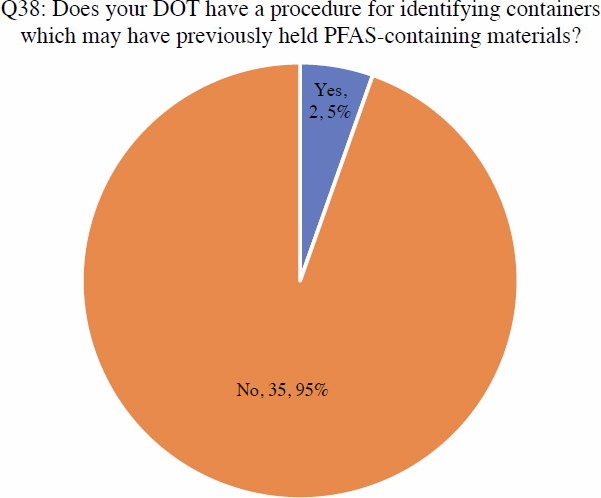
Figure 3.18 presents that two (5%) state DOTs (Alaska and Colorado) have procedures in place for identifying containers that may have held PFAS-containing materials.
The state DOTs with PFAS-related procedures were asked whether they have a standard labeling protocol for materials or containers that may contain PFAS. Two respondents in this group of four state DOTs have such procedures.

Three state DOTs reported that they identify materials or containers containing the PFAS they previously used or actively use. These states are Alaska, Colorado, and Connecticut. Of these three states, only Connecticut now monitors the areas where these materials were used.
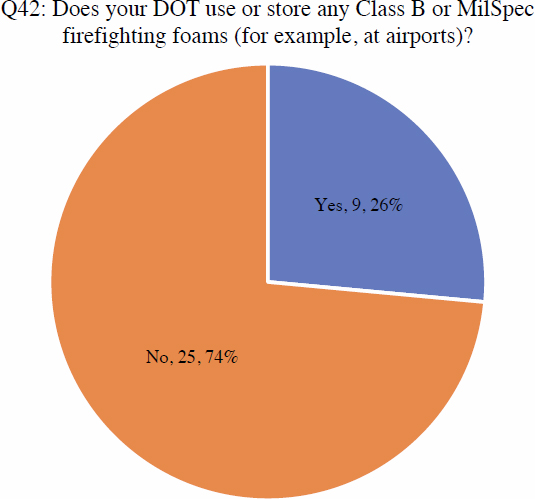
Finally, one predominant source of PFAS is Class B and MilSpec firefighting foams. State DOTs were asked whether they use or store any of these materials. Figure 3.19 shows that nine state DOTs (26% of respondents) reported using or storing such materials.
Of these nine state DOTs, 67% label Class B or MilSpec firefighting foams as containing PFAS, 22% report that labeling is inconsistent, and 11% report that labeling does not indicate the foams contain PFAS.
Summary
This chapter describes the practices state DOTs use to identify and mitigate the effects of PFAS on highway construction projects and maintenance operations. An analysis of 44 respondents of a national survey distributed to the DOTs of all 50 states and the District of Columbia found that 39% (17/44) of the responding states have formal or informal procedures, policies, or guidance for identifying and mitigating potential PFAS contamination within a state agency other than the DOT. The remaining 61% (27/44) do not have such measures or are unsure. However, just 23% (10/44) of the responding DOTs have such procedures, policies, or guidance
within the DOT itself. Among the states that do have DOT-specific guidance, 70% (7/10) have informal procedures, policies, or guidance, whereas 30% (3/10) have formal written policies.
Of the responding state DOTs, 21% (9/42) reported knowingly encountering PFAS contamination on projects or within existing right-of-way areas. Active remediation or removal of PFAS-containing materials or media at construction, maintenance, or storage sites is considered by 30% (11/37) of the responding state DOTs. Moreover, 11% (4/37) of state DOTs conduct testing or chemical monitoring for PFAS contamination at any time on construction or maintenance project sites. All the responding state DOTs that test for PFAS (4) use private or contract laboratories, and 25% (1/4) of these DOTs mentioned the use of public or state laboratories.
The responses also indicate variability in approaches. For example, 27% (11/41) of responding states have action plans related to PFAS; of those, 45% (5/11) were developed with the involvement of the state DOT. Similarly, although 50% (20/40) of responding states have an interagency group addressing human exposure to PFAS, only 40% (8/20) of them involve the state DOT.
The literature review and analysis of the state-of-the-practice questionnaire were used to identify state DOTs for follow-up interviews to facilitate the development of case examples. These case examples are presented in the following chapter.


