Impacts of National Science Foundation Engineering Research Support on Society (2024)
Chapter: Appendix B: Examples of Engineering Impacts on Society Outreach Materials
Appendix B
Examples of Engineering Impacts on Society Outreach Materials116
EXAMPLE 1: MEET AN ENGINEER
Target Audience[s]
Young people (high school), particularly in historically marginalized groups in science, technology, engineering, and mathematics (STEM) such as underrepresented gender/racial/ethnic groups
Content Objectives
- Portray engineers as people who are social, creative, and have interests outside of work
- Demonstrate that engineers have shared identities and interests with the target audience
- Spur interest in engineering careers among students who are currently underrepresented in engineering through profiles of engineers who look like them and share their interests
- Connect engineering to awe and wonder, and spark curiosity
- Demonstrate that engineering is more than math and science skills and also involves problem solving and creativity
Media Format
Video-sharing social media platform (e.g., YouTube video) (2–5 minutes long)
Online Example Media Content*117
1.1 Meet an Engineer video.mp4 [link]
1.2 Transcript: Meet an Engineer video.pdf [link]
The example media content features Dr. Gary May, Chancellor, University of California, Davis.
Pitch Outline
Interview with a high-profile engineer who has received National Science Foundation (NSF) funding and who is from an underrepresented group, inspired by NSF’s “Science Happens
___________________
116 Content in this Appendix was prepared by staff of the Alan Alda Center for Communicating Science and the Massachusetts Institute of Technology under a contract with the National Academy of Sciences. The text has been reviewed and edited by the committee.
117 Media examples are intended to depict the design language of a final product and are provided for reference only. They were created by the contractor and their content was not reviewed by the committee before production.
Here” campaign (NSF, 2023). Both the interviewee (the “subject”) and interviewer should be from the target audience demographic. The interview will take place while doing something that is of interest to the engineer that may also appeal to the target audience (e.g., Dr. Gary May, chancellor of the University of California, Davis, and his interest in superheroes and his 13,000+ comic book collection; May, 2018).
Editing for this interview will contain elements about the specifics of this engineer’s story but also connect to the bigger picture of what his or her story tells us about what it means to be an engineer and what it means to be a curious and creative human.
Script
- Introduction of Video: A voiceover (over a small montage of images) providing background information on the subject and interviewer. Then present additional information on the subject and the reasons why that person is being highlighted.
- Insert a brief soundbite from the subject to stimulate interest in the conversation to follow.
- Interviewer: “Today I had the honor of interviewing [subject], discussing [subject’s] passion for their work and the future of engineering.”
- After the introduction, the edited interview will play.
Examples of Interview Questions
- What was it that first piqued your interest in engineering?
- Based on most people’s stereotypes about engineers, what do you think would surprise them the most about you?
- How are we working to make engineering more diverse, inclusive, equitable?
- What advice do you have for those that want to be engineers or work with them?
- What about advice for people who don’t usually see others who look like them in engineering? How can they get the support networks they need?
- Given unlimited money or time, what would you change about the world using engineering?
Rationale Behind Content Choices
In addition to being the right thing to do, there are also scientific and societal benefits to diversity—diversity leads to increased productivity (AlShelbi et al., 2018; Herring, 2009), better cognitive performance in collaborations (Freeman and Huang, 2015), and innovation gains (Hofstra et al., 2020). However, the engineering workforce is not representative of the richness and diversity of the U.S. population, which stifles innovation (Kozlowski et al., 2022; McGee, 2021). Women only make up 16 percent of college-educated engineered in the United States. In 2020, women, Black, and Latinx students received 24 percent, 5 percent, and 14 percent of engineering bachelor’s degrees, respectively—well below these groups’ proportional representation in the U.S. college-age population (NCSES, 2023).
Multiple complex factors lead to these disparities, but with this particular content, we seek to address those surrounding representation and exposure. Said simply, if you can’t see it, you can’t be it. This project features an interview with an engineer who shares interests and identities with the target audience in order to expand the images and representations of engineers that young people encounter. A previous study found that targeted messages and profiles of
engineers who look like them, doing things they are interested in, can spur interest in engineering among underrepresented groups of young people (Discover Engineering, 2023).
A key science communication objective of this content is to demonstrate shared identities between the subject, interviewer, and the target audience. The tactics we use to reach this objective are designed according to best practices for strategic science communication (Besley and Dudo, 2022) and draw theoretically from social identity theory (Tajfel and Turner, 2004).
Another benefit of showcasing content in which the subject and interviewer come from the same underrepresented gender/racial/ethnic group as the target audience is that it also serves to challenge stereotypes about STEM careers and who can pursue them. Stereotype threats for Black students and for Asian students in STEM spaces provide simplistic, othering, views of students in STEM spaces that fail to see them in their full, complex humanity and psychologically burden them (McGee, 2018). Therefore, it is important that this content addresses stereotype threat.
An exemplar that we draw inspiration from for this content is The Story Collider, a nonprofit organization whose mission is “to reveal the vibrant role that science plays in all of our lives through the art of personal storytelling” (Story Collider, 2023). The Story Collider’s commitment to representation in the science stories that are told on their stages works to challenge stereotypes (Neeley et al., 2020). Their theory of change is that through storytelling, people who do not fit the stereotype of what a scientists should be like can express themselves as full, complex humans to challenge this idea.
To build trust most effectively with our target audience, we draw from evidence-based science communication studies on trust. While most scientists and engineers think about trust as a unidimensional concept, it actually contains multiple dimensions: warmth, competence, being trusting/vulnerable, showing integrity, being willing to listen, and similarity to the target audience (Besley and Dudo, 2022; Colquitt and Salam, 2012; Fiske and Dupree, 2014). Because most engineers are perceived as high in competence but low in warmth, the dimension of trust we need to focus on most in this content is warmth (Fiske and Dupree, 2014). Fortunately, there are ways to build warmth perceptions that we can achieve through this “Meet an Engineer” video interview, including being personal, being curious, being transparent, being real, and demonstrating shared values (Besley and Dudo, 2022; Dixon et al., 2016; Fiske and Dupree, 2014). Overall, this interview’s questions will be designed to demonstrate how engineers have good intentions and want to improve society in order to demonstrate the warmth dimension of trust (Besley and Dudo, 2022).
Finally, with this content we also want to consider culturally relevant ways to communicate. When it comes to interest, cultural background has a huge influence on the way that people approach STEM subjects (Davies and Horst, 2016). That is, it is not enough that both subject and interviewer are both members of the same cultural group as the audience. It is equally important to communicate in culturally relevant ways. Culture includes languages, customs, beliefs, knowledge, and the identity of a group or an individual, and all of these shape how they understand and make sense of the world. There is therefore a need to communicate in culturally relevant ways and to connect to the audience’s culture (Medin and Bang, 2014) to make it more pertinent, understandable, and accessible—that is, to connect it to the reality of their everyday lives.
Example 1 References
AlShebli, B. K., T. Rahwan, and W. L. Woon. 2018. The preeminence of ethnic diversity in scientific collaboration. Nature Communications 9(1):5163.
Besley, J. C., and A. Dudo. 2022. Strategic science communication: A guide to setting the right objectives for more effective public engagement. Baltimore, MD: Johns Hopkins Press.
Colquitt, J. A., and S. C. Salam. 2012. Foster trust through ability, benevolence, and integrity. In E. A. Locke (ed.), Handbook of principles of organizational behavior: Indispensable knowledge for evidence‐based management. Hoboken, NJ: John Wiley & Son. Pp. 389–404.
Davies, S. R., and M. Horst. 2016. Science communication: Culture, identity and citizenship. New York: Springer.
Discover Engineering. 2023. Messages matter: Effective messages for reaching tomorrow’s innovators. [White paper]. https://discovere.org/wp-content/uploads/2023/02/DiscoverE-Messages-Matter-Executive-Summary-Feb-2023.pdf (accessed April 23, 2024).
Dixon, G., K. McComas, J. Besley, and J. Steinhardt. 2016. Transparency in the food aisle: The influence of procedural justice on views about labeling GM foods. Journal of Risk Research 19(9):1158–1171.
Fiske, S. T., and C. Dupree. 2014. Gaining trust as well as respect in communicating to motivated audiences about science topics. Proceedings of the National Academy of Sciences 111(Suppl 4):13593–13597.
Freeman, R. B., and W. Huang. 2015. Collaborating with people like me: Ethnic coauthorship within the United States. Journal of Labor Economics 33(S1):S289–S318.
Herring, C. 2009. Does diversity pay?: Race, gender, and the business case for diversity. American Sociological Review 74(2):208-224.
Hofstra, B., V. V. Kulkarni, S. Munoz-Najar Galvez, B. He, D. Jurafsky, and D. A. McFarland. 2020. The diversity–innovation paradox in science. Proceedings of the National Academy of Sciences 117(17):9284–9291.
Kozlowski, D., V. Larivière, C. R. Sugimoto, and T. Monroe-White. 2022. Intersectional inequalities in science. Proceedings of the National Academy of Sciences 119(2):e2113067119.
May, G. S. 2018. Chancell-ing: Treating my action heroes to “Black Panther.” https://www.ucdavis.edu/news-chancelling-treating-action-heroes-black-panther (accessed February 2, 2024).
McGee, E. 2018. “Black genius, Asian fail”: The detriment of stereotype lift and stereotype threat in high-achieving Asian and Black STEM students. AERA Open 4(4):2332858418816658.
McGee, E. O. 2021. Black, brown, bruised: How racialized STEM education stifles innovation. Cambridge, MA: Harvard Education Press.
Medin, D. L., and M. Bang. 2014. The cultural side of science communication. Proceedings of the National Academy of Sciences 111(Suppl 4):13621–13626.
NCSES (National Center for Science and Engineering Statistics). 2023. Diversity and STEM: Women, minorities, and persons with disabilities 2023. Special Report NSF 23-315. Alexandria, VA: National Science Foundation. https://ncses.nsf.gov/pubs/nsf23315/ (accessed March 9, 2023).
NSF (National Science Foundation). 2024. Science Happens Here. https://new.nsf.gov/about/science-happens-here (accessed February 2, 2024).
Neeley, L., E. Barker, S. R. Bayer, R. Maktoufi, K. J. Wu, and M. Zaringhalam. 2020. Linking scholarship and practice: Narrative and identity in science. Frontiers in Communication 5:35.
Saffran, L., S. Hu, A. Hinnant, L. D. Scherer, and S. C. Nagel. 2020. Constructing and influencing perceived authenticity in science communication: Experimenting with narrative. PLOS One 15(1):e0226711.
Story Collider. 2024. About the Story Collider. https://www.storycollider.org/about-us-2 (accessed February 2, 2024).
Tajfel, H., and J. C. Turner. 2004. The social identity theory of intergroup behavior. In J. T. Jost and J. Sidanius (eds.), Political Psychology. Oxfordshire, England: Psychology Press. Pp. 276–293.
EXAMPLE 2: QUEEN OF CARBON FAMILY TREE
Target Audience[s]
High school students (especially women)
Content Objectives
- Frame basic engineering research as something that has far-reaching effects in the real world
- Counter the misperception of the engineer as a lone genius by telling the story of someone who was influenced by—and in turn influenced—many, thus framing engineering as a social endeavor
- Promote gender equity in the histories we tell of engineering
Media Format
Clickable, interactive graphic (web) post
Online Example Media Content*
2.1 - Carbon Queen – Windows executable file.exe [link]
2.2 - Carbon Queen Prezi presentation format embed code.pdf [link]
2.3 - Carbon Queen script.pdf [link]
2.4 - Carbon Queen - Apple OS-formatted files.zip [link]
Pitch Outline
The content is illustrated in a clickable graphic containing the many forms of carbon connected in a “family tree”-type diagram illustrating their real-world applications. Images of the engineers and scientists who work with these materials are entangled in the tree graphic to illustrate that engineering is a network and not the domain of a single genius. This tree celebrates the many contributions that Dr. Millie Dresselhaus has made to engineering (Weinstock, 2023), highlighting those supported by NSF. It also illustrates the amazing “academic family tree” that has resulted from her work.
The interactive graphic example contains some, but not all, of the content proposed in the script outline.
Script Outline
We see a woman—a representation of Millie Dresselhaus—sitting under a tree writing with a pencil. When you first click on it, it zooms in on a pencil and presents a short blurb about graphite, introducing the reader to carbon and its many uses. The story of how Dresselhaus was initially inspired by carbon is then introduced in the form of a blurb and picture of her that pops up.
We then move to roots of the tree. Every part of a tree stores carbon, from the roots to the trunk, branches, and leaves. Carbon stored underground, in particular, is considered to be the most stable reservoir for the element. Graphite intercalation compounds are addressed here; leading to insights on how the properties of graphite can be altered.
Moving up the tree, branches highlight other researchers and the technologies that have “branched off” from the roots, such as buckyballs and flexible computer screens and quantum computers made from graphene.
The tree’s vascular system represents carbon fibers and carbon nanotubes, leading to such technologies as organic light-emitting diode (OLED) displays and nanocarriers used to transport chemotherapy agents. Tree leaves represent fuel cells; droplets on those leaves introduce the concept of water purification through nanofiltration.
Integrated into these vignettes is mention of how Dresselhaus’s research laid the groundwork for all of these innovations. This includes specific callouts to the two researchers—Richard Smalley and Andre Geim—who acknowledged her in their Nobel Prize lectures.
Going back to the woman doodling under a tree, the user might click on the notebook she’s writing in. This contains a small cartoon of her with her four children and small blurb on her accomplishments specifically as a woman in engineering just to close out the presentation, but this should not be the focus of the piece as the intent is to honor her foundational contributions, not that she achieved them “despite” being a woman.
Rationale Behind Content Choices
It matters how we tell the history of engineering. While stories of science and engineering often portray it as a white, Western, and male-dominated domain (Rasekoala and Orthia, 2020), in truth, more diverse voices have always been involved (Finlay et al., 2021).
Studies indicate that girls’ enthusiasm for STEM subjects tends to decline during middle school (U.S. Department of Education, 2006). Research suggests that girls are often less interested in subjects like computer science or engineering that are characterized by gender stereotypes, suggesting a need to better disrupt these stereotypes early in education (Master et al., 2021). Engineering is stereotyped in modern American culture as a male-oriented field that involves social isolation, an intense focus on machinery, and innate brilliance (Cheryan et al., 2015).
An opportunity exists to expand the image of what it means to be an engineer beyond these narrow stereotypes. Broadening the representation of the people who do this work, the work itself, and the environments in which it occurs has been shown to significantly increase girls’ sense of belonging and interest in the field (Cheryan et al., 2015). As Cheryan and colleagues remark, “Rather than attempting to overhaul current stereotypes, which may deter some men and women, a more effective strategy may be to diversify the image of these fields so that students interested in these fields do not think that they must fit a specific mold to be a successful . . . engineer” (p. 6).
One effective way to target girls in messaging is to elevate the biographies of female engineers (Discover Engineering, 2023). This interactive image-forward blog post about Millie Dresselhaus’s “family tree” of collaborators and innovations deriving from her discoveries aims to not only elevate her biography but also to subvert some common narratives about engineering. Typically, the stories of engineering have been told as glossy hero narratives that frame stories of achievement as individual endeavors (Davies, 2021; Fahy, 2015; Felt and Fochler, 2013). But engineering is a communal, not individual; engineering is a social process (Kuhn, 1962; Oreskes, 2021). This blog post, in showing those who supported Millie and those she supported, demonstrates the social connectivity of not only her story but of the work that NSF funds.
The use of visuals in this blog post is intended to engage audiences who may not already be interested or motivated to learn about engineering. For example, a study using the Elaboration
Likelihood Model (ELM) found that audiences engaged more deeply with climate change issues that were presented with infographics than those presented with either text-only or illustration, with their learning preferences and visual literacies moderating the effect (Lazard and Atkinson, 2015). The ELM describes how attitudes change as a result of persuasive messaging either through central (deeper engagement with content) or peripheral processing (mental shortcuts), depending on whether an individual is highly informed and motivated about the topic (central) or not (peripheral) (Petty and Cacioppo, 1986). The audience for this content is likely more on the “peripheral” processing mode, so visuals may be the most effective way to engage them.
However, studies also suggest that a poor-quality picture is worse than no picture at all (Zhu et al., 2021). It is thus important to apply the best practices from the field of visual design, especially (1) treating visuals as integrated and not an add-on and (2) clearly identifying target audiences and refining visuals for them specifically (Rodríguez Estrada and Davis, 2015). Visuals must also be accessible, with such tools such as alt text, clear captions, and color contrast incorporated into the media (Crameri et al., 2020; Schwabish et al., 2022).
Example 2 References
Cheryan, S., A. Master, and A. N. Meltzoff. 2015. Cultural stereotypes as gatekeepers: Increasing girls’ interest in computer science and engineering by diversifying stereotypes. Frontiers in Psychology 6:49.
Crameri, F., G. E. Shephard, and P. J. Heron. 2020. The misuse of colour in science communication. Nature Communications 11(1):5444.
Davies, S. R. 2021. Performing science in public: Science communication and scientific identity. Community and Identity in Contemporary Technosciences 31:207.
Discover Engineering. 2023. Messages matter: Effective messages for reaching tomorrow’s innovators. [White paper]. https://discovere.org/wp-content/uploads/2023/02/DiscoverE-Messages-Matter-Executive-Summary-Feb-2023.pdf (accessed April 24, 2024).
Fahy, D. 2015. The new celebrity scientists: Out of the lab and into the limelight. Lanham, MD: Rowman and Littlefield.
Felt, U., and M. Fochler. 2013. What science stories do: Rethinking the multiple consequences of intensified science communication. In P. Baranger and B. Schiele (eds.), Science communication today. International perspectives, issues and strategies. Paris: CNRS Editions. Pp. 75-90.
Finlay, S. M., S. Raman, E. Rasekoala, V. Mignan, E. Dawson, L. Neeley, and L. A. Orthia. 2021. From the margins to the mainstream: Deconstructing science communication as a white, Western paradigm. Journal of Science Communication 20(1):C02.
Kuhn, T. S. (1962/1996. The structure of scientific revolutions (3rd ed). Chicago: The University of Chicago Press.
Lazard, A., and L. Atkinson. 2015. Putting environmental infographics center stage: The role of visuals at the elaboration likelihood model’s critical point of persuasion. Science Communication 37(1):6.
Master, A., A. N. Meltzoff, and S. Cheryan. 2021. Gender stereotypes about interests start early and cause gender disparities in computer science and engineering. Proceedings of the National Academy of Sciences 118(48):e2100030118.
Oreskes, N. 2021. Why trust science? Princeton, NJ: Princeton University Press.
Petty, R. E., and J. T. Cacioppo. 1986. The elaboration likelihood model of persuasion. In L. Berkowitz (ed.), Advances in experimental social psychology, vol. 19. Cambridge, MA: Academic Press. Pp. 123–205.
Rasekoala, E., and L. Orthia. 2020. Anti-racist science communication starts with recognising its globally diverse historical footprint. Impact of Social Sciences Blog, July 1. https://blogs.lse.ac.uk/impactofsocialsciences/2020/07/01/anti-racist-science-communication-starts-with-recognising-its-globally-diverse-historical-footprint/ (accessed April 24, 2024).
Rodríguez Estrada, F. C., and L. S. Davis. 2015. Improving visual communication of science through the incorporation of graphic design theories and practices into science communication. Science Communication 37(1):140–148.
Schwabish, J., S. J. Popkin, and A. Feng. 2022. Do no harm guide: Centering accessibility in data visualization. Urban Institute. Available at https://www.urban.org/research/publication/do-no-harm-guide-centering-accessibility-data-visualization (accessed April 23, 2024).
U.S. Department of Education. 2006. The condition of education. Washington, DC: National Center for Education Statistics, U.S. Government Printing Office.
Zhu, L., L. S. Davis, and A. Carr. 2021. A picture is not always worth a thousand words: The visual quality of photographs affects the effectiveness of interpretive signage for science communication. Public Understanding of Science 30(3):258–273.
EXAMPLE 3: EARTHQUAKE SHAKE TABLE
Target Audience[s]
General public (teens and up), especially those who live in high hazard earthquake areas of the United States
Content Objectives
- Make visible some of the innovations behind the innovation, and how behind-the-scenes investments from the NSF lead to big societal impacts
- Inspire awe about the “cool-factor” of the United States’ largest shake table
- Frame engineering as important to disaster and hazard mitigation
Media Format
TikTok “Did You Know?” format or short (2 minute) YouTube video
Online Example Media Content*
3.1 - Earthquake Shake Table - video.mp4 [link]
Pitch Outline
Start by pointing out an innocuous structure on a building and pointing out that it actually makes the building safer from earthquakes. (Cut in a video of a push-puppet as a metaphor for how the base-isolation mechanism works.)
“There is no doubt that as our planet continues to evolve, extreme weather events, like severe storms, floods, earthquakes, and wildfires are likely to cause unprecedented damage to infrastructure, communities, and ecosystems,” said Sethuraman Panchanathan (NSF director). “As we look to build a more resilient country, we must continue to leverage our science and engineering expertise to expand prosperity for our nation’s communities and protect the critical infrastructure that supports them.”
Currently, NSF is the only federal agency that supports research across all fields of science, technology, engineering, and medicine and all levels of STEM education, a vitally important distinction when it comes to building resilient futures and mitigating natural hazards.
Earthquakes are a danger to buildings and lives. Engineers are deeply concerned about designing and retrofitting buildings so they can be safer. There are many factors at play, from design aesthetics to zoning regulations and to keeping buildings affordable. For example, as we try to mitigate climate change, we also want to use less concrete, which is carbon intensive, and that leads us to explore other materials like wood (which is a carbon sink).
So, what do we do? Well, here is the story behind how the largest (in the United States) height capacity three-dimensional shake-table was developed. Engineers can simulate buildings on a computer, but we need a good way to experimentally test this in a way that won’t destroy real buildings or hurt people. With this table, engineers can mimic past earthquake conditions and reproduce their movement. This can be used to make older building stronger and to help with new design standards for new buildings.
Back to the image of the innocuous-looking piece of a building. So, next time you see this, you can feel a little bit safer, thanks to a very “shaky” table.
Optionally, a follow-up video would feature a presenter who creates his or her own structure and then tests it on a shake table.
Rationale Behind Content Choices
This content is meant for a general audience not already motivated and interested in engineering. According to the Elaboration Likelihood Model,118 attitudes change as a result of persuasive messaging through one of two pathways: central (deeper) or peripheral (shallower). Central processing involves more effortful thinking, and attitudes formed via this route are longer-lasting and more resistant to change (Petty and Cacioppo, 1986). Peripheral processing, on the other hand, is less effortful, surface-level, subject to mental shortcuts, and does not result in attitudes that are as enduring or resilient (Petty and Cacioppo, 1986). This implies that with an audience that is not already necessarily aware or interested in engineering, we will need to rely more on heuristic cues than information to engage them (Scheufele and Turney, 2006).
A study of the most popular science TikTok videos found that this genre is dominated by entertaining physics or chemistry experiments, indicating that users engage with getting to see the process of science at work on this platform (“procedural science”) (Zeng et al., 2020). This is especially important on a platform like TikTok, which has an algorithm that allows for the discovery of content beyond the user’s usual social network. TikTok’s user base is majority young and female-identifying, a population that is currently underrepresented in engineering. Using a short-duration video to explain procedurally a “cool” piece of engineering technology or infrastructure may thus be an effective way to stimulate greater interest in the field in this group.
While videos are increasingly used in science communication, they can be less effective than a slideshow if they are too long (Iamamura et al., 2020). In terms of remembering scientific knowledge, the best types of videos seem to be either narrative explanatory or animated; both had scientific content remembered much better than those in expert films (like those favored by research institutions and universities) (Boy et al., 2020). While the objectives with this content are not necessarily to teach, the narrative explanatory style is still likely to be more effective than a formal video. For this reason, a more informal, “popular” YouTube or TikTok style video would seem appropriate for reaching these specific audiences.
The example content is intended to spur interest, curiosity, wonder, and awe in the audience through the earthquake shake table.119 There are a variety of types of awe used in science communication (Luna and Bering, 2020), but awe primarily works when an audience encounters something that affects them emotionally and shifts their worldview or motivates curiosity. At the same time, there is a need to be careful about burning people out on constantly “insisting on sparking interest and curiosity” because this is an exhausting emotion to maintain for long periods of time (Davies, 2019). That is, there are multiple reasons to keep this video short in length.
With such a short video, it will also be important to be intentional about narrative design, choosing a single topic to address (rather than a bullet point list) and structuring the presentation as a story rather than a list of facts (Baron, 2010; Olson, 2015). Additionally, research suggests
___________________
118 The Elaboration Likelihood Model is also addressed in the rational section of the Content 2 discussion.
119 Note that the PBS Kids website has a create-your-own-shake-table and a test-a-structure instructional (“Design Squad Global – Seismic Shake-up”) aimed at elementary school -aged children: https://pbskids.org/designsquad/build/seismic-shake-up/.
that an “infotainment” narration style—which uses humor, personality, and informal language—is more appropriate for a less formally educated audience and better overall for learning than an expository narration style that uses formal language and conveys authority (Davis et al., 2020).
Example 3 References
Baron, N. 2010. Escape from the ivory tower: A guide to making your science matter. Washington, DC: Island Press.
Boy, B., H. J. Bucher, and K. Christ. 2020. Audiovisual science communication on TV and YouTube. How recipients understand and evaluate science videos. Frontiers in Communication 5:608620.
Davies, S. R. 2019. Science communication as emotion work: Negotiating curiosity and wonder at a science festival. Science as Culture 28(4):538–561.
Davis, L. S., B. León, M. J. Bourk, and W. Finkler. 2020. Transformation of the media landscape: Infotainment versus expository narrations for communicating science in online videos. Public Understanding of Science 29(7):688-701.
Imamura, K., K. T. Takano, N. H. Kumagai, Y. Yoshida, H. Yamano, M. Fujii, T. Nakashizuka, and S. Managi. 2020. Valuation of coral reefs in Japan: Willingness to pay for conservation and the effect of information. Ecosystem Services 46:101166.
Luna, D. S., and J. M. Bering. 2021. The construction of awe in science communication. Public Understanding of Science 30(1):2–15.
Olson, R. 2015. Houston, we have a narrative. In Houston, we have a narrative. Chicago: University of Chicago Press.
Petty, R. E., and J. T. Cacioppo. 1986. The elaboration likelihood model of persuasion. In Communication and Persuasion (pp. 1-24). Springer: New York, NY.
Scheufele, D. A. 2006. Messages and heuristics: How audiences form attitudes about emerging technologies. In J. Turney (ed.), Engaging science: Thoughts, deeds, analysis, and action. London, UK: The Wellcome Trust. Pp. 20–25. https://cspo.org/legacy/library/090423F3NZ_lib_ScheufeleDA2006M.pdf (accessed February 5, 2024).
Weinstock, M. 2023. Carbon queen. Cambridge, MA: The MIT Press.
Zeng, J., M. S. Schäfer, and J. Allgaier. 2020. Reposting “till Albert Einstein is TikTok famous”: The memetic construction of science on TikTok. International Journal of Communication 15:3216–3247.
EXAMPLE 4: GRAND CHALLENGES IN ENGINEERING
Target Audience[s]
Elementary and middle school students
Example Objectives
- Debunk the lack of representation in engineering as only a “pipeline” problem
- Encourage culturally relevant pedagogy in STEM content
- Encourage young people to bring their whole selves (especially culturally) into STEM spaces
Media Format
Workbook style, fill-in-the-blank booklet aimed at elementary school students; blog posts aimed at middle school students
Online Example Media Content*
4.1 - Grand Challenges in Engineering illustrative blog post.pdf [link]
Pitch Outline
The workbook will show the reader that he or she can already think like an engineer. Using a fill-in-the-blank format, it will have the reader engage in some design steps using drawings.
- Name a problem that you already care about. Put it in this title box.
- Next, draw a device that could help you solve that problem (box provided for drawing).
- What are some good things about this device? Does it save money? Power? Help the environment? Show this on your drawing.
- What skills might you need to make this device? (art, math, science, ….)
- What other types of people might you need to do this? (teachers, construction workers, doctors, artists, …)
See! You are ALREADY an engineer, designing solutions to problems in the world around you.
Perhaps a means might be implemented—via a QR code, for example—that would allow the students’ drawings to be posted anonymously (after screening) to an NSF public website where staff could connect the contribution to NSF-funded efforts.
The workbook would finish with encouragement to the students to continue applying engineering thinking in their lives and links where they could learn more.
The blog posts will introduce some of the grand challenges that the world is facing (e.g., climate change, health, access to clean water and food, keeping our computers safe). Using visuals of people and featuring those who are underrepresented in engineering and who are working on some of these challenges (to increase feelings of self-efficacy), it will introduce the notion of engineers tackling the world’s biggest problems. This will be accomplished by first showing past innovations brought about by engineers, such as automobiles, aircraft, telephones, and computers. It will then segue into more recent inventions such as artificial retinas and
robotics to enhance the operation and versatility of wheelchairs—two technologies brought about in part by NSF funding—and the people behind them (NASEM, 2023). Examples will be chosen to demonstrate that engineering is richer when it is more diverse and that engineers use their own backgrounds and points of view to make the world a better place.
Rationale Behind Content Choices
Communication scholarship informs us that simply sharing information does not change hearts and minds (i.e., beliefs and attitudes) (Allum et al., 2008; Sturgis and Allum, 2004). However, much of our messaging about engineering careers uses this approach.
Instead, this content uses “problem posing” methodology, drawing from the Pedagogy of the Oppressed monograph (Freire, 2020), asking students a question and having them work with that rather than giving them answers (Morgan and Saxton, 2006). This allows the young person to take on the “mantle of the expert,” a technique that comes from drama-based pedagogy (Dawson and Lee, 2018; Wilhelm, 2002). The benefits of using the mantle-of-the-expert approach are that young people feel respected by having expert status and insights and gain an understanding of the occupation they are exploring. This strategy draws on participants’ interests and may motivate them to research more about engineering topics and careers.
Additionally, this content draws upon young people’s funds of knowledge and helps them draw culturally relevant connections to the field of engineering. “Funds of knowledge” describes the accumulated life experiences, skills, and knowledge used to navigate everyday social contexts in the homes of students of color (González and Moll, 2002).
Art-based engineering communication like this content engages multiple senses and supports the young person in thinking creatively, which has been shown to lead to better learning outcomes in science topics (Jacobson et al., 2016). That is, while visuals for science communication can be effective, visualizing can also be a very effective learning tool for STEM topics (Evagorou et al., 2015). This also embraces multimodal ways of learning, which support more accessible communications through the Universal Design for Learning teaching approach (CAST, 2024).
Positioning audience members as holders of knowledge asks them to use their imagination, which puts young people in charge of their own learning and meaning-making (Greene, 1995). This may also be helpful in developing their engineering or science identity, which is thinking of oneself and being recognized by others as being an engineering or science person (Carlone and Johnson, 2007; Godwin, 2016). Research on science/engineering identity reveals there are three dimensions to the concept: competence, performance, and recognition, which this content aims to support (Kim and Sinatra, 2018).
This content also seeks to increase the audience’s feelings of self-efficacy in engineering by engaging in ideation around design (e.g., that they can do it and have the skills and imagination to do so) (Bandura, 2002). It also frames engineering as something that is creative and not just about skills in math and science. And the content helps support a sense of response efficacy, that engineering is something that has the potential to make a difference in the world. Research shows that underrepresented students are more likely to pursue STEM research for community-minded reasons (Spalter-Roth and Van Vooren, 2009) and recruiting these groups into these spaces requires emphasizing the ways in which engineering and other STEM subjects contribute to local communities.
The concept of efficacy is related to a number of communication models that seek to change behavior (e.g., pursuing an engineering career). For example, the integrated behavior
model predicts that people’s attitude, norms, and efficacy beliefs shape their intentions and eventually their behaviors (Ajzen, 1991). In this case, the hoped-for outcome is to stimulate young people to study engineering by first becoming interested in it enough to look more into it. Self efficacy can be built both by example (e.g., through messages) and through direct experience (Bandura, 1977). This content aims to do both, with a focus on direct experience.
Solving society’s wicked problems will require embracing multiple forms of knowing, not only from engineering but also from beyond engineering (Medin and Bang, 2014). We live in a complex world where we must make important decisions with incomplete evidence and account for others’ values (Funtowicz and Ravetz, 2018). This means our messaging should demonstrate the ways in which engineering is already aligned with young people’s interests and wish to help their communities. The content seeks to go beyond just broadening participation in engineering to also welcoming and empowering young people in these spaces (Bevan et al., 2020; Dawson, 2019; Humm and Schrögel, 2020; YESTEM Project UK Team, 2020).
Example 4 References
Ajzen, I. 1991. The theory of planned behavior. Organizational Behavior and Human Decision Processes 50(2):179–211.
Allum, N., P. Sturgis, D. Tabourazi, and L. Brunton-Smith. 2008. Science knowledge and attitudes across cultures: A meta-analysis. Public Understanding of Science 17(1):35–54.
Bandura, A. 1977. Self-efficacy: Toward a unifying theory of behavioral change. Psychological Review 84(2):191–215. https://doi.org/10.1037/0033-295X.84.2.191.
Besley, J.C., and A. Dudo. 2022. Strategic science communication: A guide to setting the right objectives for more effective public engagement. Baltimore, MD: Johns Hopkins Press.
Bevan, B., A. C. Barton, and C. Garibay. 2020. Broadening perspectives on broadening participation: Professional learning tools for more expansive and equitable science communication. Frontiers in Communication 5:52.
Carlone, H. B., and A. Johnson. 2007. Understanding the science experiences of successful women of color: Science identity as an analytic lens. Journal of Research in Science Teaching 44(8):1187–1218.
CAST. 2024. About universal design for learning. http://www.cast.org/our-work/about-udl.html (accessed April 23, 2024).
Dawson, E. 2019. Equity, exclusion and everyday science learning: The experiences of minoritised groups. New York: Routledge.
Dawson, K., and B. K. Lee. 2018. Drama-based pedagogy: Activating learning across the curriculum. Bristol, UK: Intellect Books.
Evagorou, M., S. Erduran, and T. Mäntylä. 2015. The role of visual representations in scientific practices: From conceptual understanding and knowledge generation to “seeing” how science works. International Journal of STEM Education 2(1):1–13.
Funtowicz, S., and J. Ravetz. 2008. Post-normal science. In N. Castree, M. Hulme, and J. D. Proctor (eds.), Companion to environmental studies. New York: Routledge. Pp. 443–447.
Godwin, A. 2016, January. The development of a measure of engineering identity. In ASEE Annual Conference and Exposition. https://doi.org/10.18260/p.26122. https://par.nsf.gov/biblio/10042227 (accessed April 23, 2024).
González, N., and L.C. Moll. 2002. Cruzando el puente: Building bridges to funds of knowledge. Educational Policy (Los Altos, Calif.) 16(4):623–641.
Greene, M. 1995. Releasing the imagination: Essays on education, the arts and social change. San Francisco: Josey-Bass. Inc.
Freire, P. 2020. Pedagogy of the oppressed. In J. Beck, C. Jenks, N. Keddie, and M. F. D. Young (eds.), Toward a sociology of education. New York: Routledge. Pp. 374-386
Humm, C., and P. Schrögel. 2020. Science for all? Practical recommendations on reaching underserved audiences. Frontiers in Communication 5:42.
Jacobson, S. K., J. R. Seavey, and R. C. Mueller. 2016. Integrated science and art education for creative climate change communication. Ecology and Society 21(3):26269971.
Kim, A.Y., and G. M. Sinatra. 2018. Science identity development: An interactionist approach. International Journal of STEM Education 5(1):1–6.
Medin, D. L., and M. Bang. 2014. The cultural side of science communication. Proceedings of the National Academy of Sciences 111 (Suppl 4):13621–13626.
Morgan, N., and J. Saxton. 2006. Asking better questions. Markham, ON: Pembroke Publishers Limited.
NASEM (National Academies of Sciences, Engineering, and Medicine). 2023. Extraordinary engineering impacts on society: Proceedings of a symposium. Washington, DC: The National Academies Press. https://doi.org/10.17226/26847.
Spalter-Roth, R., and N. Van Vooren. 2009. Idealists vs. careerists: Graduate school choices of sociology majors. American Sociological Association Department of Research and Development. https://www.asanet.org/wp-content/uploads/files/pdf/ideaslistcareerist.pdf (accessed April 23, 2024).
Sturgis, P., and N. Allum. 2004. Science in society: Re-evaluating the deficit model of public attitudes. Public Understanding of Science 13(1):55–74.
Wilhelm, J. D. 2002. Action strategies for deepening comprehension. New York: Scholastic Inc.
YESTEM Project UK Team. 2020. The equity compass: A tool for supporting socially just practice. https://yestem.org/wp-content/uploads/2020/10/EQUITY-COMPASS-YESTEM-INSIGHT.pdf (accessed April 23, 2024).
EXAMPLE 5: EXTRAORDINARY IMPACTS OF ENGINEERING
Target Audience
Gen Z/younger millennials
Content Objective
Framing engineering innovations as beneficial to people’s everyday lives, rather than just being “out there”
Media Format
TikTok/Reel-style video
Online Example Media Content*
5.1 - Extraordinary Impacts of Engineering video.pdf [link]
5.2 – Transcript—Extraordinary Impacts of Engineering video.pdf [link]
Pitch Outline
This content will feature a TikTok/Reel-style video that incorporates nostalgia and concise, descriptive language to engage the audience in a brief video format. Our aim is to create a video that will not only capture the attention of viewers but also encourage them to watch it multiple times. To achieve this, we plan to make the video vivid, humorous, and, of course, interesting.
- Introduction
- The video aims to offer viewers a unique perspective by showcasing life without some of our favorite pieces of technology, such as smartphones.
- Keeping the Video Short
- Shorter videos encourage more views, which increases engagement, and improves the video’s visibility on TikTok’s algorithm. Essentially, keeping the video short maximizes our chances of reaching a wider audience and boosting the video’s success on the platform.
- Incorporating Nostalgia
- To successfully target Gen Z and millennials, the video use nostalgia and concise language to immediately grab their attention. Connecting with them emotionally, especially through the highly regarded 2000s nostalgia will contribute significantly to the video’s success.
Video Concept
- A journey through time: Short clips from different decades transition seamlessly, showcasing people using payphones, film and digital cameras, address books, physical planners, and calendars in settings that have the appropriate aesthetic. The aim is to highlight how far we’ve come with technology and how it has revolutionized our lives. The video ends with a clip of the smartphone, a testament to
- the ingenuity of engineers and the incredible advancements in technology that have taken place.
- Animation: This could include an educational video in the form of a funny animation. The purpose of including an animation TikTok is that it ties beautifully with nostalgia as Gen Z and millennials grew up with educational animations such as the Disney Channel Healthy Handbook video,120 BrainPOP,121 and Wild Kratts.122
Script
As noted, the video will be a compilation of different videos sourced from other videos where we see people using payphones, film, and digital cameras, etc. followed by a voiceover that will begin when the smartphone is introduced: “Over the years, we have witnessed incredible technological advancements, all thanks to the unwavering efforts of engineers.”
Figure B-1 illustrates a rough draft quick concept for how the video will transition.
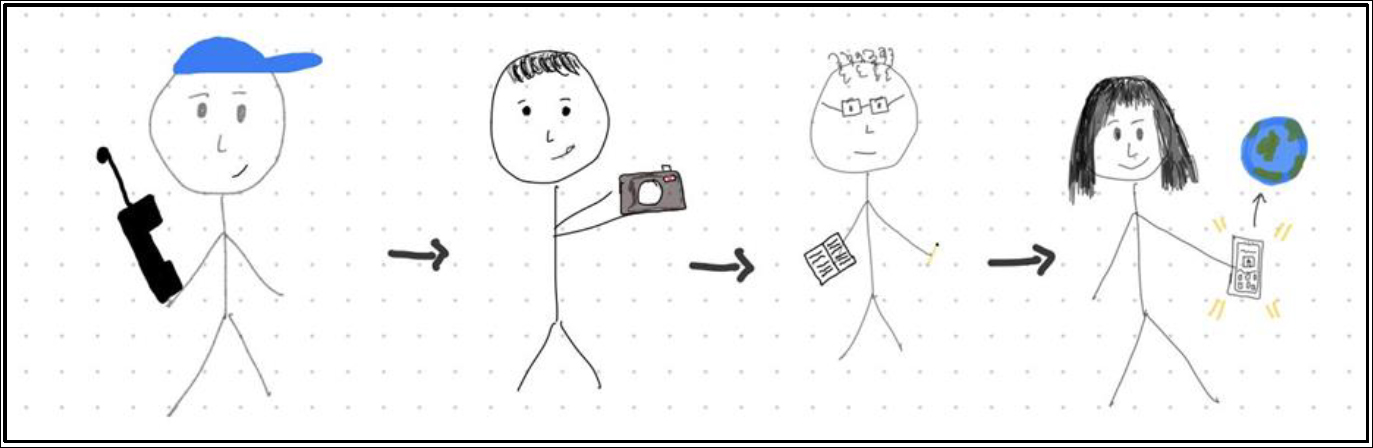
The voiceover continues, in the style of a “Did you know?” TikTok video:
“Hey, did you know that almost everything we use on a daily basis is a gift from our engineering heroes?
“Take the smartphone, for example. It has revolutionized our lives in ways we never thought possible. Remember the days when we had to carry a bulky camera, planner, address book, contacts, and even a coin purse just to use a payphone? Phew, talk about a workout! But now, we can fit all of that and more in our jeans pocket, thanks to the mighty smartphone.”
“So, let’s give a big round of applause to engineers for making our lives easier, and our pockets lighter!”
The humor takes its inspiration from 1980s commercials, which should strike a chord with the Gen Z and millennial audience.
If a more direct tie-in to NSF-funded engineering innovations is desired, then any of the more recent examples of these noted in the symposium proceedings or report can be used as the topic and mentioned in the script.
___________________
120 https://www.tiktok.com/@disneycommercials/video/7216056657204219179.
121 https://www.youtube.com/channel/UCJ5dVwsCLKlWuOZyi7WDwfw.
Rationale Behind Content Choices
Almost every object we use in our daily lives comes to us through the work of engineers, and numerous innovations can be tied back to National Science Foundation funding. However, research shows that most Americans do not know what engineers do or make the connection between engineer’s work and these innovations (Innovative Research Group, 2017; NAE, 2008). While they see engineers as a profession with a high level of expertise (competence), they do not connect the profession to its immense social value. Therefore, this content seeks to connect engineering innovations that affect people’s daily lives in a humorous way, by challenging people to imagine their lives without a piece of technology.
This content uses a persuasion technique known as “emphasis framing” which encourages an audience to think about an issue in a specific way (Druckman, 2001). The technique “select[s] some aspects of a perceived reality and make[s] them more salient in a communicating text, in such a way as to promote a particular problem definition, causal interpretation, moral evaluation, and/or treatment recommendation” (Entman, 1993, p. 52).
The messaging in this content draws from branding studies in engineering that found adults and teens of all genders rated “Engineers make a world of difference” as the most appealing marketing message for general audiences (NAE, 2008). It also draws from work in communication scholarship that suggests framing learning about science as an everyday experience rather than something that happens only in formal settings such as schools (Philip and Azevedo, 2017). In this content, it will be important to highlight impacts that have benefited underrepresented groups, not just privileged populations. Such impacts can be identified using tools like the Inclusion–Immediacy Criterion framework (Woodson and Boutilier, 2022).
Additionally, research on humor in science communication suggests that there are some situations in which humor can benefit science communication engagement. Yeo and colleagues (2020) found that “respondents who perceived more humor in the video clip (i.e., those in the condition with audience laughter) had more positive views about comedy as a valid source of scientific information” and that the observed relationship was mediated by the perceived expertise of the presenter rather than that person’s likability. Another study found that injecting positive humor123 into a science article increased engagement, especially among non-science majors but that science majors were more likely to be concerned about the credibility of the article when humor was involved (Chan and Udalagama, 2021).
However, there are times when humor can backfire or not be successful, especially when a scientist or engineer is correcting misinformation (Zhang and Lu, 2022). According to this research, expectancy violation theory predicts that when scientists or engineers violate expectations of how they might act in a particular context that feels inappropriate, humor will be less well received (for example, making a joke while correcting information about COVID-19 vaccines) (Zhang and Lu, 2022).
This content also has participatory and interactive elements. Although most science communication employs one-way deficit model approaches (Simis et al., 2016), communication scholarship reminds us that people are not passive receivers of messages (Wynne, 1992). New venues for user-generated content such as TikTok allow modally for more audience-centered, interactive, and effective messaging (Lewenstein and Baram-Tsabari, 2022). The importance of
___________________
123 “Positive humor” is defined as a funny story, funny comment, joke, professional humor, pun, or cartoon and riddle.
co-creating content with audiences is underscored by that fact that greater involvement is more likely to lead to attitudinal or behavioral change (Villar, 2021).
Using a short-form video platform like TikTok as a channel for this particular audience is also an intentional choice. Most people, especially younger people, get their science information from social media, whether they were seeking it or not (Funk et al., 2017). Engineering and science communication is a part of culture (Davies and Horst, 2016) and can be considered a subset of popular culture; it can even be thought of as a type of fandom (Gartley, 2022). NSF and engineering need to be faithful to their principles to be perceived as an authentic and relevant part of that conversation.
Example 5 References
Chan, A., and C. Udalagama. 2021. Exploring the use of positive humour as a tool in science communication: Do science and non-science undergraduates differ in their receptiveness to humour in popular science articles? Journal of Science Communication 20(4):A06.
Davies, S. R. and M. Horst. 2016. Science communication: Culture, identity and citizenship. London, New York and Shanghai: Palgrave Macmillan.
Druckman, J. N. 2001. The implications of framing effects for citizen competence. Political Behavior 23(3):225–256.
Entman, R. M. 1993. Framing: Toward clarification of a fractured paradigm. Journal of Communication 43(4): 51–58. https://doi.org/10.1111/j.1460-2466.1993.tb01304.x.
Funk, C., J. Gottfried, and A. Mitchell. 2017. Science news and information today. Pew Research Center, September 20. https://www.journalism.org/wp-content/uploads/sites/8/2017/09/PJ_2017.09.20_Science-and-News_FINAL.pdf (accessed April 23, 2024).
Gartley, L.-E. 2022. CLADISTICS ruined my life: Intersections of fandom, internet memes, and public engagement with science. Journal of Science Communication 21(05):Y01. https://doi.org/10.22323/2.21050401
Innovative Research Group. 2017. Public perceptions of engineers and engineering. https://engineerscanada.ca/sites/default/files/public-perceptions-of-engineers-and-engineering.pdf (accessed March 9, 2023).
Lewenstein, B., and A. Baram-Tsabari. 2022. How should we organize science communication trainings to achieve competencies? International Journal of Science Education, Part B 12(4):289–308.
NAE (National Academy of Engineering). 2008. Changing the conversation: Messages for improving public understanding of engineering. Washington, DC: The National Academies Press. https://doi.org/10.17226/12187.
Philip, T. M., and F. S. Azevedo. 2017. Everyday science learning and equity: Mapping the contested terrain. Science Education 101(4):526–532.
Simis, M. J., H. Madden, M. A. Cacciatore, and S. K. Yeo. 2016. The lure of rationality: Why does the deficit model persist in science communication? Public Understanding of Science 25(4):400–414.
Villar, M. E. 2021. Community engagement and co-creation of strategic health and environmental communication: Collaborative storytelling and game-building. Journal of Science Communication 20(1):C08.
Woodson, T., and S. Boutilier. 2022. Impacts for whom? Assessing inequalities in NSF-funded broader impacts using the Inclusion-Immediacy Criterion. Science and Public Policy 49(2):168–178.
Wynne, B. 1992. Misunderstood misunderstanding: Social identities and public uptake of science. Public Understanding of Science 1(3):281–304.
Yeo, S. K., A. A. Anderson, A. B. Becker, and M. A. Cacciatore. 2020. Scientists as comedians: The effects of humor on perceptions of scientists and scientific messages. Public Understanding of Science 29(4):408–418.
Zhang, A. L., and H. Lu. 2022. No laughing matter: Exploring the effects of scientists’ humor use on Twitter and the moderating role of superiority. Science Communication 44(4):418–445.


