Diagnostic Assessment and Countermeasure Selection: A Toolbox for Traffic Safety Practitioners (2024)
Chapter: 6 The Role of Expectations in Road User Behavior

CHAPTER 6
The Role of Expectations in Road User Behavior
6.1 Objectives
The objectives of this tool are to
- Describe the importance of expectations to road user understanding of the roadway environment,
- Review the types of expectations that road users develop and where they come from, and
- Provide diagnostic questions that can help assess the extent to which expectations are being met on a roadway facility.
6.2 Background
Drivers use past experiences to anticipate the future and act in the present. Designing roadway environments in accordance with expectations is a crucial way to accommodate road users’ capabilities and limitations, including their abilities to perceive and process information from the roadway in real time. When road users can rely on past experience to assist with interpreting communications from the roadway (e.g., signals, signs, and markings) and with the navigation and vehicle control tasks, they experience less demand because they only need to deeply process new or changed roadway information. Expectations are central to how a driver monitors, perceives, and interprets the roadway environment, makes decisions, and then acts or responds.
A driving environment that meets the expectations of drivers and other road users supports the accurate comprehension of roadway communications (e.g., signs, signals, markings), as well as effective and timely responses (Campbell et al., 2012). Mismatches between driver expectations and the roadway design can be a key source of misperceived and misinterpreted information and lead to “driving behaviors that are not appropriate for the traffic situation” (Martens et al., 1997, p.8). Such mismatches can be especially critical in situations involving time pressures and strong demands (i.e., a driver making a left turn at a signalized intersection with heavy oncoming traffic or a pedestrian or bicyclist deciding whether to cross at an intersection; see also Richard et al., 2006 for intersection examples). Roadways that are predictable and do not confuse or surprise drivers can allow them to plan for and anticipate decisions and required maneuvers efficiently, providing more time and mental resources to monitor dynamic elements that may be less predictable by nature, such as the real-time behaviors of other road users (e.g., vehicles, pedestrians, bicyclists).
Predictability is the key benefit to meeting users’ expectations; predictability allows the road user to place a roadway into a predefined category that—in turn—dictates behavior. As Theeuwes (2021) puts it: “maximum information with least cognitive effort is achieved when categories map onto the perceived world structure as closely as possible” (p.5). In this regard, roadways that meet user expectations can function like a familiar “script” that directs and supports behaviors
that are both effective and timely. Mental scripts are relied on to guide and support behaviors in many situations, such as eating at a restaurant, going to a theatre, or making a medical appointment. Navigating the roadways as a driver, bicyclist, or pedestrian similarly benefits from physical environments, sequences of required actions, and interactions with others that are predictable.
Expectations refer to a road user’s readiness to respond to situations, events, and information in predictable and successful ways (Alexander and Lunenfeld, 1986). For the driver, expectations are closely related to the broader principle of design consistency. Design consistency is one of the most basic principles in human factors and system design. Consistency improves user performance because it facilitates the user’s ability to predict what the system will do in any given situation; it provides rules that govern relationships between elements in the environment (e.g., signage and geometry) and driver responses (e.g., navigation and speed selection). The same underlying principle applies to other road users, such as bicyclists, pedestrians, and transit users.
Roadway designers and traffic engineers have long understood the benefits provided to road users through design consistency. Some examples of ways to provide consistency in roadway design include the following (Campbell et al., 2012):
- Recurring consistency in design elements such as lane width, curve radius, tangent lengths ahead of a curve, pavement surfaces, and roadside elements contributes to drivers’ expectations about speed selection and lane position in curves.
- Route continuity, lane balance, sign placement, and sign content all impact driver expectations when navigating a complex interchange.
- Cross-section markings, guide signs, route markers, geometry, and sight distance are all key aspects of driver expectations on rural roads.
Martens et al. (1997) highlight the importance of design in supporting expectations as follows:
The traffic environment should provoke the right expectations concerning the presence and behaviour of other road users as well as the demands with regard to their own behaviour. In order to reach this goal, clearly distinct road categories must be used, each requiring their own specific driving behaviour. (p. 8)
Expectations are also related to the positive guidance approach to roadway design; this approach reflects the road user’s reliance on both long-term and short-term expectations to accurately predict, perceive, and respond to the immediate environment. Positive guidance is a critical heuristic that roadway designers and traffic engineers use to first identify site-specific issues and then to develop efficient improvements on their roadways (Lunenfeld and Alexander, 1990; Russell, 1998). A helpful principle provided by the positive guidance approach is for designers and engineers to consider the highway system as a holistic source of information—a real-time communications device—that is continuously sampled by road users for meaningful information.
Concerning traffic control devices, the positive guidance approach helps make roadways predictable and emphasizes assisting the road user with processing information accurately and quickly by considering the following design principles:
- Principle of Primacy–Determine the placement of signs according to the importance of information and present the information when and where the information is most essential.
- Principle of Spreading–Where all the information required by the road users cannot be placed on one sign or several signs at one location, spread the signage along the facility so that information is given in small portions to reduce information load.
- Principle of Coding–Where practicable, provide cues to the road user that help organize individual pieces of information according to more general rules. Examples of such cues include color and shape coding of traffic signs. These cues accomplish this organization by coding specific information about the message based on the color of the sign background and the shape of the sign panel (e.g., warning signs are yellow, regulatory signs are white).
- Principle of Redundancy–Communicate the same thing in more than one way. For example, the stop sign in North America has a unique shape and message, conveying the message to stop. A second example of redundancy is to communicate the same information by using more than one method (e.g., the no passing message can be presented redundantly using both signs and pavement markings).
The World Road Association (PIARC, 2012) describes the need to meet user expectations succinctly with the maxim “[n]ever surprise the driver” (p. 13) and defines the self-explaining road as “a roadway whose features ‘tell’ the driver what type of road it is and what design can be expected” (PIARC, 2012, p. 27). Such an approach to design helps guide the driver’s response and provides visual cues that help the driver recognize and adapt to changes in speed, roadway function, or road user types (PIARC, 2012). Thus, designing the roadway with predictable features supports the development of expectations and a less-demanding task, which leads to driver responses (e.g., speed selection, the anticipation of transitions, glance behaviors that extract important information, and monitoring for hazards) that are matched to the nature of the roadway.
6.3 Key Concepts
Alexander and Lunenfeld (1986) noted that “expectancy is so basic to driving task performance and information handling, it should be considered in all driver-related aspects of highway design and traffic engineering” (p. 1). In general, drivers form expectations in several ways, including driver education and training activities, past and immediate experiences with the roadway facility that they are currently driving, and experience with different roadways that share design features with the current roadway. Two types of expectations can be supported by roadway design and traffic operations: long-term and short-term.
Long-term, a priori expectations reflect past experience with general types of roadway facilities (e.g., interstate highways), experience with a particular facility (e.g., the street a driver lives on), training, and even culture (Alexander and Lunenfeld, 1986). Drivers can use their a priori knowledge of a roadway section to focus their attention on aspects of the roadway most relevant to navigation and safety; this focus reduces the potential for overload and supports the development of learned patterns of behavior in response to specific roadway features or elements. For example, a driver approaching a stop sign at the end of a section of curved roadway may begin to prepare to stop even before the stop sign is visible based on prior knowledge of the sign and the roadway geometry. Pedestrians and bicyclists react similarly to familiar and predictable features along the roadway. Additional examples of long-term expectations include
- Using the color red to indicate high alert or STOP and green to indicate no threat or GO,
- Using the right-hand lane to make a right turn at an intersection, and
- Using, on freeway guide signs, destinations and arrows that match driving lanes.
Short-term, ad hoc expectations reflect in-transit, site-specific expectations corresponding to features such as road geometry, signage, presence of work zones, and land use (Alexander and Lunenfeld, 1986). Road users use ad hoc information to form new expectations about the facility to help guide the immediate task (e.g., driving, walking, bicycling). Some examples of short-term expectations include the following:
- When driving along high-speed sections of highways, drivers expect the same posted speed for the roadway ahead.
- A bus passenger or light rail user may benefit from an in-vehicle sign showing the next and upcoming stops.
- When curve warning signs are used ahead of several consecutive sharp curves on a rural road, drivers expect that future curves of a similar radius on the same road will be signed in the same manner.
- When a row of trees runs parallel to a stretch of roadway for a few miles at a set distance, drivers expect the same roadway/tree alignment on the roadway ahead.
Roadway designers and traffic engineers have long understood the benefits provided to road users through design consistency. Though tempered by design context and other local concerns such as land use, the importance of consistency is emphasized in design resources like the Manual on Uniform Traffic Control Devices (MUTCD) (FHWA, 2009) and the “Green Book” (AASHTO, 2018). For over 20 years, the FHWA has developed and maintained the Interactive Highway Safety Design Model (IHSDM) as a suite of software analysis tools for evaluating the safety and operational effects of geometric design in the highway project development process. The Design Consistency Module is one of five modules within the IHSDM and evaluates operating speed consistency through a speed-profile model that estimates expected 85th percentile, free-flow, passenger vehicle speeds along two-lane rural highways (FHWA, 2023b).
Seeing the roadway as a communications device is critical to producing roadways that are self-explaining, that is, roadways that produce safe driving simply through their design (Theeuwes, 2021). According to Theeuwes, this approach to design reflects the primacy of vision and visual selection in driving. It emphasizes how past driving experiences over a particular section of roadway bias visual search behavior when driving the same or similar roadway. Specifically, these past driving experiences help us learn and automate visual attention and responses to the environment through the selection of highly relevant information and the rejection of noise or distracting information. Road designs that are confusing and inconsistent violate expectancies and increase the likelihood of errors.
Charman et al. (2010) reviewed the literature on self-explaining roads and highlighted the importance of including physical features and cues in a roadway that help the road user identify the roadway as belonging to a particular category (i.e., functional class). Once road users understand the category of a particular roadway, they can identify the responses (e.g., required glance behaviors, speed selection) most appropriate for that roadway category. Charman et al. (2010) identified the following characteristics as supporting self-explaining roads and road user expectations by making categories of roadway types more easily distinguishable from one another:
- Unique roadway elements (i.e., homogeneous elements within a category and different from other categories)
- Unique responses for a specific category (i.e., homogeneous responses within a category and different from other categories)
- Avoidance of fast transitions going from one road category to the next; clearly marked transitions and changes
- Roadway elements (e.g., signs and markings) that define distinct categories, clearly visible under all driving conditions
This section concludes with an example that illustrates how upstream roadway elements can build expectations that can confuse and mislead drivers if the downstream portion of a facility is inconsistent with these expectations. The sequence of photographs (used with the kind permission of Samuel Tignor) in Figure 13 illustrates an example of design cues that can mislead drivers and contribute to unexpected situations. The photographs depict a two-lane arterial roadway crossing over a parkway that prohibits trucks. The first route marker (top photograph) shows the arterial roadway veering to the right. The first word sign (middle photograph), however, suggests that the arterial roadway is off to the left; the first line on this sign also suggests
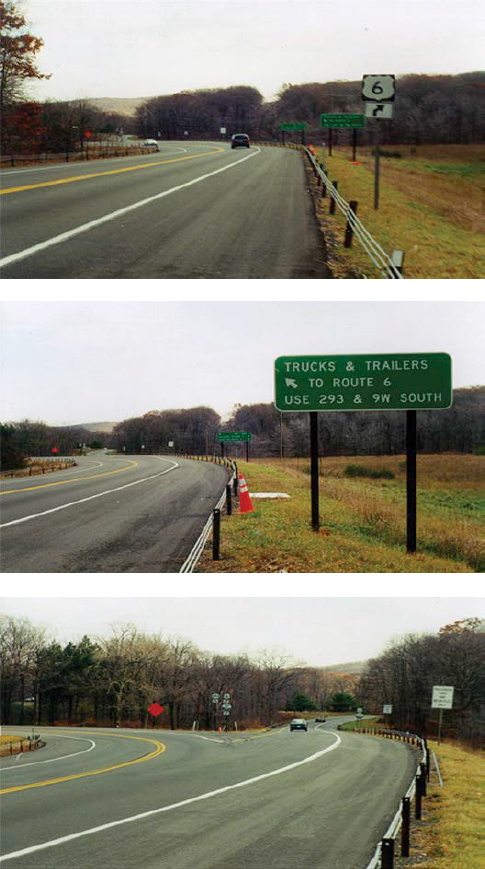
that the sign is for trucks and trailers. From the skid marks near the gore (bottom photograph), road users are uncertain about whether to follow the road to the left or continue straight onto the ramp to the parkway. Especially for a driver unfamiliar with this section of roadway, the first two signs can create misleading expectations about the upcoming transition to the arterial roadway, leading to confusion and last-minute driver maneuvers.
Key Concepts
- Mismatches between driver expectations and the roadway design can be especially critical in situations involving time pressures and strong task demands.
- Roadways that meet user expectations and are predictable can function like a familiar “script” that directs and supports behaviors that are both timely and effective.
- Design consistency improves user performance because it facilitates the user’s ability to predict what the system will do in any given situation; it provides rules that govern relationships between elements in the environment (e.g., signage and geometry) and driver responses (e.g., navigation and speed selection).
- Drivers form expectations in several ways, including driver education and training activities, past and immediate experiences with the roadway facility that they are currently driving, and experience with different roadways that share design features with the current roadway.
6.4 Diagnostic Questions Related to Expectations
Assessing violations of driver expectancies requires assessing potential surprises, changes, or clear violations of what a reasonable driver would expect at a particular site. This assessment serves as a first step toward determining if expectancy concerns exist within a facility. It may yield ideas for revisions that might address such violations and should include sections of the facility both upstream of the site under review and the site itself. The assessment should also reflect elements that could surprise drivers unfamiliar with the roadway and those that would surprise a driver familiar with the roadway. Some key questions include the following [adapted from Checklist E in Lunenfeld and Alexander (1990); and PIARC (2012)]:
- Are there any site-specific expectations that would have been formed upstream of a specific section of the facility (perhaps where there have been crashes) that (1) may have been violated and (2) contributed to the observed crashes? For example, consider the following:
- Have there been any upstream changes to road type, lane/shoulder width, road surface, road lighting, shoulder drop-off, or cross-section?
- Have there been any changes in traffic volume, traffic mix, or traffic operations?
- Have there been any signing, marking, signalization, or other information display changes?
- If the answer to any of these questions is “yes,” consider if advance warning signs or other interventions may help to support driver responses. In many cases, such changes may simply require time for road users to adjust expectations.
- Are there any site-specific expectations that may have been violated? For example, consider the following:
- At the site, are drivers surprised by key elements within the facility, i.e., roadway design and geometry, signs and markings, and visibility?
- Are changes in road characteristics, roadway alignment, or driving requirements communicated early and clearly by salient roadway elements (geometry, signs, markings)?
- As drivers enter built-up urban areas with more mixed road users (e.g., more pedestrians or bicyclists), does the roadway provide unambiguous cues to help the driver recognize needed changes in speed or a need to make changes in the driver’s glance patterns to detect potential hazards?
- Are there any elements drivers might find unusual, perhaps some first-of-a-kind features?
- Are there any elements or maneuvers that might surprise drivers?
- Are there any changes in the site’s operating practices; this could include new school zones or work zones?
- Are there any changes in the site’s visibility characteristics (e.g., lighting, sight lines)?
- If any advance warning elements are present—are they inconspicuous or insufficiently descriptive?
- If the answer to any of these questions is “yes,” consider if advance warning signs or other interventions may help to support driver understanding. As with the upstream changes, such changes may simply require time for road users to adjust expectations.


