Diagnostic Assessment and Countermeasure Selection: A Toolbox for Traffic Safety Practitioners (2024)
Chapter: 1 Introduction

CHAPTER 1
Introduction
1.1 Background
Successful roadway safety management practices require an understanding of the factors contributing to motor vehicle crashes. Continuous advancements in the science of data-driven safety analysis, as well as in the countermeasures and technologies available to address crashes, create challenges in maintaining a workforce that is proficient in the state of roadway safety management practices. Additionally, choosing an effective countermeasure requires an examination of the human factors, behavioral factors, future development, prevailing or predicted crash types, and mix of road users to determine the most appropriate treatments to apply. Doing so allows the selected countermeasure to be matched to underlying contributing factors, and thereby reduce crashes and crash severity to the greatest extent possible. However, in many cases, practitioners have limited understanding of the potential for a treatment selection to affect road users other than those targeted by the countermeasure, or to lead to unanticipated outcomes. For instance, installing a turn lane might increase vehicle speeds or pedestrian crossing distance. A better understanding of these relationships and trade-offs should inform design choices and ultimately result in safer roadways for all users.
It is common to characterize traffic safety plans as the four “E’s” of highway safety—engineering, education, enforcement, and emergency medical services. Evaluation (the fifth “E” of safety), analysis, and diagnosis of these aspects of crashes in modal and facility contexts should significantly improve the selection and design of countermeasures.
Several guides, approaches, and tools to aid the diagnostic process are already available, and the goal of this toolbox was not to reinvent the wheel, but rather to augment these existing resources. Specifically, what is lacking from the practitioner’s toolbox is an integrated set of procedures, methods, and tools for conducting comprehensive diagnostic assessments of the contributing factors to crashes and for identifying matching countermeasures with a potential to improve safety performance (i.e., crash frequency and severity) and provide a meaningful return on investment to state departments of transportation (DOTs).
Specifically, existing guides and tools
- Do not provide adequate coverage of key contributing factors, such as human factors and driver behavior;
- Can be difficult to understand and hard to use and are generally not designed to be practitioner ready; and
- Do not yield actionable outcomes that include a clear description of how proposed countermeasures will increase road user safety and the design/behavioral trade-offs associated with the countermeasures.
1.2 Objectives
To address these concerns, the objectives of this project were to (1) develop new tools for diagnosing contributing factors leading to crashes that will aid practitioners in selecting appropriate countermeasures in modally diverse contexts and (2) address a wide variety of contributing factors leading to crashes (e.g., roadway, technological, behavioral, human factors, socioeconomic, demographic, weather, and land use) to further practitioner understanding of how to balance trade-off decisions.
This toolbox is not a standard and is intended to augment—not replace—the many resources that are already available on these topics. The Appendix includes brief descriptions of some existing data sources on diagnostic assessment and countermeasure selection.
1.3 How to Use This Toolbox
Intended users. The intended users of this toolbox include those involved in the planning, design, operations, or safety analyses of roadways at the federal, state, county, and city levels. This could include planners, roadway designers, traffic engineers, state safety staff, and other practitioners.
Ways to use. This toolbox is intended to provide support to those who diagnose the contributing factors that lead to crashes and to help them identify and select effective countermeasures for these crashes.
A good starting point for most users of this toolbox will be the Summary of the Toolbox for Traffic Safety Practitioners included as part of the front matter to this report. It is recommended to read this summary first, as it highlights the key steps and elements within the body of this toolbox, including the following:
- Safe System concepts
- The Modified Haddon Matrix
- The importance of trade-offs and evaluation activities throughout diagnostic assessment and countermeasure selection
- Human factors issues that can be included in diagnostic assessments
- The importance of selecting countermeasures that reduce the demands placed on road users, enhance their capabilities, or both
The summary also includes callouts to key chapters of the toolbox where additional information and specific tools can be found.
This toolbox can be used to assess and diagnose crashes at the national level to address broad patterns in crashes, as well as the local level to address crash clusters that could occur at specific locations. This process includes the identification and consideration of the inevitable trade-offs that must be made with respect to assessing contributing factors to crashes, especially when identifying and prioritizing countermeasures. The processes and tools provided in this toolbox also emphasize the importance of including evaluations (the fifth “E”) in every stage of the diagnostic assessment/countermeasure selection process; reflecting the need to include a broad range of participants and perspectives to more fully understand why crashes occur and what can be done about them.
Chapters 2–9 of this toolbox have been developed as relatively short sections to aid rapid search and find activities on the part of the user. These chapters contain focused discussions on specific topics and include objectives, background materials, examples, and tools in the form of diagnostic questions to aid crash diagnoses, as well as flowcharts to summarize both the diagnostic assessment and countermeasure selection processes. Thus, users can obtain benefits from a mix of both (1) background knowledge that can further their understanding of key concepts
and related research and concepts and (2) practical tools that identify key concepts and questions that can frame and guide the diagnostics process. Chapter 10 contains step-by-step decision trees to aid in countermeasure selection for a broad range of facility types and crash types.
1.4 Evaluation as a Key Element of Diagnostic Assessment and Countermeasure Selection
State highway safety plans (e.g., Strategic Highway Safety Plans [SHSP]) use safety data—e.g., fatal crashes and crashes involving serious injuries along with roadway and traffic data—to identify critical highway safety problems and safety improvement opportunities. These plans include specific multi-year goals, objectives, and measures to support performance-based highway programs. Specific strategies for improving safety include the highway safety elements of engineering, education, enforcement, and emergency services (the four “E’s” of highway safety) (FHWA, 2016). According to FHWA (2016), “if speed is an emphasis area in a State SHSP, the State may consider a variety of 4 E strategies to reduce or mitigate the impact of speeding. Strategies might include increasing law enforcement efforts to reduce speeding (enforcement), applying traffic calming measures such as speed humps and roundabouts (engineering), delivering public information campaigns that focus on the dangers of speeding (education), and utilizing Emergency Medical Services data to quantify the burden to the health care system and the cost to the community (emergency services).”
Equally critical to improving safety performance is the evaluation (the fifth “E” of safety) of crash data in modal and facility contexts to assess and aid the selection and design of countermeasures. While program evaluation might be considered something to worry about after countermeasures have been identified, this fifth “E” should be implemented at every stage of the safety improvement process (see Figure 4) and include input and involvement from the range of transportation professionals involved, including planners, designers, engineers, and safety analysts. In short, having an evaluative mindset throughout the crash prevention process can add rigor and purpose to safety improvement planning.
Evaluation is simply the process of examining the value or worth of something. In the highway safety context, evaluations focus on rigorously analyzing and assessing the efficacy of safety
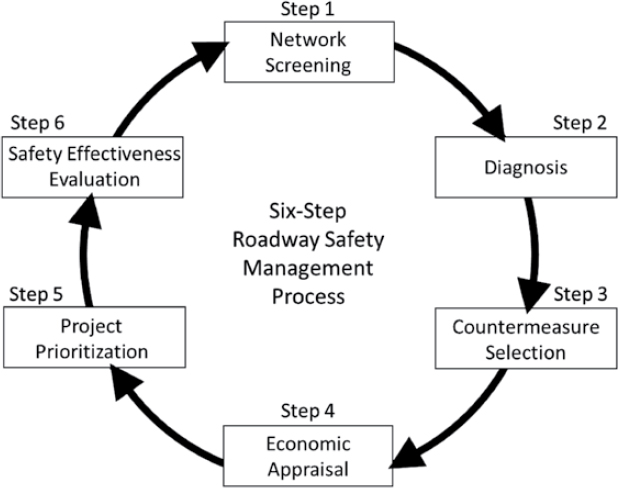
improvements to determine what is working and why. As described in Pullen-Seufert and Hall (2008), evaluations should be seen as a tool to be used throughout the highway safety improvement process to clarify problems, help develop good safety questions, prioritize countermeasures, identify metrics for success, and then assess countermeasure implementations. At their most fundamental level, countermeasure evaluations focus on two basic questions: (1) did you implement the program as planned? and (2) did you accomplish your objectives? (Pullen-Seufert and Hall, 2008).
Pullen-Seufert and Hall (2008) provide a seven-step process for evaluating highway safety programs and countermeasures, as follows:
- Identify the problem: Gather and analyze the information necessary to help determine the nature and size of the problem you wish to address, data on contributing factors, where the problem is manifesting, and who is being affected.
- Develop reasonable objectives: What will determine the success of a proposed program, treatment, or countermeasure, and how will success be measured? Program objectives should be SMART (specific, measurable, action-oriented, reasonable, and time-specific) (Pullen-Seufert and Hall, 2008).
- Develop a plan for measuring results: Develop a detailed plan that describes what you will measure, how you will measure it, and how you will analyze the results obtained. In general, evaluations are more robust when they include multiple measures obtained from multiple methods—it is beneficial to consider a range of outcome measures that are appropriate to your evaluations. For example, a countermeasure to reduce speeding behavior might use speeding-involved crashes, speeding tickets, and surveys of public awareness to assess efficacy.
- Gather baseline data: Measuring the value of a proposed program, treatment, or countermeasure often includes comparing measured outcomes before implementation to those same outcomes after implementation, while controlling for other key variables that could impact the results.
- Implement your program: Initiate the program, treatment, or countermeasure that is the focus of your evaluation and document all implementation issues, questions, or milestones that might be important as you analyze your data.
- Gather data and analyze results: Data collection and analysis may well be the most complex and labor-intensive elements of an evaluation. In this regard, a data collection schedule with detailed procedures should be developed and followed. Pay close attention to any external events that could change your outcomes in ways that are separate from the program, treatment, or countermeasure under evaluation. For example, if you are monitoring the effects of a countermeasure to reduce speeding behavior through a specific section of roadway and that roadway undergoes a major revision involving work zones and reduced traffic and throughput, you may wish to delay the evaluation or shift the implementation to another roadway to avoid confounding the results.
- Report results: Clearly communicate the objectives, methods, results, and conclusions of your evaluation to all organizations involved in the effort.
1.5 Trade-offs in a Multimodal Transportation Network
In a multimodal transportation network, trade-offs refer to the inevitable give and take around balancing multiple safety options, including assessments of the strengths and weaknesses associated with safety considerations for all road users; including drivers, pedestrians, bicyclists, and transit users. In general, trade-offs reflect a desire to achieve compromise, balance, and perhaps exchange between desirable but incompatible elements.
Thus, understanding inherent human capabilities and limitations, the broader social environment that impacts roadway safety, and how roadway infrastructure can be misaligned with
them will aid practitioners in diagnosing crashes and in identifying and balancing trade-off decisions among countermeasures.
Final countermeasure selection should include trade-offs between key variables, including countermeasure efficacy, specific safety benefits, unanticipated outcomes, and feasibility (e.g., time and cost).
1.6 Summary of the Remainder of This Toolbox
This toolbox provides the safety practitioner with an integrated set of procedures, methods, and tools to support conducting diagnostic assessments of the contributing factors to crashes, identifying matching countermeasures with a potential to improve safety performance and provide a meaningful return on investment to state DOTs. Although Treat et al. (1979) found that human error was a contributing factor to over 90% of motor vehicle crashes, 27% of the crashes they investigated were caused in some part by interactions between the road infrastructure and the road user (see Table 2-1 in Treat et al., 1979). The resources for conducting comprehensive diagnostic assessments of the contributing factors to crashes described in this toolbox, therefore, focus on (1) significant contributors to crashes in terms of their influence on safety outcomes, as well as (2) topics that can be addressed by the practitioner through roadway planning, design and/or operations. The subsequent chapters in this toolbox are summarized as follows:
- Chapter 2: What Causes Roadway Crashes? describes key research into the causes of roadway crashes and highlights the key contributing factors that reflect interactions between driver capabilities and limitations and the demands placed on the driver by the roadway infrastructure and related traffic operations.
- Chapter 3: Diagnostic Assessment in the Safe System provides a holistic framework for identifying potential road-user, vehicle, environmental, social, and road-user-mix contributions to crashes and injuries issues—and their interactions—that could be impacting the safety performance of a roadway facility.
- Chapter 4: Distinguishing Between Human Factors Issues and Aberrant Driver Behaviors describes the differences between human factors issues and aberrant driver behaviors as contributing factors to roadway crashes and provides information that can help the practitioner distinguish between these two types of errors and mistakes.
- Chapter 5: Perception-Response Time as a Contributing Factor to Crashes describes the importance of the time in which drivers perceive and respond to situations ahead to avoid crashes. It discusses the various driver, environmental, and vehicle factors that can affect perception-response time, including driver expectations, visual conspicuity, and vehicle speed. Guidance is offered in how roadway elements might be designed to increase rather than decrease the perception-response time window to avoid safety-critical events.
- Chapter 6: The Role of Expectations in Road User Behavior discusses the importance of expectations to road user understanding of the roadway environment and provides a review of the types of expectations that road users develop and where they come from, as well as ways to assess the development of helpful versus unhelpful expectations.
- Chapter 7: The Role of Visibility in Road User Behavior discusses the importance of visibility on driver performance and roadway safety and how limited visibility in the driving environment can result in driver error. Diagnostic questions are included for assessing visibility concerns in roadway contexts.
- Chapter 8: Task Demand as a Contributing Factor to Crashes describes the importance of workload to safety and crashes. It discusses workload as the relationship between task demands and user capabilities, where task demand refers to the requirements that the facility or a maneuver within the facility places on a road user in terms of perceiving and interpreting the environment, making decisions, and then executing those decisions.
- Chapter 9: Linking Contributing Factors to Countermeasures emphasizes the importance of linking countermeasure identification and selection to specific human factors issues (as well as driver behavior issues) identified during the diagnostics process concerning four crash types: run-off-road, pedestrian, work zone, and intersection crashes.
- Chapter 10: Decision Trees to Support Countermeasure Selection shares decision trees that are provided as a visual framework to aid countermeasure selection. A series of questions are provided to help identify potential countermeasures to remedy crash patterns of interest based on crash contributing factors. Diagnostic scenarios are presented for common crash types that occur along rural and urban roadway segments and urban intersections, including pedestrian and bicycle crashes.
- Chapter 11: Procedures for Assessing Road User Demands provides a diagnostic method to help practitioners identify and model the key elements of the driving tasks that shape the demands placed on the road user. This chapter provides step-by-step procedures for conducting workload analysis for a given roadway segment or driving task and shows how these methods can be adapted based on the scope and resources allocated toward this effort. Examples are provided to explain how to translate the results of these analyses into recommendations for revising roadway elements and traffic operations.
- Chapter 12: Blank Templates and Worksheets are provided to support various data-gathering activities described within the toolbox, including key aspects of the crash diagnostics process and the process for assessing roadway workload/demand.
Figures, tables, and examples are shared throughout the text to illustrate concepts, present data, and provide templates for practitioner use. Some of these materials appear in more than one chapter to facilitate usage of the varied tools. The chapters of the report are followed by the references, a list of acronyms and abbreviations, and the Appendix.


