Diagnostic Assessment and Countermeasure Selection: A Toolbox for Traffic Safety Practitioners (2024)
Chapter: 4 Distinguishing Between Human Factors Issues and Aberrant Driver Behaviors

CHAPTER 4
Distinguishing Between Human Factors Issues and Aberrant Driver Behaviors
4.1 Objectives
The objectives of this tool are to
- Describe the differences between human factors issues and aberrant driver behaviors as contributing factors to roadway crashes,
- Provide information that can help the practitioner distinguish between these two types of issues, and
- Improve the identification of applicable countermeasures to crashes caused by driver errors.
4.2 Background
Selecting countermeasures that improve road safety performance requires accurately diagnosing the factors that contribute to crashes. A review of crash data reveals that driver error is a contributing factor in approximately 93% of crashes (see also Singh, 2015; Treat et al., 1979). However, some of these errors primarily reflect disparities between inherent driver capabilities and features of the roadway’s design (e.g., limited lighting), while others reflect illegal or unsafe driver behaviors (e.g., texting while driving, driving while intoxicated).
Roadway safety professionals and design practitioners may confuse the nature and mitigation of human factors issues versus aberrant driver behaviors. Such confusion can place more blame on deliberate violations and misbehavior than is supported by the crash data, rather than on interactions between (1) the demands imposed on the roadway’s design and (2) road-user inherent capabilities. This approach can have the effect of leaving the real sources of driver errors on the roadways (e.g., limited visibility, high workload, limited time available to react) unidentified and unaddressed by improved roadway design and operations. For example, the Transportation Research Board executive committee described the components of an RSA and a Road Safety Audit Review (RSAR) that included a survey of state agencies that chose not to implement RSAs and RSARs, and one reason given for this decision is that officers from these agencies claimed that behavioral factors account for 85% of the crashes, so the tools would thus not provide a good return (Wilson and Lipinski, 2004).
Also, understanding the differences between human factors issues and aberrant driver behaviors is important, as the broader roadway safety community and individual practitioners apply the principles and practices of a Safe System approach to roadway design. A key principle of a Safe System approach is that humans make mistakes. Accordingly, the transportation system should be designed and operated to tolerate these mistakes (Able et al., 2021). Accommodating road users’ mistakes requires having an accurate understanding of the underlying causes and true nature of those mistakes. In this regard, a holistic approach to countermeasures is to consider not just physical treatments that can be added to a facility to reduce crash frequency and
severity; countermeasures can also take the form of exposure reduction (e.g., of traffic volumes, travel times, or travel distance). In addition, countermeasures can be defined in terms of both crash frequency and severity (e.g., rumble strips can reduce both total crash frequency and crash severity).
For example, consider a one-mile segment of a two-lane, two-way road in a rural area with the following design features and 5-year crash characteristics:
- No lighting
- Utility poles within clear zones left and right
- 55 mph posted speed limit
- No edge lines or centerline markings
- Head-on collisions or run-off-road crashes that result in either fatalities or serious injuries
- Key contributing factors that include nighttime driving, inattentive driving, and excessive speed
A diagnostic process for this site that is pre-disposed to focus on aberrant behaviors might conclude that driver speeding behavior was the primary cause of these crashes and would therefore identify countermeasures accordingly (e.g., to recommend increasing enforcement activities or increase the number of posted speed signs to reinforce the 55 mph posted speed limit). However, a diagnostic process that considers human factors issues informed by key driver capabilities and limitations might note that the relatively high speed limit and the number of “exceeding the speed limit” crashes, combined with the lack of lane-edge markings and lighting, create a strong likelihood of frequent lane departures. Such an analysis would likely recommend a very different set of countermeasures, such as adding edge lines, centerline markings, and/or lighting to improve delineation and visibility. Again, it is important to accurately diagnose the factors contributing to crashes before identifying and implementing countermeasures that will improve road safety performance.
4.3 Key Concepts: What Are the Differences Between Human Factors Issues and Aberrant Driver Behavior Issues?
Human factors issues and aberrant driver behaviors are both real and significant contributing factors to roadway crashes, but they can reflect different (1) driver motivations; (2) patterns of interactions between drivers, vehicles, and the roadway environment; and (3) approaches to countermeasure selection.
Human factors issues include contributing factors to crashes that reflect mismatches between the demands placed on the road user from roadway design and traffic engineering features and the inherent physical, perceptual, and cognitive capabilities and limitations of road users (see also Campbell et al., 2012). In a typical crash with human factors as the contributing cause(s), the driver is alert and attentive and follows relevant traffic laws and the typical requirements documented in state driver manuals. In the driving context, human factors issues reflect how road users interact with roadway elements, traffic control devices, vehicles, and other road users. Countermeasures that address human factors issues focus on shoring up drivers’ limitations (e.g., an advance warning sign notifying a driver of an upcoming work zone reduces the information processing requirements on the driver by giving them an early notification of upcoming roadway conditions) or on improving the capabilities of a driver (e.g., rumble strips augment the driver’s visual capabilities by adding a tactile and auditory cue that helps the driver perceive when a tire has exceeded the lane boundaries). In this example, a pattern of runoff-road crashes in which a lack of clear lane edges seems to be a contributing factor does not directly reflect bad choices or risky behaviors on the part of drivers; it reflects a road condition that may not adequately meet the driver’s visual needs to maintain a safe lane position.
The World Road Association makes a similar distinction and refers to human factors issues as those “psychological and physiological threshold limit values which are verified as contributing to operational mistakes in machine and vehicle handling. It deals with general and stable subconscious reactions of road users and excludes temporary individual reactions and conditions” (PIARC, 2019a).
Aberrant driver behaviors include contributing factors to crashes that reflect deliberate violations of law or unsafe driving practices such as driving while impaired by alcohol, texting while driving, or driving unbelted. The World Road Association refers to issues such as personality traits like aggression and conscious violation of traffic rules; appropriate countermeasures include driver education, campaigns for influencing driving behavior, and enforcement (PIARC, 2019a). Several established sources describe and provide countermeasures for crash types resulting from such behaviors, including the NHTSA’s Countermeasures That Work: A Highway Safety Countermeasures Guide for State Highway Safety Offices (Venkatraman et al., 2021) that focus on behavioral tools such as education, regulation/traffic laws, and legal enforcement. Table 6 provides some sample issues and behaviors associated with these two types of crashes and their associated countermeasures (see also Campbell et al., 2012; Venkatraman et al., 2021).
Following Reason et al. (1990), it should be emphasized that the distinctions between human factors and aberrant driver behavior issues are not always clear-cut and that these categories can sometimes overlap. For example, a crash involving an alcohol-impaired driver facing complex signage at a freeway interchange could reflect both aberrant driver behaviors (alcohol impairment) and human factors issues (increased workload and impacts on available perception-response time because of the signage). Also, speeding behaviors could be associated with roadway design elements (e.g., lane width; see Campbell et al., 2012) that may lead to higher speed
Table 6. Differences between human factors issues and aberrant driver behaviors.
| Issue Type | Sample Issues/Behaviors | Sample Countermeasures |
|---|---|---|
| Human Factors Issues | Failure to meet road user expectations | Improve design consistency, add advance information signs |
| Limited visibility | Improve lighting, add delineators, improve pavement delineation | |
| High workload | Reduce number or complexity of roadway signs | |
| Limited time for road users to react | Improve sight distance, provide longer yellow signal lights, add advance warning signs | |
| Aberrant Driver Behaviors | Alcohol and drug-impaired driving | Communications: establish positive social norms that make driving while impaired unacceptable |
| Speeding and speed management | Enforcement: publicized and highly visible enforcement of practical, sound, and broadly accepted laws | |
| Distracted driving | Outreach: inform the public of the consequences of using cell phones while driving | |
| Drowsy driving | Regulation: Graduated driver’s licensing for beginning drivers that might include night driving restrictions, or hours of service for commercial drivers |
selection by the driver, or they could reflect poor speed selection decisions/deliberate speeding by the driver. Finally, a single engineering countermeasure could apply to human factors issues and driver behavior issues; for example, rumble strips may support improved lane-keeping performance for drivers on roads with limited delineation and a history of run-off-road crashes, as well as improve lane-keeping performance for alcohol-impaired drivers.
Perhaps the earliest and clearest distinctions between human factors issues and driver behavior issues were made by Reason et al. (1990). They collected data from drivers that confirmed the distinction between what they termed errors (i.e., human factors issues) and violations (i.e., risky and unsafe behaviors). They found that while errors are generally unintentional and are accounted for by limits on the information processing capabilities of the drivers, violations are generally intentional and are accounted for by various social and motivational factors. Reason and his colleagues made clear that the boundaries between errors and violations are not always obvious and that both can be involved in the same crash sequence. Nonetheless, their work provides a framework for diagnosing crashes and selecting targeted countermeasures. Their work also highlights the central role that intentions and motivations play in assessing crashes and distinguishing between these contributing factors during the diagnostic process.
Several in-depth studies have examined the contributing factors to crashes and can serve to further explain the distinctions between crashes caused primarily by human factors issues versus those caused primarily by aberrant driver behaviors. In 1979, Treat et al. published a seminal report for the U.S. DOT and determined, from an analysis of over 2,000 motor vehicle crashes, that nearly 93% were caused in some part by human errors; more specifically, they identified improper lookout, excessive speed, and inattention as the top reasons for crashes because of driver factors issues (Treat et al., 1979).
Figure 5 from Chapter 2 above summarizes the results. As seen in the figure, while most crashes indeed reflect some form of driver error, a subset of these errors (approximately 57%) reflect primarily “driver-only” issues such as alcohol or impaired driving because of drugs or alcohol, road rage, fatigue, and distraction/inattention. Others (approximately 27%) reflect interactions, including roadway designs and traffic operation features that place demands on road users that may exceed their capabilities (i.e., human factors issues). Using more recent data from crashes documented through the NMVCCS, NHTSA investigated a sample of 5,470 crashes and analyzed the events and associated factors leading up to the crashes (Singh, 2015). The results related to the involvement of driver, roadway, and vehicle factors as contributors to these crashes are consistent with the results from Treat et al. (1979).
Wierwille et al. (2002) developed a unique taxonomy to describe driver errors, which included sub-categories such as limited knowledge, training, and skill; impairment; willful inappropriate behavior; and infrastructure or environment issues. These sub-categories highlight the need to consider not only human factors topics such as driver capabilities and limitations but also how drivers interact with the surrounding infrastructure features. For example, failure to yield at an intersection may be the general category that describes the crash type, but this type of driver error may be broken down into more specific components, like intersection features (e.g., unsignalized or skewed) and specific reasons for not yielding (e.g., visibility challenges, limited time to react) (Wierwille et al., 2002).
Using 2017–2020 data from the CISS (NHTSA, n.d.b) and 2010–2015 data from the National Automotive Sampling System (NASS) Crashworthiness Data System (NHTSA, n.d.d) and taxonomies that included those used by Treat et al. (1979) and Singh (2015; i.e., human factors, vehicle factors, and roadway and environmental factors), Dong and Wood (2023) assessed the contributing factors to crashes. Similarly to previously reported findings, their findings showed that more than 95% of the crashes investigated involved human factors or included a human error.
In over 50% of these human error-related crashes, aberrant driver behaviors such as speeding, alcohol-/drug-impaired driving, or distraction were contributing factors. Again, this suggests that a significant portion of crashes include a design or traffic control issue as a contributing factor.
Overall, these investigations into drivers’ involvement in crashes demonstrate that crashes are a result of contributing causes from various environment, vehicle, and driver factors (such as driver inattention), as well as the interactions among these factors (such as roadway designs that place strong demands on the road user).
Key Concepts
- Human factors issues and aberrant driver behaviors can reflect different: (1) driver motivations; (2) patterns of interactions between drivers, vehicles, and the roadway environment; and (3) approaches to countermeasure selection.
- Identifying effective countermeasures to address road users’ errors requires having an accurate understanding about the underlying causes and true nature of those errors.
- Some errors reflect human factors issues—mismatches between the demands placed on the road user from roadway design and traffic engineering features and the inherent physical, perceptual, and cognitive capabilities and limitations of road users.
- Other errors reflect aberrant driver behaviors—deliberate violations of laws or unsafe driving practices such as driving while impaired by alcohol, texting while driving, or driving unbelted.
4.4 A Diagnostic Process to Distinguish Crashes That Reflect Human Factors Issues versus Those That Reflect Aberrant Driver Behavior Issues
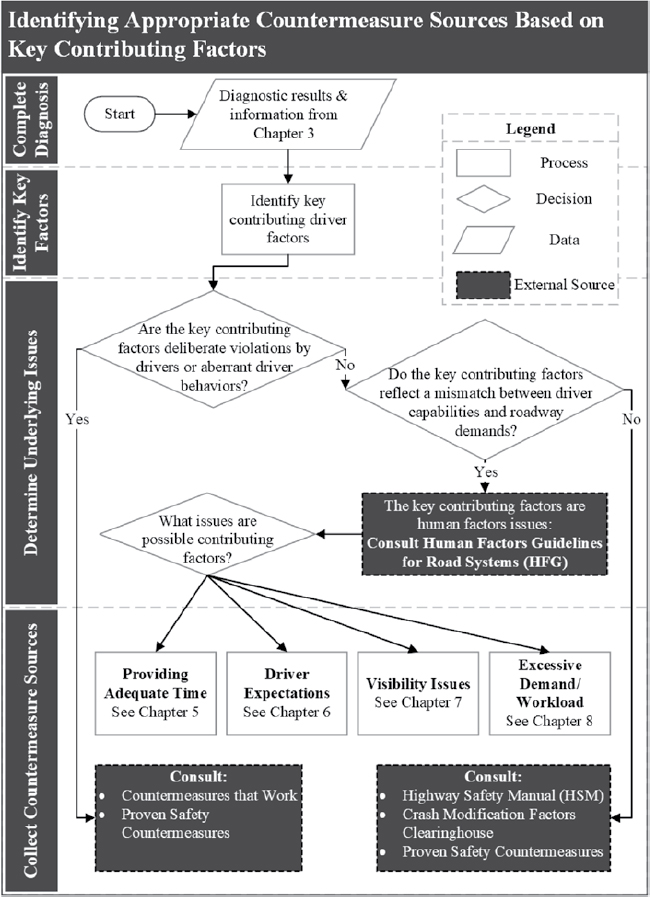
Figure 8 provides a general diagnostic process as well as individual diagnostic questions to help clarify whether a crash or group of crashes most likely reflect human factors issues as contributing factors or most likely reflect aberrant driver behavior issues as contributing factors.