Diagnostic Assessment and Countermeasure Selection: A Toolbox for Traffic Safety Practitioners (2024)
Chapter: 7 The Role of Visibility in Road User Behavior

CHAPTER 7
The Role of Visibility in Road User Behavior
7.1 Objectives
The objectives of this tool are to
- Define visibility and related characteristics as they relate to roadway safety,
- Describe the importance of visibility on driver performance,
- Describe how limited visibility in the driving environment can lead to errors and mistakes, and
- Provide diagnostic questions that can aid the practitioner in assessing the visibility concerns in a given roadway area.
7.2 Background
Visibility refers to the quality or state of being visible and relates to concepts such as conspicuity and sight distance. Vision is the primary source of information when operating a motor vehicle, with some researchers estimating that as much as 90% of information for the driving task is captured through the eyes (Hills, 1980). Studies of the visual behavior of drivers in real-world traffic conditions have found that drivers look at several important stimuli both inside and outside the vehicle to perform their tasks (Tijerina et al., 2004; Falkmer and Gregersen, 2005; Krauss, 2015). Whether or not these objects are visible to a driver at a particular point in time depends on features of the object (e.g., size, distance, and contrast with the background), features within the immediate environment that might block or obscure the object, and the attention directed by the driver toward the object.
The visual system uses a variety of cues to detect, identify, and localize objects in the environment. A primary cue that determines how quickly an object in the roadway is detected and acted on is that object’s conspicuity. Conspicuity is defined by Krauss (2015) as “those characteristics of an object or condition that determine the likelihood that it will come to the attention of an observer” (p. 57). In other words, conspicuity refers to how noticeable or visible an object is. Some of the features that increase conspicuity include brightness and contrast (e.g., reflectorized traffic signs; Olson et al., 1992), color (e.g., the orange colors of traffic cones), location (e.g., objects in the center of view are more likely to be noticed than peripherally placed objects; Krauss, 2015) and size (Campbell et al., 2004). A driver’s ability to select and act on even highly visible and conspicuous objects may be impacted by the amount and type of proximate visual information (e.g., pedestrians, other vehicles, signs, markings, buildings, planters, and so forth) in the immediate environment (Edquist and Johnson, 2008). Thus, the complexity and clutter associated with a visual scene impact visibility.
A driver’s ability to respond quickly to an object in the roadway also depends on the distance available to visually perceive the object (i.e., sight distance; Campbell et al., 2012). Sight distance depends on scene illuminance and visibility, especially during nighttime conditions,
as well as roadway design features such as vertical curvature. Pedestrian visibility is impacted by several factors, including lighting conditions, the size of the pedestrian, and the color/reflectivity of the clothing worn by the pedestrian (Campbell et al., 2012). Sight distance is directly related to the time drivers have to respond to an obstacle or situation ahead. The more visible the object or situation is ahead, the more time drivers have to perceive, decide, and respond. Conversely, the less visible the object or situation is ahead, the less time drivers have.
7.2.1 Why Is Visibility Important to Safety Performance?
As noted above, most of the information a driver uses is captured by their eyes. According to Tijerina et al. (1995a), a reduced visibility crash is defined as “interference, caused by low light or obscurance, with the capability of the road, other vehicles, or potential obstacles (including pedestrians) to stand out in relation to their backgrounds to be readily detected by the driver” (p. 1). Reduced visibility applies to both day and night conditions and conditions of fog, dust, rain, snow, or other atmospheric obscurants. Such hindrances to visibility may also be because of environmental objects restricting sight distances. Indeed, visibility is important to consider when developing diagnostic tools and countermeasures for roadway crashes, as low visibility increases the likelihood of crashes. According to Treat et al. (1979), one of the leading environmental factors related to traffic crashes is visibility.
A wide variety of categories influence visibility and how it relates to the likelihood of roadway crashes. These categories are not exhaustive but provide a glimpse into factors that play a role in rendering the roadway visible. The discussion focuses on topic areas that are important and relevant to roadway design and operations, especially those that contain features designers could modify to enhance visibility. For example, weather conditions and time of day are factors that cannot be controlled to mitigate crash potential. However, roadway signage and roadway design are determined by highway and traffic engineers and can be created to interact with uncontrolled factors to enhance visibility.
7.2.2 What Roadway Design Elements Affect Visibility?
In general, road signs, lane markings, and lighting are roadway-design elements that can significantly impact visibility, especially at night (FHWA, 2022a), and help address visibility limitations based on roadway geometry (e.g., sharp horizontal curves or vertical curves). For example, advance signage can inform the driver of upcoming limited visibility situations, and well-maintained retroreflective signs can improve nighttime visibility and reduce the risk of crashes by making signs appear brighter and easier to see and read from a distance. Similarly, well-maintained lane markings can make road curvatures more visible from a greater distance, thereby preparing the driver for unexpected curves. Finally, roadway lighting helps make roadways and surrounding areas and road users, such as pedestrians, more visible at night.
7.3 Key Concepts: What Are the Relationships Between Visibility, Vision, and Attention?
While visibility relates most directly to the quality of being visible, it is also closely related to drivers’ visual abilities, as well as attention. Key aspects of drivers’ visual abilities include the following:
- Visual acuity—The ability to see details at a distance
- Contrast sensitivity—The ability to detect slight differences in luminance (brightness of light) between an object and its background
- Glare sensitivity—The uncomfortable or disabling effects that light sources can have on nighttime vision
- Peripheral vision—The ability to detect objects outside the direct line of sight of the eye
- Movement in depth—The ability to estimate the speed of another vehicle by the rate of change of the visual angle of the vehicle created at the eye
- Color vision—The ability to see and distinguish colors in the visual field
- Visual search—The ability to search the rapidly changing road scene to collect road and traffic information
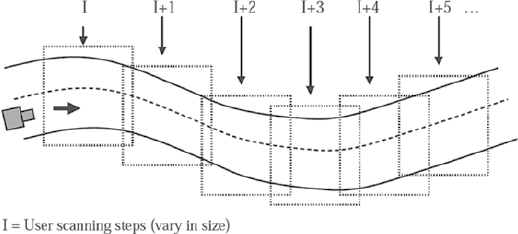
An alert and attentive driver will search for information to support trip navigation and second-by-second control activities, such as vehicle speed, level of braking, and steering. Campbell et al. (2012) describes this search for information as follows:
- Drivers scan the environment for the MMI about that particular road location and point in time.
- Drivers scanning patterns reflect the presence or absence of potentially challenging situations as they perceive them.
- Drivers are generally alert for both longitudinal and lateral challenges, such as other vehicles, pedestrians, animals, or objects near their planned path.
- Drivers develop an expectancy of the roadway based on what they previously experienced upstream.
- This searching and scanning process is continuous throughout the trip.
Figure 14 depicts this iterative visual sampling process.
7.4 Example of How Visibility Can Impact Driver Performance
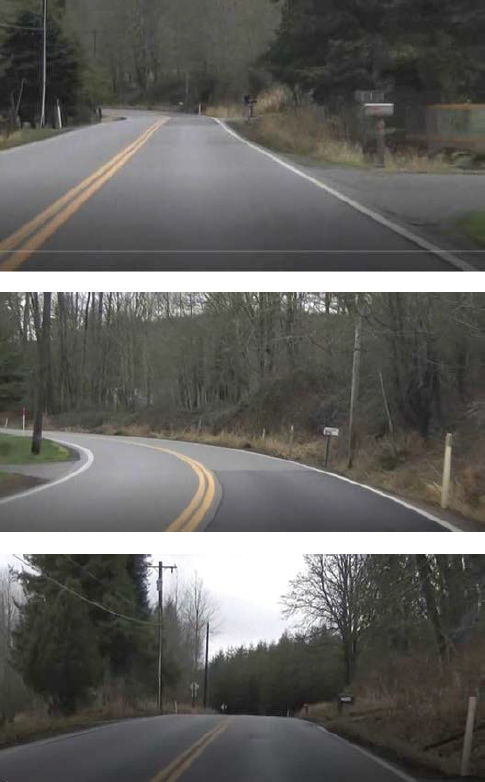
The sequence of photographs in Figure 15 provides an example of roadway features that can reduce visibility and contribute to driver error. The photographs depict key parts of an 800-ft section of a two-lane rural roadway. The top photograph shows an upcoming horizontal curve, preceded by driveways on the right. Because of the close vegetation and sharp curves, there is limited visibility of vehicles entering the roadway from driveways, of pedestrians and bicyclists on the shoulder, and even of oncoming vehicles from beyond the curve. The middle photograph depicts a vehicle just entering the curve, with an additional driveway revealed on the left. This photograph also highlights the narrow shoulders on both sides of the road. Finally, the bottom photograph features a sag vertical curve, again with (mostly) hidden driveways to either side. Although visibility is the most obvious issue with this particular section of roadway, the presence of a relatively high driver workload (maintaining lane position plus watching for vehicles emerging from the driveways) and possible time constraints compound the demands placed on drivers, not taking into consideration additional visibility demands that would be associated with nighttime and/or inclement weather conditions.
Key Concepts
- Vision is the primary source of information when operating a motor vehicle; as much as 90% of the information for the driving task is captured through the eyes (Hills, 1980).
- A primary cue that determines how quickly an object in the roadway is detected and acted on is that object’s conspicuity, which refers to how noticeable or visible an object is.
- A driver’s ability to act on even highly conspicuous objects may reflect roadway lighting, sight distance, weather, time of day, and the amount and type of visual clutter (e.g., pedestrians, other vehicles, signs, markings, buildings, planters, and so forth) in the immediate environment.
7.5 Diagnostic Questions Related to Visibility
- Does the amount of sight distance available to drivers allow for safe driver responses?
- Are signs in place to aid road users in limited-sight distance situations?
- Are signs, markings, and traffic signals well-maintained, visible, and not obscured by fixed objects (e.g., vegetation), non-permanent objects (e.g., parked vehicles), or dynamic scene elements (e.g., moving cars, animals, pedestrians, bicyclists)?
- Are critical elements (i.e., intersections, driveways, curves, lane drops, and so forth) obvious and visible under both daytime and nighttime conditions?
- Does the geometry and surrounding environment support visibility around curves?
- Are there signs, markings, or lighting elements to support visibility where necessary?
- Will road users be able to see obstacles, guidance information, and information needed for traffic control and navigation?
- Are users seeing what designers think they should be seeing?
- Can users see what they need to see when they need to see it?
- Are there unnecessary traffic signs or other objects that may contribute to visual clutter?


