On Leading a Lab: Strengthening Scientific Leadership in Responsible Research: Proceedings of a Workshop (2024)
Chapter: 4 Federal Research Funding and Resources for Leaders of Large Centers and Projects
4
Federal Research Funding and Resources for Leaders of Large Centers and Projects
Strategic Council member Lyric Jorgenson, National Institutes of Health (NIH), introduced the next panel, which focused on the role that federal research agencies can play in strengthening the leadership of the large centers. Presenters Kara Hall, National Cancer Institute (NCI) within NIH, and Dragana Brzakovic, National Science Foundation (NSF), were asked to consider what lessons can be taken from federal agency experience in working with lab center leaders on the responsible conduct of research (RCR) and other areas, best practices that have been or should be codified, and unmet needs.
FEDERAL SUPPORT FOR EVIDENCE-INFORMED RESEARCH INITIATIVES
Hall explained her comments are rooted in work with NCI’s Transdisciplinary Research Centers, which were launched about two decades ago as incubator spaces to overcome barriers to interdisciplinary of research. She and colleagues have studied the initiative to understand the resulting degree of collaboration, productivity, and other factors using qualitative and quantitative methods. This investigation helped develop the science of team science (SciTS) in order to understand the added value of doing team science, team processes that can maximize innovation and productivity, effective characteristics and skills of team leaders and members, how organizations can facilitate and support team science, and policies needed to support
team science. Early milestones included an NCI-supported conference and a special supplement in the American Journal of Preventive Medicine in 2008. These efforts also led to the National Academies report Enhancing the Effectiveness of Team Science (NRC, 2015) and the book Strategies for Team Science Success (Hall, Vogel, and Croyle, 2019).
Hall distilled the challenges of the scientific enterprise when affected by such human conditions as scarcity, competition, and power. For example, limited funds may drive competitiveness and hamper collaboration. The push to win grants may lead to a more conservative approach to research, while job security and promotion and tenure considerations may affect sharing of knowledge and an emphasis on measurable outcomes (Figure 4-1). All of these examples have implications for collaboration and innovation, Hall said. These challenges affect research leaders differently at different stages of their careers.
The SciTS literature has suggested a model of team effectiveness based in part on organizational structure (Kozlowski and Bell, 2019). In this model, interventions are intentional and evidence-informed to enable people to work together in a team and/or system and to develop processes and platforms to facilitate teams to produce products that align with the team or system’s vision and goals. Hall said that NCI has been supporting multiteam systems (MTS) by supporting processes and structures involving steering committees, working groups, and other groups to facilitate coordination and integration across the centers. Characteristics of MTS include a set of goals, inter-team interdependence, inter-team differentiation, boundary-spanning communication, and inter-team leadership (Figure 4-2).
To facilitate the success of junior faculty in a center environment, a concern raised by Catherine Lyall in the previous session, Hall noted a funding strategy that enables a junior member to be a co-principal investigator on developmental projects supported as part of a center project. She also pointed to a handbook prepared by the NSF-funded Center for Bright Beams with norms and expectations for both participants and affiliates (Center for Bright Beams, 2019) to support team functioning. Building on research from other disciplines, she noted the identification of ten collaboration planning components distilled in an open access chapter in Strategies for Team Science Success (Hall et al., 2019). Operating manuals can be a valuable structural intervention, she noted, because “the more we have things codified, the more we can have the ability to understand key organization roles and expectations, the infrastructure, and policies.” In addition to Enhancing
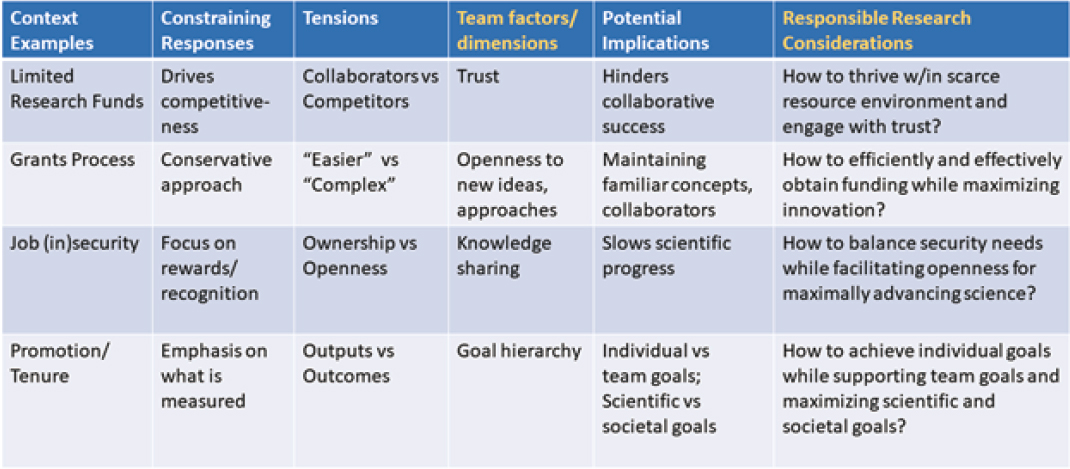
SOURCE: Kara Hall, Workshop Presentation, December 4, 2023.
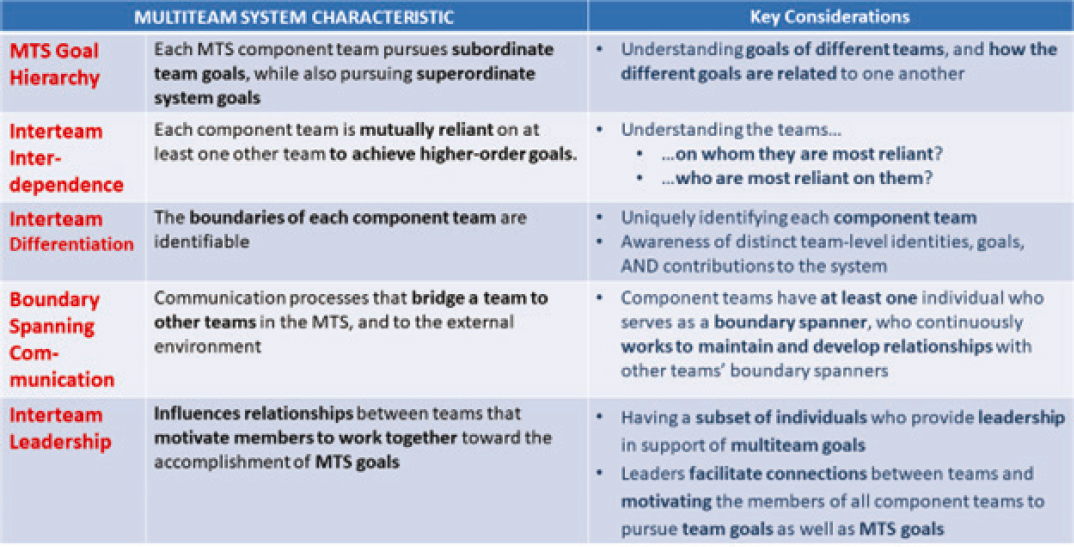
SOURCES: Kara Hall, Workshop Presentation, December 4, 2023. (Adapted from Carter, D., et al. (2019) in Hall, K. L., et al., “Strategies for Team Science Success.”)
the Effectiveness of Team Science (NRC, 2015), she called attention to several other National Academies consensus studies on interdisciplinary research (NAS, NAE, and IOM, 2005) and convergence (NRC, 2014). A newly launched consensus study is under way on the research and application in team science,1 which she said is intended to emphasize a contemporary understanding of best practices and evidence for advancing team science.
She closed by referring to the earlier discussions about building trust. She commented that there are many kinds of trust, including collaborative-based, strategic, identity-based, and competence-based. These different kinds of trust could be considered in building approaches and interventions to support collaboration, she suggested.
FEDERAL SUPPORT IN ORGANIZATIONAL SETTINGS
Brzakovic described NSF’s investments to support centers and institutes, facilities, and Federally Funded Research and Development Centers (FFRDCs), in addition to its grants to individual investigators. Support for centers and institutes began in the 1980s with several flagship center programs. They involve large, long-term investments of five years or more, with a focus on research and student education. They are managed by cooperative agreements with extensive NSF oversight that usually involves annual site visits. All, except for Science and Technology Centers (STCs), are mission-oriented to focus on specific areas of science and are housed in a cognizant NSF directorate.
In contrast, the STC program is open to all areas of research supported by NSF to fund innovative and complex research and education to create new scientific paradigms, new disciplines, and transformative technologies with the potential for broad scientific and societal impact. Partnerships are created across universities, national labs, industry, non-governmental organizations, and government and international organizations, with components that encompass research, education, and knowledge transfer outside of academia. As examples of the range of newly funded STCs, one center will combine western and Indigenous environmental knowledge, while another aims to use quantitative cell biology to develop a complete cell model. The range of topics is what makes the program exciting but also makes it difficult to have a structure for management purposes, Brzakovic commented. NSF
___________________
1For more information, see https://www.nationalacademies.org/our-work/research-and-application-in-team-science.
realized that partnerships are needed to achieve program goals. In cooperative agreements, a lead institution is responsible for subawards.
The competition process lasts two years and encompasses four stages of external review with a final internal review. She noted this process increases success because those that proceed to the next stage receive and respond to comments from reviewers. STCs may have five or more institutional core partners, 20 to 30 senior researchers, and 20 to 100 graduate students, as well as undergraduate and often K–12 student involvement. All teams are multidisciplinary, but they may work independently or in convergence. NSF directorates and the STC program manage the program with mandatory strategic planning at the beginning of the award. External advisory boards are established, and there is an STC directors’ network.
Brzakovic differentiated between STC leadership (usually the director and a small group) and management. A managing director is required to operate the center, but it is the leadership that must generate an environment that is open to ideas, in which everyone feels safe, and in which multiple institutions and disciplines function in harmony. Since 2002, ethics and RCR training is required for all participants, as well as training to learn to work across disciplines. She noted the oversight is intended to be flexible and agile to empower different scientific cultures and to keep up with the rapidly changing landscape of science.
DISCUSSION
Jorgenson noted that the NIH and NSF centers have interdisciplinary goals and she asked about the RCR components of interdisciplinary science, such as different standards and norms related to security, and how lab leaders can understand them all. Hall agreed it is an ongoing challenge as reporting requirements increase. The requirements are important, but they are increasingly taking more time to fulfill. Project management and administrative support can help, but these roles are often the first to go when budgets are cut. If these positions are unstable, the best performers will go into industry. The infrastructure must be in place, and adapting existing operating manuals to meet the needs of new collaborations can reduce some of the upfront load developing these manuals de novo, Hall suggested. Brzakovic added that the external review process can advise about potential pitfalls and opportunities.
Referring to an earlier comment about how values and skills change over time, Sheila Garrity, Department of Health and Human Services
(HHS), said the HHS Office of Research Integrity is updating materials to incorporate leadership skills based on conversations with graduate students. Hall agreed about the challenge as the culture diverges across generations and suggested that the National Academies can help voice the importance of these qualities and the need for change. C. K. Gunsalus, University of Illinois, Urbana-Champaign, urged placing these skills in the broader context of education and professional development, and not referring to them only as training needs or training programs. It is also important to recognize that professional development may have multiple goals and that addressing these may require a multifaceted approach. For example, imparting an understanding of which behaviors are unethical and irresponsible as well as teaching which leadership practices can contribute to creating research environments that prevent or discourage those behaviors are distinct goals, but effective professional development can and should be addressing both.
When asked whether larger teams increase or detract from RCR, Brzakovic said it seems to depend on the area of inquiry. Some researchers are used to working together, while others may have more misunderstandings from a lack of experience. Hall agreed that the variability is significant across the many centers she has seen. Leaders’ training and the culture they set, the team structure, and oversight make a difference. She agreed with Brzakovic that external advisory boards can provide valuable input.
Susan Wolf, University of Minnesota, raised the topic of the relationship between team effectiveness and team ethics. She commented that the National Academies report on team science, while excellent, barely mentioned ethics explicitly (NRC, 2015). Brzakovic stressed that institutions have a responsibility to set a culture. One advantage of centers is that they often have people who specialize in ethics, and NSF includes an ethics expert on site visits. Hall reflected that consideration of team effectiveness and team ethics would be a valuable area of study. She posited that the more a team operates effectively, the more need it has for checks and balances. An ineffective team often has communication and coordination challenges, which can lead to less alignment on broader ethical concerns. Wolf concurred with the need for research in this area. She urged the National Academies to push beyond the 2015 report to center ethics in the conversation about team science.
REFERENCES
Carter, D. R., Asencio, R., Trainer, H. M., DeChurch, L. A., Kanfer, R., and Zaccaro, S. J. (2019). Best practices for researchers working in multiteam systems. In K. Hall, A. Vogel, and R. Croyle (Eds.), Strategies for Team Science Success. Cham, Switzerland: Springer. https://doi.org/10.1007/978-3-030-20992-6_29.
Center for Bright Beams. (2019). Handbook of the Center for Bright Beams. https://cbb.cornell.edu/sites/default/files/2021-04/CBB_Handbook_05152020_interactive.pdf.
Hall, K., Vogel, A., and Croyle, R. (Eds.). (2019). Strategies for Team Science Success. Cham, Switzerland: Springer.
Kozlowski, S. W. J., and Bell, B. S. (2019). Evidence-based principles and strategies for optimizing team functioning and performance in science teams. In K. Hall, A. Vogel, and R. Croyle (Eds.), Strategies for Team Science Success. Cham, Switzerland: Springer.
National Academy of Sciences, National Academy of Engineering, and Institute of Medicine. (2005). Facilitating interdisciplinary research. Washington, DC: The National Academies Press. https://doi.org/10.17226/11153.
National Research Council (NRC). (2014). Convergence: Facilitating transdisciplinary integration of life sciences, physical sciences, and beyond. Washington, DC: The National Academies Press. https://doi.org/10.17226/18722.
NRC. (2015). Enhancing the effectiveness of team science. Washington, DC: The National Academies Press. https://doi.org/10.17226/19007.


