Airport Greenhouse Gas Emissions Inventory: A Primer (2024)
Chapter: Introduction
Introduction
Purpose of the Greenhouse Gas Emissions Inventory Primer
This Airport Greenhouse Gas Emissions Inventory Primer (Primer) provides guidance for airport operators to account for and manage airport greenhouse gas (GHG) emissions. While all airports can use the Airport Greenhouse Gas Emissions Inventory Primer, the Airport Cooperative Research Program (ACRP) envisioned airport operators at small- to mid-size airports as the primary audience.
By using this primer you will:
- Learn the fundamentals of GHG accounting and how to apply them to prepare an airport GHG emissions inventory;
- Understand best practices for collecting, organizing, and applying data and information to manage GHG emissions;
- Learn processes and practices to help you establish and grow an effective GHG management program; and
- Connect to informational resources that will help you stay informed of GHG management approaches and best practices as they evolve.
Why Prepare an Airport GHG Emissions Inventory?
By preparing an airport GHG emissions inventory following standardized guidance informed by industry best practices, airport operators can:
- Understand their emissions profile,
- Set more informed goals,
- Monitor their progress over time,
- Compare their performance against other airport operators, and
- Better communicate their progress toward environmental goals to their key stakeholders.
Additionally, institutionalizing airport GHG accounting will also allow your airport to be prepared if and when airport GHG reporting regulations are enacted. Currently, there is not yet national or state legislation in the United States (U.S.) that requires airport operators to prepare GHG inventories, nor is the U.S. currently subject to any international agreements that require airport operators to prepare GHG inventories. Airport operators across the U.S. have voluntarily conducted their own GHG inventories using differing methodologies, which makes it difficult to compare inventories between airports and over time.
This primer provides support to airport operators who would like to improve their airport’s environmental performance using best practices while simultaneously improving the quality of GHG accounting and reporting across the industry.
How to Prepare an Airport GHG Emissions Inventory
Managing airport GHG emissions should be an ongoing process that matures as the airport staff’s understanding of emissions and ability to reduce those emissions increases. An accurate GHG emissions inventory is foundational to the GHG management process.
This primer provides a roadmap for completing a GHG emissions inventory using the following four steps:
- Select and Apply GHG Protocols and Guidance Documents,
- Set Inventory Boundaries,
- Collect Data and Estimate Emissions, and
- Monitor Progress Over Time.
A GHG emissions inventory is a tool that you can use to inform other aspects of your GHG management program, which are also discussed in this primer, including how to:
- Set GHG Emission Reduction Goals,
- Develop and Implement Emission Reduction Strategies,
- Report and Disclose GHG Emissions, and
- Evaluate, Anticipate, and Improve Emission Reduction Strategies.
Stakeholder Engagement
As you prepare your GHG emissions inventory, it is vital to involve stakeholders early and often. Garnering stakeholders’ support and buy-in is essential to successfully completing GHG inventories and implementing effective GHG reduction strategies. Stakeholders, such as airport tenants, airline passengers, air carriers, airport staff, local and federal governments, local businesses and community groups, suppliers of goods and services, utilities, and regional groups such as transportation authorities and metropolitan planning organizations may be interested in your airport’s GHG emissions, GHG reduction goals, and the steps that you are taking to achieve them. Some stakeholders, such as tenants, air carriers, and suppliers, lie within the airport’s value chain and therefore contribute to your GHG emissions.
Understanding who constitutes your stakeholder landscape can help your airport collect data, plan ways to reduce GHG emissions, communicate your GHG inventory findings and goals, and implement and advance your GHG reduction strategies. Considering stakeholder viewpoints early helps to ensure that your airport understands stakeholder priorities and opportunities to reduce emissions. That understanding can help you make sure that your inventory is fit for this purpose—that it contains information that is important to stakeholders and that it is sufficiently accurate and complete to allow for assessing progress to achieving emission reduction goals. Consistent, intentional stakeholder engagement will help to build trust and cooperation between your airport and its stakeholders, which will be essential to achieving GHG reduction goals.
Conducting meaningful stakeholder engagement requires identifying the stakeholders of a project, initiative, or decision. Once a project is clearly defined, practitioners can determine the key issues to be addressed through stakeholder engagement, thereby identifying the primary stakeholders. Stakeholder identification is especially important for airports because they operate in a complex system of community and partners. ACRP Synthesis 65: Practices to Develop Effective Stakeholder Relationships at Smaller Airports (ACRP Synthesis 65) draws on principles for identifying stakeholders and their power (e.g., influence). Each stakeholder has one, two, or all of the following levers:
The stakeholder’s influence on the airport,
The legitimacy of the stakeholder’s relationship with the airport, and
The urgency of the stakeholder’s claim, based on time sensitivity and criticality.
Environmental Justice and Stakeholder Engagement
Historically, communities of color and low-income populations have been underrepresented as a stakeholder in environmental decision-making. This has resulted in the disproportionate impact of climate change on marginalized and vulnerable groups. Considering environmental justice—which is defined as the fair treatment and meaningful involvement of all people regardless of race, origin, or income on the development and implementation of environmental policies and regulations (Environmental Protection Agency, 2023)—as a part of the stakeholder engagement process is crucial to address the current disparities in the distribution of environmental benefits and burdens among communities. Incorporating environmental justice into the stakeholder engagement process allows historically excluded populations to voice their concerns, propose solutions, and participate in shaping the policies that affect their environment, and fosters a more equitable, sustainable future for all.

Stakeholders are then categorized into low, medium, or high relevance based on the number of attributes they possess. For a deeper understanding of stakeholder analysis and categorization, please see ACRP Synthesis 65.
Depending on the outcomes of the stakeholder analysis, practitioners may choose to implement engagement strategies such as inform, consult, involve, and/or collaborate with each stakeholder. These strategies dictate specific actions throughout the engagement process. Throughout the entirety of the stakeholder engagement process, it is vital that clear and consistent communication underpins interactions with stakeholders in order to maintain trust and build positive relationships with stakeholders. Furthermore, creating feedback mechanisms and evaluating stakeholder engagement efforts are essential pillars of stakeholder engagement. These activities assist practitioners with assessing achievements, identifying gaps, and planning improvements for future stakeholder engagement efforts. A comprehensive checklist for building effective stakeholder engagement is provided by ACRP Synthesis 65.
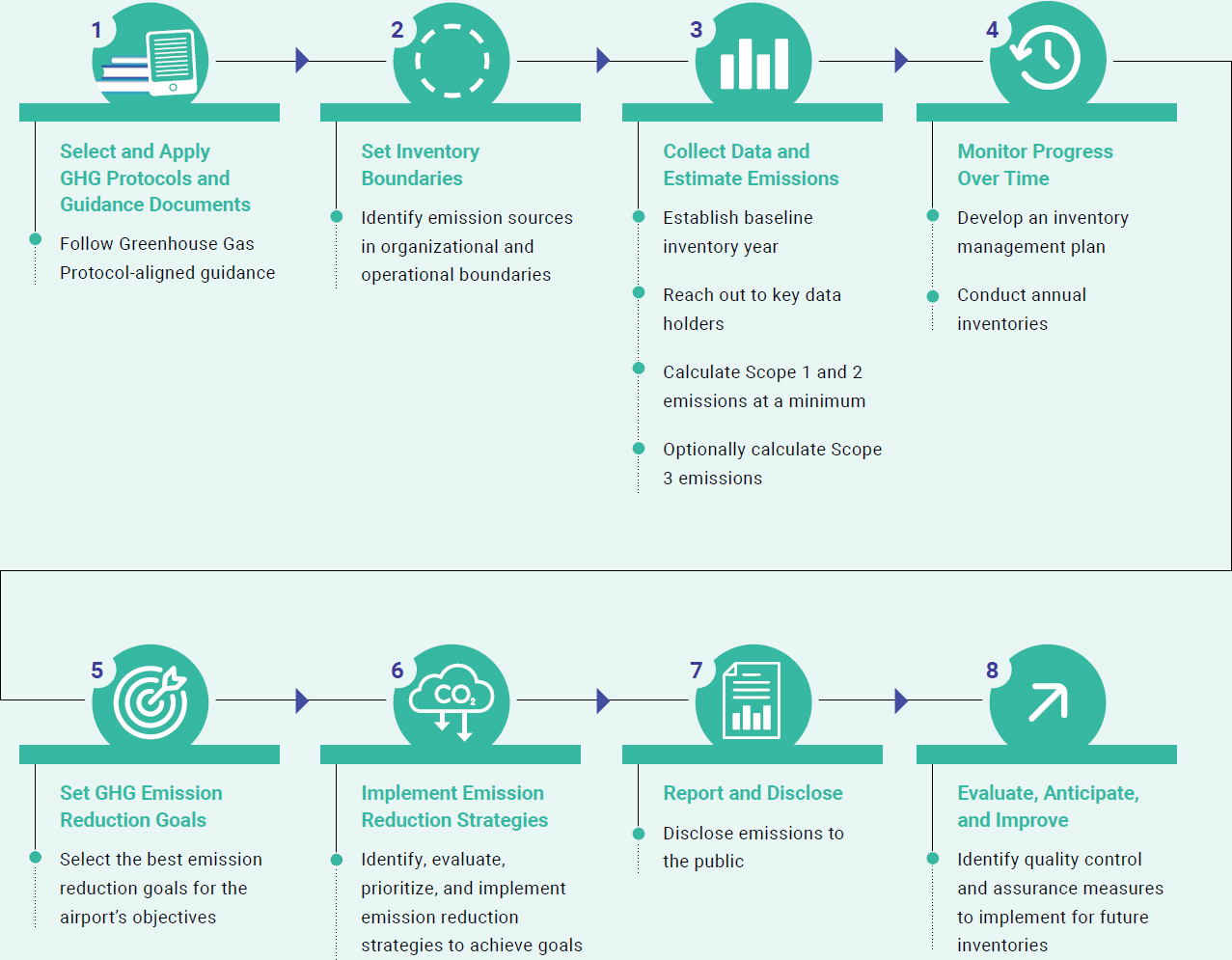
The airport GHG accounting process presented in this Primer is summarized in eight key steps:


