Developing a Guide for Truck Parking Information Management Systems (2025)
Chapter: 4 Guide Development
CHAPTER 4
Guide Development
Development of the Guide for TPIMS leveraged key takeaways from the information review and practice identification and provides a framework for the suggested practices. Recognizing that many factors go into a TPIMS deployment, the research team aimed to simplify the decisions down to “bite-sized” pieces that a reader can easily review and make an informed decision. A method that has garnered success includes simple flow charts to help ascertain priorities to determine completeness. The research team explored what might work best with the National Cooperative Highway Research Program (NCHRP) Responsible Staff Officer. This Guide contains new material that is directly relevant to this topic area and not extractions from other guides or documents.
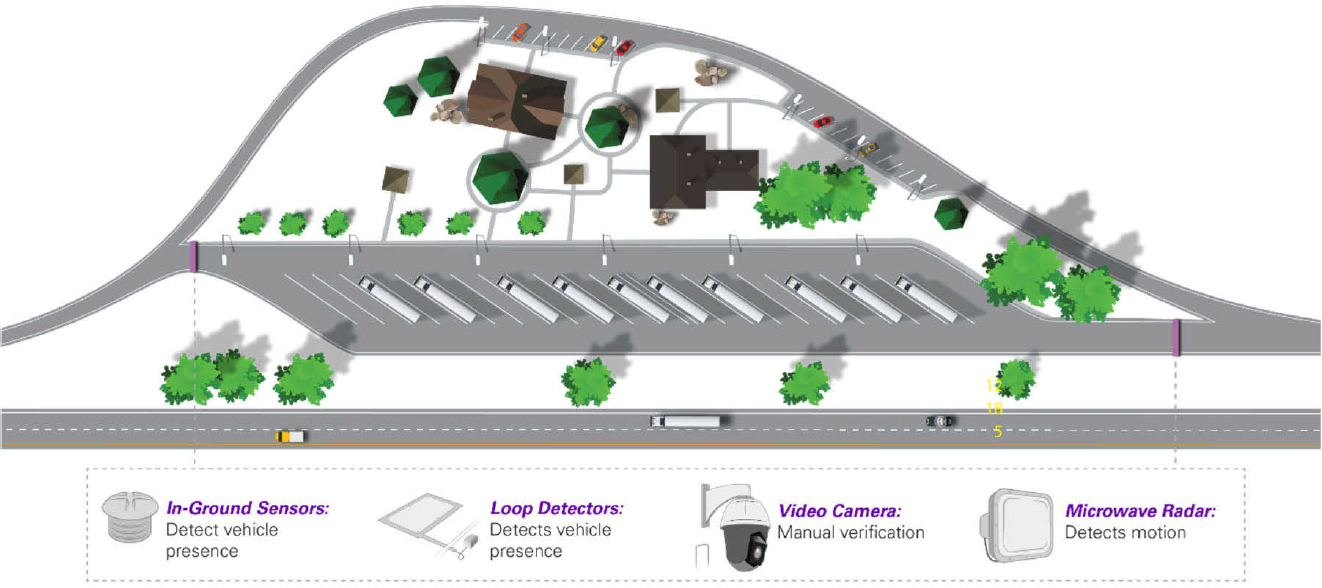
While the intended audience of the Guide is a transportation professional who wants to know what to consider with a TPIMS investment, the research team structured the Guide to provide flexibility for users of diverse levels of capability, understanding, and need for implementing TPIMS. This effort involved the creation of graphics and illustrations to “show” a concept rather than rely on text to “tell” it, and it will utilize various figures to help draw the reader’s attention to key items. The research team also created new graphics for this effort, such as the ones shown in Figure 10.
Overview of the Guide
The Guide was structured to walk the reader through the lifecycle process associated with considering and ultimately implementing TPIMS, offering an itinerary of considerations within each step, and showing the reader how certain decisions affect later phases. It provides easy-to-understand tactical decisions that an organization should consider before embarking on TPIMS, while providing supportive insights and
detailed information for those who want to learn further. The approach for developing the Guide included the following components:
- Provide a comprehensive list of key decisions that must be made (at some point) when embarking on a TPIMS investment.
- Provide the supporting details for readers to become more informed on a particular decision, specifically what work has been done to date by others and what perspectives on a topic exist in the industry.
- Offer the necessary information so an informed decision can be made. Equip the reader with the necessary facts to make them the expert among their stakeholders and decision-makers.
- Show how decisions made in the planning phase influence downstream decisions for design, operations, and maintenance.
Table 16 shows the organization of the Guide. It was structured to be useful for decision-makers at any level as well as for technical and non-technical audiences. The following subsections provide a brief scan of the topic areas covered in each chapter of the Guide.
| Chapter | Subchapters and Details |
|---|---|
| Overview of TPIMS | This introductory chapter describes, at a high level, the “who,” “what,” “where,” “when,” “why,” and “how” for TPIMS investment. It familiarizes the reader with the topic area, establishes the purpose of the Guide, and outlines the practice areas covered. |
| Identifying the Purpose and Need for TPIMS |
This chapter helps an agency identify and articulate its purpose and need for TPIMS. It recommends the following actions:
|
| Planning TPIMS |
This chapter guides an agency with the necessary planning-level decisions, utilizing direct ties to downstream impacts in its lifecycle. It recommends the following actions:
|
| Chapter | Subchapters and Details |
|---|---|
| Designing TPIMS |
This chapter guides an agency with the necessary design-level decisions, utilizing direct ties to upstream choices and downstream impacts in its lifecycle to help frame the impacts. It recommends the following actions:
|
| Procuring and Deploying TPIMS |
This chapter guides an agency with procurement options for TPIMS, recognizing the value of knowing what options are available even if contrary to current procurement methods of the agency. It recommends the following actions:
|
| Operating and Maintaining TPIMS |
This chapter guides an agency with the necessary decisions for operating and maintaining a TPIMS system, utilizing direct ties to upstream choices in its lifecycle to help frame the impacts. It recommends the following actions:
|
| Expanding the TPIMS Program |
This chapter guides an agency with how to expand the TPIMS program beyond the initial deployment, showing how certain tactical planning and design decisions made earlier in the program development now provide opportunities for expansion. It recommends the following actions:
|
Overview of TPIMS
This chapter in the Guide serves as the introductory chapter to inform the reader on Basic TPIMS concepts. It answers the “who,” “what,” “where,” “when,” and “why” for TPIMS investment. It familiarizes the reader with the topic area, establishes the purpose of this Guide, and outlines the practice areas that the Guide will consider.
One key part of this overview is establishing the mission of this Guide. While TPIMS may be either a public-sector or private-sector service, the focus of this Guide is intended to be a resource for public-sector transportation agencies looking to embark on a TPIMS program. That said, the Guide will cover different opportunities available to that agency, which may include partnerships with private-sector organizations.
Another key part of this overview will be building an understanding that various decisions impact other elements in the TPIMS program lifecycle. The specifics are outlined in each chapter, but this will convey early on that the reader should implement the Guide holistically when developing a program, rather than focus on one particular element of interest without regard to other lifecycle elements.
This overview also ties-in the systems engineering development process. This development process is used for many ITS projects in the United States and is an internationally recognized approach for developing systems and technology projects such as TPIMS. Many processes in this approach cross-reference well with the chapters in the Guide, which align with lifecycle elements of a technology project.
Identifying the Purpose and Need for TPIMS
The second chapter’s objective is to help an agency articulate the purpose and need for deploying a TPIMS program. This chapter is a kickoff step in a TPIMS program lifecycle, as it establishes the rationale that TPIMS is the preferred alternative for addressing a critical freight transportation issue. In many instances, a “champion” at a public-sector transportation agency may recognize the value of TPIMS, but also struggle to make the right pitch to management and decision-makers about why TPIMS is the best option among a myriad of other competing interests.
To solidify a purpose and need, the Guide recommended the following actions:
- Establish a Purpose and Need. One of the first steps to build an agency-specific purpose and need for TPIMS is to understand the higher-level reasons why TPIMS is an appropriate option. The problem is fairly straightforward: simply put, truck drivers do not know whether an upcoming truck parking lot will have available spaces for them, and with limited truck parking capacity in the system, it is extremely challenging to predict where parking will be available. This inhibits the truck driver’s ability to optimally plan their route, forcing potentially an earlier stop (and subsequently less income) or taking a gamble to either (1) find parking at the lot (the best outcome), (2) risk a HOS violation by driving to the next parking lot, or (3) park in an unauthorized location to meet the HOS requirement.
- Point to TPIMS Deployment Examples. Document what motivated other transportation agencies to implement TPIMS. While these reasons would likely be unique to those agencies, the purpose of this section is to help an interested agency identify issues, goals, outcomes, or program attributes that they may not have initially considered and may apply to their agency.
- Identify and Engage Stakeholders. Identifying and establishing a base of engaged stakeholders will help subsequent planning and design processes to ensure that the deployed system provides the service that the community finds of value. This subsection also suggests stakeholder group types to target for outreach, including representatives of the trucking industry and truck drivers, truck stops, transportation agencies, and enforcement.
- Tailor a TPIMS Solutions. This subsection equips readers with answers to the “Can we just copy what ‘x’ organization did instead?” that a manager or decision-maker may ask in response to the purpose and need. Unfortunately, a perception lingers that, if a particular challenge was addressed by another organization, a particular solution can be replicated with minimal effort in a different environment. In the case of TPIMS, this generic “check box” approach does not work for many reasons, and this subsection informs a reader of various counterpoints they can offer to help explain why.
- Identify a Process for Project Delivery. This subsection identifies the general process to deliver TPIMS, even before project planning has been done, to show how the purpose and need can be delivered. TPIMS, being a system of multiple subsystems, follows closely to the development practices associated with an ITS program. As previously discussed in the TPIMS Information Review section, FHWA recommends designing and deploying such systems by using the systems engineering approach. For ITS projects, systems engineering typically uses what is referred to as the V-diagram, shown in Figure 1.
- Identify Funding Opportunities. This subsection provides insights—gained through research—on what funding programs were used by other agencies with TPIMS programs. Depending on funding resources available, this may allow an opportunity to tweak the purpose and need statement to make a proposed TPIMS program more eligible for certain types of funding. As found in Phase I research, many TPIMS programs were funded through freight-related Federal programs, but others were funded as part
- of technology grant programs and safety research. This subsection helps readers remain cognizant of what funding opportunities might be considered for their respective programs.
Planning TPIMS
Chapter 3 of the Guide focuses on the necessary planning-level decisions that a transportation agency must undertake before design can commence. While all chapters touch on a critical phase of building a successful TPIMS program, many of the decisions in this section have direct implications for subsequent chapters. In order to fully plan for TPIMS, the Guide recommended the following actions:
- Identify a TPIMS Business Model. One of the first decisions for implementing TPIMS into a region is whether to use a public-sector model, a private-sector model, or a hybrid model. Even though transportation agencies focus on public-sector endeavors, identification of a private-sector or hybrid approach can be used to help set up a program that achieves a regional goal, such as improving truck parking in certain key areas. This section of Chapter 3 identified and discussed three different types of business models that are applicable to TPIMS: public model, publicly owned land/lots partnering with private-sector, and privately owned land/lots partnering with public-sector program.
- Screen and Select Eligible TPIMS Sites. Site selection and program strategy is a key consideration for a public agency looking to invest in TPIMS, regardless of which business model is supported. While private-sector groups may focus on profitable locations, public-sector agencies are often more driven to solve larger societal changes and filling gaps caused market failure, and thus will align the business model (public, private, or combination) that they fund to accomplishing that goal. Site selection involves two key steps: (1) determine the overarching truck parking issues that a public agency is charged with solving; and (2) select the eligible parking facilities to be served by TPIMS.
- Select a Count Methodology. Various methods exist for assessing truck parking availability, each has its own set of advantages, disadvantages, and applications. Understanding how this planning-level approach impacts the downstream elements of TPIMS is critical for ensuring that the system is set up for success. Similar to the selection of parking locations, selection of a particular technology system and method for assessing real-time availability will drive subsequent decisions and technology system requirements, so making an informed decision at this point will help set a TPIMS program up for success.
- Review and Choose a Preferred Data Processing Solution. This step of the planning process reviews options that are available for data processing and their associated advantages and disadvantages. Public-sector and private-sector data processing options exist, and often are driven by predecessor decisions made by business model, site identification, and (to a lesser degree) count methodology, so it represents the logical next step to undertake. This section of the Guide helps an agency identify the choices that are available to its staff. While the preferred alternative may not yet be known, identifying the eligible (and ineligible) options can help structure the TPIMS program and establish requirements.
- Strategize Methods for Information Distribution. Another key decision rests on how information will be distributed. This section of the Guide provides details on the options available to a transportation agency for reporting parking availability. It also considers tools that enable data sharing between systems which would be useful for multi-state collaboration.
- Discuss Operational Policies. Transportation agencies must consider several other operational policies as part of TPIMS planning before any design is commenced, as these policies can ultimately impact the design. Examples of operational policies include latency (i.e., the time-distance gap between when a truck driver sees that reported availability and when they reach a facility), inconsistency in data, and others. Decisions made here may require an agency to look back at previous planning-level decisions in order to verify that selection of policies still permit a particular decision to remain valid.
- Identify Other Considerations. Transportation agencies must also account for other design considerations prior to undertaking the design process, recognizing that TPIMS may operate in a variety of environments. For example, rest stops may be far from urban centers and in areas with limited agency-
- owned network communications infrastructure, so determining what is and is not allowable for design practices is critical to avoid subsequent changes later in design due to poor planning. These include the availability of power, network communications, and driver distraction regulations.
In addition, transportation agencies that have decided to undertake the TPIMS planning process can develop a series of systems engineering documents that corresponds to the project lifecycle. this section of the Guide identifies documents that support planning for TPIMS. Examples include feasibility studies, concepts of operations, and systems requirements.
Designing TPIMS
The fourth chapter of the Guide focuses on the design tasks required by a transportation agency to implement the TPIMS program that was envisioned in the project planning stage. The design of the system must meet the system requirements developed in the systems engineering process. This chapter discusses the required design steps and document development required to obtain a contractor to build the supporting infrastructure and implement system software in the back office.
To implement a TPIMS deployment, the following steps must be taken:
- Identify a Detection Technology. Based on the count methodology that is ultimately selected, the physical layout of the truck parking facility, and the requirements established as part of the system requirements document, one of the first design steps is to identify a detection technology that provides accurate monitoring. Several detection technologies may provide the required functionality, which allows for a comparative assessment of the advantages and disadvantages for each option. Often, a pilot test can be used to confirm if the proposed product or competing products will function as needed before deploying at all sites.
- Determine Methods for Site Surveillance. To ensure system accuracy, system operators must be able to independently determine the actual number of available spaces. This could be done with dedicated persons visiting the sites and doing manual counts. Since this requires resources and time to reach these sites, remote video surveillance is typically used to provide real-time images of parking facilities to help confirm the number of available truck parking spaces reported by the sensors is accurate.
- Design Site Infrastructure. Determine where and how the detection technology will be installed along with the power and communications infrastructure that must be installed to support the system. The selected sensor technology will dictate where it must be installed. The potential impact of informally parked trucks must also be taken into consideration, both from a standpoint of where detectors are placed to capture all of the vehicles that are desired to be counted and so informally parked vehicles do not block the sensors. Design of the power and communications infrastructure that must be installed to support the system must also be completed. It must be determined if power can be obtained from an existing service or if a new electrical infrastructure is needed at the site. Depending on technology and camera mounting requirements, it must also be determined if new structures are needed for mounting.
- Select Roadside Assets. In the planning phases, the means to distribute information must be determined. If it was decided to distribute information via a roadside method, then selection of roadside assets is a design decision that will need to be made. Roadside message signs are considered a preferred dissemination method by commercial motor vehicle operators. They are designed to provide real-time messages on the number of available truck spaces at upcoming truck parking areas.
- Determine Data Processing Tools. In the planning phases, one decision is to select a means to process data, with different models available to a transportation agency. Three data processing technologies: central/integrated software, independent software, and SaaS, are presented and discussed in more detail in this section. Regardless of the selected model, the software or service ultimately needs to meet the system requirements that process raw data from the sensors into reportable parking space availability.
- Evaluate Supporting Network Infrastructure. Network communication channels are required to facilitate data and information exchange. Depending on the sensor technology, there may be a need for network communications between remote units and a centralized access point. With all sensors, there will be the need to design the communications link between the sensor in the field and the application used to calculate parking availability. There must also be network communication channels to transmit the calculated truck parking availability data to roadside message signs, traveler information applications and the systems data exchange API.
- Consider Methods for Information Sharing. Truck parking availability information, as a best practice, should be shared through existing agency traveler information systems beyond roadside signing. If decisions made in the planning phases lean toward web-based information sharing platforms, then a transportation agency should evaluate what options are available as part of the design. Stakeholders should be involved in the development of information sharing methods to make sure the truck parking availability information is presented understandably and can potentially be accessible hands-free.
- Choose Data Exchange Protocols. As part of the planning and design process, a transportation agency needs to determine if value exists within sharing information with outside parties, such as other transportation agencies, third-party application providers (such as private-sector truck information services groups), and other users. In some instances, a regional TPIMS data standard may exist among certain transportation agencies with existing TPIMS programs, which can be utilized and adopted by the new TPIMS program. The data exchange specification must be provided to entities wanting to access the data to develop applications for disseminating TPIMS information.
Transportation agencies that have decided to develop a TPIMS can memorialize these design decisions in a variety of widely adopted systems engineering documents. The type of documents resulting from the design process will depend on the procurement method used to deploy the TPIMS. They include:
- High-Level Design—Often aligning with 30%-complete design plans, which some agencies refer to as ‘concept plans’ to help build consensus and allow for discussion.
- Detailed Design—Often aligning with 100%-complete design plans, specifications, and cost estimates. This subsection highlights the value of these documents.
Procuring and Deploying TPIMS
This chapter of the Guide presents the procurement options that have been used to implement and operate a TPIMS. For each of the options, the advantages and disadvantages are discussed. To procure and deploy a TPIMS, the following steps must be taken:
- Select a Procurement Method. The first step is for a transportation agency—having identified an operational model, requirements, and a preferred design—to identify a method to procure TPIMS. Transportation agencies often have several options available to them. These include the traditional design-bid-build option, design-build, and a service provider contract.
- Construct and Deploy Infrastructure. The next step is to construct and deploy the TPIMS. Deployment begins with procurement of infrastructure and technology components of the system.
- Undertake Programming/Integration/Testing/Validation. The last step is to program the TPIMS and conduct testing/validation. For the initial TPIMS deployment, the transportation agency will need to consider the implementation of a back office system to process sensor data to determine parking availability. Subsequent TPIMS deployments, such as those in later phases, may be added to the existing system, and only require the system to allow for scalability. Regarding testing and validation, this may be completed by the contractor under the oversight of agency staff or an unbiased third-party, such as an agency’s engineering consultant that was not involved in the construction.
Operating and Maintaining TPIMS
This chapter of the Guide presents the options for operating, measuring performance, archiving data, and maintaining a TPIMS. The resources required to operate the TPIMS depend on the parking availability monitoring methodology selected and procurement strategy, which were discussed previously. This chapter shows how earlier decisions have directly impacted ongoing operations and maintenance. To operate and maintain a TPIMS, the following steps must be taken:
- Identify the Operating Requirements. Operating the system entails monitoring system components to ensure they are operational and, in some cases, resetting incorrect truck parking availability information when needed. Several types of operations need to be considered: operations of the devices themselves and operations of the system functions. For the devices, the effort required to monitor their operations depends on the degree of automation associated with device malfunction reporting. Regarding the operations of system functions, a transportation agency will need to verify that the information reported to the public is accurate, and the degree of risk to this accuracy is often driven by earlier planning and design decisions. If parking availability is being determined based on counting vehicles entering and exiting the truck parking areas, operations will require the number of available spaces to be reviewed and the TPIMS updated when the reported availability is incorrect.
- Report Parking Availability. As a parking area nears capacity, actual and perceived errors in the number of available spaces reported are more obvious to truck drivers. Perceived errors occur when a truck driver considers the number of available spaces to be more than just the marked spaces. This section of the chapter discusses how agencies may choose to report parking availability in light of these errors.
- Select Methods for Capturing Performance Measures. A transportation agency will need to collect performance measures on how TPIMS operates, either in support of a grant requirement or out of interest of identifying methods to improve the system. Critical system performance measures often include system accuracy and system downtime. Accuracy should be measured by periodic comparisons of manually counted available truck parking spaces to the number of available spaces the system is reporting. The magnitude of required resets should be documented to provide data for tracking system accuracy. The accuracy data can be used to determine how often the site needs to be reset to meet minimum accuracy requirements.
- Recognize Maintenance Requirements. An agency may choose to operate and maintain its TPIMS in-house, or to contract for these services. If an agency decides to contract for operations and maintenance services for their TPIMS, it must determine who within the agency will manage the contracts and the length of the contracts. Managing the contract entails oversight, monitoring the contractor’s performance, and processing the contractor’s invoices.
- Plan for Data Management and Archiving. A TPIMS will generate a substantial amount of data. Depending on funding requirements or agency policy, data may need to be stored and/or shared with other groups, necessitating proper data management and archiving requirements. A transportation agency will need to decide how long the raw data should be saved and if and how data should be shared with others.
- Lifecycle Costs. This section of the chapter discusses TPIMS lifecycle costs. TPIMS deployments are relatively new, so there is limited TPIMS-specific lifecycle cost data. However, the lifecycle costs for TPIMS are expected to be very similar to other ITS deployments.
Expanding the TPIMS Program
This chapter in the Guide focuses on decisions revolving expansion of the TPIMS program. Its purpose is to facilitate the next steps of expanding a TPIMS program by examining successes and failures encountered with the current system. It also serves as a reinforcement to key planning and design decisions made earlier by showing how those decisions create new opportunities for program expansion.
Generally, States have not yet begun to expand their individual TPIMS programs—either in terms of geographical coverage or operational capabilities—beyond their initial deployments. Instead, proliferation of TPIMS programs has occurred via States starting new programs. For TPIMS to expand, it is essential that it is integrated into agencies’ core planning processes and that they develop design standards that allow for efficient incremental expansion of TPMIS across their networks. This chapter discusses how elements of the Guide may be used to integrate TPIMS into the planning process, some key design considerations for expanding TPIMS, and funding opportunities for facilitating expansion.
- Integrate TPIMS into the Planning Process. Integrating TPIMS into agency planning is essential for TPIMS expansion because the planning process is the first stage in determining future investments and where they occur. The Planning TPIMS chapter of the Guide discussed several documents that support planning for TPIMS, including feasibility studies, concepts of operations, and freight plans. However, in order to reach its full potential, TPIMS must be recognized as a tool to apply to truck parking challenges that are identified as part of long-range planning processes. In other words, TPIMS should be included with other TSMO solutions that are part of a DOT’s “toolbox” and would potentially be included as a recommendation in a long-range transportation plan.
- Scalable Design. A majority of agencies using the Guide would be designing TPIMS for an initial deployment. A successful demonstration project could lead to the desire to expand, implementing a network of TPIMS sites for broader coverage. To achieve scalability, agencies need to consider how these initial designs can be adapted to meet the needs of an expanding network. This section extends the guidance provided in Chapter 4 (Designing TPIMS) of the Guide, which covers design considerations for field infrastructure, including ITS devices for detection, information dissemination, and site monitoring. Its focus is on standardizing these designs to facilitate scalable implementation by developing standard drawings, requirements, and specifications for the various elements in a TPIMS deployment.
- Funding Opportunities. TPIMS can draw on funding sources from federal, state, and local levels. While some funding may be directly related to truck parking, more innovative funding could be used to support part or all of the project costs. Ensuring TPIMS funding is listed in state and metropolitan planning goals can allow for easier state funding access and provide for city and regional deployment coordination. Partnerships with private truck stops should also be leveraged where possible to decrease costs and expand parking opportunities. This section of the Guide discusses the various state and federal funding sources available to TPIMS.


