Development of the Human Factors Guidelines for Road Systems: Third Edition (2025)
Chapter: 2.0 Objectives, Methods, and Results of Tasks 1-6
2.0 Objectives, Methods, and Results of Tasks 1-6
2.1 Task 1: Assess Existing Human Factors Literature
2.1.1 Objectives
The objectives of Task 1 were to: (1) review existing literature on HF considerations in the design and operations of road systems for all types of road users, and (2) to identify a process for scoring relevant literature for its potential inclusion in the HFG4, based on the strength of evidence reported and the literature’s relevance to design and operations from a HF perspective.
2.1.2 Methods
Activities to assess relevant Human Factors literature included: reviewing keywords from previous HFG projects, conducting an initial literature review to identify potentially useful data sources, selecting key data sources based on quality and applicability, and identifying potentially useful data sources. A similar survey was conducted as part of NCHRP 17-80 Human Factors Guidelines for Road Systems, Third Edition (HFG3), and our approach reflected lessons learned from that activity. Methodological details are provided below.
Review keywords, search criteria, and search results from NCHRP Projects 17-31, 17-41, 17-47 (hereafter HFG2), and 17-80 (hereafter HFG3) and conduct new searches.
The team retained the search criteria used and the literature search results obtained from all four of our previous HFG projects and used this information as a starting point for the literature searches in Task 1 of the current effort. In addition to the search terms used to develop the HFG2, we conducted searches on topics and combinations of topics that were not covered in the HFG2, but that were under consideration for the HFG3 and now the HFG4, including: Crash Diagnostics, Transit, Freight, Older Road Users, Complete Streets, Road Diets, Motorcyclists, Electric Scooters, and Urban and Rural Issues. Exponent also retained many data sources that were previously reviewed during the development of the HFG3, but not cited because of inadequate number of sources for a topic, critical inconsistencies across data sources, or other reasons. Transportation Research International Documentation (TRID) and Google Scholar were the primary search engines employed. Because we already have the outcomes of these searches form the HFG3 effort, we limited our search in the current project to the years 2018-2021.
Conduct “broad brush” literature review to identify useful data sources.
The TRID and Google Scholar searches were combined into a single document for each chapter with citations and abstracts. As expected, the specific topics and scope of individual topics varied widely with respect to the amount and type of research available across topics and chapters. To accommodate these variations, we conducted a preliminary survey or “broad brush” review of the data sources to determine which topics warrant further division into subtopics because of their extensive research base, and to identify those topics that do not have a sufficient research base to be included in the HFG4.
Select key information using the Best Evidence Synthesis (BES) scoring technique.
A key factor in developing valuable HF guidelines is the specification of explicit, objective criteria for the selection of data sources used to develop the guidelines. For this task, the BES approach was used in which data sources representing the best evidence within a particular design topic were selected for more detailed review and development into guidelines for the HFG4. Derived from the legal principle of best evidence, BES is designed to guide the systematic analysis of technical literature in which only the best evidence in a given knowledge domain is included in the review. Importantly, the characteristics that define this “best evidence” will vary with the domain. For example, when applied to issues associated with use of color in traffic control devices, the best evidence might consist of well-controlled randomized experiments in some areas but only quasi-experimental field tests in others. The pragmatic basis of BES emphasizes the use of domain-specific review criteria to derive a set of data sources meeting minimum specified standards of quality and applicability.
Develop initial summaries of the applicability of available information to the HFG.
For each of the existing and new chapters/topics selected based on the Task 4 results (see below), we generated a data table with columns corresponding to: key references or citations, themes (corresponding to possible guideline topics), and general applicability to the HFG.
2.1.3 Results
The results of this activity were provided in our technical memo sent to NCHRP on April 22, 2022. Appendix A of that memo contained a series of tables and reference lists for each existing chapter in the HFG (except Chapters 5 and 10, which were updated as part of HFG3). The tables reflect the individual topics examined for each chapter, as well as the number of data sources (from years 2018-2021 only) yielded by each search and the number of data sources that are considered potentially useful for HFG4 development. The citations for those data sources considered potentially useful for HFG4 development were presented below each table. Note that Appendix E in the Interim Report contained the combined data sources from both the HFG3 and the current HFG4 project.
2.2 Task 2: Develop Draft Practitioner Survey
2.2.1 Objectives
The objective of Task 2 was to develop a draft practitioners survey on potential HFG4 content. NCHRP approval of the draft survey was required before work could begin on Task 3.
2.2.2 Methods and Results
Activities to develop a survey of practitioners included: identifying potential participants in the survey, developing the individual survey items, identifying the means to conduct the survey, and finalize a work plan to finalize the survey. A similar survey was conducted as part of HFG3, and our approach reflected lessons learned from that activity. Methodological details and results are provided below.
Identified potential participants for the survey.
The survey was intended for current users of the HFG and other potential users (e.g.., transportation agencies, professional designers, traffic engineers, planners, and HF experts) of the HFG who could help identify useful content in the HFG4. We developed a list of organizations that could participate in the user feedback activity. The list focuses on Transportation Research Board (TRB) standing committees relevant to safety and HF, as well as several AASHTO committees/subcommittees. The membership of these committees includes both existing and potential users of the HFG and includes transportation agencies, professional designers, traffic engineers, planners, HF experts, and others. Included in this group are past HFG project panel members, past Working Group members, points-of-contact for the HFG pilot studies conducted as part of Project 17-47, and points-of-contact for the recently completed HFG training (NCHRP 20-07(334)).
Developed the individual survey items.
We reviewed the survey items and results from the HFG3 project in light of the objectives NCHRP 22-46. Our goal was to make the survey as quick and simple as possible for respondents to complete, while making sure that we captured key information about the desired content of the HFG4. Accordingly, a mix of open-ended and multiple-choice response items were developed, focusing on content. We used many of the questions that we used for the HFG3 survey, but also removed and added some new questions based on inputs from the project panel at the kick-off meeting. As with the HFG3, survey respondents who indicated that they know about and use the HFG answered a slightly different set of questions than those who did not know about or use the HFG.
To prioritize updates to the HFG, a 12 (or 9) question internet-based survey was conducted to understand the needs of users of the HFG and identify which updates would be of greatest value. The survey questions covered the following topics:
- Demographics and job responsibilities (Questions 1 to 3)
- The respondent’s level of familiarity with the HFG (Question 4)
- Based on their response to Question 4, respondents received a different set of questions depending on whether they reported being familiar (Questions 5 to 10) or unfamiliar (Questions 11 to 13) with the HFG. All respondents received Questions 14 and 15.
- For those familiar with the HFG: What types of design issues or problems users apply the HFG to, which chapters are the most/least useful, and what new chapters/topics would be most useful (Questions 5 to 10)
- For those unfamiliar with the HFG: Why respondents have not used the HFG and what new chapters/topics would be most useful (Questions 11 to 13)
- One question to gauge respondents understanding of the difference between HF issues and driver behavior issues (Question 14)
- One question about additional recommendations for improving the HFG (Question 15)
Identified the means to conduct the survey.
As with the HFG3, we used a web-based survey provider, SurveyMonkey™ (www.surveymonkey.com) to conduct the survey. This service is inexpensive, easy to customize, and produces data files that can be exported to Excel for
analysis. We created the survey within the application and then generated a link that can be accessed by anyone.
Following the procedures used in HFG3, we sent an email to heads of key TRB and AASHTO committees, and several other groups and organizations using a standardized email invitation that contained survey access links and requests to send the invitations to members and friends. This general approach yielded over 250 responses for the HFG3; we were confident that this approach could provide the needed data to support the HFG4.
Finalized the work plan to conduct the survey.
Upon receiving feedback from the project panel to our draft workplan, we conducted a web meeting with the project panel to review the plan and modified relevant portions of the plan based on the feedback we received during this meeting.
Workplan for conducting the survey.
The survey link remained open for 3 weeks—from November 17, 2021 to December 10, 2021—with an email reminder sent out on December 6, 2021. Once the survey was closed, we downloaded the data, summarized the open-ended survey items, generated descriptive statistics for the multiple-choice items, and summarized all the results in a project report.
2.3 Task 3: Conduct Practitioner Survey
2.3.1 Objectives
The objective of the practitioner survey was to understand the needs of HFG users and identify the priorities users and potential users have for HFG updates. We surveyed transportation agencies, professional designers, traffic engineers, planners, HF experts, and others to identify potential HFG4 content.
2.3.2 Methods
The project team sent an email invitation for participation in the survey to the chairs of key TRB and AASHTO committees relevant to safety and HF with a request for them to forward the survey request and SurveyMonkey™ link to their committee members and committee friends.
The email introduced the project and purpose of the survey, summarized the HFG, identified desired characteristics of respondents, and included the SurveyMonkey™ link. The invitation email was sent to the committees and sub-committees listed in Table 1.
Table 1. HFG4 Survey Recipients
| TRB Code | Committee Name |
|---|---|
| ACH10 | Standing Committee on Pedestrians |
| ACH20 | Standing Committee on Bicycle Transportation |
| ACH30 | Standing Committee on Human Factors of Vehicles |
| ACH40 | Standing Committee on Human Factors of Infrastructure Design and Operation |
| ACH50 | Standing Committee on Road User Measurement and Evaluation |
| ACH60 | Standing Committee on Vehicle User Education, Training, and Licensing |
| ACP10 | Standing Committee on Regional Transportation Systems Management and Operations |
| ACP15 | Standing Committee on Intelligent Transportation Systems |
| ACP20 | Standing Committee on Freeway Operations |
| ACP25 | Standing Committee on Traffic Signal Systems |
| ACP30 | Standing Committee on Vehicle-Highway Automation |
| ACP35 | Standing Committee on Managed Lanes |
| ACP40 | Standing Committee on Highway Capacity and Quality of Service |
| ACP50 | Standing Committee on Traffic Flow Theory and Characteristics |
| ACP55 | Standing Committee on Traffic Control Devices |
| ACP60 | Standing Committee on Access Management |
| ACP70 | Standing Committee on Highway Traffic Monitoring |
| ACP80 | Standing Committee on Traffic Simulation |
| ACS10 | Standing Committee on Transportation Safety Management Systems |
| ACS20 | Standing Committee on Safety Performance and Analysis |
| ACS30 | Standing Committee on Traffic Law Enforcement |
| ACS40 | Standing Committee on Occupant Protection |
| ACS50 | Standing Committee on Impairment in Transportation |
| ACS60 | Standing Committee on Truck and Bus Safety |
| AJL70 | Standing Committee on Tort Liability and Risk Management |
| AKD10 | Standing Committee on Performance Effects of Geometric Design |
| AKD20 | Standing Committee on Roadside Safety Design |
| AKD30 | Standing Committee on Low-Volume Roads |
| AKD80 | Standing Committee on Roundabouts & Other Intersection Design and Control Strategies |
| AME50 | Standing Committee on Accessible Transportation and Mobility |
| APO50 | Standing Committee on Bus Transit Systems |
| ARO70 | Standing Committee on Rail Safety |
| ARO80 | Standing Committee on Highway/Rail Grade Crossings |
| ATO40 | Standing Committee on Transportation of Hazardous Materials |
| N/A | AASHTO Committee on Design |
| N/A | AASHTO Committee on Transportation Systems Operation |
| N/A | AASHTO Committee on Traffic Engineering |
The survey remained available from November 17, 2021, to December 10, 2021. The initial emails were sent on November 17, 2021, and the reminder emails were sent out on December 16, 2021. A total of 279 responses were collected during this period. These results were organized into tables and graphs for frequency analysis.
2.3.3 Results
This section discusses the results of the user survey administered to current or potential users of the HFG. Included are a summary of the findings from the survey, as well as our conclusions
regarding key criteria to be considered and detailed acceptance criteria for the new/updated content to be included in the HFG4. More details on the results were presented in Appendix B of the Interim Report.
The 279 survey respondents were from a variety of governmental, private, and academic backgrounds. The most common primary job responsibilities among respondents were Traffic Safety (41%), Planning (34%), and Traffic/Transportation Studies (30%). Nearly half of all respondents (48%) reported having more than 20 years of experience. When asked which reference materials respondents use in their job, (72%) used the MUTCD, (57%) used the AASHTO Green Book, and (52%) used the HSM. Finally, 192 respondents (69% of the sample) reported they had not heard of or had never read or used the HFG. The remaining 87 participants had at least read some of, or used, the HFG.
From the main body of the survey, several key trends emerged which are summarized here:
- The applications of the HFG as reported by users (n=65) varied considerably and included guidance on specific countermeasure selection, conducting diagnostic assessments of safety concerns and incidents, training development, and supporting RSAs.
- The top three most useful HFG chapters as reported by users (n=39) were about signalized intersections, non-signalized intersections, and signing, but responses varied, with nearly each chapter being reported at least once as being the most useful. Nearly every chapter, except “2 – How to use this document” and “22 – Tutorials”, was also noted at least once by users (n=25) as being the least useful chapter, with chapters about changeable message signs and rail-highway grade crossings listed most often.
- Regarding HFG chapters that will soon be available, more users (n=65) said they would use the Pedestrians chapter (97%) compared to the Bicycles (81%) and Roundabouts (72%) chapters.
- The majority of those who reported never reading or using the HFG (n=169), reported being unaware of its usefulness to understanding and incorporating users’ needs in Traffic Safety (57%).
- Preference for new topics were relatively consistent between both users (n=65) and nonusers (n=169) of the HFG. Both groups rated Road Diet/Complete Streets and Older Road Users as the top two highest priority (in that order), and Design for Motorcycles as the lowest priority.
- There was some consensus across users and non-users regarding proposed topics they would like to see in the HFG, including considerations for vulnerable road users (e.g., pedestrians and bicyclists), modes of micromobility (e.g., e-bikes, e-scooters), and people with disabilities (e.g., pedestrians with vision impairment).
- Question 14 asked all survey recipients to describe the differences between HF issues and driver behavior issues as they relate to roadway safety. The team scored the responses, and while scoring such open-ended responses is admittedly imperfect, the results are interesting. Even with a generous approach to the scoring, only 37 out of 194 responses (19%) were deemed correct. In Appendix B from the Interim Report, correct
answers to this question are color-coded in light green, while incorrect responses are color-coded in red.
2.4 Task 4: Develop Recommendations to Update the Content of the HFG
2.4.1 Objectives
The objectives of Task 4 were to recommend: (1) updates to guidelines from previous HFG editions due to improvements in the understanding of previously emerging and other technical issues; (2) new technical chapters to be developed, including specific guidelines, with justification for their development, and (3) new print/electronic presentation formats for the HFG4 to increase its usability and its direct cross referencing of other guidance documents such as the HSM, the AASHTO Green Book, the MUTCD, and other widely used resources.
2.4.2 Methods
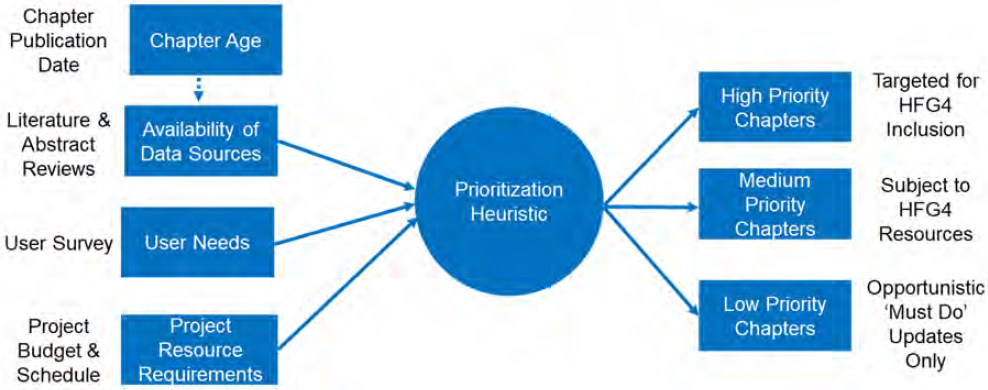
The key activity in Task 4 was to implement a process for assigning priorities for both existing HFG chapter updates, as well as new candidate chapters. Assigning priorities was necessary in order to balance the availability of data sources that could be used to generate guidance with both the topics of greatest interest to the practitioner community, as well as practical considerations including time and project resources. A structured methodology was developed to prioritize the chapters based on four factors:
- Chapter Age (from the creation date of existing chapters)
- Availability of Sources (from the Task 1 Literature Search and Abstract Reviews)
- User Needs (from the Task 3 User Survey)
- Project Resource Requirements (i.e., expected level of effort, based on the Task 1 Literature Search and Abstract Reviews)
Figure 1 illustrates the chapter prioritization process, followed by an explanation of each of the factors considered in prioritizing the new and updated chapters.
Document Chapter Age and HFG3 Priorities
The starting point for the prioritization process was the ‘age’ of the existing HFG chapters.1 ‘Chapter age’ is somewhat confounded with the availability of data sources (older chapters could potentially have more data sources available), but it was an important consideration for chapter updates, given how long it has been since some HFG chapters were developed. Chapter age then, simply reflected the year of publication: 2007 for NCHRP Report 600A, 2010 for NCHRP Report 600B, and 2012 for NCHRP Report 600 - the 2nd Edition HFG. Rated priorities for the new/updated chapters from HFG3 were taken straight from the HFG3 Interim Report. These priorities from the HFG3 were noted in order to provide a complete picture for the individual chapters, but did not play a significant role in the prioritization process.
Availability of Data Sources
The next factor examined in the prioritization process was the availability of high-quality, highly applicable data sources for creating new chapters and for updating existing chapters. This was a key consideration for the current project, as valuable updates to new or existing chapters cannot be developed without supporting data sources. For each chapter topic (existing chapters, plus candidate new chapters), project staff examined the data sources from the Task 1 literature and abstract reviews and assessed both quality and applicability relative to the HFG. Each chapter or topic was assigned a rating – high, medium, or low – corresponding to the perceived quality and applicability of the data sources that were found during our literature searches.
End-User Survey Needs for HF Guidance
Next, we considered the End-User Survey results from Task 3 and identified those new chapters that were of interest to both current HFG users and non-users. The survey included rankings of users’ interest in each of six new candidate chapters. Each potential new chapter or topic was
___________________
1The ‘age’ factor was not relevant for the candidate new chapters/topics.
assigned a rating – high, medium, or low – corresponding to the ratings provided to Questions 8 and 12 in the End-User Survey.
Prioritization of updates for the existing HFG chapters was based on responses from users of the current HFG to Questions 6 and 7: “What chapters/guidelines/topics in the HFG have been most useful to you?” and “What chapters/guidelines/topics in the HFG have been least useful to you?” Respondents answered with at least one choice for most/least useful chapter, with the opportunity to select up to five chapters (i.e., first choice, second choice, etc.). Again, each existing chapter was assigned a rating – high, medium, or low – corresponding to the frequency with which it was rated as ‘most’ and ‘least’ useful in Question 6 and 7 in the End-User Survey.
2.4.3 Results
Priorities for the HFG4
Based on these inputs, the project team developed chapter priorities for the HFG4. The results of the prioritization process and priorities for the HFG4 are shown below in Table 2. Our general heuristics for assigning priorities to the new/updated chapters were as follows:
- High Priority: Chapters were assessed as a high priority for the HFG4 if they had high ratings on both the availability of data and user needs factors, or a high rating on one of these factors and a medium rating on the other.
- Medium Priority: Chapters were assessed as a medium priority for the HFG4 if they had medium ratings on both the availability of data and user needs factors, or a low rating on one of these factors.
- Low Priority: Chapters were assessed as a low priority for the HFG4 if they had low ratings on both the availability of data and user needs factors, or a low rating on one factor and no more than a medium rating on the other.
These initial assigned priorities were then adjusted based on the chapter age and HFG3 priority. For example, the assessed needs for users of the Horizontal Curves chapter were mixed, but the older age of the chapter combined with the availability of many data sources that can be used to update the chapter rendered this a high-priority chapter for the HFG4. Similarly, an older road user chapter was on the cusp in terms of the combined ratings from the availability of data and user needs factors. However, this topic has consistently been requested by HFG users and was therefore assessed as a high-priority chapter for the HFG4.
Table 2. Results of the prioritization process and priorities for the HFG4
| Chapter | Age | Final HFG3 Priority* | Availability of Data Sources (HFG4)** | User Needs Priority (HFG4)*** | HFG4 Priorities |
|---|---|---|---|---|---|
| 5- Sight Distance | 2008 | High (Completed) | N/A | Medium-High | N/A |
| 6 - Horizontal Curves (but older)**** | 2012 | Medium | High | Mixed | High |
| 7- Vertical Curves | 2012 | Low | Low | Low | Low |
| 8 - Tangents | 2012 | Low | Low | Low | Low |
| Chapter | Age | Final HFG3 Priority* | Availability of Data Sources (HFG4)** | User Needs Priority (HFG4)*** | HFG4 Priorities |
|---|---|---|---|---|---|
| 9 – Transition Zones | 2012 | Low | Low | Low | Low |
| 10- Non-signalized Intersections | 2008 | High (Completed) | N/A | High | N/A |
| 11- Signalized Intersections | 2008 | High | High | High | High |
| 12 - Interchanges | 2012 | Medium | Medium | Low-Medium | Medium |
| 13 - Work Zones | 2008 | Medium | High | Low-Medium | Medium |
| 14 – Rail-Highway Grade Crossings | 2012 | Low | Low | Low | Low |
| 15 – Urban Environments | 2012 | Medium | Medium | Low-Medium | Medium |
| 16 – Special Considerations for Rural Environments | 2010 | Low | Low | Medium | Low |
| 17 - Speed | 2010 | High | High | High | High |
| 18 - Signing | 2010 | Low | Low | High | Medium |
| 19 - CMS | 2010 | Low | Medium | Low | Low |
| 20-Markings | 2010 | Medium | Low | Low-Medium | Low |
| 21-Lighting | 2012 | Medium | Medium | Low | Medium |
| Peds | 2020 | High (Completed) | N/A | N/A | N/A |
| Bikes | 2020 | High (Completed) | N/A | N/A | N/A |
| Roundabouts | 2020 | High (Completed) | N/A | N/A | N/A |
| Complete Streets | N/A | Medium | Medium | High | High |
| Older Road Users | N/A | Medium | Low-Medium | High | High |
| Motorcycles | N/A | Medium | Medium | Low | Low |
| Transit | N/A | Medium | Medium | Medium | Medium |
| Heavy Vehicles | N/A | Low | Low | Medium | Low |
| Connected/Automated Vehicles | N/A | Low | Low | Medium | Low |
* From NCHRP 17-80 (HFG3)
** Reflects the Task 1 Literature Review
*** Reflects responses to Questions 6, 7, 8 and 12 in the Task 2/3 user survey
**** Most of the guidelines in the Horizontal Curves chapter reflect pre-2007 data sources
Recommendations for HFG4 Content
Based on the results of Tasks 1 through 4, the project team developed the following recommendations for the HFG4 content:
- Develop the high-priority chapters identified in Table 2 above and update the Urban Environments chapter (Chapter 15) with an emphasis on developing topics and guidelines. Specifically, we will update Horizontal Curves (Chapter 6), Signalized Intersections (Chapter 11), Urban Environments (Chapter 15), and Speed (Chapter 17) and develop new chapters on Complete Streets and Older Road Users. Though both the Transit topic and the Urban Environments chapter were rated as being of only medium priority for the HFG4 (from Table 2 above), if we consider the cumulative sum of the available data sources available to support updates and new guidelines, there are
- Develop medium-priority chapters as time and budget allow, with Signing (Chapter 18) and Work Zones (Chapter 13) as the next chapters in line to be updated.
- Reorganize the HFG to reflect HFG3 and HFG4 additions/updates.
- Identify ‘spots’ for the new HFG3 & HFG4 chapters.
- Re-number chapters/guidelines, cross references, Table of Contents, and Index to reflect the HFG4.
sufficient materials available—and interest from the user community—to justify this update as part of the HFG4.
At this time, we did not recommend any new print/electronic presentation formats for the HFG4. Certainly a PDF version (as was done with the HFG2 & HFG3) should be developed. We will work with the NCHRP publications staff and Mr. David Jared, the NCHRP Senior Program Officer for this project, to determine if a print version is warranted. We also do not recommend developing a separate chapter that contains a comprehensive list of cross references to other guidance documents such as the HSM, the AASHTO Green Book, the MUTCD, and other widely used resources. We will, however, directly cross reference these guidance documents within relevant HFG4 guidelines.
Additional Recommendations for the HFG4
As stated above, one of the goals of the current project has been to develop a complete, updated HFG4. Based on our discussions for both the HFG3 and this project with Mr. David Jared, we recommended that the following additional activities be conducted as part of the HFG4.
- Edit HFG3 materials to reflect remaining reviewer comments from NCHRP 17-80
Status: There were 46 unaddressed HFG3 comments that were recommended for consideration as part of the HFG4. The comments and requested additions are varied and include requests for clarification, ideas for expanded content, suggestions additional references, and a number of requests for additional figures. Some of the comments (e.g., requests to check terminology and to reorganize the entire HFG) are already included as part of our HFG4 planning.
- Reconcile and reconstruct all HFG2 text and graphics files into the HFG4
Status: As we noted in our monthly reports since the February 2022 panel meeting, the situation with the text portions of the HFG2 was not as dire as we had reported in our February 2022 briefing, thanks to some additional help from Natalie Barnes of the TRB publications group. Ms. Barnes provided the project team with a MS Word version of the 2012 HFG2 document that is consistent with the published version of the HFG2. There were still a large number of text sections that need to be re-formatted, but this was a relatively minor activity. We also were able to obtain all the original figure files (in a mix of file formats) from Battelle that were included in the HFG2. These figures were imported into a common file format (to the extent possible); and approximately 10 of the figures needed additional work, either being re-done or making minor edits like increasing the font sizes on some figures with text labels. Overall, this activity required less additional effort than we thought when we discussed this issue at the February 2022 panel meeting.
- Revise all HFG4 materials to reflect best practices in terminology that avoid inadvertently creating tort liability implications in its content2
Status: It is important that the HFG does not inadvertently create tort liabilities for transportation agencies that use the document. Careless language and the use of certain terms and phrases can undermine the value of the document by allowing for misinterpretation and misuse by those in litigation against transportation agencies. Specifically, vague or judgmental language should not be used in the HFG, nor should the opinion of the authors be apparent from text (see also with National Academies of Sciences, Engineering, and Medicine, 2020), consistent with work currently being done to update the HSM (NCHRP 17-71A [HSM2]).
The research team developed an initial set of terms and phrases that were subjected to additional review and—if necessary—revision. These terms and phrases reflect particular context that better illustrate why and how they should be avoided or used.
These contexts include:
- Subjective terms and phrases expressing personal opinion.
- Vague and ambiguous terms and phrases.
- Terms and phrases that are directive or mandatory.
- Terms and phrases setting up for failure.
- Terms and phrases that are pejorative with liability implications.
To estimate the effort required to address this issue during HFG4 development, we conducted a series of word searches using the electronic files from the current versions of the HFG2 and HFG3 to estimate the frequency of terms and phrases that require review and possible revision as part of the HFG4 effort. The terms and phrases that we searched for are the same as those being evaluated in HSM2 and consistent with the guidance provided by National Academies of Sciences, Engineering, and Medicine (2020). The results of this exercise are shown below in Table 3. As seen in the table, we found that these were used over 4,000 times in the HFG2 and HFG3. This does not mean that we would have to change/modify 4,000 sentences/terms in the draft chapters—context is everything and many of the search yields were duplicates. However, given the frequency of use of these terms and phrases in the HFG2 and HFG3, it is evident that reviewing and editing the HFG4 so that the document does not inadvertently create tort liability implications in its content would not be a small effort.
Table 3. Results of initial searches for questionable terms and phrases in the HGF2 and HFG3
| Subjective Terms and Phrases Expressing Personal Opinion | |||
|---|---|---|---|
| Term/Phrase | HFG2 | HFG3 | TOTALS |
| Better/best | 24/31 (55) | 16/23 (39) | 94 |
| Deficient | 2 | 1 | 3 |
___________________
2We will use a 2020 NCHRP publication – “Guidelines for Drafting Liability Neutral Transportation Engineering Documents and Communication Strategies”, plus some guidance from the ongoing HSM2 project (17-71A), as an aid to this activity.
| Desired/desirable | 13/0 | 8/0 | 21 |
| Difficult | 61 | 33 | 94 |
| Excessive | 17 | 5 | 22 |
| Inadequate/insufficient | 9/13 (21) | 6/4 (10) | 31 |
| Poor | 38 | 8 | 46 |
| Preferred/preferable | 13/1 (14) | 13/2 (15) | 29 |
| Safe(r)/unsafe | 70/19 (89) | 25/10 (35) | 124 |
| Worse/worst | 1/0 | 1/0 | 2 |
| Vague and Ambiguous Terms and Phrases | |||
| Term/Phrase | HFG2 | HFG3 | TOTALS |
| Care should be taken | 1 | 0 | 1 |
| Often | 34 | 40 | 74 |
| Problematic | 3 | 0 | 3 |
| Questionable | 1 | 1 | 2 |
| Safety/safety issues/safety impacts | 352/3/6 (361) | 322/5/5 (332) | 693 |
| Troubling/troublesome | 0/0 | 0/0 | 0 |
| Use with caution | 0 | 0 | 0 |
| Terms and Phrases that are Directive or Mandatory | |||
| Term/Phrase | HFG2 | HFG3 | TOTALS |
| Essential/imperative/necessary | 11/0/45 (55) | 5/0/27 (32) | 87 |
| Mandatory | 3 | 1 | 4 |
| Must | 109 | 74 | 183 |
| Need/needs | 76/78 (154) | 47/31 (78) | 232 |
| No less than/no more than | 2/8 (10) | 0/4 | 14 |
| Regulation | 0 | 0 | 0 |
| Required/requirement | 171/32 (203) | 106/26 (132) | 335 |
| Shall | 3 | 1 | 4 |
| Should | 338 | 202 | 540 |
| Standard | 38 | 38 | 76 |
| Terms and Phrases Setting up for Failure | |||
| Term/Phrase | HFG2 | HFG3 | TOTALS |
| All | 89 | 298 | 387 |
| Always | 17 | 14 | 31 |
| Ensure | 15 | 15 | 30 |
| Possible | 44 | 50 | 94 |
| Will | 144 | 93 | 237 |
| Terms and Phrases that are Pejorative with Liability Implications | |||
| Term/Phrase | HFG2 | HFG3 | TOTALS |
| A concern/is concerned/of concern | 0/0/0 | 1/0/1 (2) | 2 |
| Danger/dangerous | 0/3 | 1/2 | 6 |
| Defect/defective | 0/0 | 0/0 | 0 |
| Drop off | 22 | 2 | 24 |
| Hazard/hazardous | 142/27 (169) | 125/19 (144) | 313 |
| Hot spot/black spot | 0/0 | 0/0 | 0 |
| Negative effect | 2 | 0 | 2 |
| Obstacle/obstruction | 1/7 (8) | 1/5 (6) | 14 |
| Problem | 37 | 17 | 54 |
| Risk/risky/risk factors/safety risk/level of risk/higher risk facilities. | 25/3/1/4/0/0 (33) | 45/2/0/2/2 (51) | 84 |
| Trap | 1 | 1 | 2 |
| Unsafe | 18 | 10 | 28 |
| Unshielded/unprotected | 0/0 | 0/1 | 1 |
| TOTALS | 2226 | 1797 | 4023 |
- Conduct reviews and as necessary, revisions to reflect recent updates to key reference documents such as the: Green Book, MUTCD, ITE Traffic Engineering Handbook, ITE Traffic Control Devices Handbook. ITE Manual of Transportation Engineering Studies
Status: An initial search of citations for these kinds of key references within the HFG2 and HFG3 yielded over 500 hits. Most of these are incidental or duplicates and we estimated that there are only about 200 or so actual citations to key design references of this type that will need to be verified and/or revised.
While these activities need to be completed in order to develop a complete, updated HFG4, they were not part of our original scope. As discussed during a panel meeting held in February 2022, we reviewed these additional activities along with several budget and schedule options with the panel during our formal panel meeting (held on June 24, 2022) following the submittal of the Interim Report.
2.5 Task 5: Develop and Submit Interim Report
2.5.1 Objectives
The objective of Task 5 was to submit an IR summarizing the findings from Tasks 1 through 4 (presented above) and present a workplan for the development of the contents of the HFG4 in Task 6. The IR would serve as the basis for a meeting to be held with NCHRP to discuss the project to-date and the Task 6 workplan. NCHRP’s approval of the workplan was required before Task 6 work could begin.
2.5.2 Methods
The development of the workplan was centered around two primary instruments: (1) annotated outlines for the new, high-priority chapters, and (2) summary tables for likely updates to existing chapters and for lower priority new chapters. Annotated outlines provide details about the information that will be presented in each guideline. Summary tables summarize the number of documents found and reviewed for each chapter and topic, along with a listing of the most relevant data sources for developing or updating the topic. The project team focused on developing annotated outlines for the three highest-priority new chapters, because there were too many references to develop full, structured document reviews or annotated outlines for all research sources in all chapters.
To develop the annotated outlines, the team carefully examined the abstracts judged to be of sufficient relevance and quality (as best as could be ascertained) for each topic in the high-priority new chapters, extracting key concepts and guidance that could potentially be useful in guideline development. The team also obtained and reviewed some full research reports, extracting relevant information that could support guideline development, as well as ideas for tables or figures, etc. Those references that provided specific design guidance or directly
specified guidelines were given priority attention. The information extracted was used to populate the annotated outlines found in Appendix D of the Interim Report.
The team also performed reviews of abstracts for candidate sources to update the other existing chapters. These data sources were listed in Appendix E of the Interim Report.
2.5.3 Results
The HFG4 would incorporate the findings from Tasks 1 through 4 of this project and provide clear and comprehensive guidance to roadway designers for designing and evaluating roadways and roadway elements in a manner that is consistent with the capabilities and limitations of all roadway users.
The data sources included in Appendix D and E of the Interim Report served as the starting point for the updates to the curves, signalized intersections, and speeding chapters. The annotated outlines presented in Appendix D of the Interim Report were used to guide the development of the new HFG chapters/topics (Complete Streets, Older Road Users, and Transit topics in the existing Urban Environments chapter).
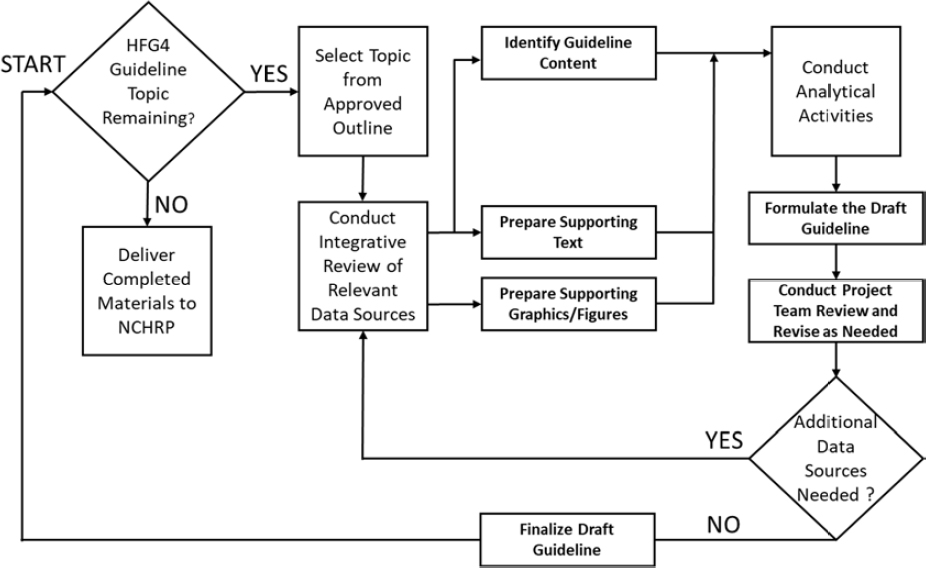
The new HFG4 materials should reflect a variety of data sources and topics resulting in a somewhat development process associated with the development of individual guidelines. Although the precise process associated with developing each guideline was topic-specific, the general procedures reflected a combination of an integrative review and analytical activities. In general, an integrative review will summarize relevant information by aggregating the results of similar data sources. With respect to a specific guideline topic, this means that the results, recommendations, or guidelines from reviewed data sources were qualitatively compared, contrasted, and perhaps combined. To the extent that goals (or research methods) are similar, relatively consistent results/recommendations provided a strong direction for the formulation of the guidelines within the new chapters. The goals, theoretical orientations, methods, and results of data sources must be carefully examined because of potential inconsistent methods and/or results. In the case of true inconsistencies (i.e., those for which there is no apparent methodological reason for the differences in results), descriptions of primary sources, expert judgment, design convention, or a description of opposing viewpoints formed the basis for final guideline content.
The HFG4 materials should be developed using the general guideline development process (see Figure 2. below) used to develop the HFG2 and HFG3 and the associated Style Guide created by the project team during the previous HFG projects.
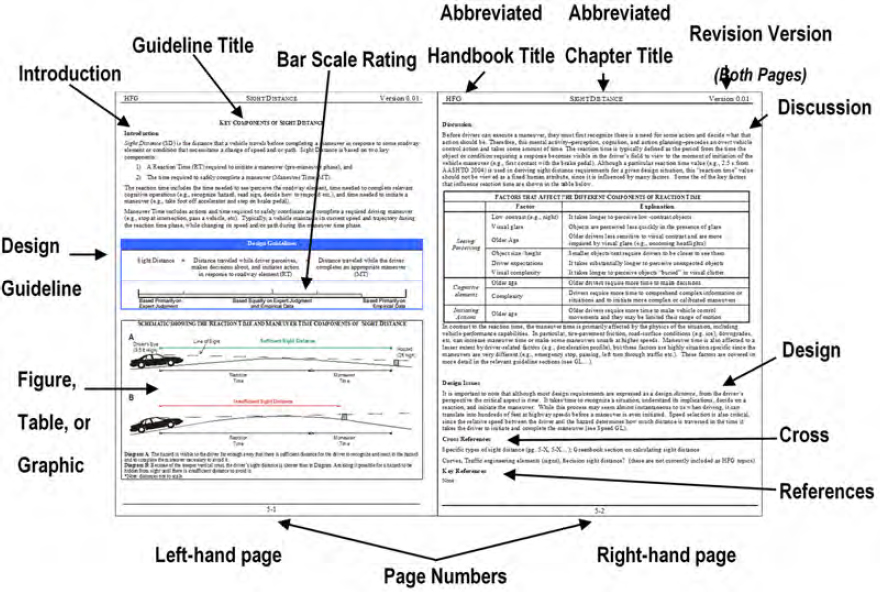
In accordance with the Style Guide developed in Project 17-31, the proposed presentation format for the new guidelines is consistent with the current HFG2 and HFG3, as shown below in Figure 3.
Workplan to Address Additional Recommendations for the HFG4
As noted above and discussed with the project panel during an interim panel meeting in February 2022, developing an updated and complete HFG4 required some additional activities beyond the project’s original scope. Below, we provide additional information and our approach for these activities.
- Edit HFG3 materials to reflect remaining reviewer comments from NCHRP 17-80
Workplan: The project team reviewed each of the 46 comments and then, if it was feasible to address each comment and if it would add value to the HFG4, we implemented the requested addition/revision.
- Reconcile and reconstruct all HFG2 text and graphics files into the HFG4
Workplan: The project team addressed the minor issues with the text formatting and revised approximately 10 figures that had degraded quality after the multiple file conversions associated with the HFG2.
- Revisions for the Final HFG4 materials to reflect best practices in terminology that avoid inadvertently creating tort liability implications in its content3
Workplan: The project team finalized a list of terms and phrases that needed to be reviewed for possible deletion or revision, conducted searches within the HFG2 and HFG3 for these terms and phrases, and revised – as needed- in a manner consistent with the guidance provided in the National Academies of Sciences, Engineering, and Medicine (2020) report. Below, we show an example of an existing paragraph from the HFG2 that contains some terms and phrases that could create unintended liability (“Before”) and a revised paragraph (“After”) reflecting guidance from this report (key issues and changes are highlighted in yellow and/or are identified using strikethroughs).
Before:
Matching driver expectations at freeway lane drops is important because lane drops represent a situation that may violate driver expectations and cause confusion when the driver expects the lane to continue on the freeway mainline. This confusion can result in high-speed variability, erratic maneuvers, and driver frustration (1). Additionally, a left lane drop situation violates multiple driver expectations and can cause more problems. All of these results have negative safety implications; thus, the more accurately that lane drops conform to driver expectations, the safer the situation will be. This guideline refers specifically to lane drops on freeway sections that do not include exit ramps.
___________________
3We will use a 2020 NCHRP publication – “Guidelines for Drafting Liability Neutral Transportation Engineering Documents and Communication Strategies,” plus some guidance from the ongoing HSM2 project, (17-71A) as an aid to this activity.
After:
Matching driver expectations at freeway lane drops is important because lane drops represent a situation that may violate driver expectations and cause confusion when the driver expects the lane to continue on the freeway mainline. This confusion can result in high-speed variability, erratic maneuvers, and driver frustration (1). Additionally, a left lane drop situation may violate multiple driver expectations and could potentially contribute to driver confusion. All of these results have negative safety implications; thus, In general, the more accurately that lane drops conform to driver expectations, the fewer opportunities there will be for driver confusion and errors. This guideline refers specifically to lane drops on freeway sections that do not include exit ramps.
- Conduct reviews and, as necessary, revisions to reflect recent updates to key reference documents such as the: Green Book, MUTCD, ITE Traffic Engineering Handbook, ITE Traffic Control Devices Handbook. ITE Manual of Transportation Engineering Studies.
Workplan: The project team worked through each of the references in the HFG2 and HFG3 to the key design standards and reference handbooks that have been updated since the HFG2 or HFG3 were published. We made sure that the information cited in the HFG2 and HFG3 was correct and revised or deleted it if it was not. We will update the citation itself as needed.
Proposed Modifications to the Project Schedule
During the February 2022 project panel briefing, we proposed options for the technical work as well as a revised project schedule. The options presented to the panel reflected the past delays associated with the loss of Battelle on the project, as well as different options for addressing the additional recommendations described above in Task 4. We reviewed options along with detailed budgets with the panel during our formal panel meeting held on June 24, 2022.
The options associated with the proposed schedules described below in Table 4.
- Original Schedule = Originally planned and current schedule.
- Option 1 = No implementation of additional recommendations/new scope.
- The remaining project tasks, Tasks 6 through 8, are pushed out by 4 months to reflect the past delays, but each of these tasks has the same period of performance as in the current schedule.
- This would require a schedule modification, but no budget increase.
- Option 2 = Drop the Task 7 Pilot and replace it with additional recommendations/new scope.
- The new scope would essentially replace the Task 7 pilot; the costs of the new scope and the Task 7 pilot are approximately equal.
- This would require a contract modification but no budget increase and because we can complete the new scope in less time than the pilot would take, this could be accomplished with minimal change to the overall schedule.
- Option 3 = Keep the Task 7 Pilot and add additional recommendations/new scope.
- This would require a contract modification to reflect the increased scope, the new schedule, and additional budget to address the new scope.
Table 4. Proposed Modifications to the Project Schedule
| Task | Current Schedule | Option 1 – No New Scope | Option 2 – Replace Task 7 Pilot with New Scope | Option 3 – Conduct Task 7 Pilot and New Scope | ||||
|---|---|---|---|---|---|---|---|---|
| Start | End | Start | End | Start | End | Start | End | |
| Project Management | Jun. 1, 2021 | May 31, 2024 | Jun. 1, 2021 | Sep. 30, 2024 | Jun. 1, 2021 | May 31, 2024 | Jun. 1, 2021 | Feb. 28, 2025 |
| Task 1: Assess Existing Human Factors Literature | Jun. 1, 2021 | Sep. 30, 2021 | N/A | N/A | N/A | N/A | N/A | N/A |
| Task 2: Develop Draft Practitioner Survey | Sep. 1, 2021 | Oct. 31, 2021 | N/A | N/A | N/A | N/A | N/A | N/A |
| Task 3: Conduct Practitioner Survey | Nov. 1, 2021 | Dec. 31, 2021 | N/A | N/A | N/A | N/A | N/A | N/A |
| Task 4: Develop Recommendations to Update the Content of the HFG | Dec. 1, 2021 | Jan. 31, 2022 | N/A | N/A | N/A | N/A | N/A | N/A |
| Task 5: Develop and Submit Interim Report | Jan. 1, 2022 | Feb. 28, 2022 | N/A | N/A | N/A | N/A | N/A | N/A |
| Task 6: Develop Updated Content for the 4th Edition HFG | Mar. 1, 2022 | Feb. 28, 2023 | Jul. 1, 2022 | Jun. 30, 2023 | Jul. 1, 2022 | Nov. 30, 2023 | Jul. 1, 2022 | Nov. 30, 2023 |
| Task 7: Conduct Pilot Studies | Mar. 1, 2023 | Nov. 30, 2023 | Jul. 1, 2023 | Mar. 31, 2024 | N/A | N/A | Dec. 1, 2023 | Aug. 31, 2024 |
| Task 8: Prepare and Submit Draft and Final Deliverables | Dec. 1, 2023 | May 31, 2024 | Apr. 1, 2024 | Sep. 30, 2024 | Dec. 1, 2023 | May 31, 2024 | Sep. 1, 2024 | Feb. 28, 2025 |
2.6 Task 6: Develop Updated Content for the HFG4
2.6.1 Objectives
Develop updated content for the HFG4 based on the Task 4 recommendations approved by NCHRP in Task 5.
2.6.2 Methods
A detailed review of each source identified in the annotated outlines (contained in the Interim Report) literature was conducted, and the annotated outlines were expanded into full guidelines where the information was sufficiently available. Additional topics identified during the in-depth reviews were also included as new guidelines where appropriate. The two highest-priority new chapters—Complete Streets and Older Road Users—were developed.
Existing chapter updates were accomplished using similar methods. Documents relevant to the existing guidelines in the chapter were reviewed to identify new information about existing topics, whether supporting or contrary to the information in the existing guideline. Relevant guidelines were modified to represent the new or updated information. Also, new guidelines within a chapter were identified and written for new themes found in the literature that had enough supporting information. Very little was changed in the execution of the HFG4 relative to our plans as described in the Task 5 Interim Report above.
2.6.3 Results
Revised Organization of the HFG.
The HFG3 effort (17-80) added three new chapters to the HFG – Pedestrians, Bicyclists, and Roundabouts and as noted above, this HFG4 effort added two new chapters – Complete Streets and Older Road Users. Given these new chapters, it seemed appropriate to examine and revise the organization of the HFG to reflect this new content. These revisions were presented to the project panel at the Interim Project Briefing. The new organization of the HFG4 is as follows:
| Part I | Introduction |
| Chapter 1 | Why Have Human Factors Guidelines for Road Systems? |
| Chapter 2 | How to Use This Document |
| Part II | Bringing Road User Capabilities into Roadway Design and Traffic Engineering Practice |
| Chapter 3 | Understanding the Road User’s Information-Seeking Behavior |
| Chapter 4 | Integrating Road User, Highway Design, and Traffic Engineering Needs |
| Part III | Human Factors Guidance for Roadway Geometric Elements |
| Chapter 5 | Sight Distance Guidelines |
| Chapter 6 | Curves (Horizontal Alignment) |
| Chapter 7 | Grades (Vertical Alignment) |
| Chapter 8 | Tangent Sections and Roadside (Cross Section) |
| Chapter 9 | Transition Zones Between Varying Road Designs |
| Chapter 10 | Non-Signalized Intersections |
| Chapter 11 | Signalized Intersections |
| Chapter 12 | Roundabouts *4 |
| Chapter 13 | Interchanges **5 |
| Part IV | Special Design Considerations |
| Chapter 14 | Speed Perception, Speed Choice, and Speed Control ** |
| Chapter 15 | Urban Environments |
| Chapter 16 | Complete Streets * |
| Chapter 17 | Rural Environments ** |
| Chapter 18 | Construction and Work Zones ** |
| Chapter 19 | Rail-Highway Grade Crossings ** |
| Chapter 20 | Lighting ** |
| Part V | Human Factors Guidance for Traffic Engineering Elements |
| Chapter 21 | Signing ** |
| Chapter 22 | Changeable Message Signs ** |
| Chapter 23 | Markings ** |
| Part VI | Human Factors Guidance for Vulnerable Road Users |
| Chapter 24 | Pedestrians * |
| Chapter 25 | Bicyclists * |
| Chapter 26 | Older Road Users * |
| Part VII | Additional Information |
| Chapter 27 | Tutorials ** |
| Chapter 28 | References ** |
| Chapter 29 | Glossary ** |
| Chapter 30 | Index ** |
| Chapter 31 | Abbreviations ** |
| Chapter 32 | Equations ** |
___________________
4* = indicates a new chapter
5** = indicates an existing chapter with a changed chapter number


