Resilient Zero-Emission Transit Bus Fleets: A Guide (2025)
Chapter: 5 Zero-Emission Bus Fleet Hazards and Consequences

CHAPTER 5
Zero-Emission Bus Fleet Hazards and Consequences
Because of the differences in fuel supply security and performance variability explained above, an agencyʼs risk profile associated with specific threats will change as a fleet transitions towards ZE technologies. Some threats are applicable to both incumbent and ZE technologies but might have different magnitudes of impact. For example, extreme temperatures will require high HVAC use, which will decrease the driving range of a bus, whether ZE or ICE. This, in turn, will impact the ability to meet normal or emergency service requirements. However, a highly efficient BEBʼs range will be impacted more than a diesel bus because it has no waste heat or motion energy to heat or air condition the bus. As a result, energy from the battery must be used to provide HVAC, and that energy is no longer available to the propulsion system, which reduces the range of the bus. Some entirely new threats will apply to a ZE fleet and require new adaptations. For instance, while both fossil fuel and ZE refueling rely on electric power, charging a fleet of BEBs during a large-scale power outage cannot be easily mitigated by a backup diesel generator. This section will focus on the threats and consequences specific to ZEB fleets to provide agencies with a starting point when considering their own threats and consequences.
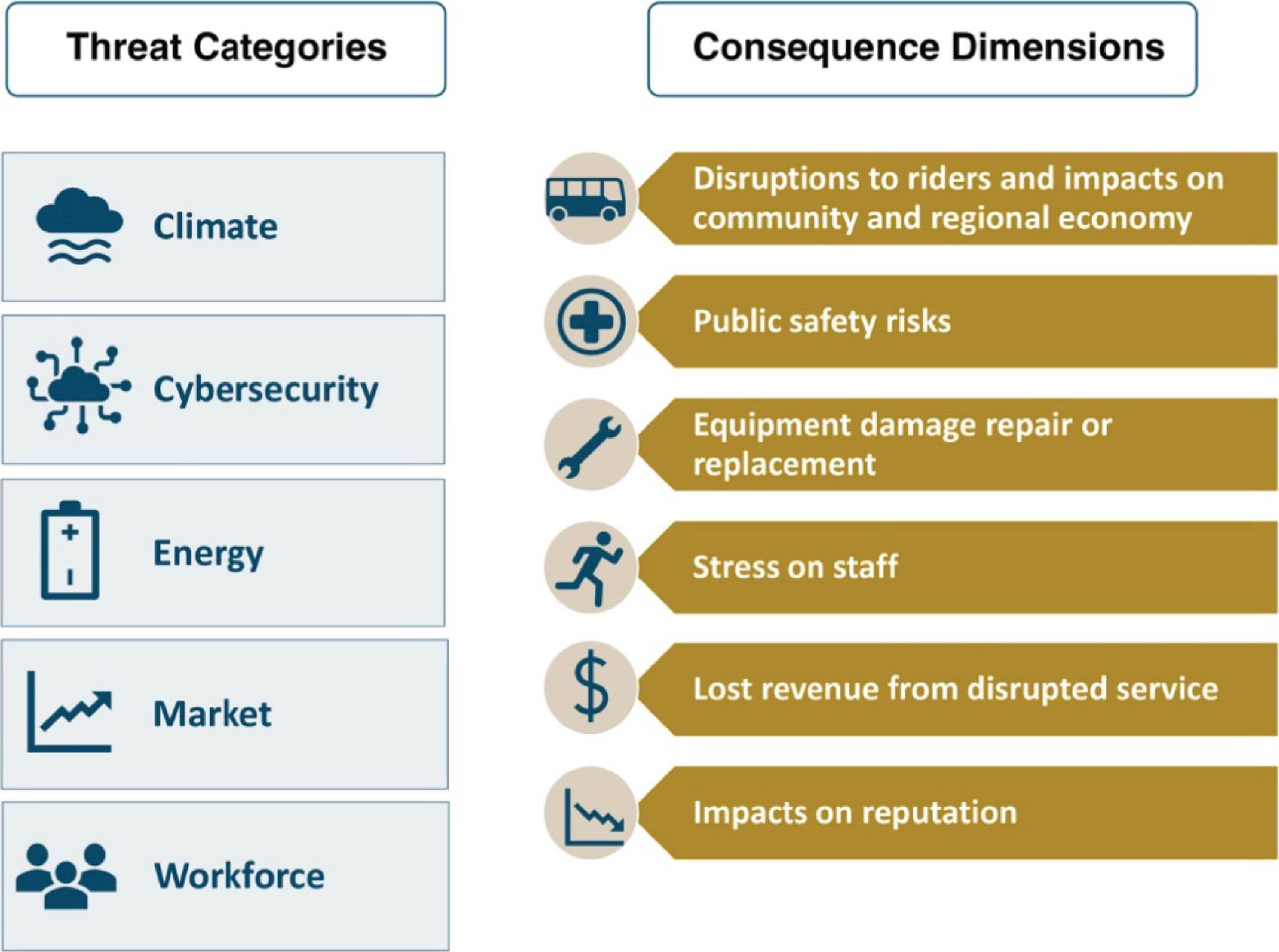
This section contains a summary of five general hazard categories and types of consequences to consider when evaluating a hazard or threat (Figure 8).
Climate Hazards and Consequences
 Climate hazards include increasing temperature extremes, increased flooding risk, more extreme precipitation events, increased wildfires, and more frequent and extreme natural disasters. While the risks to the community from these events are the same for ICE or ZE transit, ZEBs have some additional resilience considerations. For example, extreme cold or hot temperatures require increased HVAC use that can reduce a ZEBʼs range more than an ICEBʼs range. High temperatures also lead to high grid demand that can shut off power and disrupt charging more than fossil fueling, as fossil fueling can be powered with a much smaller temporary fuel source, such as a generator. Finally, response to natural disasters may be more difficult because charging and hydrogen refueling infrastructure is still developing, potentially limiting an agencyʼs ability to refuel away from the depot and disrupting evacuations.
Energy Hazards and Consequences
 The availability of energy is a critical aspect of resilience that has significant consequences for ZEB fleets. Additionally, battery thermal events, which are chain reactions that can cause a battery to catch fire, explode, or emit toxic gases, require different mitigations than ICE fires and can damage multiple buses or facilities, impact public safety, and damage reputation. While ICEBs
Long Description.
The data given in the illustration are as follows: Threat categories: Climate, cybersecurity, energy, market, and workforce. Consequence dimensions: Disruptions to riders and impacts on community and regional economy; Public safety risks; Equipment damage, repair or replacement; Stress on staff; Lost revenue from disrupted service; Impacts on reputation.
are also affected by a lack of fuel, ZEB energy (hydrogen or electricity) availability faces more severe consequences due to the differences discussed in the Fuel Supply Security section. This can result in service disruptions or cause additional logistical challenges for staff. Additionally, fuel cells and batteries can degrade if grounded for extended periods of time due to a lack of fuel. This could impact bus component warranties.
Cybersecurity and Software Hazards and Consequences
 Cybersecurity hazards are not completely novel for ZE transit. Both ICE and ZE buses have software, electronics, and wireless connectivity as components of communications, routing, and planning systems. APTAʼs existing analyses and standards evaluate the threats to communications and electronics on older and newer models of transit buses. Cyberattacks can compromise the confidentiality of information, the availability of information and systems, and the integrity of information or systems. Attacks may occur through software or physical interruption, such as jamming internet signals. For more resources on cybersecurity in transit, reference APTAʼs Cybersecurity Considerations for Public Transit or Securing Control and Communications Systems in Transit Bus Vehicles and Supporting Infrastructure (APTA 2019, 2014). Additional considerations for ZEBs arise due to the additional layer of software and systems for charging and energy management. Electric vehicle supply equipment (EVSE) provides multiple vulnerabilities to disable charging at one or more chargers, change charging power limits, falsify the SOC of the vehicle, or expose user data (Johnson et al. 2022). If managed charging and energy systems such as microgrids or energy storage are disrupted due to software bugs, a cyberattack, or simply a lack of internet connection, buses may not be able to meet service requirements, or agencies may face costly utility bills.
Market Hazards and Consequences
 As ZE transit develops, the landscape of supporting systems and original equipment manufacturers (OEMs) will evolve, which could cause disruptions to service if not planned for. Higher costs of vehicles compared to incumbent technology, changing equipment compatibility, and OEM instability all pose significant threats to the ZEB industry. ZEBs are significantly more expensive than their ICE counterparts, which puts financial strain on maintaining equipment and increasing fleet size. Rapidly evolving technology leads to significant advances that do not always prioritize backwards compatibility. As a result, existing infrastructure like charger connectors and hydrogen dispensers may become outdated and obsolete, and cause financial consequences to maintain them or replace them before the end of their expected useful life. Additionally, many OEMs have experienced financial difficulties in recent years, and their resulting market exit has left many of their previous clients without maintenance support, impacting parts availability and asset utilization.
Workforce Hazards and Consequences
 Finally, as ZE transit technology develops, the workforce must develop with it. ZE technology requires different knowledge and skills for maintenance and repairs that existing staff may not have, which, unmitigated, could cause maintenance issues. Adequate training and education are necessary for a successful ZEB deployment.
For more detailed descriptions of specific hazards and potential consequences, see Appendix D. Appendix D contains several tables separated by the general hazards: Climate, Energy, Cyber, Market, and Workforce. Each hazard has example consequences broken out by the general dimension of the consequence as it relates to a transit fleet: Customer and Service, Equipment, Staffing, Public Safety, Financial, and Reputational.


