Review of the SBIR and STTR Programs at the Department of Defense (2026)
Chapter: 7 Impact of SBIR/STTR Awards on the DOD Mission
7
Impact of SBIR/STTR Awards on the DOD Mission
This chapter examines the observable impact of the Department of Defense’s (DOD’s) Small Business Innovation Research (SBIR)/Small Business Technology Transfer (STTR) programs. This analysis is based on metrics capturing the role of firms participating in these programs on the defense innovation ecosystem and industrial base. Because one of the four central objectives of the SBIR/STTR programs is to use small business to meet federal research and development (R&D) needs, assessment of the impact of the SBIR/STTR programs in meeting their legislative objectives must account for whether the programs are successful in accomplishing this objective. Most prior SBIR/STTR evaluation and assessment studies, particularly those addressing the programs at other agencies, have tended to focus on technology transfer, whereby federally funded technologies and know-how migrate to private markets and provide benefits to the recipient firms (Howell, 2017; Lanahan and Armanios, 2018; Lerner, 1999; NASEM, 2022a, 2023), or on spillovers to other private firms (Myers and Lanahan, 2022; NASEM, 2020). Less attention has been paid to the impact of the SBIR/STTR programs on meeting the R&D needs of the government agencies that are funding the programs.
LIMITATIONS AND METHODOLOGY OF THE ANALYSIS
As emphasized in Chapter 2, DOD’s SBIR/STTR programs are fundamentally different from SBIR/STTR programs in federal agencies such as the National Institutes of Health and National Science Foundation (NSF) because of DOD’s emphasis on procurement and incorporation of funded technologies for the warfighter. Most civilian agencies with SBIR/STTR programs, in which the federal agencies are not the ultimate customers for the innovations, are more concerned with providing public benefits beyond the direct funding of firms, and
each agency interprets this mission differently.1 DOD’s enduring mission is to develop technologies for the combat-ready military forces needed to deter war and protect the security of the nation. It is therefore nontrivial when the National Defense Science & Technology Strategy 2023 calls for the DOD research enterprise to focus on “create[ing] and field[ing] capabilities at speed and scale” (DOD, 2023a, p. 1). The purpose of this chapter is to examine, to the extent possible, whether the SBIR/STTR programs contribute to achieving this goal.
Before turning to the substance of the analysis, it is useful to reinforce that, in most cases, the scale and timing associated with defense procurement are beyond the capacities of an individual small firm. While critical elements of technology that ultimately serves the warfighter may originate within an SBIR/STTR contract, development of the technology itself may entail partnerships with defense prime contractors and subcontractors and may involve combining multiple technological innovations into a multicomponent product, service, or platform. Also, the learning absorbed within DOD and by other players within the defense innovation ecosystem may lead to the application of advances first developed under an SBIR/STTR contract for purposes well outside the initial focus area. Accordingly, the pathway from an initial SBIR/STTR contract to the deployment of a technology that ultimately serves the warfighter is both multistage and nonlinear, and often involves much larger players, such as primes.
This “technology infusion” process (i.e., the process by which SBIR/STTR-funded technologies are ultimately introduced into DOD products, services, and platforms) is therefore complex, making assessment of the impact of the SBIR/STTR programs on the warfighter challenging. Ideally, one would quantitatively value the full range of impacts of SBIR/STTR-originated technologies on defense across the ecosystem. As noted, however, technology infusion most often takes place through trajectories that not only are difficult to observe but also involve a long and variable time lag between the initial R&D investment and the ultimate impact of the technology.
Moreover, deployment of a technological innovation originally developed under an SBIR/STTR contract in fielded military systems most often involves either the SBIR/STTR firm (or a follow-on entity) serving as a subcontractor (or even deeper in the supply chain) to defense prime contractors, and the subaward details are often neither transparent nor consistently captured. As well, there are many cases in which the SBIR/STTR-funded innovation may enter the defense supply chain via a corporate transaction, such as a merger or acquisition, or through a license to use a private patent, which also is not easily observed. A project that is deemed a technical failure also serves the purpose of redirecting or terminating DOD research pathways, in the process saving
___________________
1 For example, NSF focuses on basic science, and its SBIR/STTR programs generate national impact to align with the American Innovation and Competitiveness Act of 2017, primarily by focusing on startups as a strategic objective (Lanahan and Feldman, 2018). Alternatively, the National Aeronautics and Space Administration’s SBIR/STTR programs develop technologies that may be deployed on robotic space science missions, and a small firm may still be able to produces parts for these space missions in the relatively small volumes needed (Giga et al., 2022).
resources and shaping future DOD technology strategies and initiatives. Finally, the value of the SBIR/STTR-funded technology or innovation cannot easily be stated in financial terms, since the technological superiority of the U.S. military over those of U.S. adversaries ultimately safeguards the national security, enhances the safety of the warfighter (leading to reduced casualties), and has a deterrence effect that ultimately reinforces both national security and warfighter safety. From the perspective of the empirical assessment in this chapter, each of these factors makes it likely that observable impacts based on the available data will both undercount incidences of the impact of the SBIR/STTR programs and undercount the likely impact of the programs on broader national security and warfighter safety objectives.2
Despite these limitations, the committee undertook an analysis of publicly available data to describe broadly ways in which DOD’s SBIR/STTR programs are effective in enabling DOD to expand both the defense innovation ecosystem and the broader defense industrial base. To this end, the committee built on a recent body of academic and policy research (Bhattacharya, 2021; Howell et al., 2025) examining elements of technology infusion to consider both how to measure and how to assess the incidence of follow-on activity between SBIR/STTR performers and DOD.
The next section describes the challenge of measuring the impact of SBIR/STTR awards and performers on the DOD innovation ecosystem and defense industrial base. Specifically, this chapter highlights both the potential and challenges of using measures related to an explicit Phase III designation or the use of Technology Readiness Levels (TRLs). The committee then evaluates a new measure of follow-on DOD funding, which provides a proxy for Phase III–type activities both in research, development, test, and evaluation (RDT&E) and in follow-on procurement of technologies directly serving the warfighter. The committee next examines this measure for various types of awardees, different firm-owner demographics, and number of awards received. The discussion concludes with the committee’s assessment of how SBIR/STTR-awarded firms contribute to the DOD mission.
SUMMARY OF THE ASSESSMENT
The committee’s analysis suggests that DOD’s SBIR/STTR programs promote the advancement of SBIR/STTR-funded small businesses into the broader DOD innovation ecosystem in four interrelated ways.
First, for the vast majority of firms that ever receive DOD SBIR/STTR funding, DOD’s SBIR/STTR programs are the first point of contact with DOD.
___________________
2 On a related note, recent scholarship has begun to track the indirect returns of government investments, reporting knowledge and innovation returns as large as three times the initial investment (Myers and Lanahan, 2022). Currently, no research systematically captures the indirect returns to the defense innovation ecosystem, though one can expect that related mechanisms drive this effect, yielding a larger return.
Thus, the programs serve as a distinct gateway to DOD—a critical on-ramp and not simply one of many funding sources.
Second, firms that receive DOD SBIR/STTR funding have a significantly higher rate of receiving additional funding from DOD, particularly in the domain of R&D projects. In other words, DOD SBIR/STTR funding represents an important entryway for small (and young) R&D-intensive firms to enter the DOD innovation ecosystem, and there is demand from other parts of DOD (beyond simply more SBIR/STTR contracts) for the services of those DOD SBIR/STTR-funded firms. This represents an expansion of DOD’s innovation base and potentially leads to the expansion of the defense production base. Moreover, although important differences exist among DOD services and components and among different types of firms receiving awards (e.g., based on their age and level of experience with the SBIR/STTR programs), the positive association between SBIR/STTR contracts and the receipt of other DOD funding is robust across many different slices of the data.
Third, the level of additional federal non-SBIR/STTR funding for small businesses that have received DOD SBIR/STTR funding is significant: for every federal dollar allocated to firms under the SBIR/STTR programs, those firms receive (on average) more than 4 dollars of observable additional DOD funding. This funding ratio has been increasing over time and is particularly striking given that much of the impact of SBIR/STTR-funded small businesses cannot be directly observed in the available data (e.g., technology that serves the warfighter subsequent to an acquisition by a prime or major subcontractor). No similar ratio has been observed for other DOD research or innovation activities.
Finally, DOD’s SBIR/STTR programs are associated with expansion of the defense innovation industrial base. By 2020, firms participating in DOD SBIR/STTR programs accounted for nearly one-third of all firms receiving DOD R&D funding and were awarded more than 10 percent of annual DOD R&D expenditures. These ratios are particularly striking given that the SBIR/STTR programs serve as the gateway to further DOD funding for the vast majority of small businesses that ever participate in the programs, and that these measured impacts to DOD are likely an underestimate of the overall impact of the programs in light of the complex nature (and data limitations) associated with tracking or measuring the impact of these firms on ultimate national defense goods and services.3
MEASURING THE IMPACT OF DOD’S SBIR/STTR PROGRAMS ON THE DOD INNOVATION ECOSYSTEM AND INDUSTRIAL BASE
To assess the incidence and impact of technology infusion from DOD’s SBIR/STTR programs, it is necessary to construct a consistent measure of the ways in which funds from the programs are ultimately linked to follow-on
___________________
3 Specifically, the committee had access only to public records. Hence, data on classified activity were not available.
activities within DOD that are not funded directly through the DOD SBIR/STTR programs. The committee considered a wide range of alternatives, building both on a burgeoning academic and policy literature assessing the impact of the SBIR/STTR programs and other DOD innovation programs (Bhattacharya, 2021; Bresler and Bresler, 2023; Howell et al., 2025), and on insights drawn from the committee’s examination of the processes by which DOD’s SBIR/STTR programs operate (discussed in detail in Chapter 4).
Measuring how DOD’s SBIR/STTR programs contribute to the broader DOD mission requires examining how technologies initially funded by those programs move further in the defense acquisition process and eventually are incorporated into operational systems. One official mechanism for capturing one part of this transition pathway is the Phase III designation (see Box 7-1), which identifies follow-on contracts for SBIR/STTR-derived technologies that are funded from sources outside the SBIR/STTR programs. Phase III awards are meant to provide a seamless path for SBIR/STTR technologies to be further developed and incorporated into federal acquisitions. The committee found that, despite directives aimed at tracking the transition to Phase III, actual implementation of those tracking mechanisms across the various services and components and contracting platforms remains sporadic. DOD has no systematic way of tracking Phase III funding, which is challenging in any case since Phase III funding occurs in many different ways. It is important to note, however, that despite the limitations, the SBIR/STTR programs’ tracking of Phase III awards represents the best and largest effort to measure technology transition in the defense research enterprise directly.
A second way of gauging impact involves TRLs, which track how a technology matures over time (see Box 7-2). TRLs are used extensively in defense acquisition programs, as well as by other agencies, such as the National Aeronautics and Space Administration for its SBIR/STTR projects. However, DOD does not collect or update TRL data on SBIR/STTR projects in a single, uniform system, and cross-service/component TRL analyses are thus challenging to perform. While limited studies, such as those conducted by the Navy, highlight the potential of a TRL-based evaluation of SBIR/STTR contributions, it remains impractical to rely on TRLs alone as a broad measure of the programs’ ability to aid in the accomplishment of DOD’s mission (Belz et al., 2021; Hay et al., 2013).
Faced with these limitations, the committee adopted a broader measure, motivated in part by recent scholarly work such as that of Bhattacharya (2021) and Howell and colleagues (2025), which relies on follow-on DOD contracts as an indicator of successful transition. In line with these studies, the committee focused on non-SBIR/STTR DOD funding received by firms that have, at some point, received an SBIR/STTR award. This firm-level linkage captures a wide range of funding pathways, including subcontracts and other avenues that may not be explicitly labeled as Phase III. Although this approach has its own limitations—it does not, for instance, reveal the precise technological maturity of a given
BOX 7-1
The Phase III Program and Designation
Under the SBIR/STTR Policy Directive, a Phase III contract is defined as “work that derives from, extends, or completes an effort made under prior SBIR/STTR Funding Agreements, but is funded by sources other than the SBIR/STTR programs” (SBA, 2023, p. 25). This structure is designed to enable the continued development of a technology following the foundational work of Phase I and Phase II, thereby facilitating the technology’s transition into use by DOD or other federal agencies.
Phase III contracts offer several benefits:
- SBIR/STTR status and data rights: A Phase III award, by its nature, retains SBIR/STTR status and carries SBIR/STTR data rights protection.
- No limits on number, size, or timing: There is no cap on the number, duration, type, or dollar value of Phase III awards. In addition, there are no time constraints on when a Phase III award may be made relative to earlier phases.
- Flexible contracting pathways: A subcontract to a prime contractor can count as a Phase III, and any federal agency—not just the one that funded the original Phase I/II—can award a Phase III.
- Exemption from size limits: Unlike Phase I and II awards, Phase III awards are not subject to small business size requirements. A Phase III may follow the original awardee or a successor entity, even after an acquisition or substantial growth in size.
- Sole source authority: Because Phases I and II are awarded under competitive procedures, any follow-on Phase III may be awarded on a noncompetitive, sole source basis under specific conditions.
- Breadth of activities: Phase III can fund additional research, product development, production, or any combination thereof, allowing a small business to continue iterating on an SBIR/STTR-originated technology without recompeting for a new contract.
These features make Phase III contracts especially appealing to small businesses, which can outgrow the size standards of the SBIR/STTR programs or undergo ownership changes while still maintaining the thread of their original research and development. From DOD’s perspective, Phase III provides a convenient mechanism for extending promising SBIR/STTR work into more advanced, mission-relevant applications.
Tracking Phase III activity, however, is challenging. Unlike Phase I and II awards, which rely on dedicated SBIR/STTR set-asides and are tracked by the Small Business Administration, Phase III contracts are funded through general DOD (or other federal) budgets. Definitions of Phase III and coding procedures also vary among DOD services and components. In many cases, Phase III may appear only in the contract’s description or an internal note, rather than in a standardized field. As a result, systematically identifying Phase III awards across multiple contracting databases is extremely difficult. This gap in consistent labeling and record keeping means that relying solely on officially labeled Phase III awards substantially undercounts SBIR/STTR-related technology transitions.
BOX 7-2
Technology Readiness Levels
As an intermediate step in measuring technological value, it would be useful to understand whether a DOD SBIR/STTR-funded technology advances in readiness for deployment, and how far. For instance, as described in Chapter 2, Technology Readiness Level (TRL) is a key metric used throughout the aerospace and defense industries to assess advancements and estimate funding outcomes. TRLs range from 1 (idea) to 9 (used successfully) (Mankins, 2009) and are one of two significant elements used to conduct Technology Readiness Assessments (TRAs) for defense acquisition programs (DOD, 2023b). Indeed, TRAs—and the associated TRL evaluation—are required both by law and by DOD policy for technology acquisition.
Similar policies exist at the National Aeronautics and Space Administration (NASA, 2020), where a technology must reach TRL 6 to qualify for insertion into a flight mission. Terrile and colleagues (2014) attempted to value this impact to evaluate NASA’s SBIR/STTR portfolio, but an equivalent effort has not taken place at DOD. For approximately 15 years, NASA has collected the principal investigator’s initial TRL estimate in SBIR/STTR proposals and assigned its own estimate of the final TRL at the project’s conclusion. Belz and colleagues (2021) demonstrate that TRL is a key indicator in Phase II project selection and that the program largely funds technology advancement from TRL 3 to 6 (specifically, approximately 70 percent of the NASA portfolio advances from initial TRL values of 3–4 to the final stages of TRL 4–6), in agreement with an early-stage emphasis.
Unfortunately, the committee was unable to conduct such an analysis with the available DOD data, as TRLs are not recorded systematically across the agency’s SBIR/STTR projects. One estimate does exist for the Navy portfolio: Hay and colleagues (2013) determined that Navy SBIR/STTR awardees achieve the earliest TRL advances (e.g., 2–3 or 3–4) at lower cost compared with larger companies; however, this distinction vanishes at higher TRLs.
In principle, the goal of any defense technology development effort is insertion into a fielded capability, and the budget would then be allocated as a program of record. Developing even a component technology from TRL 3 to 6 probably takes about $20 million and 5 years (Alexander, 2018), and thus is out of reach for a single SBIR/STTR award. An intermediate step to value creation and fielded capabilities is to enable small firms to address research and development needs, the second SBIR/STTR program objective.
project—it offers a more complete perspective on how successfully SBIR/STTR-funded small businesses integrate into the DOD innovation ecosystem.
By examining where DOD dollars flow after an SBIR/STTR contract, the committee was able to capture an expansive view of the role of the SBIR/STTR programs in introducing new technologies, firms, and capabilities into DOD. In addition, this strategy avoids the pitfalls of relying solely on official Phase III labels or TRL metrics, both of which are documented sporadically and therefore incomplete. In this way, the analysis provides clearer evidence of the SBIR/STTR programs’ function as a gateway for innovative small businesses to
work with DOD. Ultimately, this approach aids in assessing how effectively the programs are contributing to meeting DOD’s R&D and operational needs. The committee notes that this measure may underestimate the impact of SBIR/STTR-funded firms that work with subcontractors rather than prime contractors because those interactions are incomplete in publicly available data.
Specifically, the committee created three proxies for Phase III activity that occur after a prior SBIR/STTR contract: one that looks only at DOD procurement activity, one that looks at DOD R&D awards greater than $1.5 million, and one that includes all DOD funding (the sum of the first two proxy measures). The amount of $1.5 million was chosen to represent a significant commitment that was larger than the Phase II award during the sample period and to reflect the median Phase III amount found in publicly available data. Thus, the committee incorporated an implied DOD Phase III proxy in its analysis to determine the extent of the impact of SBIR/STTR-funded small businesses on the broader DOD mission.
DOD’S SBIR/STTR PROGRAMS AS A GATEWAY TO DOD R&D AND PROCUREMENT
A central question in assessing the impact of the SBIR/STTR programs is whether they help small businesses enter the broader DOD innovation ecosystem. To address this question, the committee used public records to identify 5,919 firms that received at least one DOD SBIR/STTR award between 2012 and 2020. The committee then linked these firms to additional federal non-DOD SBIR/STTR funding during the same period. The committee limited the non-SBIR/STTR funding to amounts that were at least $1.5 million, classifying these non-SBIR/STTR awards as either research or procurement.
Among these DOD SBIR/STTR-awardee firms, 63 percent eventually received additional federal funding outside of the SBIR/STTR programs. This follow-on rate aligns closely with that of Hernández-Rivera (2023), who reported a 65 percent rate based on surveys of 1,681 SBIR awardees. Looking only at subsequent DOD funding shows that more than half of these firms received their follow-on funding from DOD.
Importantly, 85 percent of the DOD SBIR/STTR-funded firms that also received non-SBIR/STTR support from DOD engaged in research-related (R&D or special-studies) contracts rather than procurement. Of note, the vast majority (92 percent) of these firms received their SBIR/STTR award prior to non-SBIR/STTR support of more than $1.5 million from DOD. Very few (15 percent) of DOD SBIR/STTR-funded firms received procurement contracts.
Although the data show fewer firms moving directly to procurement, this does not necessarily indicate a failure in transitioning SBIR/STTR technologies. Defense procurement typically requires a multistage maturation process, often involving prime contractors and extended testing and evaluation. The fact that most SBIR/STTR-funded firms continue to pursue R&D with DOD (rather than
progressing straight into large-scale procurement) may reflect the longer trajectory needed to field defense-ready solutions.
Taken together, these findings suggest a logical, temporal flow in the way firms move through DOD contracting. The SBIR/STTR programs provide an important on-ramp to DOD research, introducing innovative, often early-stage companies to defense agencies. Once inside the system and armed with a proven technology concept, these firms are then positioned to pursue additional R&D contracts, which may eventually culminate in procurement—albeit often through complex pathways that may not be fully visible in the data. This progression underscores SBIR/STTR’s vital role in forging the early relationships and technology demonstrations that underpin the DOD’s broader modernization and readiness objectives.
To assess whether DOD’s SBIR/STTR programs provide a distinct advantage for small businesses seeking subsequent non-SBIR/STTR defense contracts, the committee compared DOD SBIR/STTR awardees with a control group of small firms that also engaged in research for the federal government without receiving a DOD SBIR/STTR award. More specifically, this control group consisted of companies appearing in USASpending.gov with Product or Service Codes indicative of R&D (codes beginning with “A” or “B”) without receiving DOD SBIR/STTR funding between 2012 and 2020. By following both sets of firms forward in time, the committee measured their respective propensities to secure non-SBIR/STTR DOD contracts. This control group consisted of more than 34,000 firms reported in USASpending.gov with R&D activity (but critically, not SBIR/STTR activity) during the 2012 to 2020 period. The firms in this control group represent a group of firms with a demonstrated record of interest in performing R&D with the federal government. These firms are likely to be very interested in having DOD as a customer given that it is the largest federal funder of R&D. The committee’s analysis does reveal differences between DOD SBIR/STTR-funded firms and other firms that engage in R&D in the federal government. Namely, DOD SBIR/STTR firms tend to be younger; more likely to be in California and Massachusetts; more likely to specialize in research and testing, computer and data processing, or engineering and architectural services; more likely to patent; and more likely to engage in private financing and get acquired.
While this analysis reveals correlation rather than causation, a key insight emerges from this comparison. Specifically, receiving a DOD SBIR/STTR award correlates with roughly a 20-percentage-point higher likelihood of contracting with DOD relative to firms in the control group. Looking only at additional R&D awards, SBIR/STTR-awardee firms were 28 percentage points more likely to receive follow-on funding from DOD compared with those firms that did not receive a DOD SBIR/STTR award during the 2012–2020 period.
Examining results across DOD services and components, the Army and Navy generally show the strongest positive associations between SBIR/STTR participation and additional DOD contracting (Figure 7-1). In all cases, however, SBIR/STTR support correlates more robustly with R&D follow-on contracts than
with procurement—a finding consistent with SBIR/STTR’s emphasis on early-stage technology development rather than immediate production.
Assessment of Multiple-Award Recipients
In discussing the effectiveness of the SBIR/STTR program, policy makers have sometimes voiced concern about so-called SBIR/STTR “mills”—firms that appear to specialize in securing multiple awards without ultimately transitioning technologies into the marketplace. On the other hand, some practitioners argue that a series of awards is precisely how many cutting-edge R&D firms build enough momentum (and DOD-specific expertise) to produce deployable innovations. The committee found that firms that received only one or two Phase I DOD SBIR/STTR awards (with or without subsequent Phase II awards) showed only modest gains in additional DOD contracts compared with otherwise similar, federal R&D contractors who did not receive DOD SBIR/STTR funding. As shown in Figure 7-2, however, once firms obtained five or more Phase I DOD SBIR/STTR awards, they exhibited a marked jump in non-SBIR/STTR DOD funding, especially in R&D contracts.

NOTE: Statistical significance of p < 0.01 in each case. These results are based on a predictive econometric model that controls for the average likelihood of funding in a given year as well as time-varying and time-invariant differences among firms.
SOURCE: Committee calculations based on USASpending.gov data.
This threshold effect suggests that multiple SBIR/STTR engagements can create the deeper technical credibility; programmatic and transition partner relationships with industry and government organizations; and familiarity with defense acquisition, security, and contracting processes needed to secure DOD contracts beyond the SBIR/STTR programs. While each additional SBIR/STTR award may raise concern about overreliance on government R&D subsidies, these findings imply that repeat participation can also yield significant longer-term benefits—both for the participating firms, which become more integrated in DOD’s innovation pipeline, and for DOD itself, which gains continued access to specialized technical expertise. In other words, firms experienced with DOD’s SBIR/STTR programs that cross the five-award Phase I threshold are, on average, the same firms that make the most demonstrable leap to securing larger-scale, non-SBIR/STTR DOD contracts. Standing in direct contrast to historical critiques of the programs, this evidence suggests that a history of multiple SBIR/STTR awards may often be a stepping stone, rather than a stagnant endpoint as firms contribute to the defense innovation ecosystem.
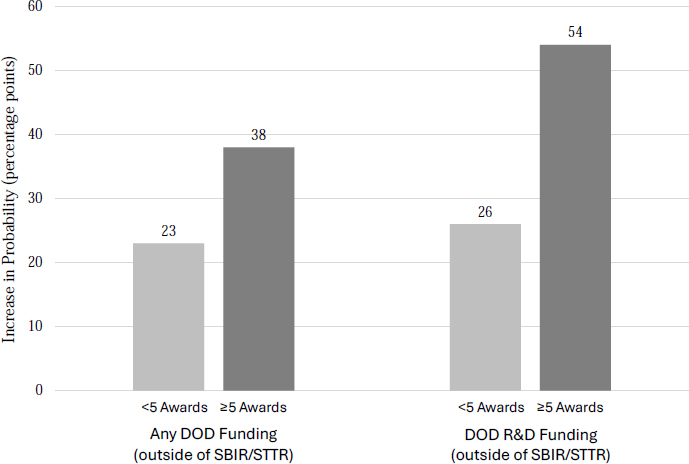
NOTE: Statistical significance of p < 0.01 in each case. Both groups are compared with similar non-SBIR/STTR firms in the DOD funding ecosystem. These results are based on a predictive econometric model that adjusts for firm differences and includes time and firm-level fixed effects.
SOURCE: Committee calculations based on USASpending.gov data.
These results suggest that cumulative engagement with SBIR/STTR may be crucial for building technical credibility, DOD-specific expertise, and stakeholder relationships that lead to follow-on non-SBIR/STTR federal funding. A firm that completes multiple projects through SBIR/STTR is more likely to have demonstrated consistent performance on DOD-funded R&D; developed a network of DOD program managers and technical points of contact, including in organizations responsible for transitioning technologies into acquisition programs and operational use; and navigated DOD’s contracting and compliance processes multiple times. This repeated engagement lowers administrative barriers for future awards. In other words, while an initial SBIR/STTR award may open the door to DOD, securing five or more awards appears to embed a firm in the defense innovation ecosystem to a degree that yields larger-scale opportunities beyond the SBIR/STTR pipeline.
Assessment of Additional Heterogeneity by Various Firm Features
Subgroup analyses revealed that this overarching pattern—strong gains in R&D, comparatively weak movement into direct procurement, and threshold-based benefits—persists across various firm types. Woman-owned firms, minority-owned firms, and startups (firms less than 5 years old) all show similar outcomes. Although procurement transitions remain less frequent, the SBIR/STTR programs are a valuable on-ramp to DOD’s research-intensive contracting environment for all these demographic subsets (Figure 7-3).
In summary, a central takeaway across these various assessments is that the SBIR/STTR programs serve as a significant on-ramp to DOD contracting. Firms with only a handful of awards see modest gains compared with the control group, whereas those surpassing five awards experience a marked increase—on the order of 20 percentage points—in the likelihood of securing non-SBIR/STTR defense work. This analysis underscores that DOD’s investments via SBIR/STTR are not all equally transformative; repeat awards often signal deeper partnerships, more advanced technology development, and a strong foothold in DOD research efforts. This is logical given that the repeat awards are the result of government processes for selection of program managers, which entail assessing the awards’ technical merit and potential contribution to overall agency missions and represent a prioritized allocation of limited program resources over competing proposals and activities.
DOD SBIR/STTR PERFORMERS ATTRACT SIGNIFICANT FOLLOW-ON DOD RESEARCH AND PROCUREMENT EXPENDITURES
Between 2012 and 2020, DOD invested $13.5 billion in Phase I and Phase II SBIR/STTR awards. Over the same period, the firms that received these awards obtained $59.2 billion in additional (non-SBIR/STTR) DOD contracts. As noted previously, this translates to more than 4 dollars of additional DOD
expenditures for every 1 dollar of SBIR/STTR funding—a testament to how SBIR/STTR can help small research-oriented companies become integral parts of the DOD innovation ecosystem (Figure 7-4). No similar data-based measurement of follow-on award activity has been demonstrated for any other defense research or innovation programs.
It is crucial to note, however, that this ratio should not be interpreted as a return on investment (ROI) from DOD’s standpoint. The figure of $59.2 billion represents incremental government expenditures beyond the initial SBIR/STTR outlay—money that DOD chose to spend because it deemed further development or procurement of these technologies to be worthwhile. This is not revenue flowing back to DOD, but additional DOD costs directed toward the same SBIR/STTR-performing firms. Nonetheless, the mere fact that DOD allocated its limited and often oversubscribed RDT&E and procurement dollars to these small firms at such a high multiple implies that DOD decision makers recognized value in the technologies and capabilities offered by SBIR/STTR participants.

NOTE: Statistical significance of p < 0.01 in each case. All firms are compared with similar non-SBIR/STTR firms in the DOD funding ecosystem. These results are based on a predictive econometric model that adjusts for firm differences and includes time and firm-level fixed effects.
SOURCE: Committee calculations based on USASpending.gov data.
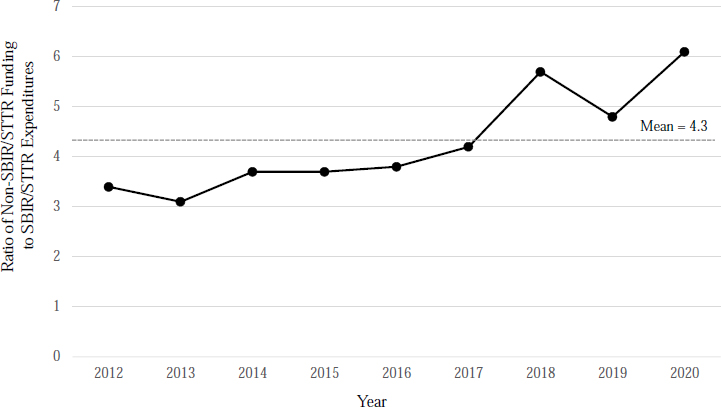
SOURCE: Committee calculations based on USASpending.gov data.
In this sense, the 4-to-1 ratio signals leverage. The additional funding demonstrates that major DOD entities—beyond the SBIR/STTR program itself—deem these firms worthy of continued investment. That willingness to pay for additional development or procurement indicates how effectively the SBIR/STTR programs identify and nurture specialized technologies aligned with DOD priorities. Ultimately, these efforts strengthen the defense industrial base and promote innovation within the broader national security ecosystem.
FRACTION OF THE DOD INNOVATION ECOSYSTEM AND DEFENSE INDUSTRIAL BASE REPRESENTED BY SBIR/STTR PERFORMERS
An important metric of the SBIR/STTR programs’ influence is the extent to which participating firms meet DOD’s broader research needs, including larger-scale R&D efforts. Although DOD SBIR/STTR awardees typically do not develop fully scaled solutions destined for immediate procurement, many undertake sizable research contracts that feed into DOD’s overall technology pipeline. To gauge just how much of DOD’s R&D portfolio relies on SBIR/STTR performers, the committee created a measure termed the SBIR/STTR Firm Research Share. This indicator captures two dimensions of SBIR/STTR participation within
DOD’s non-SBIR/STTR R&D contracting:
- the fraction of total R&D dollars awarded to SBIR/STTR-awardee firms, and
- the fraction of all R&D awardee firms accounted for by SBIR/STTR awardees.
Both of these dimensions illuminate the portion of the defense innovation ecosystem represented by SBIR/STTR awardees. In essence, SBIR/STTR Firm Research Share assesses how much of DOD’s R&D enterprise depends on SBIR/STTR-funded companies—both in total money spent on R&D and number of contractors engaged.
Analysis of these dimensions reveals that firms that have ever received a DOD SBIR/STTR award represent roughly one-third of all firms receiving DOD R&D funding, a substantial figure in a defense industrial base historically dominated by large prime contractors. Even more notable, these SBIR/STTR performers capture slightly more than 10 percent of DOD’s total R&D dollars (Figure 7-5). Although 10 percent may sound modest in some contexts, it is in fact quite significant given the degree to which DOD’s top-tier procurement and R&D spending is highly concentrated among a small group of major prime contractors.
Notably, both the number and dollar shares of SBIR/STTR awardees in DOD’s R&D portfolio have been growing over the past decade. This trend indicates that SBIR/STTR firms have become an increasingly integral source of new technologies and capabilities for DOD. Although each individual SBIR/STTR project may remain relatively small compared with the marquee programs funded by large defense primes, the collective presence of these smaller, research-intensive firms constitutes an expanding facet of the defense industrial base and national security innovation base. The SBIR/STTR programs continue to serve as a powerful mechanism for expanding DOD’s sources of innovation and deepening its overall R&D capacity.
SUMMARY
Drawing on a comprehensive set of public records and prior literature, the committee’s analysis shows that DOD’s SBIR/STTR programs function effectively as both a gateway and a catalyst for broader DOD engagement. Firms that receive even a single SBIR/STTR award are substantially more likely to secure follow-on R&D contracts, establishing a logical, temporal flow from early-stage technology development to deeper involvement in DOD-sponsored research. Although transitions to large-scale procurement are less frequent, multiple SBIR/STTR awards appear to strengthen a firm’s foothold in the defense innovation ecosystem, suggesting that repeated engagement builds the capabilities, networks, and credibility necessary for further DOD investment.

SOURCE: Committee calculations based on USASpending.gov data.
Moreover, SBIR/STTR participants represent an important and growing share of the defense industrial base. They now account for roughly one-third of DOD R&D contractors, and while their share of total R&D funding is more modest, it is nonetheless significant in the context of DOD’s historically prime-contractor-dominated expenditures. Finally, the ratio of additional DOD funding to SBIR/STTR dollars of more than 4 to 1 (although, to reiterate, not a traditional ROI metric) highlights the extent to which DOD’s operational units and program offices are willing to invest further in SBIR/STTR-originated technologies. Taken together, these patterns indicate that the SBIR/STTR programs successfully identify and elevate a wide range of emerging firms and relevant ideas, encouraging technical disruption and innovation and expanding overall capacity within DOD’s research portfolio.
Overall, the evidence strongly supports the conclusion that SBIR/STTR awardees—especially those with multiple awards—enjoy a clear, measurable advantage in obtaining follow-on DOD contracts compared with otherwise similar federal R&D contractors.
FINDINGS AND RECOMMENDATIONS
Finding 7-1: DOD’s SBIR/STTR programs serve as a gateway for small firms to enter the defense innovation ecosystem and receive subsequent R&D funding from DOD, consistent with their role in expanding the defense industrial base.
Finding 7-2: Firms that receive more than five DOD SBIR/STTR Phase I awards are more likely to become part of the broader defense innovation ecosystem than are firms that receive fewer.
Finding 7-3: Available data indicate that DOD contracts for additional R&D from DOD SBIR/STTR-funded firms, instead of procuring goods and other services.
Finding 7-4: Data on defense subcontracting are not always transparent, nor are they consistently captured in publicly available data; thus, it is difficult to determine the full extent of subcontracting by prime contractors or defense subcontractors to SBIR/STTR awardee firms in defense procurement.
Finding 7-5: Firms that have participated in DOD’s SBIR/STTR programs ultimately meet a significant and growing fraction of DOD’s extramural R&D needs and represent nearly one-third of participants in the defense R&D base.
Finding 7-6: DOD SBIR/STTR firms ultimately attract more than 4 dollars in non-SBIR/STTR funding from DOD for each dollar of DOD SBIR/STTR funding.
Finding 7-7: Both startups (firms less than 5 years old) and older firms that participate in DOD’s SBIR/STTR programs receive follow-on R&D funding from DOD at similar rates.
Recommendation 7-1: Given the demonstrated impacts of the Department of Defense’s Small Business Innovation Research/Small Business Technology Transfer (SBIR/STTR) programs on the development and fielding of new defense systems and capabilities, as well as on the defense innovation ecosystem and defense research and development industrial base, Congress should make the SBIR/STTR programs permanent.
Recommendation 7-2: The Secretary of Defense should initiate a rigorous study on ways to encourage the timely transition of Department of Defense Small Business Innovation Research/Small Business Technology Transfer (SBIR/STTR)-funded technologies into defense procurement in order to maximize their impact on the warfighter.
Recommendation 7-3: The Department of Defense’s (DOD’s) Office of the Secretary of Defense Chief Information Officer should conform with the digitization requirements for the Modernization
of DOD Business Processes to provide greater fidelity and precision for Small Business Innovation Research/Small Business Technology Transfer (SBIR/STTR) Phase III awards.
Recommendation 7-4: The Office of the Under Secretary of Defense for Research and Engineering should require that all Department of Defense (DOD) Small Business Innovation Research/Small Business Technology Transfer (SBIR/STTR) applications include Technology Readiness Level data. These data should be included in the award portal, along with data on subsequent procurement of DOD SBIR/STTR-supported technologies.