Review of the SBIR and STTR Programs at the Department of Defense (2026)
Chapter: 8 Impact of DOD's SBIR/STTR Programs: Innovation and Additional Private-Sector Funding
8
Impact of DOD’s SBIR/STTR Programs: Innovation and Additional Private-Sector Funding
This chapter examines the observable impact of the Department of Defense’s (DOD’s) Small Business Innovation Research (SBIR) and Small Business Technology Transfer (STTR) programs by looking at key indicators of innovation and commercialization, including external venture funding, company acquisitions, and patenting activity. Although it is challenging to determine whether SBIR/STTR funding directly increases a firm’s capacity to produce innovative products, the committee’s analysis indicates that DOD SBIR/STTR awardees consistently display stronger outcomes on these external measures relative to comparable firms that receive federal funding but not DOD SBIR/STTR support. By examining these metrics, the committee assessed the extent to which DOD SBIR/STTR awardees either develop or attract additional resources for technologies beyond the realm of federal contracting or even beyond DOD. This analysis helped the committee determine how DOD SBIR/STTR firms fulfill two of the legislative purposes of the programs: (1) to stimulate technological innovation, and (2) to increase private-sector commercialization of innovations derived from federal research and development (R&D).1
As in the previous chapter, it is important to underscore that these analyses cannot definitively establish a causal effect of SBIR/STTR awards. Because DOD may target firms already possessing strong potential, the favorable outcomes observed might arise from both the selection process and any gains produced by SBIR/STTR support. Nevertheless, by comparing these firms with a control group of other federally funded R&D small business contractors that did not participate in DOD’s SBIR/STTR programs, one can gauge the degree to which SBIR/STTR awardees stand out on the key indicators of external innovation. Moreover, as discussed in Chapter 2, DOD funding may go to controlled or classified projects, and information on those projects may not be available for security reasons. Because patents covering classified information are
___________________
1 U.S. Congress, Small Business Innovation Development Act of 1982, P.L. 97-219, Section 2(b) (July 22, 1982).
not public, the analysis may undercount the number of patents produced by some firms.
DEFINING COMMERCIALIZATION
As a preliminary matter, it is important to situate the term commercialization within the SBIR/STTR context. Although the SBIR/STTR Policy Directive (SBA, 2023) and academic literature both emphasize the transition of federally funded research into marketable products or services, there is no single, universally accepted definition of commercialization. In practice, the concept can encompass sales to federal or nonfederal customers, licensing arrangements, or simply attracting follow-on funding to develop a technology further. While commercialization can overlap with transition to military programs, not every SBIR/STTR-funded firm follows the same path. Box 8-1 explores the various definitions of commercialization that appear in earlier studies, clarifying the scope and limitations of the indicators used in this chapter.
The committee’s empirical approach parallels the methodology in Chapter 7. The committee identified 5,919 firms that received at least one DOD SBIR/STTR award between 2012 and 2020 and a much larger set—34,351 firms—that served as a comparison group of R&D contractors that did not participate in DOD’s SBIR/STTR programs during the same period. Both sets of companies were then linked to multiple external data sources, including Crunchbase records on private financing, the U.S. Patent and Trademark Office patent database, the System for Award Management and USASpending.gov for ownership and demographic information, and the National Establishment Time-Series Database for firm age. By examining outcomes such as external funding, acquisition activity, and patenting, this approach illuminates whether DOD SBIR/STTR awardees show different patterns of commercial innovation after controlling for attributes such as firm age, size, location, and industry.
PRIVATE FINANCING, VENTURE CAPITAL, AND ACQUISITIONS
An important question in assessing the broader effectiveness of DOD’s SBIR/STTR program is whether awardee firms attract additional private-sector investment. Prior studies have suggested that SBIR/STTR’s R&D support complements venture capital: Gans and Stern (2003) reported that SBIR/STTR awards fund a broader range of industries and technologies compared with venture investors, while Lerner (2000) showed that SBIR-funded companies experienced stronger sales growth if they were located in regions with robust venture capital ecosystems. Howell (2017) further demonstrated that certain recipients of Department of Energy SBIR/STTR awards between 1983 and 2013 were nearly twice as likely to secure venture capital as comparable firms that narrowly missed out on SBIR/STTR funding. Lanahan and Armanios (2018) found that SBIR/STTR funding across multiple federal agencies generally increases a firm’s
BOX 8-1
Defining Commercialization
Multiple definitions of commercialization exist in the SBIR/STTR ecosystem, reflecting the variety of ways in which a technology can mature beyond early-stage research.
- SBIR/STTR Policy Directive: The SBIR/STTR Policy Directive broadly defines commercialization as “the process of developing products, processes, technologies, or services and the production and delivery (whether by the originating party or others) of the products, processes, technologies, or services for sale to or use by the Federal Government or commercial markets” (SBA, 2023, p. 7). This language encompasses both private markets and federal buyers, but it does not specify a clear threshold at which an R&D effort becomes a commercial product.
- Self-reported sales surveys: Many agencies, including DOD, have historically relied on surveys that ask whether a firm has generated any sales—products, processes, or services—incorporating the funded technology. While this method can help measure realized market impact, there is often a substantial lag between initial R&D and the revenue stream arising from it, and many firms prefer not to share proprietary sales data.
- Transition within DOD: In defense contexts, some researchers and program offices use commercialization to indicate Phase III or other post-SBIR/STTR funding that extends the technology’s development under DOD budgets. This narrower lens underscores that sales or deployments within DOD also represent a form of commercial success, albeit in a specialized government market.
- Academic scholarship: A series of academic studies focuses on broader market outcomes, such as patenting, licensing, or venture investment. These metrics are more readily observed in public data, but they may only approximate commercial progress. A firm might patent heavily with no eventual market success, or it might raise outside capital without ever fielding a product.
Because of these varied definitions, no single data source or metric can perfectly capture the commercial trajectory of SBIR/STTR-funded research. This chapter’s approach, like that of many academic and policy studies, focuses on intermediate indicators of technological advancement—particularly patents and private capital—rather than on sales figures or final deployment. While this approach provides tangible insights into the innovation potential of SBIR/STTR firms, the discussion should be read with an understanding that commercialization is a nuanced concept, the realization of which often spans multiple funding stages and organizational arrangements.
ability to acquire private financing, while additional awards from a single agency decrease a firm’s ability to acquire private financing. More recently, Howell and colleagues (2025) reported that firms receiving DOD SBIR/STTR open topic contracts from the Air Force attracted greater private investment relative to peers funded through conventional SBIR/STTR channels, highlighting the interplay between public R&D support and private capital markets.
Building on this body of work, the committee examined whether DOD SBIR/STTR awardees from 2012 to 2020 garnered additional financing or were acquired by other firms. Drawing on Crunchbase, a leading database for publicly disclosed investment deals, the committee focused on venture capital but also tracked angel funding and crowdfunding. While Crunchbase likely underestimates the true incidence of private financing (because it documents only announced deals), false positives are rare, making it a credible source for identifying significant private investment events.
The analysis indicates that 18 percent of DOD SBIR/STTR awardees reported at least one external financing round, compared with just 6 percent of non-DOD SBIR/STTR awardees. Even after controlling for firm age, size, location, and other attributes, DOD SBIR/STTR funding correlates with a 9-percentage-point higher probability of raising private investment. Although this association is not strictly causal—DOD may well be selecting firms with exceptional growth potential—it is robust across multiple services, with the Army showing the strongest relationship. Figure 8-1 illustrates these differences and displays how the boost in external financing is distributed among larger DOD
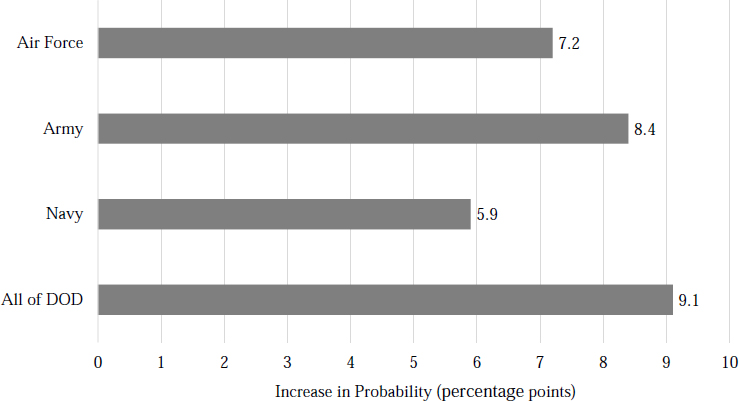
NOTE: Statistical significance of p < 0.01 in each case. These results are based on a predictive econometric model that adjusts for firm differences and includes time and firm-level fixed effects.
SOURCE: Committee calculations based on data from the Small Business Administration’s SBIR/STTR Award database (SBIR.gov), Crunchbase, and USASpending.gov.
SBIR/STTR funding organizations (military services) and for DOD as a whole. The committee also looked at whether startups perform differently from the control group. Young firms (those less than 5 years old) that received DOD SBIR/STTR awards had a 9.7-percentage-point higher probability of raising private investment than the control group, which is slightly higher than the figure for all of DOD.
A further indicator of commercial validation is the acquisition of SBIR/STTR-funded companies by larger enterprises. In contexts such as defense, where significant costs and long lead times can complicate commercialization, acquisitions can integrate promising R&D into established manufacturing and distribution networks, thereby creating efficiencies and spurring greater innovation overall. Looking at the full set of DOD SBIR/STTR awardees (1983–2022), the committee identified 567 of those awardees that were acquired between 1990 and 2022, representing about 4 percent of all DOD SBIR/STTR-funded firms. Looking more specifically at acquisitions by major defense contractors, the committee found that 95 DOD SBIR/STTR firms were eventually acquired by these companies, almost 20 percent of those acquisitions. Although Lockheed Martin, General Dynamics, and Raytheon did acquire some DOD SBIR/STTR awardees, such as Voyager Space Holdings, the acquisition of some DOD SBIR/STTR awardees by 3M, Hewlett Packard, and Merck illustrate the diversity of acquiring firms and the range of technological domains in which DOD SBIR/STTR-funded small businesses can excel.
The committee also looked at acquisition comparisons in the 2012–2020 time period between DOD SBIR/STTR firms and the control group of firms that did not receive DOD SBIR/STTR funding. In that period, the committee found that DOD SBIR/STTR firms were twice as likely to be acquired compared with the control group, and that difference was statistically significant. While acquisitions can reflect broader industry consolidation, the higher prevalence among DOD SBIR/STTR awardees underscores the perceived value of these firms’ intellectual property, personnel, and long-term potential, as well as the sole source contracting benefits of receiving an SBIR/STTR contract. Acquisition activity among DOD SBIR/STTR firms has grown over time, reflecting overall trends in the economy—acquisitions have become a well-adopted corporate strategy and have increased over time—and consolidation in the defense industry. But the fact that SBIR/STTR firms are acquired at a higher rate than the matched sample indicates the perceived value of the program.
INNOVATION: PATENTING RATES BY DOD SBIR/STTR FIRMS
Patents are a widely used indicator of technological creativity, offering a standardized but inherently imperfect measure of new knowledge production. During the 2012–2020 time period, more than one-third (34 percent) of DOD SBIR/STTR awardees held at least one patent, a figure that stands in sharp contrast to 7 percent among the control group of firms that did not receive a DOD
SBIR/STTR award. When the committee adjusted for the underlying differences between these groups—recognizing that DOD SBIR/STTR firms tend to be younger, more technology focused, and more often located in technology clusters such as California or Massachusetts—a pronounced gap in patenting remained. As illustrated in Figure 8-2, controlling for differences in firm characteristics confirms that DOD SBIR/STTR funding is associated with a roughly 23-percentage-point increase in the probability of obtaining a patent. This pattern holds across services, though the Army exhibits a slightly stronger relationship. Across DOD a whole, young firms, or startups, that received DOD SBIR/STTR awards had a nearly 23-percentage-point higher probability, similar to the figure for all of DOD.
Although DOD SBIR/STTR firms clearly patent at higher rates, the committee also investigated whether their patents receive more forward citations—a standard proxy for patent quality or influence. Forward citations are the number of subsequent patents that cite a given patent as prior art in the invention. Comparing DOD SBIR/STTR-funded firms with the control group did not provide insight into the quality of these patents, likely because the analysis

NOTE: Statistical significance of p < 0.01 in each case. These results are based on a predictive econometric model that adjusts for firm differences and includes time and firm-level fixed effects.
SOURCE: Committee calculations based on data from the Small Business Administration’s SBIR/STTR Awards database (SBIR.gov), the United States Patent and Trademark Office, and USASpending.gov.
analyzed patents and forward citations only during the 2012–2020 time period. Citation-based measures often take considerable time to mature, and patents originating from newly established or specialized technologies may not accumulate many citations in the early years. A relatively short observation window can further obscure the long-term impact of patents by DOD SBIR/STTR-funded firms.
The committee took a closer look at patents produced by DOD SBIR/STTR awardees to determine whether these firms generate economic value through the flow of knowledge to other defense contractors, particularly the large prime contractors.2 To examine this issue, the committee assembled data on 5,278 companies that received Phase II DOD SBIR/STTR awards between 2012 and 2020. These firms produced 17,001 patents after receiving their DOD SBIR/STTR contract during that period.3 Among these, 995 (18.9 percent) produced at least one “government interest” patent by 2021, totaling 2,820 such patents. Government interest patents are inventions that were supported by federal funding, and inventors are required to disclose this support by including government interest statements in their patent applications. Of these government interest patents, 271 patents from 254 firms were tagged as having been specifically funded through the DOD SBIR/STTR programs.
Of the total 271 patents that included DOD SBIR/STTR funding in their government interest statement, 8.5 percent were cited by one or more defense contractors. During the same period, these DOD SBIR/STTR-funded companies also generated 14,181 patents without government interest markers; only 3 percent were cited by the same set of defense companies.
Table 8-1 presents these citation patterns. The data suggest that the defense contractors reference ideas emerging from SBIR/STTR-funded research and that knowledge explicitly tied to SBIR/STTR funding—evidenced by government interest patents—disseminates more readily into the R&D portfolios of major defense firms. In other words, patents attributed to DOD SBIR/STTR awards are cited nearly three times more often than non-SBIR/STTR patents among the same recipients, underscoring the potential for DOD SBIR/STTR-funded innovations to transition into acquisition programs and operational use.
MULTIPLE-AWARD RECIPIENTS
As in Chapter 7, the committee explored whether the intensity of a firm’s SBIR/STTR participation shapes its external outcomes. While all DOD
___________________
2 The committee looked at the top 50 arms-producing and military services companies in the world, and found that only seven contractors (RTX Corporation, BAE Systems, Honeywell, Boeing, Northrop Grumman, Naval Group, and General Electric) cited patents produced by SBIR/STTR-funded firms with a government interest statement acknowledging SBIR/STTR funding.
3 Because the committee looked at patents issued post–SBIR/STTR award, the time period for collecting patent information extended to 2021.
TABLE 8-1 Patenting by DOD SBIR/STTR Awardees (2012–2020) and Forward Citations
| Postfunding | SBIR/STTR Government Interest Patents | Non-SBIR/STTR Government Interest Patents | Non–Government Interest Patents |
|---|---|---|---|
| Patent count of SBIR/STTR Phase II Awardees | 271 | 2,549 | 14,181 |
| Total number of forward citations | 1,118 | 6,924 | 50,022 |
| Percentage of patents with at least one forward citation | 47.6% | 45.2% | 44.5% |
| Number of forward citations by top 50 defense contractors | 552 | 1,501 | 5,537 |
| Percent of patents with at least one forward citation by a defense contractor | 8.5% | 5.7% | 3.0% |
| Percentage of forward citations by top 50 defense contractors | 49.4% | 21.7% | 11.1% |
NOTE: Table data include patents received by 2021.
SOURCE: Committee calculations based on United States Patent and Trademark Office patent data, accessed via Patentsview, and USASpending.gov data; SBIR/STTR firms from the Small Business Administration’s SBIR/STTR Awards database (SBIR.gov); and prime contractors from the top 50 firms listed in Stockholm International Peace Research Institute (Liang et al., 2023).
SBIR/STTR awardees see higher patenting and private financing rates, there is a clear threshold effect once companies surpass five awards. The estimated increase in the probability of patenting nearly doubles when moving from fewer than five to five or more DOD SBIR/STTR awards, suggesting that multiple SBIR/STTR projects may confer deeper technical expertise and visibility. On the financing side, the positive association grows more pronounced—though sometimes failing to reach statistical significance—for firms that hold 40 or more awards (Figure 8-3). This threshold phenomenon indicates that repeated engagement with DOD SBIR/STTR can reinforce a firm’s innovation capabilities and market appeal.
DIFFERENCES BETWEEN SBIR AND STTR
Although the above analyses frequently group DOD SBIR and STTR awards together, the committee also examined the two programs separately. Overall, both show positive and statistically significant results for patenting and private investment, but the effects are generally larger and more precisely estimated for SBIR awardees (Figure 8-4). STTR participants, which typically

NOTE: *Only the (< 5 Awards) and (≥ 40 Awards) categories show statistically significant effects (p < 0.05). These results are based on a predictive econometric model that adjusts for firm differences and includes time and firm-level fixed effects.
SOURCE: Committee calculations based on data from the Small Business Administration’s SBIR/STTR Awards database (SBIR.gov), Crunchbase, and USASpending.gov.
partner with a university or other nonprofit research institution, may be working on earlier-stage ideas that take longer to yield patentable or market-ready technology. That extended timeline may in turn make it more difficult to detect robust short-term differences in the data, which focus on the 2012–2020 period.
SUMMARY
Taken together, the findings reported in this chapter reinforce the notion that DOD SBIR/STTR awardees occupy an important position in the broader innovation ecosystem, not only within federal contracting but also in private markets. Firms that participate in DOD’s SBIR/STTR programs show higher rates of patenting, are more likely to attract external funding, and often become acquisition targets for larger companies seeking to capitalize on new technologies, when compared with a group of R&D contractors who did not participate in DOD’s SBIR/STTR programs during the same period of analysis. While the direction of causality remains difficult to pin down—these firms may possess

NOTE: *Only the SBIR categories show statistically significant effects (p < 0.01). These results are based on a predictive econometric model that adjusts for firm differences and includes time and firm-level fixed effects.
SOURCE: Committee calculations based on data from the Small Business Administration’s SBIR/STTR Awards database, the United States Patent and Trademark Office, Crunchbase, and USASpending.gov.
intrinsic capabilities that led DOD to select them in the first place (reflective of an informed and effective award selection process)—the correlations are both sizable and consistent across different metrics, time periods, and services.
In broad terms, the results of the committee’s analyses suggest that DOD SBIR/STTR awards often identify or catalyze promising small businesses that go on to achieve stronger innovation outcomes relative to other R&D-focused federal contractors. This finding echoes the core policy rationale behind the SBIR/STTR programs of fostering high-potential firms and helping them develop commercially viable technologies that can ultimately serve defense needs. Just as with DOD-centered follow-on funding, there remain gaps—particularly in measuring the downstream quality of patents and in understanding why STTR effects appear smaller than those of SBIR—but overall, the evidence points to an SBIR/STTR-driven ecosystem of technologically active and investor-backed small companies that extends well beyond purely military applications.
FINDINGS AND RECOMMENDATION
Finding 8-1: DOD SBIR/STTR firms are more likely than other federal R&D–performing firms to create patented technology and to receive private financing.
Finding 8-2: DOD SBIR/STTR firms with at least five Phase I awards are associated with higher levels of patenting and follow-on financing relative to those with fewer.
Finding 8-3: DOD SBIR/STTR awardees register a significant rate of knowledge transfer to prime contractors. For example, patents attributed to DOD SBIR/STTR funding are cited nearly three times more often compared with non-SBIR/STTR patents among the same recipients. Additionally, nearly 20 percent of acquisitions of DOD SBIR/STTR-funded firms are by one of the top defense contractors.
Finding 8-4: The lack of data on subcontracting by DOD contractors makes it difficult or impossible to track procurement of DOD SBIR/STTR-supported technologies and to compare it with the procurement of technologies from other firms engaging in federal R&D activities.
Recommendation 8-1: The Office of the Under Secretary of Defense for Research and Engineering should analyze the patent and follow-on investment activities of Department of Defense Small Business Innovation Research/Small Business Technology Transfer (SBIR/STTR) awardees to understand best practices for creating incentives for private-sector investment in defense technologies and defense firms.
This page intentionally left blank.