Unit Manufacturing Processes: Issues and Opportunities in Research (1995)
Chapter: 6 Deformation Processes
6
Deformation Processes
Deformation processes transform solid materials from one shape into another. The initial shape is usually simple (e.g., a billet or sheet blank) and is plastically deformed between tools, or dies, to obtain the desired final geometry and tolerances with required properties (Altan, 1983). A sequence of such processes is generally used to form material progressively from a simple geometry into a complex shape, whereby the tools represent the desired geometry and impart compressive or tensile stresses to the deforming material through the tool-material interface, as illustrated in Figure 6-1 for the cases of extrusion and deep drawing. Deformation processes are frequently used in conjunction with other unit operations, such as casting, machining, grinding, and heat treating, to complete the transformation from raw material to finished and assembly-ready discrete parts. Deformation processes, along with machining, have been at the core of modem mass production, because they involve primarily metal flow and do not depend on long-term metallurgical rate processes.
Classification And Characteristics Of Processes
Deformation processes can be conveniently classified into bulk-forming processes (e.g., rolling, extrusion, and forging) and sheet-forming processes (e.g., stretching, flanging, drawing, and contouring). In both cases, the surfaces of the deforming material and of the tools are usually in contact, and friction between them has a major influence. In bulk forming, the input material is in billet, rod, or slab form, and a considerable increase in the surface-to-volume ratio occurs in the formed part. In sheet forming, a sheet blank is plastically deformed into a complex three-dimensional configuration, usually without any significant change in sheet thickness and surface characteristics.
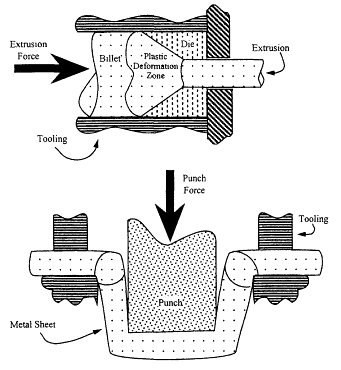
Figure 6-1
Basic components of process modeling.
Bulk-forming processes have the following characteristics:
- The workpiece undergoes large plastic deformation, resulting in an appreciable change in shape or cross section.
- The portion of the workpiece undergoing permanent plastic deformation is generally much larger than the portion undergoing elastic deformation. Therefore, elastic recovery or springback after deformation is negligible.
The characteristics of sheet-metal forming processes are as follows:
- The workpiece is a sheet or a part fabricated from a sheet.
- The deformation usually causes significant changes in shape but not in cross-section of the sheet.
- In some cases, the magnitudes of permanent plastic and recoverable elastic deformations are comparable; therefore, elastic recovery or springback may be significant.
Some processes can fall under both categories (e.g., sheet-metal and bulk-forming), depending on the configuration of the workpiece. For example, in reducing the thickness of a tube, if the starting workpiece is a thick-wall tube, the reduction (ironing) process would be classified as a bulk-forming process, whereas if the starting workpiece is a thin can, the ironing process could be considered to be a sheet-metal forming process.
In addition to shape change, forming processes also alter the metallurgical structure of the workpiece and may be used to enhance material properties. Such improvements may eliminate the need for heat treatment and provide property combinations that were previously unattainable. Formed parts may be produced to net, or near-net, dimensions and surface, reducing or eliminating the need for finishing steps and the material loss due to machining and trimming (Kudo, 1990). Deformation processes are less energy intensive than casting processes because they are carried out at lower temperatures, and the deformation energy required for shape change is much less than the thermal energy required to reach the molten state.
Deformation processes are especially attractive in cases where:
- the part geometry is of moderate complexity, and the production volumes are large, so that tooling costs per unit product can be kept low (e.g., automotive applications, such as those depicted in Figure 6-2); or
- the part properties and metallurgical integrity are extremely important (examples include load-carrying components used in aircraft, jet engines, and steam or gas turbine components that require very high in-service reliability).
Design of proper tooling is the key to successful deformation processes, but it requires extensive experience and know-how to reduce the expense and time involved, since process development is still heavily based on trial-and-error effort. Although this approach has been highly successful, future competitiveness requires complementary model-based methodologies for process design. There is great need for a predictive capability through which material and process
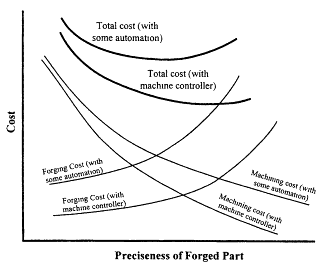
Figure 6-2
Minimum total manufacturing cost arising from a compromise between forming and finish machining costs (adapted from Kudo, 1990).
control can be exercised to achieve desired product features economically and without defects.
Toward this end, it is useful to consider generalizations about the physical phenomena that are common to all deformation processes: this forms the basis for a rational approach to understanding the characteristics of each process and to enhancing the art of metalforming. In Figure 6-1, incoming material is transformed into outgoing material by passing through a zone of plastic deformation.1 During transformation through the plastic deformation zone, in addition to changes in shape and dimensions, metallurgical structure and surface are altered as well. Energy transfer occurs within the plastic deformation zones as heat and external forces are transferred to the workpiece material by forming equipment through the tooling and the interfaces between the tooling and workpiece.
Significant Process Variables
Shape, structure, and surface transformations occurring in the plastic deformation zone, for a given material, are controlled by the equipment, tooling, and interfaces. The metal flow, the friction at the tool-material interface, the heat generation and transfer during deformation, and the relationships between microstructure/properties and process conditions are difficult to analyze and predict. Therefore, complete knowledge of the complex interactions between the process parameters and the workpiece material form the basis of the predictive capability required for rational process design. This systems approach, as illustrated in Figure 6-1 and Table 6-1, allows the study of the input/output relationships and of the effects of process variables on product quality and process economics.
The key to successful metal deformation (i.e., to obtaining the desired shape and properties) is the understanding and control of metal flow. The direction of metal flow, the magnitude of deformation, and the temperatures involved greatly influence the properties of formed products. Metal flow determines both the mechanical properties related to local deformation and the formation of defects such as cracks or folds at or below the product surface. The local metal flow in turn is influenced by the process variables, as summarized in Table 6-1.
Discrete parts often undergo several sequential forming operations (e.g., preforming) to transform the initial simple geometry into a complex one, without causing material failure or degrading material properties (Sevenler et al, 1990). A typical sequence is shown in Figure 6-3. Consequently, one of the most significant steps for future enhancement of deformation processes is the capability to predict the optimal forming sequences. For a given operation (e.g., preforming or finish forming), such design essentially consists of three steps:
- predicting metal flow by establishing the kinematic relationships (e.g., shape, velocities, strain rates, and strains) between the deformed and undeformed part;
- establishing the limits of formability or producibility within which the part can be formed without surface or internal failures; and
- selecting equipment and tooling designs based on the prediction of the forces and stresses necessary to execute the forming operation.
Incoming Material—Billet Or Sheet Blank
Material properties under processing conditions (i.e., flow stress of the deforming material under various temperature, strain, and strain-rate conditions)
Table 6-1 Significant Variables in a Deformation Process
|
Starting Material |
Tooling |
|
Flow stress (constitutive equation) |
Geometry |
|
Workability (forming limit curves) |
Surface conditions/coatings |
|
|
Material/heat |
|
Surface condition |
treatment/hardness |
|
Thermal/physical properties |
Temperature |
|
Initial conditions |
|
|
Microstructure evolution |
|
|
|
Conditions at Tool/ |
|
Product/Final Material |
Material Interface |
|
Geometry |
Lubricant |
|
Dimensional accuracy/tolerances |
Heat transfer |
|
Surface finish |
|
|
Microstructure and properties |
|
|
|
Process Equipment |
|
Deformation Zone |
Speed/production rate |
|
Deformation mechanics |
Force/energy capabilities |
|
Kinematics |
Rigidity and accuracy |
|
Stress state |
|
|
Temperature |
Resources and Environment |
|
|
Available manpower |
|
|
Air, noise, and waste water |
|
|
pollution |
|
|
Plant and production |
|
|
facilities and control |
must be known in order to analyze, simulate, and optimize a deformation process. The flow properties of the incoming material are determined by its chemical composition and previous thermal and mechanical treatment history. Accurate determination of these data allows reliable estimation of tool stresses and equipment loading, as well as prediction of metal flow and elimination of forming defects.
Another material parameter requiring improved understanding is the influence of geometric characteristics of incoming material (i.e., tolerances,
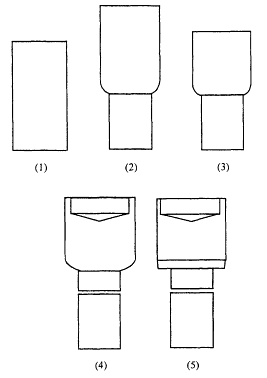
Figure 6-3
An example forming sequence retrieved from the Forming Sequence Database. (The exact dimensions of the part are in the database.) (adapted from Sevenler et al., 1990). (1) is cut off; (2) is forward extrude; (3) is upset; (4) is backward extrude; and (5) is upset.
quality of sheared edge, and surface finish) on the subsequent forming operations.2
Information essential for the prediction of microstructure evolution during deformation processing using process modeling must be developed and made
available to process-design practitioners in industry, research laboratories, and educational institutions.
Product
The two main characteristics of a deformed product are its geometry (e.g., dimensions, tolerances, and surface finish) and its mechanical properties. As in all manufactured products, the design of the deformed part—that is, the consideration of ease by deformation processing during the design stage—determines the magnitude of the effort necessary for process and tool development (Altan and Miller, 1990). For example, geometric features that satisfy various functional requirements such as stiffness and strength could be evaluated regarding their formability. This information would greatly reduce the effort necessary for tool and process design. To date, research efforts have had limited success in developing knowledge-based systems to aid in part designs and process sequence selection for improved formability.
Current major trends in manufacturing products by deformation processing include:
- deformation-formed parts with complex geometries, such as gears with formed teeth, trunnions, and universal joint components (Pale et al., 1992), that are replacing parts produced by other processes, such as casting and machining, due to their lower cost (e.g., see the cost trade-off in Figure 6-4 for a precision gear);
- better surface finish, tolerances, and elastic springback control, which allow elimination of finish machining and grinding operations; and
- microstructure and properties optimized to reduce the need for heat treatment or use of high alloyed materials.
Deformation Zone And Mechanics
The understanding and prediction of process kinematics (velocities, strain, strain-rate), stresses, and temperatures of a deformation process are essential in estimating process conditions (tool stresses and deformation forces), understanding defect formation, and predicting the microstructure and properties of formed parts. This capability would allow the process conditions and tooling design to be optimized to obtain high-quality products with a minimum amount of trial and error during process development.
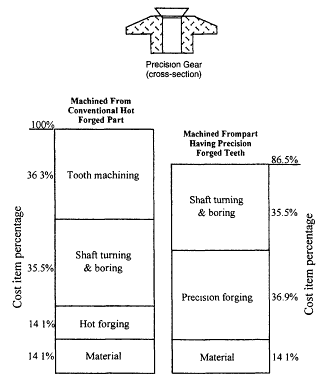
Figure 6-4
An example of manufacturing cost reduction by combining net-shape forming and partial machining for a precision gear.
Advances in the development and use of finite-element methods to solve nonlinear plastic deformation problems have led to practical solutions for two-dimensional deformation processes (Kobayashi et al., 1989). Work is now being done to extend process models that are based on finite-element methods to estimate parameters such as elastic defection of tooling, tool life, distortion of the formed part, and microstructure and properties of formed parts and to predict the occurrence of workpiece defects (Knoerr et al., 1992). Further progress in the use of finite-element methods in three-dimensional deformation has been slow due to difficulties in three-dimensional mesh generation, automatic remeshing, formulation of efficient solution algorithms, and effective visualization or post processing of results.
Tooling
Design and manufacture of tooling are essential factors determining the performance of deformation processes. The key to successful deformation processing is tool design, which has been, to a very large extent, experience based. Innovative multi-action tool designs are being developed for near-net shaping of increasingly complex parts, such as gears and universal joint components. These tooling approaches can be extended. Many companies already are using computer-aided engineering and computer-aided manufacturing to design and fabricate process tooling (Tang et al., 1988).
Advanced heat treatment and coating techniques can extend tool life. Studies are being conducted to measure and predict lubricant behavior and heat transfer at the tool-material interface in support of lubricant coatings development based on an understanding of mechanisms of erosive tool wear. This is an extremely important area, since tool life directly influences the economics of deformation processes.
Conditions At Tool-Material Interface
The quantitative knowledge of friction and heat transfer at the tool-material interface is essential for adequate design of the process. New and environmentally benign lubrication systems are being developed to establish a reproducible process that provides parts with high quality and excellent surface finish. For instance, in hot forging the quality of lubrication and the oxidation of the billet surface greatly influence the thermal conditions at the tool surface and determine tool life and process economics.
Equipment
The productivity, reliability, and cost of equipment used for deformation processes are extremely important factors, since they determine the economics and practical application of a given process. In both sheet and bulk forming, the stroking rate of the forming machine tools are being continuously increased. Thus the machine dynamics and machine stiffness are of increasing concern. As in other unit processes, the use of sensors for process monitoring and control is essential and continues to increase.
Sensors can also be used to continuously monitor the condition of the tooling. Such systems can not only improve part quality but enable higher
production rates from expensive deformation process equipment by greatly reducing unscheduled break-downs.
Safety And Environmental Factors
Safety is the paramount concern in deformation processes where machine speeds and forces are relatively high. Other concerns include the environmental effects of lubricants, cooling and heating fluids, scrap material, and noise. In developing a new unit process, it is necessary to minimize or eliminate adverse environmental effects caused by the process.
Research Opportunities
Considering the systems view of deformation, as shown in Table 6-1, the opportunities in deformation processing may be reviewed in terms of process or system components. Improvements in process design capability can be divided into two general areas:
- enhanced numerical methods for accurate representation of material and friction behavior, including microstructure and defect evolution; and
- expanded capability to measure material behavior, friction, and part quality.
Listed below are research opportunities to advance the state of the art in deformation unit processes.
- Research efforts are needed to generate, evaluate, and systematically store flow stress and formability data for both sheet and billet materials under actual processing conditions (i.e., high temperature, strain, and strain-rate regimes).
- The relationships between process variables and obtainable microstructure and properties, after deformation and heat treatment, must be developed for many new materials.
- Design for producibility requires further research. Research is needed to develop expert systems to assist part designers in the design of components to be produced by forming, particularly in manufacturing complex-shaped parts.
- Prediction of microstructure and property evolution, as well as surface and internal damage caused by processing, is required for advanced process modeling.
- The effect of lubricants and coolants on thermal conditions at the tool-material interface is a significant research topic. The result will be extended tool life through improved heat treatments of the tools and the incorporation of new coatings.
- Further development of suitable sensor systems that can maximize machine utilization rates and reliability through real-time condition monitoring of machine performance is required, so that the resulting information can be used to schedule preventive maintenance.
- Research is needed to establish tooling design guidelines for reducing tool stresses, improving lubricant distribution, and influencing metal flow in dies. Work is needed to link the tool stresses, calculated by using finite-element programs, to tool fracture and fatigue criteria that are obtained experimentally for various tool materials and configurations.
- Better understanding of the effects of coatings and surface treatments on heat transfer and interface conditions is needed to improve the selection of existing coatings and guide the development of new coatings.
- Research should be extended in innovative and practical design of multi-action tooling and machines for forming parts with complex shapes and tight tolerances. Key research areas include increasing dynamic stiffness to improve tolerances; on-line monitoring of machine and tooling performance to avoid unscheduled down time; and techniques and methods for on-line monitoring of part quality, particularly for high-rate forming systems.
- R&D efforts must be conducted with multidisciplinary research groups so that theoretical and experimental developments concurrently benefit each other and thus lead to a high degree of realism and confidence in the process models. Collaborative mechanisms for the development and widespread dissemination of the data and methodologies may be required, particularly for small manufacturers who typically do not have in-house groups of multidisciplinary researchers.
- Implicit in these needs is the requirement for training and education at a much higher level than is currently available in the majority of companies using deformation processing in manufacturing.
References
Altan, T. 1983. Metal Forming—Fundamentals and Applications. Metals Park, Ohio: ASM International.
Altan, T., and R.A. Miller, 1990 Design for forming and other near-net shape manufacturing processes. Annal of the Institution for Production Engineering Research 39:609-620.
Knoerr, M., K. Lange, and T. Altan. 1992 An integrated approach to process simulation and die stress analysis in forging. Pp. 53-60 in Vol. 20 of the Proceedings of the North American Manufacturers Research Conference held May 1992 in Pullman, Washington. Urbana, Illinois: University of Illinois.
Kobayashi, S., S. Oh, and T. Altan. 1989. Metalforming and Finite Element Methods. New York: Oxford University Press.
Kudo, H. 1990. Towards net shape forming. Journal of Materials Processing Technology 22:307-342.
Pale, J., R. Shivpuri, and T. Altan. 1992. Recent developments in tooling, machines, and research in cold forming of complex parts. Journal of Materials Processing Technology 33:1-30.
Sevenler, K., P.S. Raghupathi, and T. Altan. 1987. Forming sequence design for multi-stage cold forging. Journal of Metalworking Technology 14:121-135.
Tang, J., S.I. Oh, T. Altan, and R.A. Miller. 1988. A knowledge based approach to automate forging design. Journal of Materials Shaping Technology 6:7-17.


