Unit Manufacturing Processes: Issues and Opportunities in Research (1995)
Chapter: 2 What are Unit Manufacturing Processes?
2
What Are Unit Manufacturing Processes?
Manufacturing involves the conversion of raw materials, usually supplied in simple or shapeless forms, into finished products with specific shape, structure, and properties that fulfill given requirements. This conversion into finished products is accomplished using a great variety of processes that apply energy to produce controlled changes in the configuration properties of materials. The energy applied during processing may be mechanical, thermal, electrical, or chemical in nature. The results are meant to satisfy functional requirements that were defined during the product design stage.
In the past, design, materials engineering, and manufacturing were often treated as independent engineering specialties. However, modem manufacturing must be cost-effective and timely. This requires that everyone involved in the entire product life cycle work together concurrently to provide a functional product that can be produced efficiently, can be operated reliably, and is easy to maintain and recycle (Taguchi, 1993). This report identifies a large number of opportunities for improving unit processes. These can be considered as future options for the concurrent engineering teams.
Manufacturing a product or component usually requires the integration of a number of processes. For example, the initial process may involve casting a metal into a mold to produce a desired shape. Next, the casting may be machined with cutting tools to generate surfaces of specified form. Finally, a surface treatment may be employed to improve the durability of the part. Each of these three individual operations—casting, machining, and surface treatment—is a unit manufacturing process. For brevity, in this report they will be referred to as ''unit processes." They are the individual steps required to produce finished goods by transforming raw material and adding value to the workpiece as it becomes a finished product.
The information and material flows associated with a typical unit process are shown in Figure 2-1. Raw material or parts from a previous unit process are
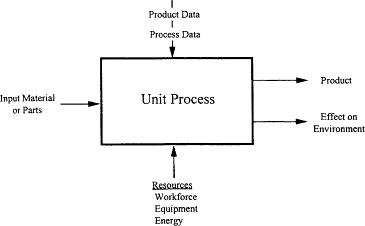
Figure 2-1
Unit process information and materials flow.
the input. The output consists of parts, which are one step closer to their final form, and of an influence on the environment, such as particulate or noise pollution. The information input and control to the unit process include product data, process information, and process control methodology. The resource requirements of the unit process are such items as manufacturing equipment, energy, and human resources.
A unit process can be considered optimized when the value added in terms of the required configuration and property changes is delivered to the workpiece in the most cost-effective manner from the system as a whole. This involves minimization of factors such as energy use, scrap generation, labor costs, and capital equipment requirements. In addition, rapid response to the needs of customers and a safe working environment are essential. Sequential unit processes, known as process strings, include cost factors that may result from previous unit processes, such as repair operations required by quality lapses of intermediate process steps. Therefore, many factors must be considered in evaluating cost-effectiveness. A general definition is "minimization of input and resource costs per unit of output product value."
A vast number and a great variety of individual classical and novel unit processes exist. Compilations have been prepared that identify several hundred individual processes; for example, the Welding Handbook, Volume I (AWS, 1987). It would be of limited usefulness to discuss each process individually in this report. Instead the Unit Manufacturing Process Research Committee has selected a schematic model that identifies five components common to all unit processes.
In this chapter, the committee presents the rationale for a unit process taxonomy containing five major families. These processes are applicable to the full range of workpiece materials: metals, polymers, ceramics, and composites. The end result is a three-dimensional framework composed of process components, process families, and materials. This scheme provides a concise description of the broad topic of unit processes. Using this framework, the committee determined that there are a few areas of applied scientific and technical knowledge that enable the design and operation of essentially all unit processes. These areas are referred to here as ''enabling technologies."
Components Of A Unit Process
A schematic model of a unit process is depicted in Figure 2-2. Energy is delivered to the workpiece material by means of the process equipment and its tooling and is transferred to the workpiece through an interface region between the tooling and the workpiece. Often the interface contains a medium such as a coolant or lubricant. The specific changes in the workpiece configuration and structure usually occur in a localized area of the workpiece, designated as the workzone. For example, a group of metal removal processes, loosely known as
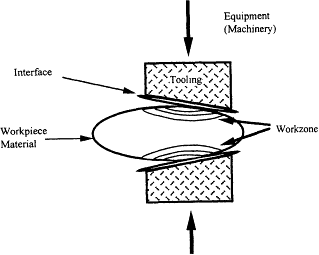
Figure 2-2
Unit manufacturing process model.
machining, includes several operations (e.g., turning, milling, drilling, boring, etc.). Each of these processes is distinguished by the tooling design, the interface (represented by the cutting fluid), and the equipment design and characteristics (i.e., degrees of motional freedom, rate of workpiece or tool feed, and machine rigidity). The workzones of these processes are localized on the workpiece surface and involve shear deformation and fracture as workzone mechanisms, which impart a change in shape to the workpiece.
The wide diversity of unit processes (e.g., machining, forging, casting, and injection molding) incorporate equally diverse groups of equipment, tooling designs, interface materials, and workzone mechanisms. The process equipment may belong to the groups of mechanical, thermal, chemical, photonic, and electrical equipment, as well as to combinations of the groups. Tooling elements include cutting tools, grinding media, dies, molds, forms, patterns, electrodes, and lasers. The array of interface materials typical of unit processes includes lubricants, coolants, insulators, electrolytes, hydraulic fluids, and gases. The operative mechanisms found in the workzones of unit processes include deformation, solidification, fracture, conduction, convection, radiation, diffusion, erosion, vaporization, melting, microstructure change, phase transformations, chemical reactions, and many others. Examples of the five unit process components for six illustrative unit manufacturing processes are presented in Table 2-1.
Each of the five process components—equipment, workpiece, tooling, interface, and workzone—are influenced by the other process components. For example, the interface conditions may govern the rate of energy transfer from the equipment to the workzone and may control the extent of the workzone localization and the uniformity of the changes in the workpiece shape and structure. In the machining process, variation in the thermal behavior or effectiveness of the cutting fluid may impose thermal distortions in the workpiece or equipment and result in a loss of process precision, manifested in products of poor quality.
Most processes involve several competing workzone mechanisms, with one mechanism overriding the others, at any given instant in the process. The design and selection of the process components and operating conditions are usually predicated on the assumption that a prime mechanism will remain dominant during process operation. In some instances, the process conditions may change so that an alternative mechanism becomes dominant, impacting the process operation and the resulting product quality. For example, in hot forging of jet-engine disks from elevated temperature alloys, extended contact time between the heated workpiece material and colder forging dies leads to increased heat flow to the dies. As a result, the workpiece material near the die-workpiece interface cools and does not deform as readily as the hotter zones of the workpiece. This
Table 2-1 Examples of Unit Process Components
|
Unit Process |
Illustrative Equipment |
Workpiece Material |
Typical Tooling |
Typical Interface |
Primary Workzone Mechanism |
|
Machining |
lathe |
bar stock |
single point |
cutting fluid |
deformation, fracture |
|
surface modification |
furnace |
part |
atmosphere |
diffusion |
phase change |
|
casting |
furnace |
melt |
mold |
release agent |
solidification |
|
forging |
press |
preform |
die |
lubricant |
deformation |
|
powder compaction |
press |
powder |
die |
lubricant consolidation |
deformation |
|
fusion arc welding |
power supply |
part |
arc |
plasma |
phase change |
nonuniformity in deformation affects the microstructure and the properties of the forged disk. The solution to this problem is to control the speed of the forging operation, thus minimizing the contact time of the workpiece and dies and the temperature loss at the workpiece surface. The end result is uniform deformation and uniform microstructure and properties in the forged part.
Taxonomy Of Unit Manufacturing Processes
The identification of process components provides a useful overview. However, several hundred individual unit manufacturing processes are commercially used in manufacturing operations. In order to discuss these processes in more detail, it is necessary to classify them using some common features. Many such classifications or taxonomies have been presented in the relevant technical literature. The taxonomy chosen for this study emphasizes the physical process by which the configuration or structure of a material is changed. The subsequent discussion of unit processes will be organized according to this taxonomy. Five families of physical processes make up this taxonomy:
- Mass-change processes remove or add material by mechanical, electrical, or chemical means. Included in this family are the traditional processes of plating, machining, and grinding, as well as nontraditional removal processes such as electrodischarge and electrochemical machining.
- Phase-change processes produce a solid part from material originally in the liquid or vapor phase. The casting of metals, infiltration of composites, and injection molding of polymers represent this family. (Phase changes in the solid state are considered to belong to the structure-change process family.)
- Structure-change processes alter the microstructure of a workpiece, either throughout its bulk or in a localized area, such as its surface. Heat treatment and surface hardening are commercial processes representative of this family. Solid-state phase changes are considered part of this family.
- Deformation processes alter the shape of a solid workpiece without changing its mass or composition. Classical metalworking processes of rolling and forging fall into this category, as do the sheet-forming processes of deep drawing and ironing.
- Consolidation processes combine materials such as particles, filaments, or solid sections to form a part or component. Powder metallurgy, ceramic molding, and polymer-matrix composite pressing are examples of consolidation processes. Joining processes, such as welding and brazing, also belong to this process family.
Identifying Priority Opportunities For Unit Process Research
The overall significance of a unit process innovation can be determined from several key considerations that are derived from the application context, and which can be structured as criteria. These criteria allow identifiable metrics to be established at the beginning of a development program that can later provide a benchmark to measure progress. These criteria can also be used to organize a "lessons learned" database that future efforts could access to enhance their chance of success.
- Does it offer the potential to be cost-effective? This factor examines, from basic considerations, the ability of a process to provide the required quality level at minimum input cost per unit of output. This would include, for example, the minimization of such factors as energy use, scrap generation, and labor costs. Thus, a single precisely controlled process that combines in essentially one operation what had previously required multiple operations could be highly rated by this criterion.
- Does it provide a unique way to cost-effectively exploit the physical properties of an advanced material? Too often, advanced materials with outstanding properties have languished in the laboratory because little, if any, consideration had been given to the methods required to produce them in usable shapes and quantities. Processes that are fundamentally simple, requiring low capital investment, would be highly rated by this criterion.
- Can it shorten the time to transform a product technology from the research stage to commercialization? This factor includes the capability of providing rapid response to customer needs. Unit processes that are relatively easy to scale-up from the laboratory to the factory due to their inherent flexibility, as well as efforts to develop process technology concurrently with the product technology, would be highly rated.
- Does it provide a method of processing that is fundamentally environmentally friendly? Since it is often difficult to attach a firm cost to environmental transgressions a priori, processes that avoid the difficulty in the first place, or that produce environmental effects that can be readily mitigated, would be highly rated.
- Is it applicable to a diverse range of materials? This criterion would rate higher those processes that are adaptable to a range of materials, and those that are more specialized would rate lower. However, it should be noted that nearly every unit process requires some amount of adjustment to accommodate different types of materials.
Enabling Technologies
The processes in each family of the unit manufacturing process taxonomy can be applied to any material—metal, ceramic, polymer—or to the many composite formulations of these materials with polymers, metals, or ceramics as the matrix material. For example, processes in the consolidation family are used in the production of metals (powder compaction), ceramics (hot pressing), and polymer composites (autoclaving). In addition, each combination of process and material requires consideration of the five process components for successful production.
Figure 2-3 illustrates this interaction of process families, materials, and process components. The committee examined the many research opportunities that were identified within each family of unit processes in Part II to determine which were the most important to the advancement of unit process technology. The committee concluded that the efficacy of a new unit process, or process improvement, could only be assessed in the context of a specific application, although criteria could be developed to identify promising research opportunities. This led the committee to synthesize the various research opportunities identified for each family of unit processes. In doing so, it became apparent that a thorough understanding of any unit process with its five process components is dependent on six critical or key technologies that enable the correct design and operation of all processes. The committee determined that the six enabling technologies are workpiece material behavior, process simulation and modeling, process sensors, process control, process precision and metrology, and equipment design.
- Materials behavior involves an understanding of materials properties and microstructure of the workpiece at the start of the process and during the process as the material is modified. A large database for properties for the extremes of processing conditions (e.g., temperature, strain-rate) may be required. The evolution of microstructure, the conditions under which fracture occurs, and an understanding of interface conditions such as friction are among the factors that must be understood in the context of specific unit processes.
- Simulation and modeling involves the analytical and numerical representation of the five components of a unit process, which are depicted in Figure 2-2. This approach can eliminate time-consuming and expensive trial-and-error process development and lead to rapid development of processes for new materials and new types of parts. These models must be experimentally validated.
- Sensors are independent devices that can measure process conditions in situ, as well as the response of the workpiece material. They may be remotely located, part of the equipment, contained in the workpiece, or in the interface
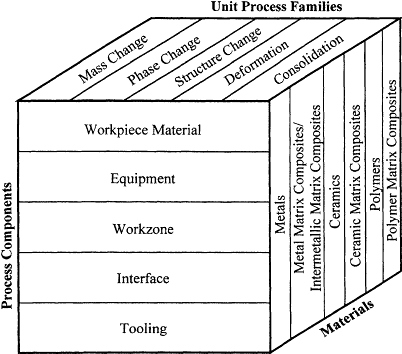
Figure 2-3
Unit manufacturing process families, components, and material classes.
- between the workpiece and the tooling. The incorporation of innovative sensing devices could greatly enhance the operation and control of unit processes.
- Process control involves the development of improved computer software and hardware to provide the optimum operation of process equipment at the required level of precision. A high-fidelity representation of the unit process, together with the implementation of appropriate process sensors, can contribute to improving process control.
- Process precision and metrology technologies directly determine the quality level. In addition to building precision into a process, geometric measurements are required to ensure dimensional control.
- Equipment design is the central feature of any unit process. The equipment and associated tooling must be designed to fulfill specific functions in a production environment. In addition, factors such as cost and time of fabrication, maintenance, flexibility of use, production rates, productivity, quality of the parts produced, and environmental friendliness are important aspects. Equipment may involve combinations of mechanical, electrical, chemical, and optical devices. Innovative design concepts can lead to dramatic improvements in unit processes.
The six enabling technologies are not independent of each other. For example, the design of process equipment is highly dependent on an understanding of the process precision and metrology, which are, in turn, integral to the sensor selection and process control methodology. In addition, advanced equipment design efforts often utilize simulation of the equipment operation, including accurate modeling of the workpiece and interface materials behavior during processing. These relationships among the six enabling technologies and the five major process components are depicted schematically in Figure 2-4. The
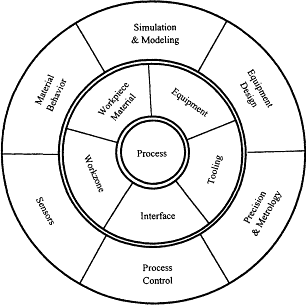
Figure 2-4
Unit process components and enabling technologies.
concentric (hierarchial) structure is shown to emphasize that knowledge flows from the six enabling technologies to the process components, which, in turn, form the unit process.
Process Streams And Integrated Processes
In most cases, product manufacture includes a series of sequential unit processes, referred to as a process stream. Each individual unit process of the stream has the output of the preceding unit process as its input material and is influenced by the characteristics of this material. Each product may then be considered the carrier of the history of the unit processes that preceded it. The final product properties, including microstructure, are the summation of the individual unit process experiences, both positive and negative, and define the final part quality and performance in the application.
The full benefit from an improvement to a particular unit process that is part of a process stream may not be realizable due to limitations in the processes that precede or follow it. The removal of such limitations provides additional opportunities for unit process improvements. The different unit processes can be so directly linked together that they effectively form an integrated system. Such systems are discussed in Chapter 8.
Advanced unit processes would do little good if they were not applied in manufacturing to improve the competitiveness of products by reducing cost and improving quality (IEEE Spectrum, 1993). With proper planning, implementation of these new unit processes can result in continual improvement of manufacturing operations (NAE, 1988; Bakerjian, 1993). While this report necessarily focuses on manufacturing, the important roles of product design engineering, the enterprise's commitment to excellence, participation by the work force, and so on, cannot be neglected in modernizing manufacturing (Clausing, 1994).
References
AWS (American Welding Society). 1987. Welding Handbook, Vol I. Miami, Florida: AWS.
Bakerjian, R., ed. 1993. Tool and Manufacturing Engineers Handbook. Volume 7, Continuous Improvement. Dearborn, Michigan: Society of Manufacturing Engineers.
Clausing, D.P. 1994. Total Quality Engineering: A Step-by-Step Guide to World Class Concurrent Engineering. New York: American Society of Mechanical Engineers Press.
IEEE Spectrum. 1993. Special report: Manufacturing a la carte. Institute of Electrical and Electronic Engineers Spectrum 30(9):24-27.
NRC (National Research Council). 1988. The Technological Dimensions of International Competition. National Academy of Engineering, NRC. Washington, D.C.: National Academy Press.
Taguchi, G. 1993. Robust Development. New York: American Society of Mechanical Engineers Press.


