The Global Positioning System: A Shared National Asset (1995)
Chapter: Wide-Band Signals at High Frequency
as the square of the distance, a fourfold increase in signal power will allow the distance at which the jammer defeats GPS tracking to be halved.
Military Enhancements
Block IIF Signal Structure Military Enhancements
If the NRC committee's recommendation to add an additional, unencrypted L4 signal on Block IIR satellites and increase the signal strength of L2 is adopted, the one remaining area in which further improvement might be considered for Block IIF satellites is that of enhanced resistance to RF (radio frequency) interference for military users. To achieve this capability, wider-band signals than currently provided by the present Y-code can be used or the desired signals can be supplied at greater intensity, possibly using spot-beam techniques, which would illuminate an area of conflict.
Wide-Band Signals at High Frequency
A significant increase (approximately 10 dB) in anti-jam capability could possibly be achieved on the Block IIF satellites by using another wide-band signal, occupying perhaps 100 MHz to 200 MHz.9 Such a broad signal would require that the carrier be at S-band frequency (approximately 2 GHz) or higher frequency. Although moving to a higher frequency would require receiver and spacecraft antennas to accommodate the signal, as well as other modifications, the move to a higher frequency would result in a reduced nulling antenna size and increase its performance. Such a high frequency would also provide increased immunity to the effects of ionospheric scintillation, which can degrade receiver performance when it is present.10
To demonstrate the effectiveness of a wide-band signal against a jammer (assumed to be co-located with a target), calculations have been performed for jammers operating at power levels of 100 watts and 10 kilowatts. (See Appendix L). At these two power levels, code and carrier tracking thresholds were estimated as a function of range from the jammer. For many applications, the key parameter is not the minimum range for loss of signal lock, but the minimum range for acceptable miss distance (range error) at the target. Therefore, the minimum range-to-jammer for a 1-meter range error was also determined.
|
9 |
Additional information on wide-band signals is given in Appendix L. |
|
10 |
Ionospheric scintillation is a phenomenon in which the Earth's ionosphere introduces rapid phase and amplitude fluctuations in the received signals. |
Figures 4-1 and 4-2 are the pseudorange errors as a function of distance for various receiver alternatives described in Appendix L and the two jammer power levels.11 The difference between the narrower-band Y-code and wide-band options is rather dramatic, even on the log-log plots. The most capable system operates below the 1-meter level to within about 45 meters of the 100-watt source. At 1,000 meters, the code tracking error is below the centimeter level. As shown in Table 4-1, carrier phase tracking and code loop aiding are available within several hundred meters of the jammer. The miniaturized nulling antenna with aiding is good down to about 175 meters. Both wide-band options, which are combined with inertial aiding, are substantially more capable than the best performing existing Y-code system.
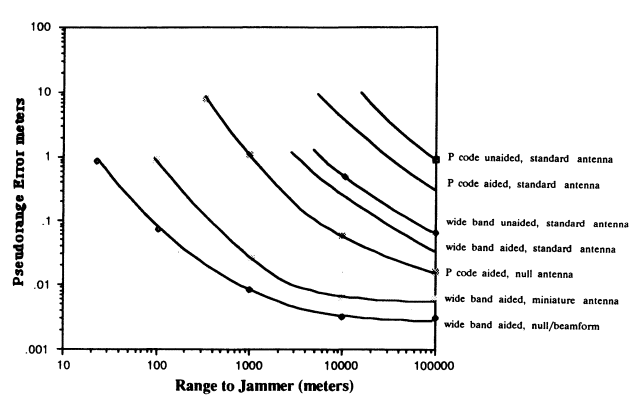
Figure 4-1
Wide-band GPS with a 100-watt jammer.
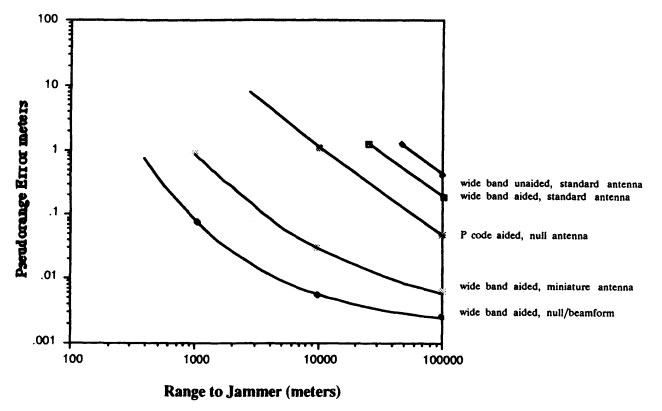
Figure 4-2
Wide-band GPS with a 10-kilowatt jammer.
Tables 4-1 and 4-2 summarize the results of this exercise. The most significant finding, perhaps, is that with the wide-band signal using unaided tracking and a simple antenna, a vehicle can approach a 100-watt jammer to within 6 kilometers before a 1-meter range error has accumulated. With aided tracking, this range is reduced to about 3 kilometers. For many airborne weapons systems, this is sufficiently close to permit a successful mission when using inertial navigation for the balance of the flight, that is, assuming the worst case scenario in which the jammer and target are co-located. Considering that the size and cost of current nulling antennas may prohibit their use on certain weapon systems, this is a significant finding and supports the notion that consideration should be given to the eventual inclusion of a new, very wide-band waveform.
Table 4-1 GPS Wide-Band Signal Augmentation Performance with a 100-Watt Jammer
|
System Option |
Code Status |
Carrier Telemetry Status |
||
|
|
Jammer distance at loss of lock (meters) |
Jammer distance for 1-meter range error (meters) |
Jammer distance at loss of lock (meters) |
Range error at loss of lock (meters) |
|
1. Y-code unaided standard antenna |
18,000 |
90,000 |
90,000 |
1.0 |
|
2. Y-code aided standard antenna |
10,000 |
35,000 |
21,000 |
—— |
|
3. Y-code aided nulling antenna |
550 |
1,000 |
1,400 |
1.9 |
|
4. Wide-band unaided standard antenna |
6,000 |
6,000 |
35,000 |
0.1 |
|
5. Wide-band aided standard antenna |
3,100 |
3,100 |
6,500 |
0.27 |
|
6. Wide-band aided miniature antenna |
175 |
175 |
450 |
0.19 |
|
7. Wide-band aided null/beamforming antenna |
45 |
45 |
215 |
0.19 |


