The Global Positioning System: A Shared National Asset (1995)
Chapter: Space Segment
Space Segment
The GPS constellation consists of 24 satellites, arranged in 6 orbital planes of 55-degree inclination, 20,051 kilometers (12,532 miles) above the Earth. Each satellite completes one orbit in one half of a sidereal day and therefore passes over the same location on earth once every sidereal day, or approximately 23 hours and 56 minutes. This particular orbital configuration and number of satellites allows a user at any location on the earth to have at least four satellites in view 24 hours per day. The constellation described above currently consists of 24 Block II/IIA satellites and one Block I satellite, which have been built for the U.S. Air Force by Rockwell International Satellite and Space Electronics Division, Seal Beach, California. Based on a fixed price, multi-year procurement contract totalling approximately $1.5 billion for 28 satellites, the unit cost of each satellite is approximately $53.8 million (1995 dollars).13 Each Block II/IIA satellite is designed to operate for 7.5 years, but may operate beyond this life span based on the success of the Block I series. Figure C-3 shows a typical Block II/IIA GPS satellite.
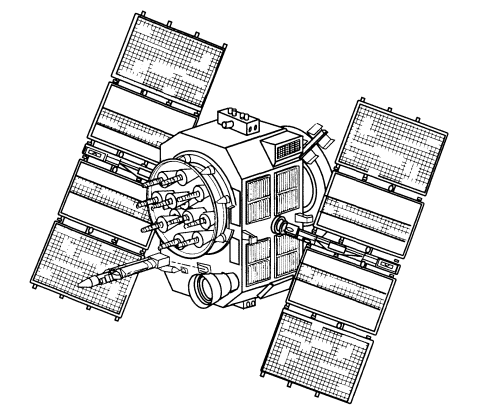
Figure C-3
Typical Block II/IIA satellite. (Courtesy of the Aerospace Corporation)
Each Block II/IIA satellite weighs 1,881 kg (4,147 pounds) when fueled and is designed for a solo launch aboard an Air Force Delta II rocket.
The follow-on Block IIR replenishment satellite contract was competitively awarded in 1989 to Martin Marietta Astro Space Division, East Windsor, New Jersey for a total of 20 satellites. The estimated unit cost of each Block IIR satellite is $30.1 million (1995 dollars).14 Recently, the Air Force exercised an option in the Block IIR contract to purchase one additional satellite. These satellites will also be carried into orbit by the Delta II rocket, with the first launch currently scheduled for 1996. Figure C-4 represents a typical Block IIR satellite.
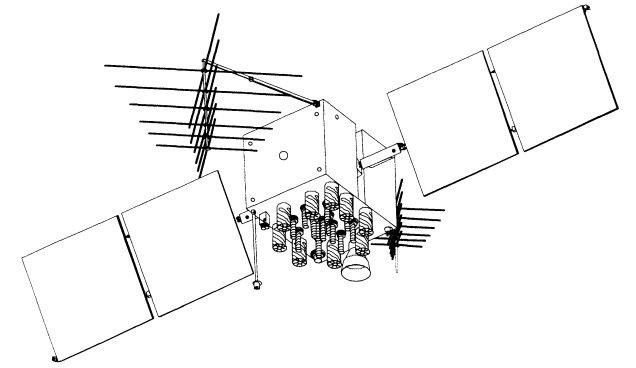
Figure C-4
Typical Block IIR satellite. (Courtesy of the Aerospace Corporation)
Although the Block IIR satellites are very different in appearance from the Block II/IIA satellites, they have been built to the same basic specifications and comprise the same kinds of components and subsystems. Many of the subsystems and components,

