The Global Positioning System: A Shared National Asset (1995)
Chapter: IMPROVEMENT IMPLEMENTATION STRATEGY
|
(4) |
Schedule denial jamming/spoofing. Tactically, the U.S. military can interrupt denial jamming/spoofing for short time periods, typically 2 to 3 minutes hourly, to assist those friendly forces in need of C/A-code to reacquire the Y-code. These scheduled times would be short and random to prevent hostile troops from taking advantage of interrupted jamming. Dependence upon this technique will diminish as improved training procedures and time discipline techniques are disseminated into the force structure. |
|
(5) |
Develop and utilize C/A-code selective denial techniques that minimize impact upon friendly L1-only military receivers, such as the Plugger. The L4 selective denial analysis of Appendix J suggests a four-part approach to selective denial of C/A-code on the L1 band: |
- apply shaped denial jamming combined with spoofing;
- use a switchable retrofit bandstop RF front-end filter; and,
- improve clock discipline, through operator training.
Improvement Implementation Strategy
Because of the relatively long life time of GPS satellites (5 to 10 years) and the length of time required to replace the total constellation of 24 satellites, opportunities for introducing enhancements and technology improvements to the system are limited.
Figure 3-6 shows the current plan for satellite replacements. According to the GPS Joint Program Office, current plans for the Block IIF contract include 6 short-term, and 45 long-term "sustainment" satellites. As currently planned, the Block IIF satellites will be designed to essentially the same specifications as the Block IIR satellites. The current program and schedule make it possible for another country to put up a technically superior system that uses currently available technology before the United States can do so. Under current planning, the earliest opportunity for an infusion of new technology in the GPS space segment would be after Block IIF, probably sometime after the year 2020.
As noted throughout this chapter, the NRC committee believes that there are significant improvements that could be made to the system that would not only enhance its performance for civilian and military use, but also make it more acceptable and competitive internationally. One method to incorporate technology in an efficient and timely manner is through a preplanned product improvement (P3I) process. With this type of approach, planned changes and improvements could intentionally be designed into the production of the satellites at specific time intervals.
Assuming that the first improvements suggested in this report are incorporated in the later half of the Block IIR satellites, additional funding might be required to incorporate changes for the already completed Block IIR satellites. However, the NRC committee believes that the timely improvement in system performance is adequate justification for the additional cost. Recommended improvements to the space segment and the operational control segment are summarized in Tables 3-13 and 3-14.
In addition to the specific recommendations given in this report, the NRC committee also discussed several enhancements that it believes have particular merit and should be seriously considered for future incorporation. These items are discussed in Chapter 4. Although a few enhancements could be included on the Block IIR spacecraft, especially if a P3I program were implemented, most of the enhancements would have to be incorporated in the Block IIF spacecraft design.
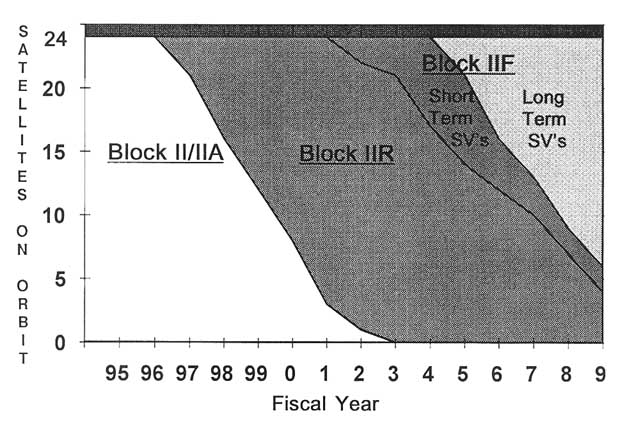
Figure 3-6
Current Plan for Satellite Replacement. (Courtesy of the GPS Joint Program Office)
Table 3-13 Space Segment Enhancements
|
Proposed Enhancement |
Satellite Block |
Implementation Date |
Benefit of Enhancement |
|
Turn SA to zero. |
Block II/IIA, IIR, IIF |
Immediately |
Approximately 30- meter (2 drms) stand-alone accuracy for civil users. |
|
Add a new L-band signal (would be usable before the Block IIR constellation is complete). |
Block IIR, IIF |
As soon as possible |
Approximately 12- meter (2 drms) stand-alone accuracy for civil users. Enhanced integrity monitoring. |
|
Use inter-satellite crosslinks to relay satellite health information and commands. |
Block IIR, IIF |
As soon as possible |
Improve overall system reliability and availability |
|
Use inter-satellite crosslinks to relay ground-based integrity monitoring information and commands. |
Block IIR, IIF |
As soon as possible |
Improve GPS signal integrity for all users. |
Table 3-14 Operational Control Segment Enhancements
|
Proposed Enhancement |
Implementation Date: |
Benefit of Enhancement |
|
Provide more frequent correction updates. |
As soon as possible |
Improve stand-alone GPS accuracy for PPS and SPS users (if SA is off and 48-hour embargo is lifted) by reducing combined clock and ephemeris errors by half. |
|
Add more monitoring stations. |
As soon as possible |
Improve stand-alone GPS accuracy Improve overall system reliability by allowing prompt detection of satellite anomalies. Allow for uninterrupted tracking of all satellites. |
|
Improve Kalman Filter and dynamic models. |
Added to 1995 Operational Control Station Request for Proposal |
Improve accuracy by reducing combined clock and ephemeris errors with non-partitioned Kalman Filter (15%) and with improved dynamic model (5%). |
|
Establish procurement coordination of improved monitor station receivers, computers, and software contracts. |
As soon as possible and in conjunction with the 1995 contract award |
Improve accuracy. Allow for integrity monitoring of C/A-code. |
|
Reexamine planned Block IIR operation and compare to the accuracy advantages gained by incorporating inter-satellite ranging data in the ground-based Kalman Filter and uploading data at some optimal time. |
Immediately |
Possibly improve accuracy over planned Block IIR operation. |
|
Proposed Enhancement |
Implementation Date: |
Benefit of Enhancement |
|
Use Block IIR satellite communication crosslinks to the extent possible with the existing crosslink data rate to support on-board satellite health monitoring. |
Block IIR satellites |
Improved reliability and availability Permits more rapid response time by the ground station. |
|
Use Block IIR inter-satellite communication crosslinks to relay integrity information determined through ground-based monitoring. |
Block IIR satellites |
Permits more rapid response time for integrity monitoring. |
|
Permanent backup master control station. |
Immediately |
Reduce risk and improve reliability of overall system. |
|
Provide simulator to test software and train personnel. |
Immediately |
Reduce risk and improve reliability of overall system, improve efficiency of operations. |
|
Update the operational control segment software using modern software engineering methods in order to permit easy and cost-effective updating of the system and to enhance system integrity. This should be specified in the 1995 OCS upgrade request for proposal. |
Should be specified in 1995 Operational Control Station Request for Proposal. |
Easier to make modifications to software. Reduces cost and complexity |


