The Global Positioning System: A Shared National Asset (1995)
Chapter: EFFECT OF ELIMINATING SELECTIVE AVAILABILITY (SA): IMPACT ON RAIM
Effect Of Eliminating Selective Availability (SA): Impact On RAIM
Receiver autonomous integrity monitoring (RAIM) is a method for ensuring the integrity of GPS through the use of redundant satellites. For a GPS position solution the pseudoranges of at least four satellites are required. If more than four satellites are in view, the resulting redundancy may be used for integrity by determining the consistency among all of the pseudorange measurements. Thus, in principle, if five satellites are in view, it may be possible to detect the presence of a large position error but not to identify which satellite's pseudorange is erroneous. If six or more satellites are in view, it may be possible to identify a faulty satellite that is causing a large position error. However, the ability of RAIM to perform the detection and identification functions depends upon the relative geometry between the satellites and the user's location, and upon the nominal pseudorange errors as expressed as a standard deviation. At any place and time the geometry is fixed. Therefore, RAIM improvement would be possible if the standard deviation of pseudorange errors could be significantly decreased. This significant decrease can be obtained by setting selective availability to zero. The effect on RAIM due to setting selective availability to zero can be measured in terms of availability and RAIM outage duration.
RAIM algorithm requirements involve alarm rate, probability of missed detection, and position protection level. False alarm rate must be controlled; otherwise RAIM would be a nuisance. Of course, the missed-detection probability must be low to provide protection when large errors occur. The position protection level means that there will be an extremely low probability that the user's position error will exceed this level without a warning. Table 1 contains a summary of the RAIM algorithm requirements used in the following analysis. These requirements are presently used by the FAA in its evaluation of RAIM.
Four RAIM augmentations were investigated. They are:
- Redundant pseudoranges
- Redundant pseudoranges + altimeter input
- Redundant pseudoranges + accurate clock
- Combination of all above
The altimeter input provides another range source. An accurate crystal or small atomic clock is calibrated when RAIM is available, and used if RAIM becomes unavailable.
Effects of eliminating Selective Availability (SA) on RAIM are considered only for the en route and nonprecision approach phases of flight. The effects are not considered for precision approach because the required accuracy for that phase of flight is too high to meet even with elimination of SA.
For all of the above RAIM augmentations, availability and outage durations were calculated for routes between major city pairs for en route navigation and at representative terminal areas for nonprecision approach. These are listed in Table 2. Then their average availabilities were tabulated. Separate tabulations were made for
Use of GPS as a supplemental navigation system only requires the former; use of GPS as a primary means of navigation requires both the former and the latter. A supplemental navigation system requires a primary navigation system to be part of the avionics so that in the event of loss of the supplemental system, the pilot can use the primary navigation system. A primary navigation system can operate on its own. Today GPS can be used as a supplemental means of navigation. In the future when GPS is used as a primary means of navigation, RAIM (or some external system) would have to provide the identification function.
Table 3 contains the results for the RAIM detection function when SA is present (pseudorange standard deviation = 33 m) and when SA is absent (pseudorange standard deviation = 4.3 m for dual frequency users and 8.3 m for single frequency users). While the GPS satellite constellation with all 24 satellites operating represents the best case for GPS satellite availability, the probability that all 24 satellites will be operating is estimated to be only about 70 percent. On the hand, DOD guarantees at least 21 satellites to be available with 98 percent probability, and thus the 21 satellite constellation represents a realistic case to address for a primary system.
The results of Table 3 indicate significant improvement when selective availability is set at zero. Since the FAA requires only barometric altimeter input to RAIM for supplemental navigation, the availability improvement from about 90 to 99 percent for supplemental nonprecision approach is very significant when a typical set of 21 satellites are operating.
The results of Table 4 again indicate significant improvement when selective availability is set at zero. The improvement of availability of RAIM identification function for a nonprecision approach is from about 94 to over 99 percent when a typical set of 21 satellites are operating. This is a significant improvement.
The results indicate that if selective availability is set to zero, RAIM availability and outage durations will be significantly improved. As shown in the Air Navigation Requirements Table in NRC report, the required availability for the FAA's Wide Area Augmentation System is 99.999 percent for GPS to be used as a primary navigation system in the en route and nonprecision approach phases of flight. The results of the above analysis indicate that this level of availability cannot be achieved by RAIM alone even when selective availability is set to zero unless perhaps access to dual frequency is available, and the constellation contains at least 24 satellites (Table 4).
Table 1 RAIM Availability Criteria
|
Function |
Requirements |
|
RAIM detection function |
1) The presence of a malfunction of a satellite causing the position error protection limit to be violated shall be detected with a minimum probability of 0.999, given that the protection limit is violated and 2) The rate of internal alarms (false or true) shall not be more than 0.002/hr. |
|
RAIM identification function |
Upon the occurrence of a malfunctioning satellite with an abnormal range error, RAIM shall be able to detect the occurrence and also correctly identify the satellite before the protection limit is violated with a probability of 0.999. |
Table 2 Cases for RAIM Availability Analysis
|
Phases of flight |
User location |
|
En route (Protection limit = 2 nmi) |
User on a moving platform: |
|
Terminal (Protection limit = 1 nmi) |
New York to Los Angeles |
|
|
San Fransisco to Narita, Japan |
|
|
Dallas-Fort Worth to Paris |
|
|
User at a fixed location: |
|
Nonprecision approach |
Seattle |
|
(Protection limit = 0.3 nmi) |
Chicago |
|
|
Boston |
|
|
Los Angeles |
|
|
Dallas-Fort Worth |
|
|
Miami |
Table 3
RAIM Detection Function (5º Mask Angle)
|
|
|
SA on |
SA off (single freq user) |
SA off (dual freq user) |
|||||||||||||||
|
|
|
21 GPS |
24 GPS |
21 GPS |
24 GPS |
21 GPS |
24 GPS |
||||||||||||
|
|
|
A |
B |
C |
A |
B |
C |
A |
B |
C |
A |
B |
C |
A |
B |
C |
A |
B |
C |
|
0.3 nmi PL |
GPS Alone |
70.74 |
33 |
161 |
97.86 |
97 |
29 |
94.7 |
12 |
44 |
100 |
0 |
0 |
96.91 |
7 |
23 |
100 |
0 |
0 |
|
Baro |
90.79 |
21 |
61 |
99.84 |
2 |
5 |
99.1 |
6 |
15 |
100 |
0 |
0 |
99.34 |
5 |
15 |
100 |
0 |
0 |
|
|
Clock |
92.87 |
19 |
56 |
99.83 |
3 |
8 |
99.5 |
4 |
14 |
100 |
0 |
0 |
99.88 |
2 |
8 |
100 |
0 |
0 |
|
|
Comb |
96.13 |
21 |
45 |
99.86 |
2 |
5 |
99.71 |
3 |
14 |
100 |
0 |
0 |
99.9 |
2 |
8 |
100 |
0 |
0 |
|
|
1 nmi PL |
GPS Alone |
93.43 |
28 |
49 |
99.59 |
5 |
11 |
97.54 |
7 |
26 |
99.93 |
1 |
3 |
98 |
6 |
26 |
99.96 |
1 |
2 |
|
Baro |
97.97 |
9 |
34 |
100 |
0 |
0 |
99.52 |
4 |
15 |
100 |
0 |
0 |
99.63 |
4 |
14 |
100 |
0 |
0 |
|
|
Clock |
98.72 |
8 |
17 |
100 |
0 |
0 |
99.88 |
2 |
4 |
100 |
0 |
0 |
99.98 |
1 |
2 |
100 |
0 |
0 |
|
|
Comb |
99.06 |
7 |
16 |
100 |
0 |
0 |
99.93 |
1 |
4 |
100 |
0 |
0 |
100 |
0 |
0 |
100 |
0 |
0 |
|
|
2 nmi PL |
GPS Alone |
95.8 |
8 |
49 |
99.69 |
2 |
6 |
98.01 |
6 |
26 |
99.96 |
1 |
2 |
98.26 |
6 |
26 |
99.98 |
0.3 |
1 |
|
Baro |
99.59 |
6 |
16 |
100 |
0 |
0 |
99.84 |
3 |
10 |
100 |
0 |
0 |
99.85 |
3 |
10 |
100 |
0 |
0 |
|
|
Clock |
99.61 |
4 |
9 |
100 |
0 |
0 |
99.98 |
1 |
2 |
100 |
0 |
0 |
99.99 |
0.3 |
1 |
100 |
0 |
0 |
|
|
Comb |
99.86 |
1 |
6 |
100 |
0 |
0 |
100 |
0 |
0 |
100 |
0 |
0 |
100 |
0 |
0 |
100 |
0 |
0 |
|
|
Legend: A: Availability (%) B: Average outage duration (min) C: Maximum outage duration (min) |
|||||||||||||||||||
Table 4
RAIM Identification Function (5° Mask Angle)
|
|
|
SA on |
SA off (single freq user) |
SA off (dual freq user) |
|||||||||||||||
|
|
|
21 GPS |
24 GPS |
21 GPS |
24 GPS |
21 GPS |
24 GPS |
||||||||||||
|
|
|
A |
B |
C |
A |
B |
C |
A |
B |
C |
A |
B |
C |
A |
B |
C |
A |
B |
C |
|
|
GPS Alone |
38.34 |
52 |
361 |
76.19 |
16 |
56 |
67.96 |
18 |
86 |
95.58 |
6 |
30 |
76.92 |
11 |
67 .97 |
86 |
4 |
12 |
|
0.3 |
Baro |
80.89 |
23 |
126 |
98.88 |
9 |
17 |
91.1 |
14 |
63 |
100 |
0 |
0 |
93.12 |
11 |
48 |
100 |
0 |
0 |
|
nmi PL |
Clock |
76.25 |
26 |
168 |
97.88 |
10 |
25 |
92.34 |
11 |
67 |
99.87 |
2 |
6 |
95.54 |
6 |
21 |
99.95 |
1 |
3 |
|
|
Comb |
94.3 |
12 |
47 |
99.7 |
4 |
9 |
99.1 |
6 |
11 |
100 |
0 |
0 |
99.53 |
4 |
11 |
100 |
0 |
0 |
|
|
GPS Alone |
66.93 |
18 |
215 |
93.86 |
8 |
27 |
82.28 |
8 |
87 |
98.48 |
3 |
13 |
85.38 |
6 |
87 |
99.01 |
2 |
13 |
|
1 nmi |
Baro |
89.96 |
14 |
49 |
99.57 |
4 |
13 |
94.39 |
8 |
40 |
99.95 |
1 |
2 |
95.19 |
6 |
34 |
99.98 |
0.3 |
1 |
|
PL |
Clock |
91.63 |
12 |
49 |
99.62 |
3 |
7 |
96.37 |
6 |
32 |
99.96 |
1 |
2 |
97.34 |
4 |
26 |
99.98 |
0.3 |
1 |
|
|
Comb |
97.42 |
9 |
32 |
100 |
0 |
0 |
99.22 |
5 |
13 |
100 |
0 |
0 |
99.29 |
5 |
13 |
100 |
0 |
0 |
|
|
GPS Alone |
76.36 |
11 |
92 |
97.12 |
4 |
17 |
85.48 |
6 |
87 |
99.01 |
2 |
13 |
87.15 |
6 |
87 |
99.4 |
2 |
13 |
|
2 nmi |
Baro |
93.16 |
9 |
40 |
99.89 |
2 |
4 |
96.34 |
5 |
29 |
99.98 |
0.3 |
1 |
96.8 |
5 |
29 |
100 |
0 |
0 |
|
PL |
Clock |
94.37 |
9 |
34 |
99.85 |
2 |
4 |
97.37 |
4 |
26 |
99.98 |
0.3 |
1 |
97.9 |
4 |
26 |
100 |
0 |
0 |
|
|
Comb |
99.17 |
5 |
13 |
100 |
0 |
0 |
99.55 |
3 |
12 |
100 |
0 |
0 |
99.61 |
3 |
12 |
100 |
0 |
0 |
|
Legend: A: Availability (%) B: Average outage duration (min C: Maximum outage duration (min) |
|||||||||||||||||||
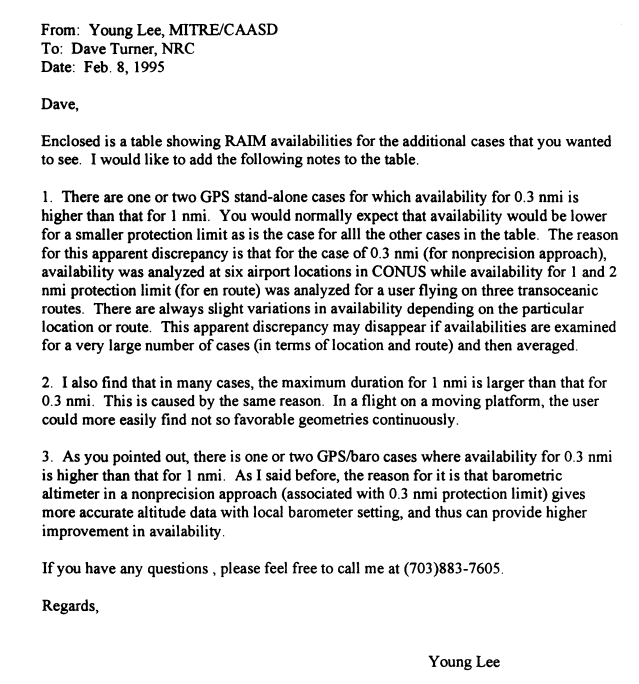
Table 5
SA off (sigma r = 1.9 m), 5° Mask Angle
|
|
|
RAIM detection |
RAIM Identification |
||||||||||
|
|
|
21 GPS |
24 GPS |
21 GPS |
24 GPS |
||||||||
|
|
|
A |
B |
C |
A |
B |
C |
A |
B |
C |
A |
B |
C |
|
0.3 nmiPL |
GPS Alone |
98.125 |
4 |
11 |
100.000 |
0 |
0 |
83.426 |
7 |
67 |
99.086 |
2 |
6 |
|
GPS/Baro |
99.549 |
3 |
11 |
100.000 |
0 |
0 |
94.363 |
9 |
48 |
100.000 |
0 |
0 |
|
|
1 nmi PL |
GPS Alone |
98.304 |
6 |
26 |
99.978 |
0.3 |
1 |
87.352 |
7 |
87 |
99.407 |
2 |
13 |
|
GPS/Baro |
99.676 |
4 |
14 |
100.000 |
0 |
0 |
95.697 |
6 |
34 |
100.000 |
0 |
0 |
|
|
2 nmi PL |
GPS Alone |
98.462 |
8 |
26 |
100.000 |
0 |
0 |
88.138 |
9 |
87 |
99.577 |
2 |
13 |
|
GPS/Baro |
99.854 |
3 |
10 |
100.000 |
0 |
0 |
97.076 |
5 |
29 |
100.000 |
0 |
0 |
|
|
Legend: A: Availability (%) B: Average outage duration (min) C: Maximum outage duration (min) |
|||||||||||||
| This page in the original is blank. |


