The Global Positioning System: A Shared National Asset (1995)
Chapter: SCENARIO 7: AIDED WIDE BANDWIDTH WITH NULLING AND BEAM-FORMING ANTENNA
Noise Jammer Limited Case
As for Scenario 4, any increase in free-space loss with frequency is equal for both the interference source and the GPS satellite. Therefore the wider bandwidth yields a 10-dB advantage in break-lock margin and a further operational advantage at a specified pseudorange accuracy level.
Scenario 6: Aided Wide Bandwidth With Miniaturized Nulling Antenna
The comparative baseline is the aided Y-code receiver operating its nulling antenna, Scenario 3. For equal nulling performance, a fourfold increase in radio frequency would reduce the overall antenna footprint to one-sixteenth the original area, making for a much more practical design in many applications. With aiding, the code- and carrier-tracking loop bandwidths are conservatively reduced to 0.1 Hz and 1 Hz, respectively.
Receiver Thermal Noise Limited Case
Same comments as for Scenario 4.
Noise Jammer Limited Case
As in Scenario 5, the widened signal bandwidth gives an immediate improvement in effective carrier-to-noise ratio of 10 dB against the reference system and a consequent 10-dB increase in jamming-to-signal ratio code and carrier tracking margin. As shown in Table L-1, this factor, together with narrowed tracking loop bandwidths yields a factor of three improvement in minimum jammer distance before loss of lock. More importantly, a factor of six reduction in jammer distance to the 1-meter error threshold is obtained. These results are achieved with a much smaller antenna than at L1.
Scenario 7: Aided Wide Bandwidth With Nulling And Beam-Forming Antenna
The baseline is Scenario 3, an aided Y-code receiver operating with a null-steering antenna. The size advantages of Scenario 4 are now given up in favor of a wide-band antenna possessing four times as many elements. This translates into more (and deeper) nulls and the capacity to form beams in the direction of GPS satellites. It is assumed that nulls are improved by 6 dB over the reference antenna and that a 6-dB gain may be
obtained in the direction of each satellite. Obviously these parameters need future study and verification.
Receiver Thermal Noise Limited Case
Because of antenna beam-forming, there is just a 6-dB loss in carrier-to-noise ratio as compared with the reference Y-code system. Above tracking threshold this loss is more than offset by increased signal bandwidth, with an order of magnitude ranging error improvement.
Noise Jammer Limited Case
This is the most important case. Over the reference system, the widened signal bandwidth gives an immediate improvement in effective carrier-to-noise ratio of 10 dB. To this add 12 dB from improved antenna nulling and beamforming, for a total of 22 dB increase in the jamming-to-signal ratio code- and carrier-tracking margin. As shown in Tables L-2 and L-3, and Figures L-1 and L-2, there is an order of magnitude improvement in minimum jamming distance before loss of lock and a factor of 20 improvement in minimum jamming distance at 1-meter error threshold.
Figures L-1 and L-2 show the pseudorange errors as a function of distance for various receiver alternatives described in Table L-1 and the two jammer power levels.2 The difference between the Y-code and wide-band options is rather dramatic, even on the log-log plots. The most capable system operates below the 1-meter level to within about 45 meters of the 100-watt source. At 1,000 meters, the code-tracking error is below the centimeter level. As shown in Table L-2, carrier-phase tracking and code-loop aiding are available within several hundred meters of the jammer. The miniaturized nulling antenna with aiding is good down to about 175 meters. Both aided wide-band options are substantially more capable than the best performing existing Y-code system.
Tables L-2 and L-3 summarize the results of this exercise. The most significant finding, perhaps, is that with the wide-band signal using unaided tracking and a simple antenna a vehicle can approach a 100-watt jammer to within 6 kilometers before a 1-meter range error has accumulated. With aided tracking, this range is reduced to about 3 kilometers. For many airborne weapons systems this is sufficiently close to permit a successful mission when employing inertial navigation for the balance of the flight (i.e., assuming the worst case scenario in which the jammer and target are co-located). Considering that the size and cost of nulling antennas may prohibit their use on certain weapon systems, this is a significant finding and supports the notion that consideration should be given to the eventual inclusion of a new, very wide-band waveform. Note also that a move to higher frequency makes the nulling antenna more feasible for many vehicles. As a means of defeating enemy jamming, the Air Force should explore the feasibility of adding
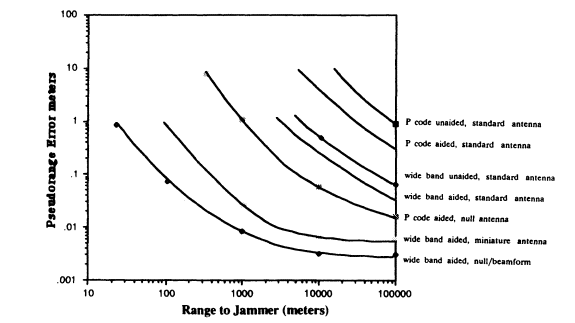
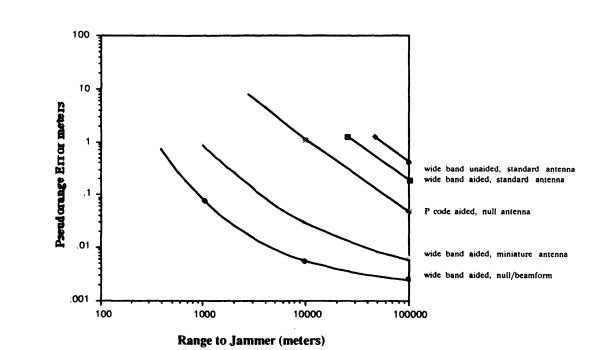
Table L-2 GPS Wide-Band Signal Augmentation Performance 100-Watt Jammer
|
System Option |
Code Status |
Carrier Telemetry Status |
||
|
Jammer distance at loss of lock (meters) |
Jammer distance for 1- meter range error (meters) |
Jammer distance at loss of lock (meters) |
Range error at loss of lock (meters) |
|
|
1. Y-code unaided standard antenna |
18,000 |
90,000 |
90,000 |
1.0 |
|
2. Y-code aided standard antenna |
10,000 |
35,000 |
21,000 |
-- |
|
3. Y-code aided nulling antenna |
550 |
1,000 |
1,400 |
1.9 |
|
4. Wide-band unaided standard antenna |
6,000 |
6,000 |
35,000 |
0.1 |
|
5. Wide-band aided standard antenna |
3,100 |
3,100 |
6,500 |
0.27 |
|
6. Wide-band aided miniature antenna |
175 |
175 |
450 |
0.19 |
|
7. Wide-band aided null/beamforming antenna |
45 |
45 |
215 |
0.19 |
Table L-3 GPS Wide-Band Signal Augmentation Performance 10-Kilowatt Jammer
|
System Scenario |
Code Status |
Carrier Telemetry Status |
||
|
Jammer distance at loss of lock (meters) |
Jammer distance for 1- meter range error (meters) |
Jammer distance at loss of lock (meters) |
Range error at loss of lock (meters) |
|
|
1. Y-code unaided standard antenna |
-- |
-- |
-- |
-- |
|
2. Y-code aided standard antenna |
-- |
-- |
-- |
-- |
|
3. Y-code aided nulling antenna |
-- |
20,000 |
-- |
-- |
|
4. Wide-band unaided standard antenna |
-- |
60,000 |
-- |
-- |
|
5. Wide-band aided standard antenna |
-- |
31,000 |
-- |
-- |
|
6. Wide-band aided miniature antenna |
-- |
1,800 |
-- |
-- |
|
7. Wide-band aided null/beamforming antenna |
-- |
450 |
-- |
-- |


