The Global Positioning System: A Shared National Asset (1995)
Chapter: Carrier Phase (Interferometric) GPS
Visit
NAP.edu/10766
to get more information about this book, to buy it in print, or to
download it as a free PDF.
Previous Chapter:
Differential GPS
 Next Chapter:
Receiver Autonomous Integrity Monitoring (RAIM)
Next Chapter:
Receiver Autonomous Integrity Monitoring (RAIM)
Suggested Citation:
"Carrier Phase (Interferometric) GPS." National Research Council. 1995. The Global Positioning System: A Shared National Asset. Washington, DC: The National Academies Press.
doi: 10.17226/4920.
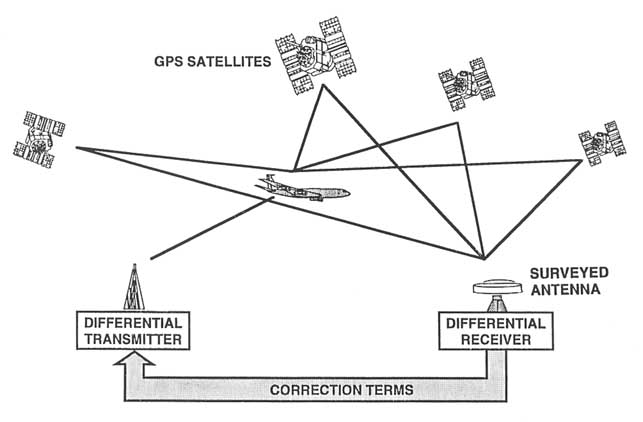
Figure C-8
Differential GPS concept. (Courtesy of the Aerospace Corporation)
Carrier Phase (Interferometric) GPS
In addition to the use of C/A-code, Y-code, or both as measurements of pseudorange for obtaining a position solution, many GPS receivers also measure the L-band carrier phase itself. This enhancement technique can produce very high precision measurements, sometimes as good as 1 to 5 millimeters and, thus, is valuable for high- performance applications. The carrier phase data is used almost exclusively in an interferometric mode, where the phase data from two receivers are processed together to solve for the baseline between them. This eliminates atmospheric errors, and when combined with DGPS, can result in sub-centimeter positioning accuracies.

Subscribe to Emails from the National Academies
Stay up to date on activities, publications, and events by subscribing to email updates.