Global Perspectives for Local Action: Using TIMSS to Improve U.S. Mathematics and Science Education, Professional Development Guide (1999)
Chapter: Module 1: Slides

What Is TIMSS?
Third International Mathematics and Science Study
Largest and most comprehensive study of math/science education ever conducted
Involved more than 1/2 million students in Population 1 (9-year-olds); Population 2 (13-year-olds); and Population 3 (final year of secondary school)
Spanned 41 countries
Why should we care about TIMSS?
Recognize the importance of math/science education to the economy and quality of life
Learn about alternative ways of dealing with educational challenges
Gain insights into teaching and learning internationally
Reexamine conventional practices
Consider new possibilities for U.S. education
TIMSS Achievement Results
Population 1—Science
Nations with Average Scores | |||||
Significantly Higher than the U.S. | Not Significantly Different than the U.S. | Significantly Lower than the U.S. | |||
Nations | Average | Nations | Average | Nations | Average |
Korea | 597 | Japan | 574 | England | 551 |
|
| United States | 565 | Canada | 549 |
|
| Austria | 565 | Singapore | 547 |
|
| Australia | 562 | Slovenia | 546 |
|
| Netherlands | 557 | Ireland | 539 |
|
| Czech Republic | 557 | Scotland | 536 |
|
|
|
| Hong Kong | 533 |
|
|
|
| Hungary | 532 |
|
|
|
| New Zealand | 531 |
|
|
|
| Norway | 530 |
|
|
|
| Latvia (LSS) | 512 |
|
|
|
| Israel | 505 |
|
|
|
| Iceland | 505 |
|
|
|
| Greece | 497 |
|
|
|
| Portugal | 480 |
|
|
|
| Cyprus | 475 |
|
|
|
| Thailand | 473 |
|
|
|
| Iran, Islamic Republic | 416 |
|
|
|
| Kuwait | 401 |
From: Pursuing Excellence: A Study of U.S. Fourth-Grade Mathematics and Science Achievement in International Context |
| International Average=524 | |||
TIMSS Achievement Results
Population 1—Mathematics
Nations with Average Scores | |||||
Significantly Higher than the U.S. | Not Significantly Different than the U.S. | Significantly Lower than the U.S. | |||
Nations | Average | Nations | Average | Nations | Average |
Singapore | 625 | Slovenia | 552 | Latvia (LSS) | 525 |
Korea | 611 | Ireland | 550 | Scotland | 520 |
Japan | 597 | Hungary | 548 | England | 513 |
Hong Kong | 587 | Australia | 546 | Cyprus | 502 |
Netherlands | 577 | United States | 545 | Norway | 502 |
Czech Republic | 567 | Canada | 532 | New Zealand | 499 |
Austria | 559 | Israel | 531 | Greece | 492 |
|
|
|
| Thailand | 490 |
|
|
|
| Portugal | 475 |
|
|
|
| Iceland | 474 |
|
|
|
| Iran, Islamic Republic | 429 |
|
|
|
| Kuwait | 400 |
| International Average=529 | ||||
From: Pursuing Excellence: A Study of U.S. Fourth-Grade Mathematics and Science Achievement in International Context |
|
| |||
TIMSS Achievement Results
Population 2—Science
Nations with Average Scores | |||||
Significantly Higher than the U.S. | Not Significantly Different than the U.S. | Significantly Lower than the U.S. | |||
Nations | Average | Nations | Average | Nations | Average |
Singapore | 607 | England | 552 | Spain | 517 |
Czech Republic | 574 | Belgium-Flemish | 550 | France | 498 |
Japan | 571 | Australia | 545 | Greece | 497 |
Korea | 565 | Slovak Republic | 544 | Iceland | 494 |
Bulgaria | 565 | Russian Federation | 538 | Romania | 486 |
Netherlands | 560 | Ireland | 538 | Latvia (LSS) | 485 |
Slovenia | 560 | Sweden | 535 | Portugal | 480 |
Austria | 558 | United States | 534 | Denmark | 478 |
Hungary | 554 | Germany | 531 | Lithuania | 476 |
|
| Canada | 531 | Belgium-French | 471 |
|
| Norway | 527 | Iran, Islamic Republic | 470 |
|
| New Zealand | 525 | Cyprus | 463 |
|
| Thailand | 525 | Kuwait | 430 |
|
| Israel | 524 | Colombia | 411 |
|
| Hong Kong | 522 | South Africa | 326 |
|
| Switzerland | 522 |
|
|
|
| Scotland | 517 | International Average=516 | |
From: Pursuing Excellence: A Study of U.S. Eighth-Grade Mathematics and Science Achievement in International Context | |||||
TIMSS Achievement Results
Population 2—Mathematics
Nations with Average Scores | |||||
Significantly Higher than the U.S. | Not Significantly Different than the U.S. | Significantly Lower than the U.S. | |||
Nations | Average | Nations | Average | Nations | Average |
Singapore | 643 | Thailand | 522 | Lithuania | 477 |
Korea | 607 | Israel | 522 | Cyprus | 474 |
Japan | 605 | Germany | 509 | Portugal | 454 |
Hong Kong | 588 | New Zealand | 508 | Iran, Islamic Republic | 428 |
Belgium-Flemish | 565 | England | 506 | Kuwait | 392 |
Czech Republic | 564 | Norway | 503 | Colombia | 385 |
Slovak Republic | 547 | Denmark | 502 | South Africa | 354 |
Switzerland | 545 | United States | 500 |
|
|
Netherlands | 541 | Scotland | 498 | International Average=513 | |
Slovenia | 541 | Latvia (LSS) | 493 |
|
|
Bulgaria | 540 | Spain | 487 |
|
|
Austria | 539 | Iceland | 487 |
|
|
France | 538 | Greece | 484 |
|
|
Hungary | 537 | Romania | 482 |
|
|
Russian Federation | 535 |
|
|
|
|
Australia | 530 |
|
|
|
|
Ireland | 527 |
|
|
|
|
Canada | 527 |
|
|
|
|
Belgium-French | 526 |
|
|
|
|
Sweden | 519 |
|
|
|
|
From: Pursuing Excellence: A Study of U.S. Eighth-Grade Mathematics and Science Achievement in International Context | |||||
TIMSS Achievement Results
Population 3—Science: General Knowledge
Nations with Average Scores | |||||
Significantly Higher than the U.S. | Not Significantly Different than the U.S. | Significantly Lower than the U.S. | |||
Nations | Average | Nations | Average | Nations | Average |
Sweden | 559 | Germany | 497 | Cyprus | 448 |
Netherlands | 558 | France | 487 | South Africa | 349 |
Iceland | 549 | Czech Republic | 487 |
|
|
Norway | 544 | Russian Federation | 481 | International Average=500 | |
Canada | 532 | United States | 480 |
|
|
New Zealand | 529 | Italy | 475 |
|
|
Australia | 527 | Hungary | 471 |
|
|
Switzerland | 523 | Lithuania | 461 |
|
|
Austria | 520 |
|
|
|
|
Slovenia | 517 |
|
|
|
|
Denmark | 509 |
|
|
|
|
From: Pursuing Excellence: A Study of U.S. Twelfth-Grade Mathematics and Science Achievement in International Context | |||||
TIMSS Achievement Results
Population 3—Mathematics: General Knowledge
Nations with Average Scores | |||||
Significantly Higher than the U.S. | Not Significantly Different than the U.S. | Significantly Lower than the U.S. | |||
Nations | Average | Nations | Average | Nations | Average |
Netherlands | 560 | Italy | 476 | Cyprus | 446 |
Sweden | 552 | Russian Federation | 471 | South Africa | 356 |
Denmark | 547 | Lithuania | 469 |
|
|
Switzerland | 540 | Czech Republic | 466 | International Average=500 | |
Iceland | 534 | United States | 461 |
|
|
Norway | 528 |
|
|
|
|
France | 523 |
|
|
|
|
New Zealand | 522 |
|
|
|
|
Australia | 522 |
|
|
|
|
Canada | 519 |
|
|
|
|
Austria | 518 |
|
|
|
|
Slovenia | 512 |
|
|
|
|
Germany | 495 |
|
|
|
|
Hungary | 483 |
|
|
|
|
From: Pursuing Excellence: A Study of U.S. Twelfth-Grade Mathematics and Science Achievement in International Context | |||||
TIMSS Achievement Results
Population 3—Advanced Mathematics
Nations with Average Scores | |||||
Significantly Higher than the U.S. | Not Significantly Different than the U.S. | Significantly Lower than the U.S. | |||
Nations | Average | Nations | Average | Nations | Average |
France | 557 | Italy | 474 | None | |
Russian Federation | 542 | Czech Republic | 469 |
|
|
Switzerland | 533 | Germany | 465 | International Average=501 | |
Australia | 525 | United States | 442 |
|
|
Denmark | 522 | Austria | 436 |
|
|
Cyprus | 518 |
|
|
|
|
Lithuania | 516 |
|
|
|
|
Greece | 513 |
|
|
|
|
Sweden | 512 |
|
|
|
|
Canada | 509 |
|
|
|
|
Slovenia | 475 |
|
|
|
|
From: Pursuing Excellence: A Study of U.S. Twelfth-Grade Mathematics and Science Achievement in International Context | |||||
TIMSS Achievement Results
Population 3—Physics
Nations with Average Scores | |||||
Significantly Higher than the U.S. | Not Significantly Different than the U.S. | Significantly Lower than the U.S. | |||
Nations | Average | Nations | Average | Nations | Average |
Norway | 581 | Austria | 435 | None | |
Sweden | 573 | United States | 423 |
|
|
Russian Federation | 545 |
|
| International Average=501 | |
Denmark | 534 |
|
|
|
|
Slovenia | 523 |
|
|
|
|
Germany | 522 |
|
|
|
|
Australia | 518 |
|
|
|
|
Cyprus | 494 |
|
|
|
|
Latvia | 488 |
|
|
|
|
Switzerland | 488 |
|
|
|
|
Greece | 486 |
|
|
|
|
Canada | 485 |
|
|
|
|
France | 466 |
|
|
|
|
Czech Republic | 451 |
|
|
|
|
From: Pursuing Excellence: A Study of U.S. Twelfth-Grade Mathematics and Science Achievement in International Context | |||||


Performance of U.S. 8th-Graders in Mathematics Compared to the International Average
About Average | Worse than Average |
— Algebra | — Geometry |
— Data Representation, Analysis, and Probability | — Measurement — Proportionality |
— Fractions and | Number Sense |
One of 33 nations with no gender differences | |
From: Pursuing Excellence: A Study of U.S. Eighth-Grade Mathematics and Science Achievement in International Context
Performance of U.S. 8th-Graders in Science Compared to the International Average
Better than Average | Worse than Average |
— Environmental Issues and the Nature of Science | — None |
— Life Science |
|
— Earth Science |
|
One of 11 nations with no gender differences | |
From: Pursuing Excellence: A Study of U.S. Eighth-Grade Mathematics and Science Achievement in International Context
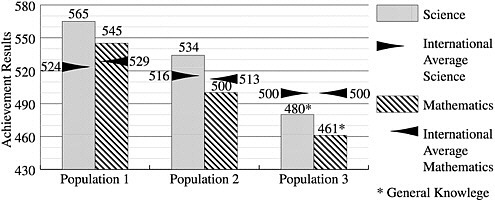
Summary: Achievement
The U.S. starts strong but falls further and further behind as the years of schooling progress.
By high school, the U.S. is at or near the bottom.
Top U.S. students in Population 1 are above the international average in science but slightly below in mathematics.
Top U.S. students in Population 2 are above the international average in science but below in mathematics.

Issues Related to Curriculum
(continued)
Structure of curriculum:
Focus—attention given to single content topics, either within a single class session or across class sessions; and
Coherence—“connectedness” of math/science ideas and skills presented to students over time.
From: Global Perspectives for Local Action
Number of Topics in Mathematics Textbooks
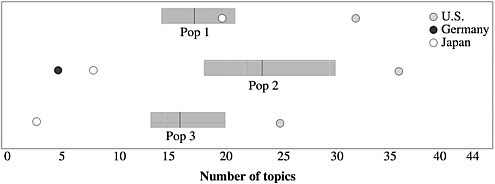
The gray bars extend from the 25th percentile to the 75th percentile for the number of topics among countries studied in the TIMSS curriculum analysis. The black line within each gray bar indicates the median number of topics for each population. German textbook data were not available for Populations 1 and 3.
From: A Splintered Vision: An Investigation of U.S. Science and Mathematics Education
Number of Topics in Science Textbooks
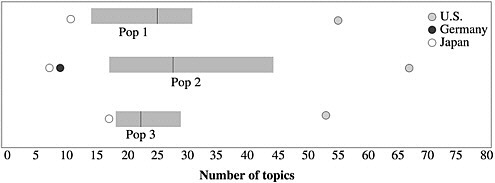
The gray bars extend from the 25th percentile to the 75th percentile for the number of topics among countries studied in the TIMSS curriculum analysis. The black line within each gray bar indicates the median number of topics for each population. German textbook data were not available for Populations 1 and 3.
From: A Splintered Vision: An Investigation of U.S. Science and Mathematics Education
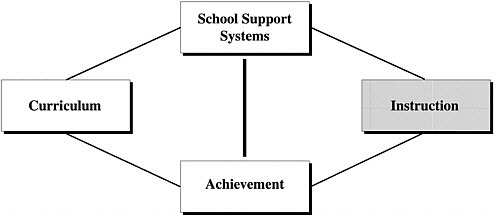
Overview of Videotape Study
First of its kind
Nationally representative sample of Population 2 mathematics classrooms in Germany, Japan, and the U.S.
Purposes
To describe teaching practices in each nation
To look at teaching with a fresh perspective
To encourage reflection
From: Global Perspectives for Local Action

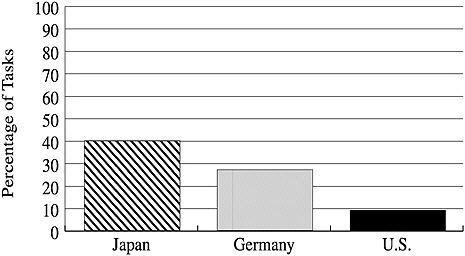
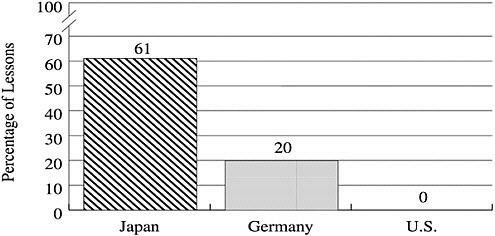


Summary: School Support Systems
Japanese teachers have more opportunities to discuss teaching.
Beginning teachers in Japan have a structured induction plan.
Japanese students watch as much TV as U.S. students but do better in school.
Attitudes of U.S. students toward math/science are similar to the international average; they are positive and decline from the 4th grade to the 8th grade.
“Educational systems tend to overcorrect for what is seen as a problem and end up with a different situation that may be just as unsatisfactory. We seek in this report to help decision-makers balance the pendulum swings so as to make more likely steady progress toward a better education in science and mathematics for all our students and for our nation.”
From: Global Perspectives for Local Action


