Previous Chapter: Appendix D: Acronyms and Abbreviations
Suggested Citation: "Color Plates." National Research Council. 2000. Radiation and the International Space Station: Recommendations to Reduce Risk. Washington, DC: The National Academies Press. doi: 10.17226/9725.

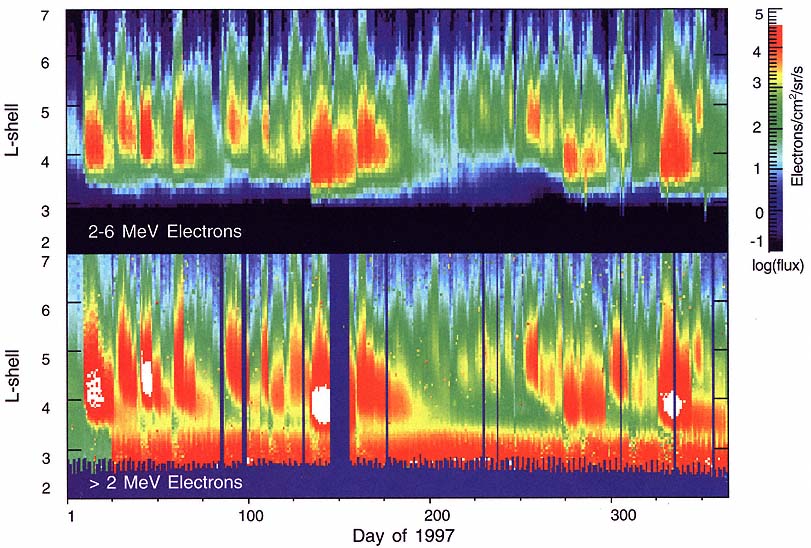
Plate 1 Average flux of energetic electrons during 1997 recorded on SAMPEX (top) and POLAR (bottom) satellites at low (SAMPEX) and high (POLAR) altitudes. Note the appearance on day 20 of a third belt in the POLAR panel near L = 3 following a major magnetic storm.

Suggested Citation: "Color Plates." National Research Council. 2000. Radiation and the International Space Station: Recommendations to Reduce Risk. Washington, DC: The National Academies Press. doi: 10.17226/9725.

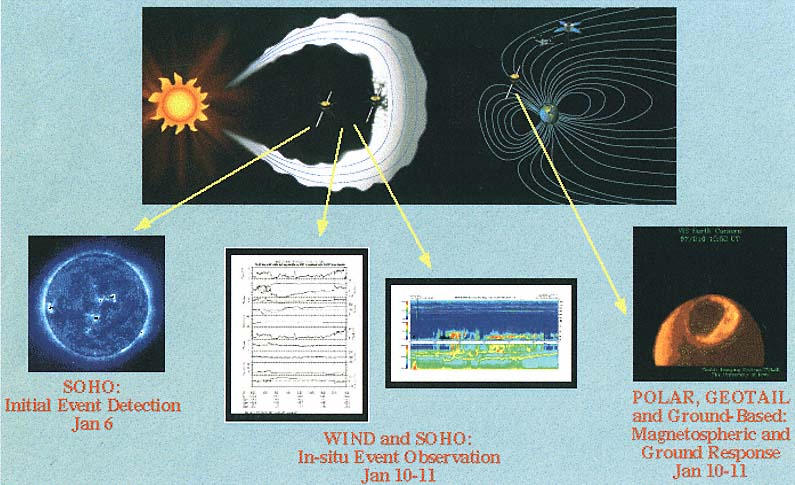
Plate 2 The Sun-Earth Connection event of January 1997. A CME left the Sun on January 6 and passed Earth on January 10 and 11. The figure illustrates the tracking of the event and its effects on the geospace environment.

Suggested Citation: "Color Plates." National Research Council. 2000. Radiation and the International Space Station: Recommendations to Reduce Risk. Washington, DC: The National Academies Press. doi: 10.17226/9725.

Plate 3 Top panel, solar wind speeds measured on SOHO during the January 1997 Sun-Earth Connection event. Bottom panel, SAMPEX measurements of radiation belt intensities at 600 km altitude. Notice the large increase in SAMPEX intensities on January 10, when a high-speed, high-density stream impacted Earth.

Suggested Citation: "Color Plates." National Research Council. 2000. Radiation and the International Space Station: Recommendations to Reduce Risk. Washington, DC: The National Academies Press. doi: 10.17226/9725.

Plate 4 Global MHD simulation of the impact on the magnetosphere of the interplanetary shock wave of March 24, 1991, which violently compressed Earth's magnetosphere and rearranged the radiation belts. The top diagram shows the configuration just before the shock hit; the bottom one shows the configuration few minutes later, as the shock moved the magnetotail. Area colors indicate temperature in the equatorial plane. Colored lines are magnetic field lines.

Suggested Citation: "Color Plates." National Research Council. 2000. Radiation and the International Space Station: Recommendations to Reduce Risk. Washington, DC: The National Academies Press. doi: 10.17226/9725.
Page 77
Suggested Citation: "Color Plates." National Research Council. 2000. Radiation and the International Space Station: Recommendations to Reduce Risk. Washington, DC: The National Academies Press. doi: 10.17226/9725.
Page 78
Suggested Citation: "Color Plates." National Research Council. 2000. Radiation and the International Space Station: Recommendations to Reduce Risk. Washington, DC: The National Academies Press. doi: 10.17226/9725.
Page 79
Suggested Citation: "Color Plates." National Research Council. 2000. Radiation and the International Space Station: Recommendations to Reduce Risk. Washington, DC: The National Academies Press. doi: 10.17226/9725.
Page 80
Subscribe to Emails from the National Academies
Stay up to date on activities, publications, and events by subscribing to email updates.