Forecasting the Ocean: The 2025–2035 Decade of Ocean Science (2025)
Chapter: 5 A New Decade of Ocean Science Research
5
A New Decade of Ocean Science Research
The new decade will continue to see transformations in the world’s ocean, and thus ocean science research must also transform, using new technologies, increasing the ability to forecast future changes, and improving benefits to society. Both basic and use-inspired research are needed to meet the anticipated challenges. New knowledge from focused disciplinary research needs to be integrated through transdisciplinary approaches leading to a holistic understanding of the ocean and improved forecasts. Data and information gained will need to incorporate a broad base of knowledge, including from traditional sources, Indigenous and local knowledge, collaborative development and production of research and knowledge, and citizen science. Workforce development and education will be key to preparing and enhancing the multifaceted talent pool that will be needed to support and advance oceanographic research. Expanded and fairly distributed investments in research, infrastructure, technology, and workforce will fuel increased understanding and improve the capability to forecast changes.
The coming decade will see a more rapid evolution toward an integrated, collaborative, and technologically advanced approach to understanding the world’s ocean, as well as progressing the capability to forecast the future ocean at a variety of scales relevant to human life. Bridging the gap between disciplines while simultaneously leveraging cutting-edge, discipline-based research methodologies and technologies will enhance understanding of the interconnected nature of physics, chemistry, biology, and geology, and address the multiple stressors facing the ocean. For example, the nature-based solution of using oyster reefs to protect shorelines from storm surges requires integration of fundamental understanding of fine-scale hydrodynamics, sediment transport, ocean chemistry, phytoplankton primary production, and oyster physiology, as well as various aspects of societal needs. These approaches recognize the complexity and interdependency of the ocean system. The outcomes of this new research portfolio will deepen understanding and support innovative and cost-effective solutions for mitigating and adapting to the impact of changes to the Earth system on ocean processes and coastal communities.
Rapid and timely curation, processing, and analysis of the vast amounts of ocean data that are being collected will be required to support accurate and reliable forecasts. The use of artificial intelligence (AI), machine learning, and cyberinfrastructure is rapidly advancing, promising to enhance real-time analysis of data and ocean model output. Acquiring adequate resources critical for taking full advantage of new data sources and processing technologies and to sustain measurements into the future will require the National Science Foundation’s (NSF’s) Division of Ocean Sciences (OCE) to forge new relationships and foster collaboration with international partners, philanthropic foundations, and private-sector companies.
The committee hopes this report will galvanize the U.S. and international ocean science community around the common global goal and challenge of forecasting critical ocean processes on scales that matter most to humankind, and that, by the end of the next decade, the science, tools, and technology needed to tackle the urgent research priorities in ocean and earth sciences will be available. Led by the OCE, and together with other NSF directorates and divisions, federal agencies, and nongovernmental organizations, the headlines in 2035 could be quite different from today’s. Headlines like “NSF Announces Bold new Partnership to Sample the Ocean’s Depths,” “Earthquake Early Warning System Saves Lives and Livelihoods,” and “Predictions of the Evolution of the AMOC System now Available Through 2045—How to Prepare for What is to Come” could be realized.
The committee sought balance between goals possible under different funding realities as well as opportunites to fill gaps by leveraging resources and building strategic partnerships. This chapter is focused on providing a framework for OCE to create a roadmap to address the urgent science needed and prioritize the enabling elements, such as research vessels and laboratories, ocean observations, an expanded and broadened workforce, coordination of data, computing centers, and new partnerships. Strong U.S. leadership, as well as international collaboration, is necessary to address urgent ocean science needs via these enabling
elements. These points are further emphasized in the scientific motivation behind the establishment of the 5th International Polar Year, which was developed simultaneously with this report, prioritizing overlapping research priorities, infrastructure needs, and transdisciplinary approaches to research (Box 5.1).
BOX 5.1
The Polar Oceans: An “All Hands on Deck” Example
It is striking that the scientific motivation for the establishment of a 5th International Polar Year (IPY5, n.d.), 2032–2033 is so similar to the global ocean science priorities, needs, and approaches presented in this 2025 Decadal Survey report. While independently written, both recognize the potential impacts to economies, ecosystems, and human well-being of increasing temperatures, sea level rise, ocean acidification, changes in sea ice, and the possibility of extreme events. Both recognize that some rates of change in the Earth system and its ocean system are occurring rapidly with the potential for complex nonlinear responses and feedbacks. And both recognize that many of these changes are linked to processes occurring in the Arctic and Antarctic polar regions. For example, the polar and subpolar regions are where all deep water forms (sinks) at the ocean surface, and thus these regions are a first-order control on global ocean circulation, the related redistribution of heat and salt, and the supply of dissolved oxygen to the marine realm. Ice sheet–ocean interactions (Figure 5.1, lower) at both poles affect the formation of deep water. Oceanic field work and remote sensing, as well as the collection of marine records of paleo ice sheet and paleo ocean behaviors are important for supplying needed data to inform and test predictive models on future sea level rise, rates of change, and ecosystem responses to changing boundary conditions. Additionally, changing sea ice conditions in the Arctic have a direct impact on marine food webs, potential access to seabed resources, global commerce (Figure 5.1, upper), and U.S. national security. These changes will likely lead to greater competition for power in the region. Improving scientific understanding of the Arctic environment is one strategy to prepare for changes to come.
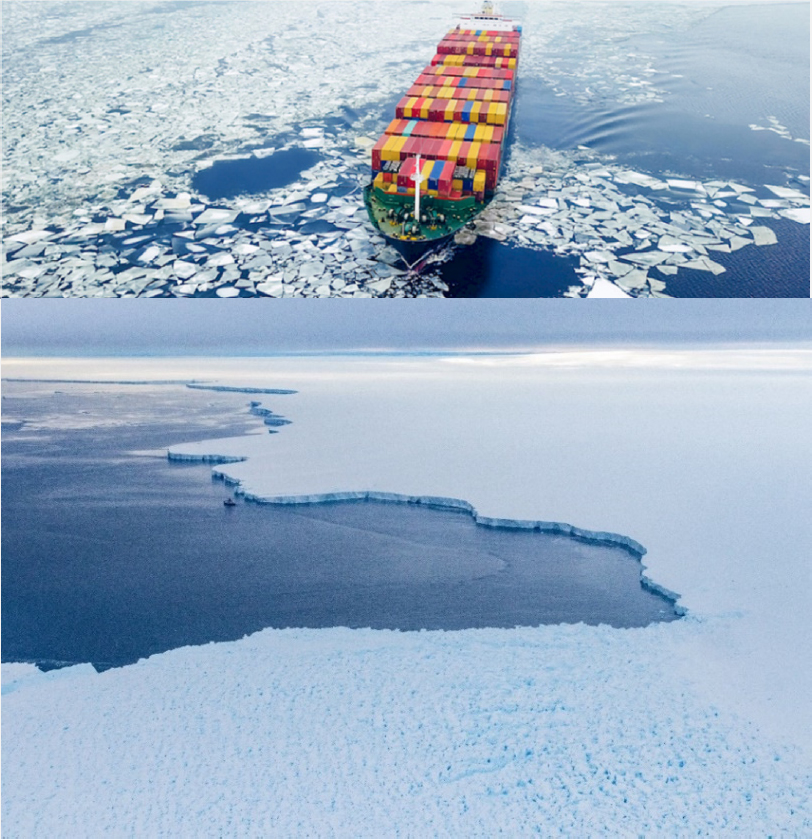
SOURCE: Upper: Thomas Ronge, International Ocean Discovery Program; lower: A. Medvedkov, Arctic Council, https://arctic-council.org/projects/arctic-ship-traffic-data-astd.
Investments in polar ocean science will need funding both for infrastructure and basic/applied research. This is especially true given the reduction in the number and type of polar research vessels (e.g., vessels that can operate in polar open waters, ice-reinforced vessels, and icebreakers), which if not addressed, makes it harder for the United States to make meaningful contributions to polar ocean science. Such infrastructure needs were highlighted in the recent report Future Directions for Southern Ocean and Antarctic Nearshore and Coastal Research (NASEM, 2024d) and the letter report, Acquisition and Operation of Polar Icebreakers: Fulfilling the Nation’s Needs (NASEM, 2017b). Additionally, increased research on nonlinear dynamics and support for sustained, long-term observing to distinguish directional changes in polar oceans are needed.
Both the IPY5 planning and recommendations in this Decadal Survey report identify the need for transdisciplinary coordinated efforts. Especially in the Arctic, such ocean science efforts can benefit from the long history of Indigenous knowledge. Indigenous well-being is also a foundational principle to guide Arctic Ocean research. Transdisciplinary coordination will require collaboration and partnerships between OCE and NSF’s Office of Polar Programs, with multisector U.S. agencies, such as the National Oceanic and Atmospheric Administration and the Department of Defense, and with other countries and international polar organizations (e.g., Arctic Council). U.S. scientific leadership in polar ocean science is perhaps never more important than in this time of global transitions. U.S. leadership in multilateral science and technology forums is one way to strengthen the U.S. position to compete and collaborate internationally (Subcommittee on International Science & Technology Coordination [ISTC], 2024).
INTEGRATED FORECASTS IN OCEAN SCIENCE
As explained in Chapter 2, the committee presents a challenge for the coming decade: by 2035, establish a new paradigm for forecasting ocean processes at scales relevant to human well-being. This challenge is based on the following:
- The ocean is changing in unanticipated ways and at an unprecedented pace.
- Understanding and anticipating the change in the ocean has never been more urgent.
- To truly address these changes to the ocean, basic research in key areas is needed to advance predictive technologies.
The interconnected nature of the urgent ocean science research portfolio emphasizes the need to study the ocean as part of the entire Earth system. Research to improve understanding of the function and role of the ocean in the Earth system need to continue, in addition to employing transdisciplinary research approaches to fully understand important aspects of the ocean and to enable forecasts of future change. For example, a study of ocean heat and carbon transport will support a focus on the interconnections between these three urgent research themes (see Box 2.2 in Chapter 2) by considering the fundamental role of microorganisms in marine food webs and in carbon transformation. Direct measurements and models of such interconnections, which are largely missing from ecosystem models today, will support a better understanding of feedbacks1 within these three core themes and their impacts within the wider Earth system. Studying marine heat waves as holistic phenomena will provide greater understanding of their impact on the atmosphere, on ocean mixing, on the exchange of carbon and nutrients between surface and deeper waters, on primary productivity, on organismal physiology, and on ecosystem connections. Even further, studying heat and carbon transport can also help forecast the health of corals, which have direct impact on coastal effects from storm surge (Box 5.2). The committee regards the list of examples that can be derived from these interconnections infinitely generative; clearly understanding the interconnected ocean system will be key to tackling the three urgent ocean science research questions. This is further emphasized by scientific motivations, priorities, needs, and approaches being pursed for polar ocean research (Box 5.1).
___________________
1 A feedback is defined as a process working within a system that can either increase or decrease the effects of change, and in this case, climate change.
BOX 5.2
Coral Health: Interconnected Nature of Ocean Sciences
SOURCE: U.S. Fish and Wildlife Service.
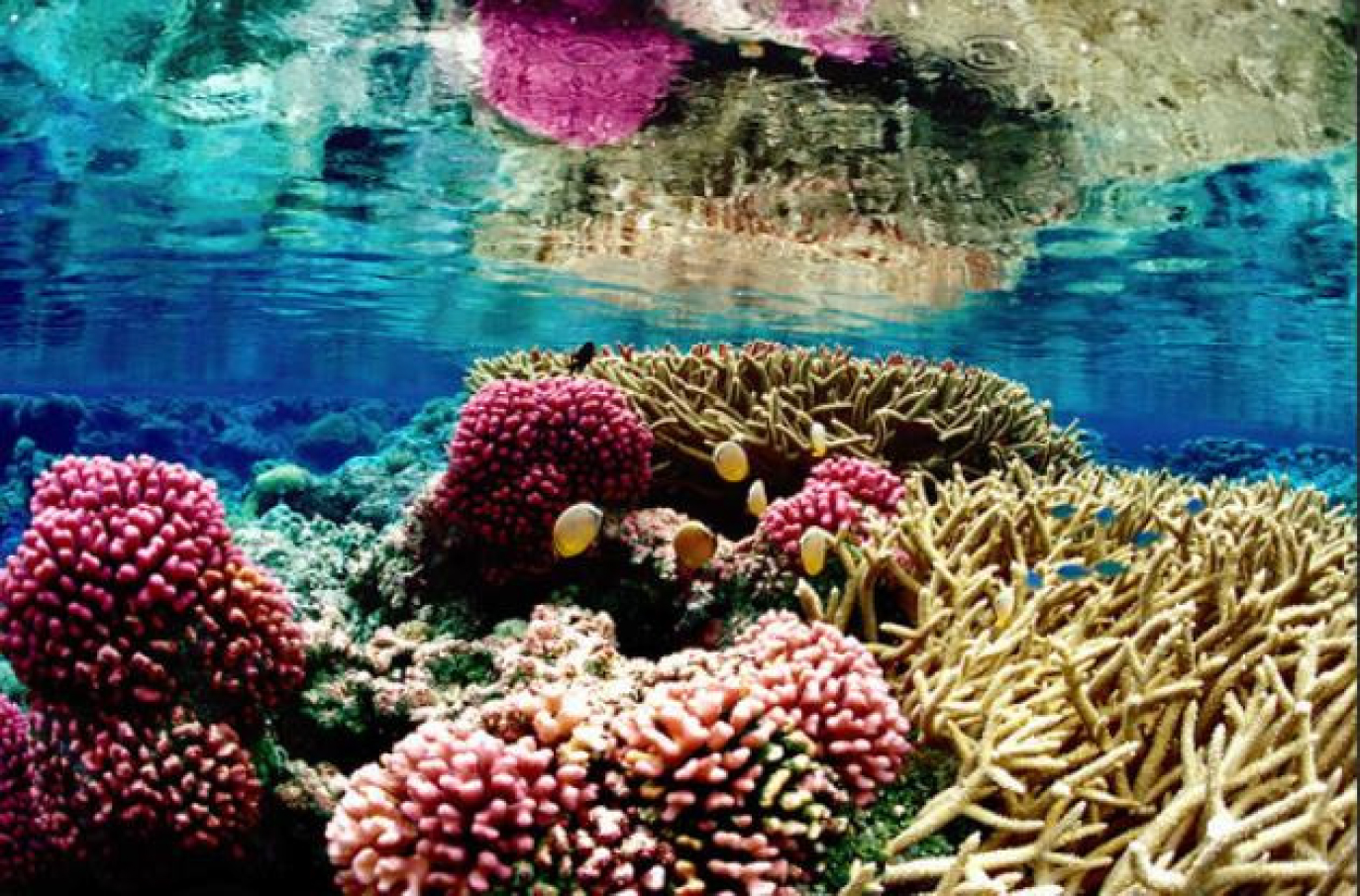
Humans living in coastal communities have deep generational knowledge about the ocean and health. Historically, as scientists have gained more knowledge about the ocean, integration of generational knowledge and multiple knowledge systems have been largely ignored. Coral reefs are an excellent example of an ecosystem that requires transdisciplinary research, with inclusion of historical and biocultural knowledge, to advance understanding. Corals build reefs of carbonate are among the largest biological structures on Earth; these reefs not only have the highest biodiversity of any ecosystem on Earth but are a critical food source, serve as a vault for sequestering carbon dioxide, and protect coastal communities from the effects of extreme storms. True advancement through transdisciplinary research would include investing in improving the ability to forecast the health of these important systems, through integration of disciplines and sectors such as social science, engineering, biophysical research, and computer science. In addition, revival of subsistence fishing practices within many coastal communities and understanding of human dimensions and cultural ecosystem services through transdisciplinary approaches will ensure ecosystem resilience through effective management of resources.
Storm damage from rising sea levels is mitigated by reefs comprised of coastal species such as corals, oysters, mangroves, and marshes, which act to slow rough wave action and mitigate onshore disasters. Changes in temperature also impact ecosystems. Ocean temperatures that exceed the tolerance threshold of organisms can cause certain species to migrate to cooler waters, thus creating shifts in fishing habitats, changes in shipping lanes to avoid whale strikes, changes in the species fished, and sometimes reconsideration of marine protected areas.
To truly grasp the ocean’s role in the Earth system and forecast the future health of the planet requires ocean sciences research that integrates all three priority themes: ocean and climate, ecosystem resilience, and extreme events.
Key to ensuring integration across these themes is the establishment of a cross-cutting, comprehensive oceanography program that has as its sole purpose linking the inherent understanding, and hence predictions, from each of the three themes. Precedents exist for allocating new resources to support such an integrative program, but a large-scale, coordinated effort to which NSF makes a long-standing commitment is now critically needed to address the societal needs arising from the challenges faced. Such an effort would require new investment involving significant coordination and partnerships with other directorates, organizations, and agencies, as well as other disciplines. Any such program would not only integrate across the themes but also provide an opportunity to support a sense of community across all oceanographic disciplines that is typically lacking.
CONCLUSION 5.1: To truly accelerate progress in ocean science, new knowledge will need to be integrated into research projects focused across the three priority themes: ocean and climate, ecosystem resilience, and extreme events. A cross-cutting, comprehensive, and sustainable program could be established with the sole purpose of connecting the three themes. Enabling this connection requires significant resources, coordination, and established partnerships with multiple NSF directorates, organizations, and agencies, as well as other disciplines. NSF-wide mechanisms such as existing and new Science and Technology Centers and Long-Term Ecological Research programs could be leveraged to achieve the NSF-wide support for such a program.
REGAINING U.S. LEADERSHIP IN OCEAN SCIENCE
OCE-supported research at academic and other institutions has made the United States the world leader in ocean science research, leading to many scientific advances and understanding ocean processes in all subfields of the ocean sciences. However, the rest of the world is now also investing heavily in research in the ocean sciences; large-scale science projects, such as the scientific ocean drilling program and the Argo program, depend upon the talent and resources of multiple countries working together. In the next decade, the United States has the opportunity to strengthen existing partnerships with other countries, build new partnerships, and develop procedures for evaluating the success of these collaborations.
The next decade of ocean science research is critical, and without significant new investment, U.S. leadership will continue to erode, resulting in a loss of expertise and talent to other countries. A loss of worldwide leadership in science, technology, engineering, and mathematics (STEM) impacts the U.S. economy and national security. The committee believes that consideration of conclusions and full implementation of recommendations included in this report will be important steps toward regaining NSF-supported U.S. leadership in ocean science research. Demonstrating strong U.S. leadership in ocean science research will also improve management and decision-making of our coastal and ocean resources, enhance national security and economic prosperity, and propel the blue economy in burgeoning sectors of marine carbon dioxide removal, harmful algal bloom mitigation, development of aquaculture, and other applications.
CONCLUSION 5.2: The next decade of ocean science research is critical, and without significant new investment, U.S. leadership will continue to erode. Demonstrating strong U.S. leadership in ocean science research will improve management and decision-making of our coastal and ocean resources, enhance national security and economic prosperity, and propel the blue economy.
IMPLEMENTATION AMID UNCERTAINTY
Without knowledge of future budgets and costs to implement the committee’s recommendations, it is not possible to lay out a full implementation plan for the next decade. Some recommendations can likely be implemented within a level budget or with modest increases; others will require substantial new resources. For example, significant and strategic investments will be required for new initiatives for sensors, AI and machine learning, real-time hazard monitoring, numerical models, data curation, and replacement of current facilities.
Overarching Framework
NSF should continue to fund basic research proposals, with a balanced portfolio across the subdisciplines of all ocean sciences (Recommendation 2.1), and with special consideration of the three science questions the committee poses:
- Ocean and Climate—How will the ocean’s ability to absorb heat and carbon change?
- Ecosystem Resilience—How will marine ecosystems respond to changes in the Earth system?
- Extreme Events—How can the ability to forecast extreme events driven by ocean and seafloor processes be improved?
This research should emphasize advancing forecasting with deep understanding of ocean processes (Recommendation 2.2), while also creating opportunities to foster fair and indiscriminate transdisciplinary research practices, as appropriate (Recommendation 3.1). Implementation of Recommendation 3.1 also requires complementary action on the part of OCE’s academic partners.
Immediate Actions for Opportunities and Impacts
A subset of the recommendations in this report will require time to mature, so work to advance the recommendations will benefit from immediate action in order to fully support the innovative, societally relevant, and use-inspired urgent ocean and Earth science research of the next decade. Efforts that can be, and must be started immediately are as follows:
- Investments to expand and broaden participation in the ocean sciences with transdisciplinary teams—the science required for national success cannot be accomplished without a larger workforce that includes broad representation (Recommendation 3.2).
- Obtain ocean observations that will advance the urgent ocean science research questions, and to include strategic partnerships (Recommendation 3.3), such as with the Technology, Innovation and Partnership Directorate, to develop and produce ocean observing technologies critical to achieving the science of the next decade (Recommendation 4.4).
- Support and enhance data curation and thoughtful consideration of ocean data stewardship, in part so it is most useful for sophisticated analyses and to support improved numerical models (Recommendation 4.5).
Addressing Infrastructure Needs
The next subset of the recommendations is related to the infrastructure needed to support research related to the three urgent ocean science questions. Planning needs to begin now to reap benefits within the next decade.
- Continued and enhanced operation of the Academic Research Fleet, taking into account the contributions of autonomous platforms that can expand the footprint of vessels at sea and the replacement schedule for the aging fleet (Recommendation 4.1).
- Continued operation of components of the Ocean Observatories Initiative that are required to implement the committee’s science questions but with a timely review of the science outcomes and careful consideration of its fundamental scientific framework (Recommendation 4.2).
- Enabling future scientific ocean drilling in support of the urgent research questions, including planning to replace what was lost with decommissioning the JOIDES Resolution (Recommendation 4.3).
- Continued development, evaluation, and implementation of new technologies and approaches, as well as other innovations that may arise in the coming decade (Recommendation 4.4).
- Work with other directorates, agencies, the private sector, and philanthropic organizations, perhaps by hosting convening sessions, to learn how to take full advantage of advances in cyberinfrastructure to support accelerated science and discovery (Recommendation 4.5).
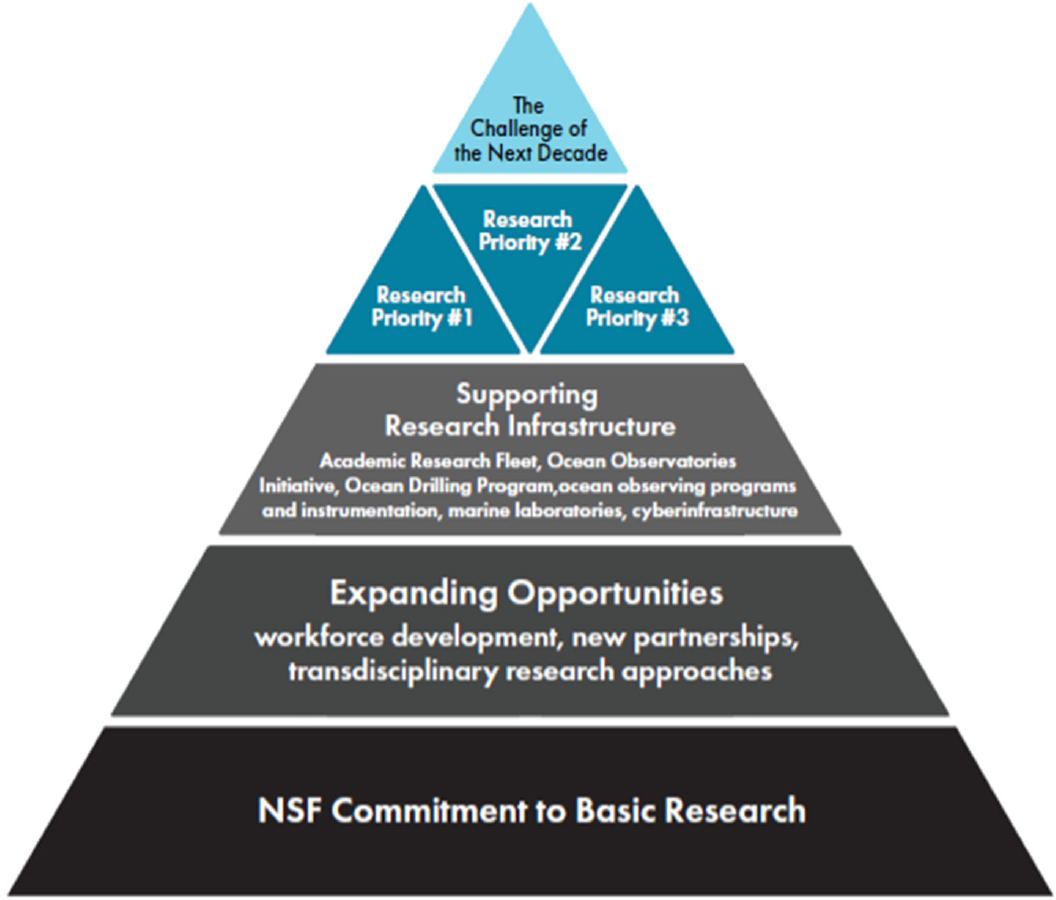
In summary, the challenge in the field of ocean sciences for the next decade has been constructed on a foundation of an expanded and broadened workforce, as well as utilization of existing and new infrastructure (Figure 5.3). Answering the urgent ocean science research questions laid out in this report will necessitate individual principal investigator–driven research, as well as interdisciplinary and transdisciplinary research teams working together. Achieving the desired forecasting capabilities will result from an iterative process combining advanced and sustained ocean observations, modeling, the use of artificial intelligence and machine learning, and in-depth scientific understanding. Achieving this will also require additional resources and new partnerships with other NSF directorates, other agencies, philanthropies, industry, and international organizations.
MEASURING OCE’S SUCCESS
Moving forward, periodic reviews of large-scale programs supported by OCE (e.g., the Academic Research Fleet, Ocean Observatories Initiative, and Ocean Drilling Program), will determine the value of these programs to the scientific community, to the funders, and to the public. These reviews need to go beyond evaluating how well the infrastructure is meeting cooperative agreement deliverables and include
an assessment of the scientific and societal outcomes enabled by infrastructure investments. Reviews of this nature also need to allow for feedback and mechanisms for course correction.
Similarly, at the mid-decade, a self-review of OCE’s progress towards implementing the 2025 Decadal Survey recommendations is encouraged to serve as a tool for communicating progress to the public and other partners, providing insight into the specific downstream effects of the OCE budget environment and valuable feedback into the development of any future decadal survey of ocean sciences. Such a review could be led by the Advisory Committee for Geosciences and with input from the broader ocean and Earth science community.
RECOMMENDATION 5.1: Any large-scale, long-term program (e.g., Academic Research Fleet, Ocean Observatories Initiative, Ocean Drilling Program) supported by the National Science Foundation (NSF) should be periodically evaluated on how the program is achieving its science goals and meeting the science community needs and to allow for feedback and mechanisms to correct course. Evaluations should include meaningful metrics that measure the scientific and societal benefits, including community engagement and workforce training, not just whether the given program is meeting its operational objectives. Outcomes of the evaluations should be shared with NSF and the public. Similarly, after 5 years (i.e., the mid-point of the decade), the committee recommends that the Division of Ocean Sciences (OCE) review and assess its progress towards implementing the 2025 Decadal Survey recommendations, with consideration to the broader OCE budget environment.
A NEW DECADE, A NEW APPROACH
With the goal of realizing the challenge of the next decade, the committee approached the statement of task (see Box 1.2 in Chapter 1) with a lens of doing science differently. Equal to defining the research portfolio and infrastructure needed for the next decade of ocean research and beyond is the importance of broadening participation and creating opportunities to cross societal boundaries, disciplines, and sectors. In Box 5.3, the committee presents its call to action to the broader ocean science community to tackle the complex and urgent challenges of the coming decade described in this report.
BOX 5.3
A Call to Action for Ocean Sciences
Progress in ocean sciences research over the next decade will require a directed effort to establish predictive capabilities and enable accurate forecasts of the interconnected ocean processes at scales relevant to human life. This report calls for an “all hands on deck” approach to ocean science: embracing new and evolving tools and methodologies, establishing transdisciplinary ocean science research teams, and integrating Indigenous and local knowledge systems into the research process. By addressing the human dimensions within the field of ocean science, along with advancing observations and predictions, new discoveries and knowledge will be made that enhance adaptation, resiliency, and prosperity of humankind and the ecosystems foundational for human life and well-being.
The committee urges the greater ocean sciences community to thoughtfully consider initiatives and pathways that promote equal opportunity in workforce training, as well as provide access and agency in data management and usage. The committee champions the importance of fundamental science approached through a transdisciplinary lens and implementation of mechanisms that will allow the research results to be rapidly shared and utilized.
Furthermore, the committee strongly encourages members of the existing ocean science community (along with new partners and interest holders) to bring their talents and skills to the specific questions outlined herein—to innovate, collaborate, and push the boundaries of knowledge. In order to maximize the impact of future scientific endeavors, the committee strongly encourages explicit assessment of progress while cultivating fertile ground for unforeseen, groundbreaking discoveries. By integrating knowledge and expertise across disciplines and communities, it can be ensured that ocean science research remains relevant and continues to improve the well-being of our planet and all its inhabitants.
CONCLUSION
OCE-supported research at academic and other institutions has helped make the United States the world leader in ocean science research, leading to many scientific advances and understanding of ocean processes in all subfields within the field of ocean sciences. This new decade is starting out at a time when U.S. investment in STEM in general, and the geosciences in particular, is not keeping pace with growing societal needs, including better understanding of the ecosystems supporting fisheries, changes in the Arctic related to national security, and the capacity of the ocean to absorb heat from a warming atmosphere. At the same time, scientific leadership and competition from other countries, including U.S. competitors, are increasing. The U.S. investments in ocean science in the last decade do not take into account the changing landscape of ocean science research today or the needs of the future. Thus, the past 10 years of funding is not representative of what is needed in the next 10 years. The United States is at a critical juncture in which major investments are needed for new and replacement infrastructure, and to support basic and applied research, without which the United States may be left behind in global ocean science research transformation.
The 2025 Decadal Survey was developed to ensure that OCE will continue to provide the foundation for contributions to ocean science research, not only within NSF but also across the federal agencies that use research in ocean science to accomplish their mission. Now is the time for the United States to invest and take leadership in answering the urgent ocean science priorities outlined in this report for a healthy and well-understood ocean, allowing the anticipation and assessment of changes, which is critical for national security, economic prosperity, and environmental stewardship, and for the well-being of humans and the ecosystems on which people depend, in the next decade and beyond.


